
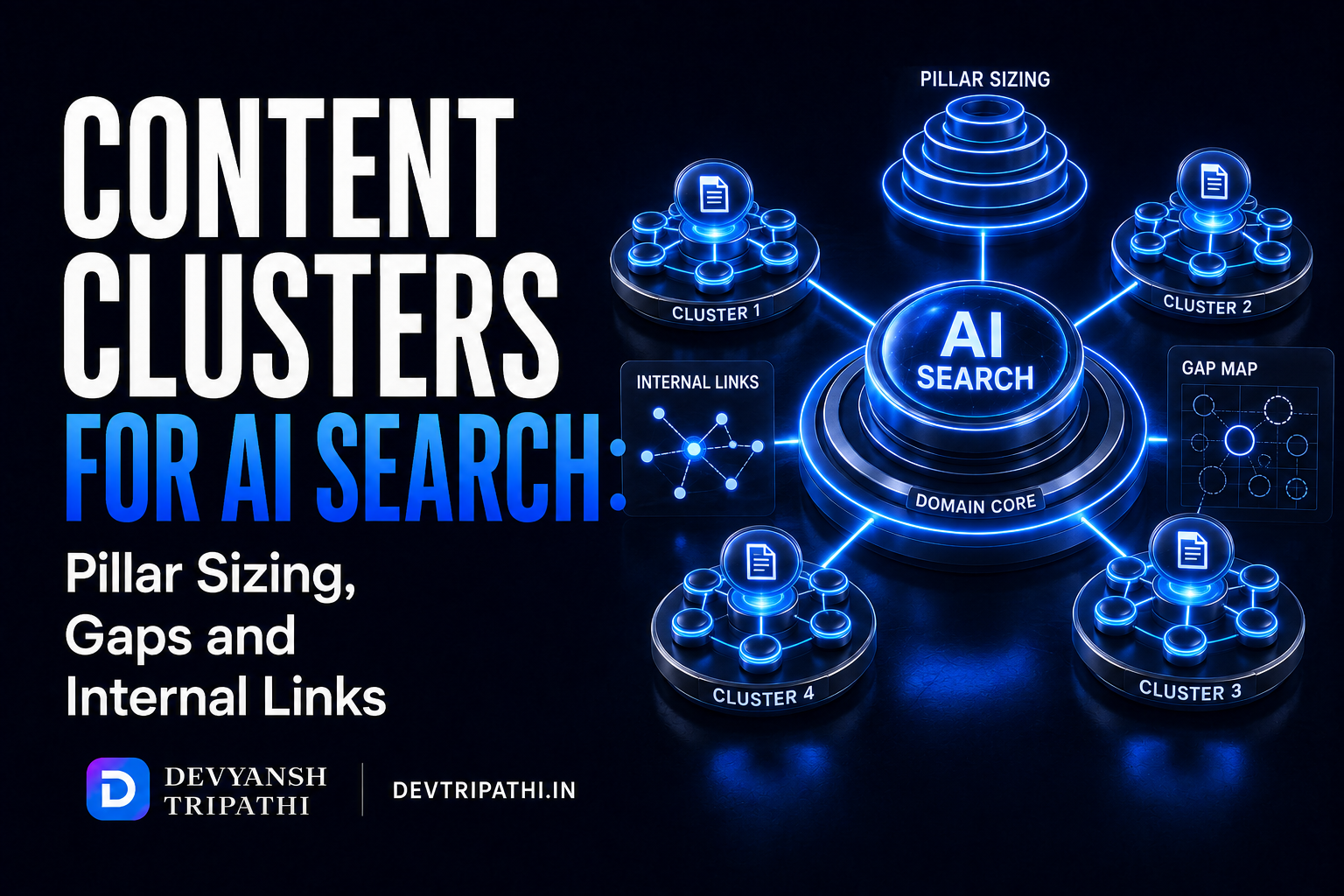
Content Clusters for AI Search: Pillar Sizing, Gaps and Internal Links
11 July 2026
Topical authority SEO in 2026 is the practice of building a pillar-cluster content architecture comprehensive enough to satisfy AI query fan-out, the mechanism by which AI systems expand a single user prompt into multiple related sub-searches, with research confirming that clustered content earns 3.2 times more AI citations than standalone posts and drives 30 to 40% more organic traffic, making content architecture rather than individual page optimization the primary determinant of both traditional ranking success and AI citation eligibility.
This advanced guide covers the topical authority framework built on the latest 2026 architecture research: the specific pillar-cluster sizing data from multiple independent studies converging on 8 to 15 cluster pages per pillar, the query fan-out mechanism that makes comprehensive topical coverage a direct AI citation requirement rather than a traditional SEO nicety, the concentration-over-volume principle showing 25 well-connected articles outperforming 250 scattered ones, the internal linking architecture that signals topical coherence to both crawlers and AI retrieval systems, and the topical gap analysis methodology for identifying exactly which cluster pages are missing from an existing content library.
Does Your Content Architecture Satisfy AI Query Fan-Out or Only Individual Keywords?
Get a complete topical authority audit covering your pillar-cluster coverage gaps, internal linking coherence, query fan-out readiness, and a prioritized cluster development roadmap for the topics where your competitors currently hold citation and ranking advantage.
Get My Topical Authority AuditWhy Topical Authority Has Become an AI Citation Requirement, Not Just a Ranking Factor
Topical authority SEO has existed as a recognized discipline since before the AI search era, built on the observation that Google’s Helpful Content systems reward comprehensive topic coverage over isolated keyword-targeted pages. What has changed decisively in 2026 is the mechanism connecting topical authority directly to AI citation eligibility: query fan-out, the process by which AI systems including Google AI Mode expand a single user prompt into multiple related sub-searches before synthesizing a complete response.
When a user submits a complex query to an AI-powered search experience, the system does not search for a single best-matching document. It expands the query across related subtopics, retrieves relevant passages from multiple sources for each expanded sub-query, and constructs a synthesized response drawing from whichever sources best address each specific dimension of the fan-out. A brand with only isolated pages addressing individual keywords, without the comprehensive cluster coverage that addresses every adjacent intent a fan-out expansion might generate, is retrieved for only a fraction of the sub-queries that a single complex AI Mode prompt actually triggers. This is the direct mechanism by which clustered content earns 3.2 times more AI citations than standalone posts.
3.2xmore AI citations for clustered content vs standalone posts (Whitehat SEO 2026)
43%more organic traffic for pillar-cluster architecture vs single-page strategy (XICTRON 2026)
50-300%traffic increase transitioning from keyword-focused to cluster model within 6-12 months (Involve Digital)
2.5xlonger ranking retention for clustered content vs standalone posts (Whitehat SEO 2026)
The Converged Pillar-Cluster Sizing Standard for 2026
Multiple independent 2026 research sources have converged on a consistent sizing range for effective pillar-cluster architecture, providing content teams with evidence-based guidance rather than the widely varying recommendations that characterized earlier topical authority guidance. This convergence across independently conducted research studies gives the sizing standard significantly more credibility than any single source’s recommendation alone.
Tier 1 — Foundation
Pillar Page: 2,500 to 5,000 Words of Comprehensive Overview
The pillar page covers a broad, high-volume topic comprehensively at a strategic level, addressing the full scope of the subject without going so deep on any single subtopic that it eliminates the reader's need for the dedicated cluster pages. Digital Applied's 2026 research specifies 3,000 to 5,000 words for pillar pages, while Posicionament Web's analysis recommends 2,500 to 4,000 words, converging on a broad but consistent range depending on topic complexity. The pillar page must link to every cluster page in the topic, serving as the canonical entry point and authority anchor for the entire cluster.
Tier 2 — Depth
Cluster Pages: 8 to 15 Supporting Articles per Pillar
Whitehat SEO's research found most successful topic clusters contain 8 to 12 supporting cluster pages per pillar, while HubSpot recommends a minimum of 6 to 10 subtopics with 8 to 10 being ideal, and Posicionament Web recommends 8 to 15 satellite articles. Each cluster page, typically 1,500 to 2,500 words according to Involve Digital's research, goes deep on a specific subtopic while linking back to the pillar and to other relevant cluster pages within the same topic when a genuine connection exists between subtopics.
Tier 3 — Support
Supporting Pages: FAQs, Case Studies, and Service-Specific Content
Supporting pages including FAQ collections, case studies, and service-specific pages round out the complete cluster architecture, addressing the long-tail and highly specific queries that neither the pillar page nor the primary cluster pages directly cover. These supporting pages are particularly valuable for query fan-out coverage because AI systems frequently generate highly specific sub-queries that only granular, narrowly focused content can satisfy directly, making this tier essential for maximizing the number of fan-out sub-queries a complete cluster can address.
The Concentration-Over-Volume Principle
One of the most consequential findings in 2026 topical authority research is the confirmation that concentration beats volume as a ranking and citation factor. A brand with 25 well-connected articles on a single topic now consistently ranks and earns citations better than a generalist competitor with 250 scattered articles covering unrelated subjects with minimal depth on any single one. This finding directly contradicts the content-volume-first strategies that dominated SEO practice for much of the previous decade.
The mechanism behind this shift is Google’s increasingly sophisticated topical depth evaluation combined with the Knowledge Graph’s growing refinement in associating brands with specific topic entities. A site publishing broadly across dozens of unrelated topics never accumulates the topical depth signal on any single subject that dedicated, concentrated coverage produces, and the Knowledge Graph struggles to establish a clear brand-to-topic entity association when content is spread too thin across too many unrelated subjects. Without that clear entity association, brands do not appear in brand-plus-topic search queries or AI-generated recommendations for that topic category regardless of overall site content volume. For the complete entity association framework this concentration principle depends on, see our Knowledge Graph Optimization Cycle 3 guide.
Applying the Concentration Principle to Existing Content Libraries
For brands with an existing content library built on a volume-first, scattered-topic approach, applying the concentration principle requires an audit that identifies which existing pages genuinely support a coherent pillar-cluster structure and which pages dilute topical focus without contributing to any clear cluster. Rather than immediately producing large volumes of new content, the highest-return first action is often consolidating, redirecting, or removing low-value scattered content that competes with and dilutes the topical signal that a properly concentrated cluster structure would otherwise produce clearly.
| Architecture Element | Recommended Range (2026 Consensus) | Primary Function | AI Citation Role |
|---|---|---|---|
| Pillar Page | 2,500 to 5,000 words | Comprehensive topic overview, canonical entry point | Broad query citation, entity anchor |
| Cluster Pages | 8 to 15 pages, 1,500 to 2,500 words each | Deep subtopic coverage | Specific fan-out sub-query citation |
| Supporting Pages | Variable, as needed for long-tail coverage | FAQs, case studies, granular queries | Long-tail and highly specific fan-out citation |
| Internal Links per Cluster | Bidirectional pillar-cluster, selective cluster-cluster | Semantic hierarchy signal to crawlers | Topical coherence signal to AI retrieval |
A Brand with 25 Focused Articles Now Outranks One with 250 Scattered Pages
Dev Tripathi designs complete pillar-cluster content architectures covering topic mapping, cluster sizing aligned with 2026 research consensus, internal linking strategy, and the query fan-out coverage that maximizes both traditional ranking performance and AI citation eligibility.
Build My Topical Authority ArchitectureInternal Linking as the Semantic Hierarchy Signal
Bidirectional internal linking between pillar and cluster pages, using descriptive anchor text rather than generic phrases, explicitly defines a semantic hierarchy for web crawlers and prevents orphaned pages from diluting topical authority. This internal linking structure is regarded as one of the central drivers of the traffic and citation advantages that well-architected clusters demonstrate, because it is the mechanism through which both traditional search engines and AI retrieval systems understand which pages belong to a coherent topic and how they relate to each other in depth and specificity.
Effective internal linking within a cluster follows a specific pattern: every cluster page links back to its pillar page using descriptive anchor text that includes the pillar’s primary topic terminology, the pillar page links out to every cluster page it governs, and cluster pages link to each other selectively where a genuine topical connection exists between the specific subtopics, rather than linking indiscriminately across the entire cluster regardless of actual relevance. This selective cross-linking prevents the internal link graph from becoming diluted noise while still capturing the legitimate connections that help both crawlers and AI systems understand the cluster’s internal structure.
Preventing Orphaned Pages and Cannibalization
Two common structural failures undermine topical authority even when individual content quality is strong: orphaned pages that exist outside any clear cluster structure without adequate internal linking, and content cannibalization where multiple pages compete for the same search intent rather than each addressing a distinct subtopic. Quarterly cluster audits should identify both failure types: pages receiving minimal internal link equity that should either be integrated into an existing cluster or consolidated with related content, and pages with overlapping target intent that should be merged or clearly differentiated to eliminate the internal competition that dilutes ranking and citation potential for both competing pages.
Topical Gap Analysis and Query Fan-Out Mapping
Systematic topical gap analysis identifies exactly which cluster pages are missing from an existing content library relative to the complete topical coverage that maximizes both traditional ranking authority and AI query fan-out citation eligibility. This analysis should combine traditional keyword and subtopic research with direct AI platform testing that reveals the specific sub-queries AI systems generate when fan-out expanding a complex prompt related to the target pillar topic.
Conducting a Fan-Out-Informed Gap Analysis
Test your primary pillar topics as complex, multi-part prompts directly in Google AI Mode and ChatGPT, recording every sub-question or related topic the AI system references or generates in its response. These AI-generated sub-topics represent the platform’s own model of how a complex query on this subject naturally decomposes into component parts, providing a direct data source for cluster topic identification that traditional keyword research tools, built around a different query structure, cannot replicate as precisely. Cross-reference this AI-generated topic map against your existing cluster pages to identify specific coverage gaps where fan-out sub-queries have no corresponding dedicated content addressing them directly.
Prioritize gap-filling cluster page development based on two factors: the frequency with which a given sub-topic appears across multiple fan-out tests for related pillar queries, and the commercial or informational value of that specific sub-topic to your target audience. Sub-topics appearing consistently across multiple fan-out tests represent core components of how AI systems understand the broader topic, making them higher priority than sub-topics appearing only occasionally in edge-case query variations. For the complete prompt research methodology that this gap analysis builds on, see our Prompt Optimization Cycle 3 guide.
Frequently Asked Questions About Topical Authority SEO
What is topical authority SEO in 2026?
Topical authority SEO in 2026 is the practice of building a pillar-cluster content architecture comprehensive enough to satisfy AI query fan-out, the process by which AI systems expand a single complex prompt into multiple related sub-searches before synthesizing a response. It requires organizing content around a central pillar page linked bidirectionally to 8 to 15 supporting cluster pages, each addressing a specific subtopic with sufficient depth to be selected as a citation source when AI systems retrieve content for the corresponding fan-out sub-query.
Why does clustered content earn 3.2 times more AI citations than standalone posts?
Clustered content earns significantly more AI citations because query fan-out requires AI systems to retrieve sources for multiple related sub-queries when responding to a complex prompt, and a comprehensive cluster provides dedicated, deep content addressing far more of those sub-queries than an isolated standalone page ever could. A single standalone post might satisfy one or two fan-out sub-queries, while a properly structured cluster with 8 to 15 dedicated pages can satisfy the majority of sub-queries an AI system generates when fan-out expanding a related complex prompt.
How many cluster pages should a pillar page have according to 2026 research?
Multiple independent 2026 research sources converge on 8 to 15 cluster pages per pillar as the optimal range. Whitehat SEO found most successful clusters contain 8 to 12 supporting pages, HubSpot recommends 6 to 10 subtopics with 8 to 10 being ideal, and Posicionament Web recommends 8 to 15 satellite articles. This convergence across independently conducted studies provides a credible, evidence-based sizing standard for content teams planning cluster architecture, replacing the widely varying recommendations that characterized earlier topical authority guidance.
What is query fan-out and why does it matter for content architecture?
Query fan-out is the mechanism by which AI systems including Google AI Mode expand a single user prompt into multiple related sub-searches, retrieving relevant content for each expanded sub-query before synthesizing a complete response. It matters for content architecture because a brand with only isolated pages addressing individual keywords is retrieved for only a fraction of the sub-queries a complex AI Mode prompt actually triggers, while comprehensive cluster coverage addressing every adjacent intent maximizes the probability of citation across the full range of fan-out sub-queries a given topic generates.
Why does concentration beat volume in 2026 topical authority strategy?
Concentration beats volume because Google's content quality systems and the Knowledge Graph both evaluate topical depth and brand-to-topic entity association rather than raw content quantity. A brand with 25 well-connected articles on a single topic establishes clear topical depth and a strong entity association that a generalist competitor with 250 scattered articles across unrelated topics never achieves on any single subject. Without that established depth and entity association, brands fail to appear in brand-plus-topic queries and AI-generated recommendations for that category regardless of total site content volume.
How long does it take for topical authority investment to show measurable results?
Topical authority investment typically pays off within 3 to 12 months, with the effect compounding significantly over time according to XICTRON's 2026 research. A consistent pattern across multiple studies shows that the first cluster articles take the longest to build rankings and citation presence, while later content within the same cluster benefits from the already-established topical strength and becomes visible significantly faster, meaning the return on cluster investment accelerates as the cluster matures rather than remaining constant across all content pieces.
What internal linking practices maximize topical authority signal?
Maximizing topical authority signal through internal linking requires bidirectional linking between every cluster page and its pillar page using descriptive anchor text that includes the pillar's primary topic terminology, the pillar page linking out to every cluster page it governs, and selective cross-linking between cluster pages only where a genuine topical connection exists between specific subtopics. This structure explicitly defines a semantic hierarchy for crawlers and AI retrieval systems while preventing the internal link graph from becoming diluted by indiscriminate cross-linking that does not reflect genuine content relationships.
How should existing scattered content libraries transition to a cluster architecture?
Transitioning an existing scattered content library to cluster architecture should begin with an audit identifying which existing pages genuinely support a coherent pillar-cluster structure and which pages dilute topical focus without contributing to a clear cluster. Rather than immediately producing large volumes of new content, the highest-return first action is often consolidating, redirecting, or removing low-value scattered content, then mapping remaining strong content into proper pillar-cluster relationships before filling identified gaps with new, strategically targeted cluster pages.
What is topical gap analysis and how is it conducted using AI platforms?
Topical gap analysis identifies which cluster pages are missing from an existing content library relative to complete topical coverage. Conduct it by testing primary pillar topics as complex prompts directly in Google AI Mode and ChatGPT, recording every sub-question or related topic the AI generates in response. These AI-generated sub-topics represent the platform's own model of how a complex query decomposes, providing a direct data source for identifying specific coverage gaps that traditional keyword research tools cannot replicate as precisely, since they were built around a fundamentally different query structure than AI fan-out generates.
How does topical authority connect to Knowledge Graph entity recognition?
Topical authority and Knowledge Graph entity recognition reinforce each other directly. The Knowledge Graph recognizes brands as entities associated with specific topics, and without a clear, consistently demonstrated topical association built through comprehensive cluster coverage, brands do not appear in brand-plus-topic search queries or AI-generated category recommendations regardless of individual page quality. Building topical authority through concentrated, well-structured pillar-cluster content is one of the primary mechanisms through which a brand establishes the topic-entity association that Knowledge Graph optimization requires. For the complete entity building framework, see our Knowledge Graph Optimization Cycle 3 guide.
What role did Google's December 2025 Helpful Content Update play in topical authority ranking?
Google's December 2025 Helpful Content Update specifically rewarded sites demonstrating clear topical authority through pillar-cluster architecture, with clustered sites gaining an average 23% increase in organic visibility following the update according to Whitehat SEO's research. This update reinforced the broader 2026 trend toward evaluating domain-level topical competence rather than individual page quality in isolation, confirming that content architecture investment produces algorithm-update-resilient ranking benefits compared to isolated page optimization approaches that remain more vulnerable to individual update volatility.
How does topical authority strategy connect to the broader GEO framework?
Topical authority provides the content architecture foundation that GEO strategy builds citation eligibility on top of. Where GEO addresses the brand authority, earned media, and citation source selection signals that determine whether AI systems recommend and cite a brand, topical authority ensures that when a brand is selected for recommendation, it has comprehensive content coverage across every fan-out sub-query the AI system generates for that topic. Without the pillar-cluster architecture covered in this guide, even strong brand authority signals cannot translate into comprehensive citation coverage across the full range of related queries a topic actually generates.
Ready to Build the Content Architecture That Wins Both Rankings and AI Citations?
Get a complete topical authority programme covering your pillar-cluster gap analysis, query fan-out mapping through direct AI platform testing, internal linking architecture design, and a prioritized content development roadmap sized to the 2026 research consensus of 8 to 15 cluster pages per pillar.
Start My Topical Authority ProgrammeConclusion
Topical authority SEO in 2026 has evolved from a traditional ranking best practice into a direct AI citation requirement, driven by the query fan-out mechanism that makes comprehensive cluster coverage the determining factor in how many of an AI system’s expanded sub-queries a brand’s content can satisfy. The converged 2026 research standard of a 2,500 to 5,000 word pillar page supported by 8 to 15 cluster pages, each addressing a specific subtopic in 1,500 to 2,500 words, provides content teams with an evidence-based architecture to build toward rather than relying on the varied and often contradictory guidance that characterized earlier topical authority practice.
The concentration-over-volume principle, confirmed by the finding that 25 well-connected articles now consistently outperform 250 scattered ones, should reshape content investment priorities for brands still operating on volume-first assumptions from earlier SEO eras. Combined with disciplined internal linking architecture and systematic, AI-platform-informed gap analysis, the pillar-cluster model provides the most reliable path to the compounding traffic and citation advantages that 2026’s most rigorous topical authority research has now documented across multiple independent studies. For the complete conversational search framework that topical clusters must satisfy for multi-turn AI Mode sessions, see our Conversational Search Optimization Cycle 3 guide.

Devyansh Tripathi
I’m Devyansh Tripathi, an SEO strategist and digital growth expert, helps businesses and individuals rank higher and drive organic traffic. Through DevTripathi., he shares cutting-edge SEO insights, content strategies, and marketing hacks. Passionate about digital success, he’s on a mission to make SEO simple, effective, and result-driven!
Posts
- What Google’s New AI Search Documentation Means for SEO Teams
- Google I/O 2026 Search: AI Agents, Gemini 3.5 and the Unified Box
- Google’s AI Optimization Guide: The Technical and Content Checklist
- July 2026 SEO Update: AI Overviews, llms.txt and Search Console
- Prompt Optimization Beyond Page One: The Position-21 Citation Opportunity
Categories
- AI Citation Optimization
- AI Search Optimization (AISEO)
- AI Visibility Tracking
- Answer Engine Optimization (AEO)
- Brand Authority SEO
- Brand SERP Optimization
- Community Signal SEO
- Conversational Search Optimization
- Generative Engine Optimization (GEO)
- Knowledge Graph Optimization
- Modern SEO Strategies
- Multimodal Search Optimization
- Prompt Optimization
- SEO Trends
- Social Search Optimization
- Topical Authority SEO
- Uncategorized
- Video Search SEO
- Visual Search Optimization
- Voice Engine Optimization (VEO)
- Zero Click Search Optimization
Latest News
Text Widget
Empowering brands with insights, strategies, and stories that drive digital growth.