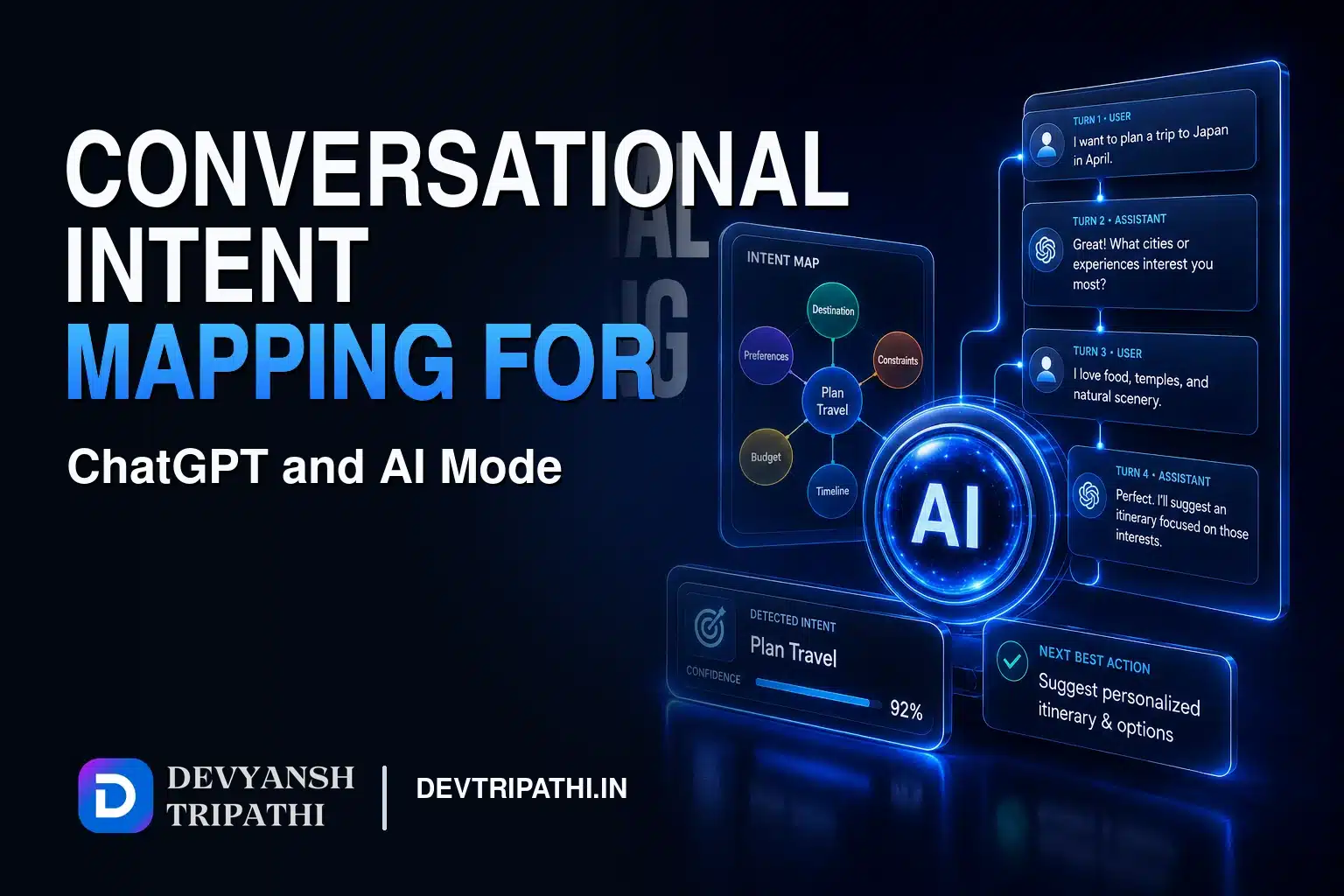
Conversational Intent Mapping for ChatGPT and AI Mode
15 June 2026
Conversational Search Optimization is the practice of structuring content around the natural language questions users submit to AI-powered search systems, including ChatGPT, Perplexity, Google AI Mode, and voice assistants, so that your pages are retrieved, cited, and delivered as spoken or synthesized answers rather than simply ranked as blue links on a traditional results page.
This guide covers the complete 2026 framework for Conversational Search Optimization: the data behind the shift from typed keywords to spoken and typed natural language queries, the specific content structures that perform best in AI-powered conversational responses, the six-step conversational intent mapping process that replaces traditional keyword research, and the technical requirements including schema markup and page structure that make content reliably extractable by AI systems processing conversational queries. You will also find the question matrix method for generating comprehensive natural language query coverage, platform-specific strategies for ChatGPT, Perplexity, Google AI Mode, and voice assistants, and the measurement framework that tracks conversational search performance across all major AI surfaces simultaneously.
Free Conversational Search Audit for SEO Professionals
Is Your Content Structured for How People Actually Ask Questions in 2026?
Find out how your pages perform for natural language conversational queries across ChatGPT, Perplexity, Google AI Mode, and voice search with a complete conversational search audit covering query mapping, schema deployment, and answer block structure.
Get My Conversational Search AuditWhat Is Conversational Search Optimization and Why It Matters in 2026
Conversational search optimization is the evolution of SEO from matching documents to keyword fragments into matching content to the full, natural-language questions that users now submit to AI-powered search systems. It represents the convergence of three behavioral shifts that are reshaping how people discover information: the mass adoption of AI search assistants, the growth of voice search to 27% of all queries, and the shift from Google’s traditional results page to AI-synthesized conversational answers that either cite your content or leave you invisible.
The rigid keyword-stuffing strategies that dominated SEO for decades are becoming obsolete in the AI search era. Traditional search engines rewarded pages that matched exact keyword phrases. AI engines including ChatGPT, Perplexity, Claude, and Gemini understand context, intent, and nuance. A user who types “email marketing ROI” into Google and a user who asks ChatGPT “what is the average ROI for email marketing campaigns in 2026 for B2B SaaS companies” have the same underlying intent but use fundamentally different query formats. Content optimized only for the former is structurally invisible to the latter. For the foundational AI search strategy that Conversational Search Optimization operates within, see our AI Search Optimization (AISEO) guide.
The Scale of the Conversational Search Shift in 2026
The shift from typed keyword search to conversational AI search is measurable and significant. AI platforms now capture 15 to 20% of informational query volume, according to Digital Applied’s April 2026 AI search market share research. ChatGPT Search processes 250 to 500 million weekly queries. Voice search accounts for 27% of all global search queries. And informational queries, the exact category where most content marketing investment is concentrated, trigger Google AI Overviews 98% of the time according to Northwestern University research.
The practical consequence for SEO professionals is direct: the users most likely to consume your informational content are increasingly submitting queries in conversational natural language form to AI systems that synthesize answers from sources rather than showing ranked lists of links. Brands that structure their content to match conversational query patterns earn citations in those synthesized answers. Brands that do not are structurally excluded from 15 to 20% of the most commercially valuable search interactions happening in their category right now.
How AI Systems Process Conversational Queries Differently From Traditional Search
Understanding how AI systems interpret conversational queries is the prerequisite for optimizing content to perform well in them. The processing pipeline for a conversational AI query is fundamentally different from the keyword matching that powers traditional search ranking, and the difference explains why content that ranks well on Google often fails to appear in AI-generated answers for the same topics.
Intent Parsing Beyond Keywords
When a user submits the query “I run a small agency and I’m not sure whether to invest in GEO or keep focusing on traditional SEO — what makes more sense for a 10-person team?” to Perplexity or ChatGPT, the AI does not search for pages containing those exact words. It identifies the user’s decision context (small agency, resource-constrained), the comparison being made (GEO versus traditional SEO), and the specific information type needed (a practical recommendation with reasoning, not an academic explanation of the difference). It then retrieves sources that address that specific combination of intent dimensions.
Content that only addresses “GEO versus SEO” at a general level fails to match the specific intent depth of that query. Content that addresses GEO versus traditional SEO specifically for resource-constrained small teams with practical recommendation criteria matches all intent dimensions and has significantly higher citation probability. This is why conversational intent mapping, which maps content structure to the full natural language query at intent-depth level, outperforms keyword-based content planning for AI search performance.
Context Retention Across Multi-Turn Conversations
Unlike traditional search engines that treat each query independently, AI platforms retain conversational context across multiple turns in a session. A user who asks “what is conversational search optimization,” then “how is it different from traditional SEO,” then “which tools do I need,” is engaged in a single coherent research session. The AI system tracks this context and retrieves content that fits the ongoing conversation rather than resetting intent with each new query.
This multi-turn reality has a direct content implication. Comprehensive guides that address a topic from introduction through implementation through measurement serve conversational research sessions far better than narrow single-question pages. A page that answers the primary query and anticipates the natural follow-up questions remains the cited source across multiple turns rather than being replaced by a competitor’s page at the second or third turn of the conversation. For the complete zero click optimization strategy that builds on this multi-turn dynamic, see our Zero Click Search Optimization guide.
Fan-Out Sub-Query Generation
AI systems break complex conversational queries into multiple concurrent sub-queries to gather more comprehensive information. A user asking “what is the best content strategy for AI search in 2026 for a SaaS startup” generates AI sub-queries covering conversational search structure, topical authority architecture, GEO content requirements, AI citation tactics, and content freshness requirements as five separate retrieval operations. Your content must match multiple sub-queries in that fan-out to maximize citation probability.
This fan-out mechanism is why conversational query mapping requires generating the full range of question variants for every major topic rather than targeting a single primary keyword. A content cluster that covers all the natural question variants around a topic matches more fan-out sub-queries and earns citations across a wider range of conversational queries than isolated single-keyword pages. For the complete topical cluster strategy that builds this multi-query coverage, see our Topical Authority SEO guide.
The Conversational Intent Mapping Process: Replacing Keyword Research for AI Search
Conversational intent mapping is the systematic alignment of content structure to the actual questions users submit to AI assistants. Unlike keyword research, which identifies high-volume search terms for traditional ranking, conversational intent mapping captures the full natural-language question syntax, contextual qualifiers, and intent depth that AI search users employ. The six-step process below replaces traditional keyword research as the content planning foundation for AI search performance.
Step 1: Build the Question Matrix for Every Core Topic
For each core topic on your site, generate the complete range of natural language question variants using the six question-word dimensions: what, who, where, when, why, and how. The gap between a typed query like “email marketing ROI” and its conversational equivalent “what is the average ROI for email marketing campaigns in 2026 for B2B SaaS companies” represents the optimization target that most content strategies miss entirely.
Question Matrix Example — Topic: GEO Strategy
What: "What is Generative Engine Optimization and how does it work?" | Who: "Who needs a GEO strategy in 2026?" | Where: "Where should I start with GEO for my website?" | When: "When should I prioritize GEO over traditional SEO?" | Why: "Why is GEO becoming more important than traditional keyword SEO?" | How: "How do I get my content cited by ChatGPT and Perplexity?" | Which: "Which GEO tactics deliver the fastest citation rate improvements?"
Use four primary sources to build comprehensive question matrices: Google’s People Also Ask box for each topic, Google Search Console query data filtered for queries of five or more words, Reddit and Quora threads in your niche where users phrase problems naturally, and direct testing of your topic in ChatGPT and Perplexity to observe what follow-up questions the AI itself generates in response to initial queries.
Step 2: Map Contextual Qualifiers to Question Variants
Conversational queries include specific contextual qualifiers that traditional keyword tools miss entirely. These qualifiers include: audience type (“for beginners,” “for agencies,” “for enterprise teams”), budget or resource constraints (“on a tight budget,” “with limited resources”), temporal context (“in 2026,” “this quarter”), and scenario-specific qualifiers (“during a rebrand,” “after a Google core update,” “for a new website”).
For each question in your question matrix, identify the three most common contextual qualifiers your target audience adds. A question like “how do I build topical authority” becomes “how do I build topical authority for a new website with limited budget in 2026” when contextual qualifiers are added. Content that explicitly addresses those qualifiers matches a significantly more specific conversational query and faces less competition for AI citation at that specificity level.
Step 3: Determine Intent Depth for Each Question
Conversational queries have different intent depths. A definitional query (“what is conversational search optimization”) needs a concise direct answer. An implementation query (“how do I implement conversational search optimization on my existing content”) needs a step-by-step process with specific instructions. A comparison query (“how does conversational search optimization differ from traditional SEO”) needs a structured contrast with clear criteria. An evaluation query (“is conversational search optimization worth the investment for a small business”) needs a recommendation framework with decision criteria.
Matching content structure to intent depth is as important as matching keywords to queries. AI systems that process a definitional query will not cite an implementation guide for it, even if that guide contains the definition somewhere in it. Every question in your question matrix needs content structured to the appropriate intent depth, not only content that contains the answer somewhere within a longer article.
Step 4: Align H2 and H3 Headings to Conversational Query Language
H2 and H3 headings are the primary structural signal AI systems use to match content sections to conversational sub-queries during fan-out retrieval. GenOptima’s 2026 AI optimization research specifies this directly: H2 and H3 headings should mirror prompt language, with a heading matching “best AI search optimization techniques 2026” directly mirroring the user prompt of the same phrasing.
Audit your most important pages and replace generic descriptive headings with question-format or conversational phrase headings that mirror how users actually ask about that topic. A heading “Types of Conversational Queries” becomes “What Are the Main Types of Conversational Queries AI Systems Receive?” A heading “Benefits of Conversational Search Optimization” becomes “Why Does Conversational Search Optimization Improve AI Citation Rates?” Each heading revision makes the section more precisely matchable to a conversational query sub-query in the fan-out process.
Step 5: Write Two-Tier Answer Blocks for Dual Delivery
Conversational search content in 2026 must satisfy two distinct delivery formats simultaneously. AI-generated written responses prefer self-contained answer blocks of 40 to 50 words that provide a complete, extractable answer to the section heading’s question. Voice assistants prefer even shorter spoken answers of under 30 words that read naturally aloud without losing coherence.
Structure each key section with a two-tier answer system. The first tier is a 30-word voice-optimized direct answer that stands completely on its own and reads naturally when spoken aloud. The second tier is a 40 to 50 word written AI-optimized expansion that adds the additional context needed for a complete written citation. Below both tiers, the full explanatory content expands for human readers who want comprehensive depth.
Two-Tier Answer Structure Example
Heading: What Is the Optimal Answer Length for Conversational Search? | Voice Tier (under 30 words): For voice delivery, answers should be under 30 words. For written AI responses, 40 to 50 words provides a complete extractable answer that AI systems can cite accurately. | Written AI Tier (40 to 50 words): Conversational search requires two answer lengths optimized for different delivery formats. Voice assistants prefer answers under 30 words that read naturally aloud. AI systems generating written responses prefer 40 to 50 word self-contained blocks that provide a complete answer without requiring surrounding context.
Step 6: Build a Conversational FAQ Section for Every Pillar Article
FAQ sections are the most directly actionable conversational search optimization structure available. They are pre-formatted as natural language questions with standalone answers, which is exactly the format AI systems need for reliable extraction. Build your FAQ questions directly from your question matrix and question keyword research, using the exact phrasing users submit rather than paraphrased versions that only approximate the natural query language.
Every FAQ entry must have a standalone answer that makes complete sense without requiring the surrounding article for context. This self-containedness is what makes FAQ content citable across multiple different conversational queries, not just the query that matches the FAQ question exactly. Apply FAQPage JSON-LD schema to all FAQ content so AI retrieval systems can extract individual Q&A pairs reliably. For the complete answer engine optimization framework that governs FAQ structure and deployment, see our Answer Engine Optimization guide.
Platform-Specific Conversational Search Optimization Strategies
Each major AI search platform processes conversational queries through different retrieval mechanisms, weights different content signals, and serves different user intent patterns. A unified conversational content strategy provides the foundation, but platform-specific optimizations significantly improve citation rates on each individual platform.
| Platform | Query Style | Top Conversational Signal | Priority Optimization |
|---|---|---|---|
| Google AI Overviews | Informational, research, how-to | Top-10 organic ranking plus answer block structure | Answer block in first 150 words, FAQPage schema, H2/H3 as questions |
| ChatGPT Search | Complex multi-part research questions | Long-form depth, entity authority, Wikipedia presence | Comprehensive guides, expert attribution, Wikidata entity registration |
| Perplexity | Research, comparison, evaluation | Content freshness, multi-source corroboration, precise factual answers | Regular content updates, statistics with cited sources, mandatory citation structure |
| Google AI Mode | Multi-turn research sessions, follow-up questions | Topical cluster coverage, multi-turn intent coverage | Comprehensive pillar-and-cluster content, follow-up question anticipation |
| Voice Assistants | Spoken questions, local intent, quick facts | Featured snippet, Speakable schema, under-30-word answers | Speakable schema, 30-word answer tier, Google Business Profile completeness |
Google AI Overviews: The Highest-Volume Conversational Surface
Google AI Overviews are the highest-volume conversational search surface in 2026, appearing for 98% of informational queries. The optimization approach combines traditional ranking signals with conversational content structure. You must rank in approximately the top 10 for a query to enter the AI Overview retrieval pool, and then your content must be structured conversationally enough to be extracted as a citation source from that pool.
The critical structural requirement for AI Overview citation is the direct answer block in the first 150 words of the page. Research shows 55% of AI Overview citations come from content in the first 30% of the page. Combined with question-format H2 and H3 headings that mirror the exact conversational phrasing of target queries, FAQPage JSON-LD schema, and expert attribution on all specific claims, this structure reliably converts ranking eligibility into AI Overview citation presence.
ChatGPT and Perplexity: Research-Depth Conversational Platforms
ChatGPT Search and Perplexity serve users who submit longer, more complex conversational research queries than typical Google searches. These platforms favor content that addresses the full semantic scope of a research question rather than a single keyword. Long-form comprehensive guides that cover a topic from definition through implementation through measurement in a single piece match the multi-part research sessions these platforms serve.
Perplexity specifically rewards fresh content: its citation patterns show strong preference for pages updated within the past 30 to 90 days. Adding a visible “last updated” timestamp and refreshing statistics quarterly maintains Perplexity citation eligibility. For the complete GEO strategy covering both ChatGPT and Perplexity citation optimization, see our Generative Engine Optimization guide.
Voice Search: The Spoken Conversational Layer
Voice search represents the most purely conversational form of search interaction. Users speak complete natural language questions and expect a single concise spoken answer, not a list of results to evaluate. Optimizing for voice search conversational queries requires the under-30-word answer tier described in the two-tier answer block method, Speakable schema markup that explicitly marks content sections as suitable for audio delivery, and Google Business Profile completeness for local intent voice queries.
Voice queries average 7 to 10 words versus the 2 to 3 word fragments of traditional typed search, confirming that voice users naturally submit the full conversational question form rather than abbreviated keyword approximations. Content targeting typed keywords without their conversational question equivalents is missing voice search traffic entirely. For the complete voice engine optimization strategy, see our Voice Engine Optimization guide.
Technical Requirements for Conversational Search Optimization
Conversational search optimization has a specific technical foundation that supports the content strategy. The schema types, page speed requirements, and structural elements that make content reliable for AI retrieval systems directly determine whether well-structured conversational content actually gets cited or remains invisible despite its quality.
The Conversational Search Technical Stack
FAQPage Schema
Maps each question-answer pair as a distinct machine-readable unit for AI extraction. The most directly conversational schema type available. Apply to all FAQ sections and validate using Google's Rich Results Test.
Speakable Schema
Explicitly marks specific content sections as suitable for audio delivery by Google Assistant. The most direct voice conversational search signal available. Apply to 30-word answer tiers and key definition paragraphs.
HowTo Schema
Structures step-by-step content for sequential voice and AI delivery. AI systems can extract individual steps and deliver them as a numbered sequence in conversational responses to process queries.
Article Schema
Provides E-E-A-T verification signals including author attribution and publication date. Required for content to pass AI system credibility checks before being selected as a citation source for conversational responses.
Mobile Page Speed
Voice search is predominantly mobile-initiated. Pages with LCP above 2.5 seconds are deprioritized in voice search retrieval. Core Web Vitals compliance is a non-negotiable prerequisite for voice conversational citation eligibility.
Multi-Index Verification
ChatGPT and voice assistants including Siri and Alexa use Bing as their primary web retrieval source. Submit your sitemap to Bing Webmaster Tools. Bing indexing is required for conversational citation on these platforms.
Build Conversational Search Visibility That Compounds
Most Content Is Still Optimized for How People Typed in 2015, Not How They Ask in 2026
Book a strategy session and get a complete conversational search optimization roadmap covering your question matrix, intent depth mapping, two-tier answer block implementation, schema deployment, and the measurement framework that tracks citation rates across ChatGPT, Perplexity, Google AI Mode, and voice simultaneously.
Book My Strategy SessionMeasuring Conversational Search Optimization Performance
Conversational search performance requires a measurement framework that captures AI citation activity, voice search eligibility, and the downstream business signals that confirm conversational visibility is generating commercial value. Standard keyword ranking dashboards miss all three of these measurement dimensions.
Conversational Query Coverage Rate
Build your question matrix for the top 10 topics in your content cluster. For each question in the matrix, check whether your site has a dedicated, well-structured page or section that addresses that specific conversational query. Calculate the percentage of question matrix entries covered by high-quality, conversationally structured content. Track this coverage rate monthly. A rising coverage rate is the primary leading indicator of improving conversational search performance before citation rates and traffic confirm the outcome.
AI Citation Frequency for Conversational Queries
Test your question matrix queries, not just your head keywords, weekly in ChatGPT, Perplexity, Gemini, and Google AI Mode. Submit the full natural language question form including contextual qualifiers, not just the short keyword form. Record whether your brand or pages are cited in the response. Track the citation rate for conversational queries separately from your Share of Model metric for shorter keyword queries, since AI citation patterns differ significantly between full conversational questions and abbreviated keyword inputs.
Voice Search Impression Volume
Filter your Google Search Console Performance report for queries of five or more words. These long-tail queries are the closest available proxy for voice and AI conversational query traffic within standard analytics. Track impression volume and average position for this filtered query segment separately from your overall search performance. Improving impression volume for five-plus-word queries without corresponding ranking improvement indicates increasing AI Overview and featured snippet appearances for conversational queries.
Featured Snippet Ownership as Voice Answer Proxy
Featured snippet ownership is the primary indicator of voice answer eligibility for Google Assistant. Track featured snippet ownership for your question matrix queries using Semrush or Ahrefs position tracking filtered for featured snippet SERP features. Each new featured snippet won for a conversational query represents a potential voice answer for every Google Assistant query using that conversational phrasing. For the complete AI visibility tracking framework, see our AI Visibility Tracking guide.
Frequently Asked Questions About Conversational Search Optimization
The following questions address the most common practical uncertainties SEO professionals encounter when implementing conversational search optimization across both traditional AI Overview surfaces and voice search platforms in 2026.
What is Conversational Search Optimization?
Conversational Search Optimization is the practice of structuring content around the natural language questions users submit to AI-powered search systems including ChatGPT, Perplexity, Google AI Mode, and voice assistants. It replaces traditional keyword density optimization with question matrix-based content planning, two-tier answer blocks for written and spoken delivery, and conversational schema markup that makes content reliably extractable by AI retrieval systems processing full natural language queries.
How is conversational search different from traditional SEO?
Traditional SEO optimizes content to match 2 to 3 word keyword fragments typed into a search box, targeting a position in a ranked list of results. Conversational search optimization structures content to match 7 to 10 word natural language questions submitted to AI assistants that synthesize a single answer from multiple sources. The metric changes from keyword ranking position to AI citation frequency and featured snippet ownership. The content planning method changes from keyword research to conversational intent mapping.
Why do informational queries trigger AI Overviews 98% of the time?
Google’s AI Overviews are specifically designed to satisfy informational search intent directly on the results page. Informational queries, those beginning with what, how, why, who, when, and which, represent the clearest cases where a synthesized answer is more efficient than a list of links for the user. Northwestern University research cited by GenOptima’s 2026 AI optimization analysis confirms the 98% trigger rate. This makes informational content the highest-leverage investment for AI Overview citation optimization.
What is conversational intent mapping?
Conversational intent mapping is the systematic process of generating the full range of natural language question variants for every core topic and aligning content structure to match those questions at the correct intent depth. It replaces traditional keyword research by capturing what, who, where, when, why, how, and which variants of each topic, adding contextual qualifiers like audience type, budget, and scenario, and structuring content to address each question variant with the appropriate answer format for its specific intent depth.
What is the optimal answer length for conversational search content?
Conversational search requires two answer lengths optimized for different delivery contexts. Voice assistants prefer answers under 30 words that read naturally aloud without losing coherence when spoken. AI systems generating written responses prefer 40 to 50 word self-contained answer blocks that provide a complete answer without requiring surrounding context. Structure every key content section with both tiers: a 30-word voice tier followed by a 40 to 50 word written AI tier, then full explanatory content for human readers below both.
How does the question matrix method work?
The question matrix method generates the full range of natural language question variants for each core topic using six question-word dimensions: what, who, where, when, why, and how. For each dimension, you generate the natural language question form, add the three most common contextual qualifiers your target audience uses, and determine the appropriate intent depth for the content addressing each variant. The output is a complete question bank that drives content planning for comprehensive conversational search coverage across all AI platforms.
What schema markup is most important for conversational search?
FAQPage schema is the most directly impactful schema type for conversational search because it maps question-answer pairs as machine-readable units for AI extraction. Speakable schema is essential specifically for voice conversational search, marking content sections as suitable for audio delivery by Google Assistant. HowTo schema structures step-by-step answers for sequential voice delivery of process queries. Article schema provides E-E-A-T verification needed for conversational citation credibility. Deploy all four as a single JSON-LD stack on every pillar content page.
How do voice search queries differ from typed AI search queries?
Voice queries average 7 to 10 words and are phrased as complete natural language questions including full grammar and often contextual qualifiers. Typed AI search queries in ChatGPT and Perplexity tend to be even longer and more complex, often multi-part or multi-clause questions reflecting deeper research intent. Both differ fundamentally from traditional Google keyword searches which average 2 to 3 words. Content optimized only for short keyword fragments is structurally misaligned with both voice and AI conversational query formats.
Which AI platform should I prioritize for conversational search optimization?
Google AI Overviews should be the primary conversational search priority for most brands because they appear for 98% of informational queries and reach the largest audience of any single AI search surface. ChatGPT Search is second because of its 250 to 500 million weekly query volume for complex research questions. Perplexity is third because of its mandatory citation model that drives measurable referral traffic from conversational research sessions. Voice assistants are fourth for brands with local presence or strong information-query categories.
How do I find the conversational queries my audience is actually using?
The four most reliable sources for real conversational query research are Google’s People Also Ask boxes for your core topics, which surface the exact question phrasing Google has identified as high-frequency in your category; Google Search Console query data filtered for five-plus-word queries showing existing conversational impressions; Reddit and Quora threads in your niche where users naturally write out problems in full question form; and direct prompt testing in ChatGPT and Perplexity to observe what follow-up questions the AI itself generates.
What is the two-tier answer block method?
The two-tier answer block method structures each key content section with two distinct answer lengths for different AI delivery contexts. The first tier is a 30-word voice-optimized direct answer that reads naturally when spoken aloud without losing coherence. The second tier is a 40 to 50 word written AI-optimized answer that provides a complete, self-contained response suitable for AI written citation extraction. Full explanatory content for human readers follows both tiers. Both tiers must make complete sense without requiring surrounding context.
How does conversational search optimization connect to GEO and AEO?
Conversational Search Optimization, GEO (Generative Engine Optimization), and AEO (Answer Engine Optimization) address overlapping but distinct dimensions of AI search performance. AEO focuses on the answer-extraction layer, ensuring specific content is selected as a direct answer. GEO addresses citation authority across generative platforms. Conversational Search Optimization specifically addresses the content structure, query language alignment, and two-tier answer formatting required to match full natural language conversational queries at the intent-depth level AI systems evaluate. All three disciplines share the same foundational content requirements and reinforce each other when implemented together. For the complete GEO and AEO framework, see our AI Citation Optimization guide.
Ready to Win Conversational AI Search in 2026?
Get a Complete Conversational Search Optimization Strategy Built for Your Content and Your Audience
Free strategy session covering your question matrix, intent depth analysis, two-tier answer block implementation, schema deployment checklist, and the measurement framework that tracks conversational citation rates across every major AI platform your audience uses.
Get My Free Strategy SessionConclusion
Conversational Search Optimization is not a future strategy to prepare for. Voice search already accounts for 27% of all global queries. AI platforms capture 15 to 20% of informational query volume. Informational queries trigger AI Overviews 98% of the time. The users most likely to consume your content are already submitting queries in natural language conversational form to AI systems that synthesize answers from sources, and they are doing it right now.
The content strategy shift required is real but completely achievable. Replace keyword research with the question matrix method. Map every core topic to its what, who, where, when, why, and how question variants. Add contextual qualifiers. Align H2 and H3 headings to mirror conversational query language. Structure every section with a 30-word voice tier and a 40 to 50 word written AI tier. Deploy FAQPage, Speakable, HowTo, and Article schema as a complete JSON-LD stack. Verify Bing indexing. Measure conversational query coverage rate, AI citation frequency, and featured snippet ownership monthly.
The brands that structure their content to match how people actually ask questions in 2026 will be the brands that AI systems consistently select as citation sources when those questions are submitted across ChatGPT, Perplexity, Google AI Mode, and every voice assistant in use. The competitive window is still open in most niches. The question matrix you build this week is the foundation the compounding citation authority of the next twelve months builds on.

Devyansh Tripathi
I’m Devyansh Tripathi, an SEO strategist and digital growth expert, helps businesses and individuals rank higher and drive organic traffic. Through DevTripathi., he shares cutting-edge SEO insights, content strategies, and marketing hacks. Passionate about digital success, he’s on a mission to make SEO simple, effective, and result-driven!
Posts
- What Google’s New AI Search Documentation Means for SEO Teams
- Google I/O 2026 Search: AI Agents, Gemini 3.5 and the Unified Box
- Google’s AI Optimization Guide: The Technical and Content Checklist
- July 2026 SEO Update: AI Overviews, llms.txt and Search Console
- Prompt Optimization Beyond Page One: The Position-21 Citation Opportunity
Categories
- AI Citation Optimization
- AI Search Optimization (AISEO)
- AI Visibility Tracking
- Answer Engine Optimization (AEO)
- Brand Authority SEO
- Brand SERP Optimization
- Community Signal SEO
- Conversational Search Optimization
- Generative Engine Optimization (GEO)
- Knowledge Graph Optimization
- Modern SEO Strategies
- Multimodal Search Optimization
- Prompt Optimization
- SEO Trends
- Social Search Optimization
- Topical Authority SEO
- Uncategorized
- Video Search SEO
- Visual Search Optimization
- Voice Engine Optimization (VEO)
- Zero Click Search Optimization
Latest News
Text Widget
Empowering brands with insights, strategies, and stories that drive digital growth.