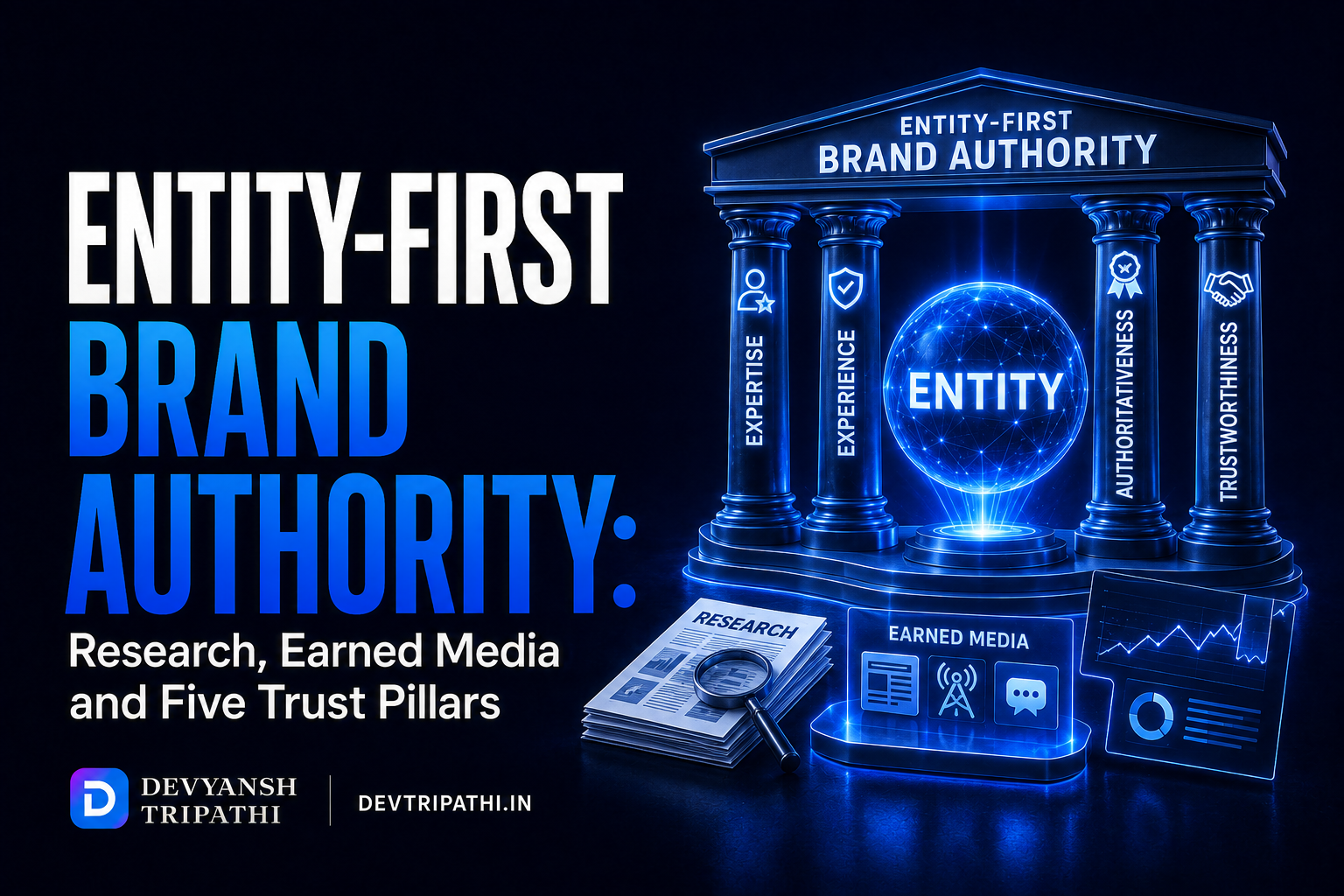
Entity-First Brand Authority: Research, Earned Media and Five Trust Pillars
30 June 2026
Brand authority SEO in 2026 requires a fundamentally different framework from the domain authority and link-building model that governed traditional search. AI systems determine which brands to cite in generated responses based primarily on entity clarity, multi-platform brand presence, and earned media volume rather than backlink counts, making brand authority building an AI citation strategy as much as a search ranking strategy.
This guide covers the advanced brand authority framework for the AI citation era: the specific correlation data showing which authority signals actually drive AI citation rates, why YouTube mentions show a stronger correlation with AI visibility than backlinks, the five-pillar entity authority system that produces the most durable AI citation advantages, how to build earned media authority at scale without a traditional PR budget, the original research investment strategy that produces compounding citation authority, and the measurement framework that connects brand authority actions to AI citation rate improvements and downstream revenue attribution.
Is Your Brand Authority Built to Earn AI Citations?
Most brand authority strategies are built for Google rankings. In 2026, the same signals that drive AI citations are different from traditional link signals. Get a complete brand authority audit covering your entity signals, YouTube presence, earned media profile, review platform coverage, and AI citation rate across ChatGPT, Perplexity, and Google AI Overviews.
Get My Brand Authority AuditWhy the Brand Authority Signal Hierarchy Has Inverted for AI Search
Traditional SEO treated domain authority and backlinks as the primary quality proxies for ranking decisions. The correlation between backlink count and ranking position was strong enough that link building became the central activity of most SEO programs for two decades. AI citation systems use a different hierarchy because they evaluate sources through a different mechanism: entity confidence rather than link graph position.
AI systems must decide which brands to recommend from training data and retrieval, and they use entity recognition, multi-source corroboration, and real-world mention volume as confidence signals rather than backlink counts. A brand with 10,000 backlinks from low-authority domains but minimal YouTube presence, no review profiles, and sparse earned media in authoritative publications will consistently lose AI citation share to a competitor with half the backlinks but strong presence across the platforms AI systems draw from most heavily. Understanding this inversion is the prerequisite for building brand authority that produces AI citation results rather than organic ranking results alone.
The Correlation Data That Confirms the Signal Shift
MR Research’s June 2026 citation factor analysis produced the clearest quantification of the new authority hierarchy. YouTube mentions show the strongest single correlation with AI visibility at 0.737. Brand web mentions in authoritative publications show 0.664. Brand search volume shows 0.334 to 0.392. Backlinks show only 0.218, the weakest of all measured signals. The practical implication is that the same time spent building backlinks would produce 3.4 times more AI citation impact if redirected toward building YouTube presence and earned media coverage instead. This does not mean abandoning link building, which remains essential for organic rankings. It means recognizing that the marginal return on additional authority investment is now higher in YouTube and earned media than in traditional link acquisition for brands seeking AI citation growth.
For the complete citation factor framework and the specific actions that address each signal tier, our AI Citation Optimization Advanced Guide provides the full implementation sequence. This brand authority guide focuses specifically on the brand-level authority building investments that provide the foundation for those citation signals to take effect.
0.737YouTube mentions correlation with AI visibility (MR Research June 2026)
53.5%AI citation rate for brands with Trustpilot profiles vs 1% without (Seer Interactive May 2026)
82%of AI citations come from earned media (Muck Rack 2026)
2.8xmore likely in ChatGPT for brands on 4+ platforms (Ekamoira research)
The Five-Pillar Entity Authority Framework
Entity authority is the AI-era equivalent of domain authority: a measure of how confidently AI systems can identify, describe, and recommend your brand across different query contexts. Entity authority is built through five interconnected pillars that together create the multi-source corroboration pattern AI systems recognize as high-confidence authority rather than a single isolated source making unverifiable claims.
Pillar 1
Wikipedia and Wikidata Entity Registration
Wikipedia and Wikidata are among the highest-weighted training data sources for most major AI systems. ChatGPT cites Wikipedia in 47.9% of responses where citations are provided. Creating and maintaining an accurate Wikipedia presence for your brand, where notability criteria are met, and registering your brand entity on Wikidata with complete property data creates the foundational entity recognition that allows AI systems to identify your brand across different query contexts with high confidence.
Not every brand qualifies for a Wikipedia article under notability guidelines. For brands that do not meet Wikipedia's notability requirements, Wikidata registration without a linked Wikipedia article still provides entity disambiguation signals. Organization schema on your website with a sameAs array pointing to Wikidata, Crunchbase, LinkedIn, and major review platforms creates the same entity graph signal even without Wikipedia coverage.
Pillar 2
Knowledge Panel and Google Knowledge Graph Presence
Google's Knowledge Panel is the most visible indicator of Knowledge Graph entity recognition and one of the strongest AI citation authority signals available. Brands with Knowledge Panels receive 2.8 times more AI citations than brands without them because Google's Gemini AI is trained on Knowledge Graph data and treats Knowledge Panel entities as higher-confidence citation sources. Build Knowledge Panel eligibility through consistent entity definition, Organization schema with complete sameAs array, verified Google Business Profile, and multi-source brand coverage in indexed publications.
For the complete Knowledge Graph building sequence, our Knowledge Graph Optimization guide covers the six-lever entity building process in detail. Knowledge Panel establishment is typically an 8 to 24 week process depending on brand notability and existing coverage.
Pillar 3
YouTube Authority and Video Presence
YouTube's 0.737 correlation with AI visibility is the single most significant brand authority finding of 2026 and the most underinvested signal for most brands. YouTube now appears in 16% of all LLM answers. Google AI Overviews cite YouTube as the second most common source category at 18.8%. Gemini treats YouTube as a primary reference platform. Building YouTube authority requires both your own channel with consistent expert content and generating presence in third-party YouTube videos through product reviews, expert commentary opportunities, and tutorial collaborations.
The distinction between owned YouTube content and earned YouTube mentions is significant for authority building. Your own channel establishes topical association between your brand and your expertise area. Earned mentions in independent YouTube videos, where creators discuss your brand, products, or methodology without commercial relationship, create the multi-source corroboration pattern that drives the 0.737 correlation. Both are necessary for maximum YouTube authority signal, but earned mentions produce the stronger correlation because they represent independent third-party validation.
Pillar 4
Review Platform Coverage and Sentiment
The Seer Interactive finding that a minimal Trustpilot profile increases AI citation rate from 1% to 53.5% represents the most dramatic single-action ROI in brand authority building. Review platforms provide the third-party social proof signal that AI systems treat as real-world validation of brand claims. A brand present on Trustpilot, G2, Clutch, and Google Business Profile with positive reviews across all platforms creates a four-source review consensus that AI systems treat as high-confidence brand validation. Set up every relevant review platform profile before investing in more complex authority building activities. The setup time is measured in hours; the authority impact is measurable within weeks.
Pillar 5
LinkedIn and Community Platform Authority
LinkedIn became the number one cited domain for professional queries across all six major AI platforms between November 2025 and February 2026. For B2B brands and professional service providers, LinkedIn is now the highest-priority brand authority platform available because it directly influences Microsoft Copilot citations, ChatGPT B2B query responses, and the professional context signals that AI systems use when generating expert recommendations. Building LinkedIn authority requires consistent expert content publishing in creator mode, engagement with trending industry discussions, and maintaining a complete company page with keyword-rich descriptions and regular company updates. For community authority beyond LinkedIn, our Community Signal SEO guide covers the Reddit and forum authority strategies that complement LinkedIn for B2C and mixed audiences.
Earned Media as the Primary AI Citation Authority Signal
82% of AI citations come from earned media and 94% from non-paid sources according to Muck Rack research. This finding reflects the fundamental design principle of AI citation systems: they favor independent third-party sources over self-published content because third-party sources provide the external validation that makes citations more credible to the users receiving AI generated responses. Building earned media authority is therefore not supplementary to brand authority SEO. It is the primary mechanism through which brand authority translates into AI citation rates.
What Constitutes High-Value Earned Media for Brand Authority
Not all earned media contributes equally to brand authority for AI citations. AI systems weight earned media sources based on the authority of the publication, the specificity of the brand mention within the content, and the recency of the coverage. Publication authority is measured by AI systems through the publication’s presence in training data, the frequency of the publication being cited in other contexts, and any domain authority signals that correlate with credibility in the AI model’s training source evaluation.
The most valuable earned media placements for brand authority are bylined expert articles in recognized industry publications under your team members’ names, brand citations within research reports from industry organizations, mentions in comparison or roundup content from well-trafficked publications in your category, and expert quotes in news coverage from general business and technology publications. Each of these placement types creates a different layer of brand authority: expert articles build individual and organizational credibility, research citations build category authority, roundup mentions build recommendation presence, and news quotes build real-time relevance signals.
Strategic Syndication for Faster Authority Building
Strategic content syndication, distributing original research, expert commentary, and insight content across multiple authoritative publications simultaneously, increases brand mention frequency by an average of 45% within 60 to 90 days according to ALM Corp’s 2026 AI search trends research. The mechanism is multi-source corroboration compression: instead of building brand mentions slowly through individual PR placements over months, strategic syndication generates multiple simultaneous authoritative mentions that AI systems register as a cluster of evidence for brand credibility rather than a single isolated reference.
Syndication targets should be selected based on which publications appear in AI-generated responses for your target query categories. Test your top 20 target queries in Perplexity and record every source URL cited. The publications appearing most frequently are the publications your target AI systems already treat as authoritative for your topic area. Earning coverage in those specific publications produces a higher AI citation impact per placement than coverage in publications AI systems rarely draw from, even if the less-cited publications have higher traditional domain authority scores. For the complete GEO strategy that connects earned media to generative AI citation rates, see our GEO Advanced Playbook.
Original Research as the Highest-Compound-Return Brand Authority Investment
Original research is the only brand authority investment that creates citation necessity rather than citation competition. When your brand publishes data that no other source has produced, AI systems that encounter a question requiring that data must cite your brand or provide no answer at all. Every other form of content, no matter how well-structured and authoritative, competes with equivalent content from competitors for the same citation slot. Original research eliminates that competition for the queries your data directly answers.
What Qualifies as Citable Original Research
Citable original research for brand authority purposes does not require an academic methodology or institutional research budget. It requires data that your brand has access to and can share that no other source has produced. Examples include: survey data collected from your customer or community base on a topic relevant to your category, analysis of trends or patterns observed across your client work that produce a novel finding, proprietary performance benchmarks from your service delivery that reveal something verifiable about your approach, and documented case studies with specific measurable outcomes that demonstrate your methodology’s results under real conditions.
The key criteria for research that earns compounding citations are: the data must be specific enough that citing it produces a meaningfully different response than not citing it, the research must be published in a permanently accessible form rather than as a time-limited campaign, and the findings must be promoted through earned media channels so that other publications cite your research and extend its citation reach beyond your own owned properties. Research promoted through a single company blog post earns only the citations your own page earns. Research cited in three industry publications earns citations through those publications as well, multiplying the citation reach of the same data.
Building a Research Publication Cadence
One original research publication per quarter is the minimum cadence for brands seeking to build compounding research citation authority. Monthly publications are optimal for categories with high content velocity where quarterly data becomes stale. The research publication cycle should align with the brand authority measurement cadence so that the citation rate impact of each publication can be isolated and measured. Track AI citation rate for research-related queries in the weeks before and after each publication to build a research-to-citation attribution record that justifies continued research investment with documented ROI.
Build Brand Authority That Compounds Over Time
Brand authority for AI citation requires a different investment strategy than traditional link building. Dev Tripathi designs brand authority programmes that systematically build the five-pillar entity system, earned media coverage, and original research capability that produce lasting AI citation advantages.
Build My Brand Authority ProgrammeMeasuring Brand Authority for AI Citation Performance
Brand authority measurement for AI citation purposes requires tracking leading indicators that precede citation rate improvements by 60 to 90 days, alongside lagging indicators that confirm citation and business impact. A complete brand authority measurement framework covers three layers: entity signal health, earned media volume and quality, and downstream AI citation and revenue outcomes.
Entity Signal Health Metrics
Entity signal health metrics confirm that the technical foundation for AI entity recognition is in place and current. Track these four signals quarterly: Knowledge Panel presence and accuracy (present or absent, all information current and correct), Organization schema sameAs array completeness (all major platform URLs included and active), Wikidata entry status (QID assigned, key properties populated, no conflicting data), and review platform coverage rate (percentage of major platforms with active profiles and minimum 10 reviews). Any gap in these four metrics represents a brand authority floor that prevents higher-level investments from producing their full citation impact.
Earned Media Quality and Velocity Metrics
Earned media tracking focuses on publication authority, mention specificity, and mention velocity. Record every brand mention in an external publication monthly, categorize it by publication authority tier (tier one being industry recognized publications, tier two being niche publications, tier three being low-authority sources), and calculate total monthly mentions by tier. Track earned media velocity, the month-over-month change in total tier-one and tier-two mentions, as the leading indicator of AI citation rate changes. Growing earned media velocity at 15% or more month-over-month consistently precedes AI citation rate improvement in the 60 to 90 day attribution window that separates earned media publication from AI model citation update.
AI Citation Rate as the Primary Brand Authority Outcome Metric
The ultimate measure of brand authority SEO effectiveness is the AI citation rate for your target query set across the major AI platforms your audience uses. Test your top 50 brand-relevant queries monthly across Google AI Overviews, ChatGPT, and Perplexity. Record citation frequency by platform and by query category. Calculate month-over-month change in citation rate. Map citation rate changes to specific brand authority actions taken 60 to 90 days earlier to build the attribution record that connects investment to outcome. For the complete AI citation measurement framework and tracking tool comparison, see our Brand SERP Optimization guide.
Frequently Asked Questions About Brand Authority SEO
What is brand authority SEO in the context of AI search?
Brand authority SEO in the AI search context is the practice of building the entity signals, earned media coverage, multi-platform presence, and knowledge graph representation that AI systems use to evaluate citation confidence when generating responses. It extends traditional brand SEO beyond link-based authority metrics to include the YouTube presence, review platform coverage, LinkedIn authority, and original research signals that correlate most strongly with AI citation rates in 2026.
Why do YouTube mentions correlate more strongly with AI visibility than backlinks?
YouTube transcripts constitute a significant portion of AI model training data, and brands consistently mentioned across multiple independent YouTube videos generate the multi-source entity corroboration that AI models internalize during training and retrieval. YouTube appears in 16% of all LLM answers and accounts for 18.8% of Google AI Overview citations. Backlinks, by contrast, are signals evaluated by traditional ranking algorithms that AI systems use as a secondary input rather than a primary citation selection signal.
How can a brand with limited PR budget build earned media authority?
Brands with limited PR budgets can build earned media authority through three accessible channels. Expert content contributions to industry publications, which most publications accept without payment and which are indexed as external brand citations, build publication-level authority. Original research publications of any scale, including small surveys of your customer base, create citable data that other publications may reference. Active participation as an expert source through platforms like HARO (Help a Reporter Out) generates news citation placements without outreach infrastructure or agency budget.
What is entity authority and how does it differ from domain authority?
Entity authority is the degree to which AI systems and knowledge graphs can confidently identify, describe, and recommend your brand across different query contexts. Domain authority is a metric measuring the strength of a website's backlink profile relative to other websites. Entity authority is multi-source and platform-distributed, existing across Wikipedia, Wikidata, review platforms, YouTube, and news coverage. Domain authority is single-source and website-specific. AI systems use entity authority signals to make citation decisions rather than domain authority metrics.
What is the five-pillar entity authority framework?
The five-pillar entity authority framework covers Wikipedia and Wikidata entity registration, Google Knowledge Panel and Knowledge Graph presence, YouTube authority through both owned content and earned video mentions, review platform coverage across Trustpilot, G2, Clutch, and Google Business Profile, and LinkedIn and community platform authority for professional and B2B query contexts. Together these five pillars create the multi-source entity corroboration pattern that AI systems recognize as high-confidence brand authority worthy of consistent citation recommendation.
How quickly does brand authority building produce AI citation improvements?
Technical entity building actions such as review platform profile creation and Organization schema implementation typically produce measurable citation rate improvements within 2 to 6 weeks. Earned media placements show citation impact within 60 to 90 days of publication. YouTube presence building through third-party mentions shows citation impact on a 3 to 6 month lag depending on how frequently AI systems update their retrieval and recommendation patterns. Knowledge Panel establishment takes 8 to 24 weeks from initial implementation of entity signals. Stack all five pillars simultaneously to compress the total time to measurable citation improvement.
What makes original research the highest-compound-return brand authority investment?
Original research is the only brand authority investment that creates citation necessity rather than citation competition. When your brand produces data no other source has published, AI systems answering questions that require that data must cite your brand or provide an incomplete answer. Every other content type competes with equivalent competitor content for the same citation slot. Original research eliminates this competition for the specific queries its findings answer, producing citation share that compounds as other publications cite the research and extend its reach beyond your owned channels.
Why did LinkedIn become the number one cited domain for professional queries?
LinkedIn's emergence as the number one cited domain for professional queries across all six major AI platforms between November 2025 and February 2026 reflects AI training data composition: major AI models were trained on LinkedIn as a primary professional knowledge source, creating strong weighting for LinkedIn content in professional query responses. For B2B brands, this makes consistent LinkedIn expert content publishing the highest single-platform investment available for professional audience AI citation authority.
How do review platforms affect brand authority for AI citations?
Review platforms provide the real-world third-party validation signal that AI systems treat as corroboration for brand claims. The Seer Interactive finding of a 53.5% AI citation rate for brands with minimal Trustpilot profiles versus 1% for brands without any review presence demonstrates that even a minimal review profile creates a multi-source validation signal that dramatically increases AI citation confidence. The mechanism is entity corroboration: a brand mentioned on its own website, on LinkedIn, and on Trustpilot has three independent sources confirming its existence and relevance, creating higher citation confidence than a brand present only on its own domain.
How does the Seer Interactive post-hoc citation finding affect brand authority strategy?
Seer Interactive's 2026 hypothesis, based on 362,388 AI response analyses, suggests AI systems decide which brands to recommend from training data first and then search for citation sources to support those recommendations. If confirmed, this means that brand authority building at the training-data level, through YouTube presence, earned media, and Wikipedia coverage, is the prerequisite for citation page optimization to work. Content structure improvements can only convert recommendation selection into citation appearance for brands that AI systems have already identified as relevant recommenders in their category.
What is the relationship between brand authority SEO and traditional link building?
Brand authority SEO and traditional link building are complementary rather than competing investments in 2026. Traditional link building remains essential for organic search rankings, which are the prerequisite for most AI citation eligibility (93.67% of AI Overview citations come from top-10 organic URLs). Brand authority SEO addresses the additional signals above organic ranking that determine whether ranked pages are actually selected as AI citations. Both are needed: link building for ranking eligibility, brand authority SEO for citation selection. Marginal investment returns are currently higher in brand authority than in additional link building for brands that have already achieved stable top-10 rankings.
How should brand authority SEO connect to the broader AI search strategy?
Brand authority SEO is the foundation layer of a complete AI search strategy. Without sufficient brand authority, GEO content structure improvements and AEO schema optimization produce suboptimal results because AI systems lack the entity confidence to recommend your brand consistently. Brand authority SEO should be implemented first, or simultaneously with, GEO and AEO content optimization. The combined investment of entity clarity, earned media, YouTube presence, and review platform coverage provides the authority infrastructure that GEO and AEO tactics then optimize into measurable citation rate improvements. Our GEO Advanced Playbook covers the content optimization layer built on this brand authority foundation.
Ready to Build Brand Authority That Earns AI Citations Consistently?
Get a complete brand authority programme covering your five-pillar entity audit, YouTube citation signal strategy, earned media programme design, original research plan, review platform setup, and the measurement framework connecting authority investments to AI citation rates and revenue outcomes.
Start My Brand Authority ProgrammeConclusion
Brand authority SEO in 2026 requires building a different set of signals than the link-based authority model that governed traditional search. YouTube mentions at 0.737 correlation, brand mentions at 0.664, and backlinks at only 0.218 confirm that the authority hierarchy has shifted fundamentally toward entity signals, platform presence, and earned media coverage. The five-pillar entity framework provides the systematic approach to building all five of these signals simultaneously: Wikipedia and Wikidata registration, Knowledge Panel presence, YouTube authority, review platform coverage, and LinkedIn and community authority.
Earned media is the primary mechanism through which brand authority translates into AI citation rates, with 82% of AI citations coming from earned third-party sources rather than self-published content. Strategic syndication accelerates this process by generating multiple simultaneous authoritative mentions. Original research compounds it by creating citation necessity rather than citation competition. And the measurement framework that tracks entity signal health, earned media velocity, and AI citation rate provides the attribution infrastructure that makes brand authority investment accountable to measurable commercial outcomes rather than intangible brand metrics.
Start with the highest-ROI available action: set up your Trustpilot, G2, or equivalent review platform profile this week. The 1% to 53.5% citation rate improvement from minimal review presence is the fastest measurable brand authority win in the entire SEO playbook. Then build outward through the five pillars systematically, measuring citation rate improvement at each stage to build the attribution record that justifies sustained brand authority investment.

Devyansh Tripathi
I’m Devyansh Tripathi, an SEO strategist and digital growth expert, helps businesses and individuals rank higher and drive organic traffic. Through DevTripathi., he shares cutting-edge SEO insights, content strategies, and marketing hacks. Passionate about digital success, he’s on a mission to make SEO simple, effective, and result-driven!
Posts
- What Google’s New AI Search Documentation Means for SEO Teams
- Google I/O 2026 Search: AI Agents, Gemini 3.5 and the Unified Box
- Google’s AI Optimization Guide: The Technical and Content Checklist
- July 2026 SEO Update: AI Overviews, llms.txt and Search Console
- Prompt Optimization Beyond Page One: The Position-21 Citation Opportunity
Categories
- AI Citation Optimization
- AI Search Optimization (AISEO)
- AI Visibility Tracking
- Answer Engine Optimization (AEO)
- Brand Authority SEO
- Brand SERP Optimization
- Community Signal SEO
- Conversational Search Optimization
- Generative Engine Optimization (GEO)
- Knowledge Graph Optimization
- Modern SEO Strategies
- Multimodal Search Optimization
- Prompt Optimization
- SEO Trends
- Social Search Optimization
- Topical Authority SEO
- Uncategorized
- Video Search SEO
- Visual Search Optimization
- Voice Engine Optimization (VEO)
- Zero Click Search Optimization
Latest News
Text Widget
Empowering brands with insights, strategies, and stories that drive digital growth.