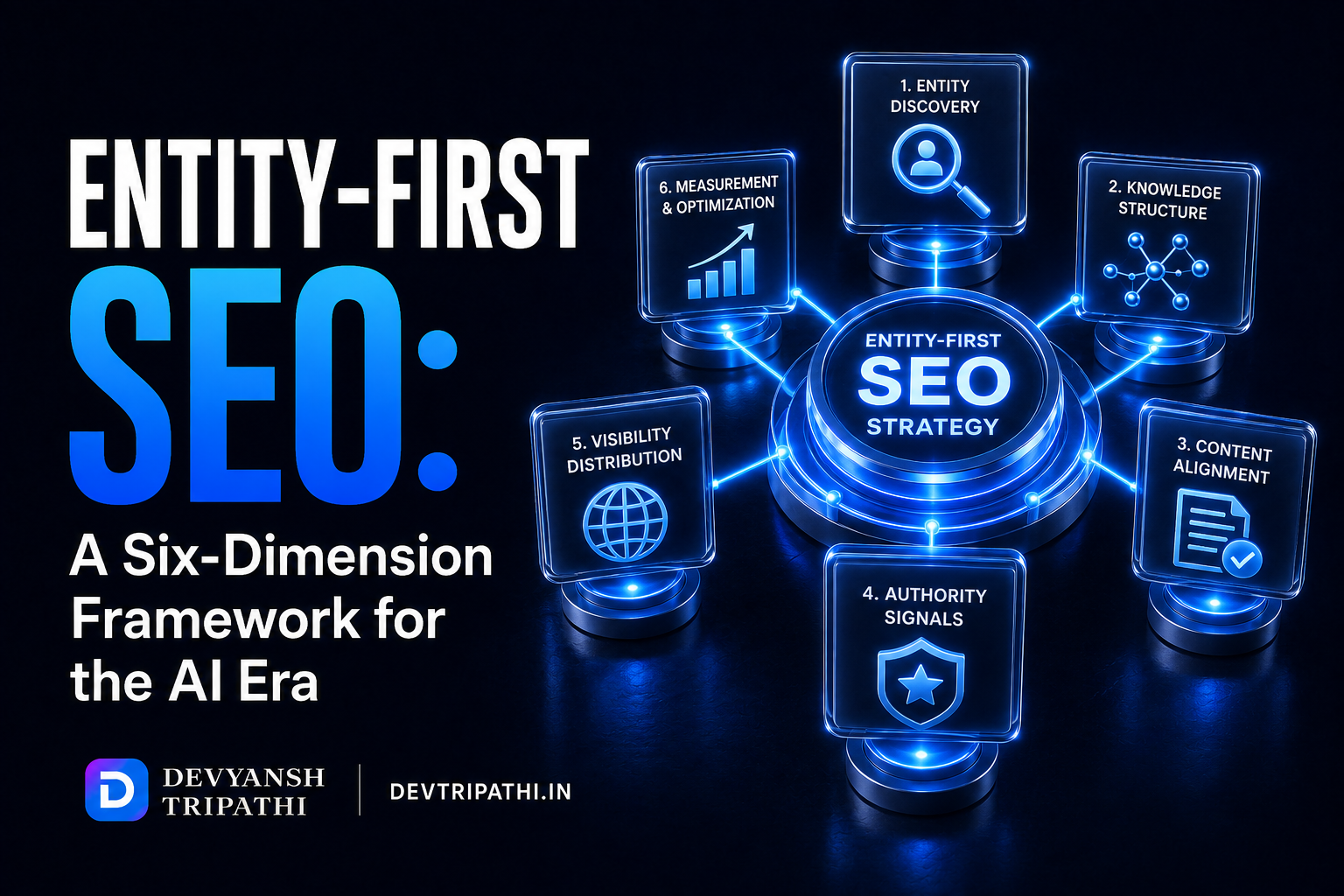
Entity-First SEO: A Six-Dimension Framework for the AI Era
06 July 2026
Advanced modern SEO strategies in 2026 require integrating the entity-first content architecture, trust-signal hierarchy, and multi-platform citation optimization that Cycle 1 and Cycle 2 modern SEO guides introduced into a single unified operating system where every SEO action simultaneously serves traditional ranking, AI citation eligibility, and entity authority building rather than treating these three objectives as separate workstreams competing for the same budget and team capacity.
This Cycle 3 guide covers the advanced modern SEO framework built on the most complete 2026 research base available: the entity-first content design methodology that builds topical authority and AI citation signals simultaneously, the trust signal hierarchy that defines which authority investments produce the highest compound returns across both traditional rankings and AI citation systems, the 2% cross-platform citation concentration finding and its strategic implications, the integrated AISEO-GEO-AEO operating framework that replaces siloed optimization approaches, and the six-dimension measurement system that captures performance across both traditional and AI search surfaces without requiring separate analytics infrastructure for each optimization discipline.
Is Your Modern SEO Strategy Integrated Across Traditional Rankings, AI Citations, and Entity Authority?
Advanced modern SEO requires a unified operating system rather than three separate optimization disciplines. Get a complete framework assessment covering your entity-first architecture, trust signal hierarchy, cross-platform AI citation coverage, and integrated measurement system across all six performance dimensions.
Get My Advanced SEO AssessmentThe Entity-First Content Design Methodology
The most significant evolution in advanced modern SEO strategy from Cycle 1 and Cycle 2 thinking is the shift from keyword-first to entity-first content design. Keyword-first content design starts with keyword research, identifies target queries, and builds content to satisfy those queries. Entity-first content design starts with entity definition, maps the entities that should be associated with your brand and expertise area, and builds content that establishes those entity associations through verified facts, expert attribution, and cross-platform consistency before optimizing for specific keyword queries.
The practical difference in output is significant. Keyword-first design produces content that ranks for specific queries but may not build the entity recognition that AI systems use for brand recommendation and citation. Entity-first design produces content that simultaneously earns traditional rankings, builds AI citation eligibility through entity clarity signals, and creates the Knowledge Graph representation that makes Knowledge Panel emergence possible. All three outcomes from one content investment represent the compounding return that entity-first methodology produces over keyword-first approaches for brands that need both traditional and AI search performance.
How Entity-First Content Design Works in Practice
Entity-first content design follows a specific pre-writing sequence before any keyword or content planning begins. First, define your brand entity and its properties: what your brand does, who it serves, where it operates, when it was founded, and what it is recognized for in the market. Second, define the expert entities (team members) who will be attributed as content authors and what their specific knowledge domains are. Third, map the topic entities that should be associated with your brand in the Knowledge Graph: the primary discipline entities (AI search optimization, GEO, AEO), the method entities (entity building, citation optimization, prompt research), and the outcome entities (AI citation rate improvement, Share of Model growth, branded search volume growth). Only after this entity mapping does the keyword research and content planning phase begin, ensuring that the resulting content simultaneously builds entity associations and satisfies keyword-based search intent rather than only doing the latter.
2%of cited URLs appear across all AI platforms simultaneously (Growth Memo May 2026)
54%of SEO professionals name content quality as the #1 modern SEO strategy (Goodfirms 2026)
325%more AI citations from earned media distribution vs own-domain publishing (Stacker Dec 2025)
39.8%of all clicks go to the first organic result (AIOSEO 2026 verified statistics)
The Trust Signal Hierarchy for Advanced Modern SEO
The trust signal hierarchy defines the priority sequence for SEO investments based on their compound return across both traditional rankings and AI citation systems simultaneously. Advanced modern SEO strategy organizes investments in this hierarchy rather than allocating budget equally across all available optimization activities, because the top-tier trust signals produce returns in both search environments while lower-tier signals produce returns primarily in only one.
Tier 1 — Highest Compound Return
Entity Authority Signals
Entity authority signals including Knowledge Panel presence, Wikidata registration, Organization schema sameAs array, and review platform validation produce compound returns across traditional rankings (through E-E-A-T evaluation), AI Overview citation selection (through entity confidence), and AI Mode recommendations (through Gemini Knowledge Graph training data). A single investment in review platform setup produces a 53-percentage-point AI citation rate improvement per Seer Interactive's research while simultaneously strengthening the entity clarity that Google's quality raters evaluate for traditional rankings.
Tier 2 — High Compound Return
Earned Media and External Validation
Earned media in authoritative publications produces 325% more AI citations than own-domain publishing and simultaneously generates the high-authority backlinks that traditional ranking algorithms rely on. A single placement in a recognized industry publication contributes domain authority for traditional rankings, AI citation corroboration as an independent authoritative source, and entity validation as external confirmation of your brand's existence and expertise. This dual-surface return makes earned media the highest compound-return external investment in advanced modern SEO.
Tier 3 — Strong Single or Dual Surface Return
Content Quality and Structure
High-quality content with answer-first structure, data density of 19 or more data points, Q&A formatted headings, and nested FAQPage schema produces strong returns in both AI citation selection (citation eligibility) and traditional rankings (search intent satisfaction). However, content structure alone cannot overcome weak entity authority, so Tier 3 investment is most effective after Tier 1 and Tier 2 foundations are in place, converting entity recognition into citation page selection and search intent satisfaction into ranking stability.
Tier 4 — Traditional Ranking Returns
Technical SEO and Page Experience
Technical SEO including Core Web Vitals compliance, mobile-friendliness, HTTPS implementation, and structured crawlability remains essential for traditional ranking eligibility but produces minimal direct AI citation returns beyond enabling content accessibility for AI crawlers. The one exception is schema markup deployment, which crosses into Tier 3 by simultaneously enabling rich results for traditional search and structured data extraction for AI citation systems. Technical SEO should be treated as a floor investment that enables other tiers rather than as a competitive differentiator in itself once baseline requirements are met.
The 2% Cross-Platform Citation Problem and the Platform Portfolio Strategy
The Growth Memo’s May 2026 finding that only 2% of cited URLs appear across all three major AI platforms simultaneously (Google AI Overviews, ChatGPT, and Perplexity) while 91% appear in only one AI engine has a direct strategic implication that most modern SEO frameworks have not yet addressed. A brand that has invested in one AI platform’s optimization is achieving comprehensive AI citation coverage for at most 9% of its citation opportunities, assuming it is the 9% of URLs with some cross-platform presence. The remaining 91% of citation opportunities on non-optimized platforms remain entirely unaddressed regardless of how strong the single-platform performance is.
The platform portfolio strategy responds to the 2% finding by treating AI citation optimization as a portfolio management challenge rather than a sequential optimization challenge. Rather than optimizing for one platform first and moving to the next, the platform portfolio strategy establishes a baseline optimization profile for each major platform simultaneously and then deepens platform-specific optimization proportionally based on where the target audience is most active. For the platform-specific optimization sequences for Google AI Mode, ChatGPT, and Perplexity, see our GEO Cycle 3 guide.
The Integrated AISEO-GEO-AEO Operating Framework
The most significant structural advance in advanced modern SEO thinking for 2026 is the recognition that AI Search Optimization (AISEO), Generative Engine Optimization (GEO), and Answer Engine Optimization (AEO) are not three separate disciplines but three overlapping dimensions of the same visibility challenge that should be addressed through a single integrated operating framework rather than three independent programmes.
| Discipline | Primary Focus | Shared Foundation | Unique Element | Measurement Metric |
|---|---|---|---|---|
| AISEO | Comprehensive AI platform visibility strategy | Entity authority, content quality, technical foundation | Cross-platform portfolio management, platform selection | AI Citation Share across all platforms |
| GEO | Citation source selection within generative AI | Entity authority, content quality, technical foundation | Data density, earned media distribution, citation decay management | Share of Model, citation frequency per platform |
| AEO | Answer extraction for featured snippets and voice | Entity authority, content quality, technical foundation | Answer format architecture, schema for answer extraction | Featured snippet ownership, voice answer rate |
All three disciplines share the same three foundational requirements: entity authority that establishes brand recognition confidence, high-quality content that satisfies intent at appropriate depth, and technical SEO foundations that ensure content accessibility. The unique elements of each discipline address specific optimization objectives within that shared foundation. Integrating all three under a single framework eliminates the duplicated foundational work that separate programmes require and concentrates the unique-element investment where each discipline adds the most incremental return above the shared baseline. For the advanced AEO component of this integrated framework, see our AEO Advanced Strategies guide.
Build One Integrated SEO System Rather Than Three Separate Programmes
Advanced modern SEO in 2026 produces the highest compound returns when AISEO, GEO, and AEO are integrated into one operating framework rather than managed as separate workstreams with duplicated foundational investments. Dev Tripathi designs integrated AI-era SEO systems covering all three disciplines from a single entity-first foundation.
Build My Integrated SEO SystemThe Six-Dimension Modern SEO Measurement System
Advanced modern SEO measurement in 2026 requires tracking six dimensions simultaneously rather than the three-metric traditional dashboard (rankings, organic traffic, conversions) that captures only the traditional search surface and misses AI citation performance, entity authority health, and earned media velocity entirely.
Dimension 1
Traditional Ranking Performance
Track positions for top 50 commercial queries monthly with click-through rate and impression volume from Google Search Console. Focus on the top-three positions where 68.7% of all clicks concentrate. The first organic result receiving 39.8% of clicks and rich results earning 58% CTR versus 41% for non-rich results remain the most actionable traditional ranking benchmarks for reporting position-to-traffic relationships.
Dimension 2
AI Citation Rate per Platform
Test 20 to 50 priority queries weekly across Google AI Mode, ChatGPT, and Perplexity independently. Track citation rate separately per platform because the 2% URL overlap means aggregate cross-platform citation rate is a meaningless metric. Platform-specific citation rate reveals where optimization investments are producing results and where platform-specific gaps remain unaddressed.
Dimension 3
Entity Authority Health
Audit Knowledge Panel status, Wikidata entry completeness, Organization sameAs array coverage, and review platform presence quarterly. Entity authority health is the leading indicator of AI citation rate changes: improvements in entity signals typically precede measurable citation rate improvements by 60 to 90 days, making entity health the most actionable early warning metric in the advanced SEO measurement system.
Dimension 4
Earned Media Velocity
Count monthly earned media placements in authoritative publications by tier (tier one being industry recognized, tier two being niche publications). Track earned media velocity, the month-over-month change in tier-one and tier-two placement count, as a leading indicator of AI citation rate improvements with a 60 to 90 day lag. Growing earned media velocity at 15% or more month over month consistently precedes Share of Model improvement.
Dimension 5
AI-Referred Revenue Attribution
Configure GA4 custom channel groups for AI platform referrers (chatgpt.com, perplexity.ai, gemini.google.com, claude.ai). Track sessions, conversion rate, and revenue from the AI channel monthly. AI-referred traffic converting at 4.4 to 15.9 times the organic rate makes this channel the highest-value acquisition source per session on most websites that have begun earning AI citations.
Dimension 6
Branded Search Volume Growth
Track branded query impressions monthly in Google Search Console. Consistent growth above 15% month over month confirms that multi-surface visibility investment is generating brand recall that converts to direct search intent. Branded search volume growth is the downstream indicator that zero-click AI citation exposure is producing commercial recognition even without direct website visits.
Frequently Asked Questions About Advanced Modern SEO Strategies
What distinguishes advanced modern SEO strategies from foundational modern SEO?
Advanced modern SEO integrates the entity-first content design methodology, trust signal hierarchy, platform portfolio strategy for the 2% cross-platform citation problem, and the unified AISEO-GEO-AEO operating framework into one coherent system. Foundational modern SEO covers individual optimization techniques for traditional rankings and AI citations without integrating them into a single compound-return investment framework that maximizes returns across both search surfaces simultaneously from a shared foundational investment.
What is entity-first content design and how does it differ from keyword-first?
Entity-first content design begins with defining brand, author, and topic entities before any keyword research or content planning, ensuring that the resulting content simultaneously builds entity associations in AI knowledge systems and satisfies keyword-based search intent. Keyword-first design starts with keyword research and builds content to rank for specific queries, which satisfies traditional search intent but may not build the entity recognition that AI systems require for brand recommendation and citation. Entity-first produces compound returns across both objectives; keyword-first optimizes primarily for traditional rankings.
Why does the 2% cross-platform citation finding matter so much?
The Growth Memo's May 2026 finding that only 2% of cited URLs appear across Google AI Overviews, ChatGPT, and Perplexity simultaneously means any single-platform optimization strategy leaves 91% of AI citation opportunities unaddressed. A brand optimized exclusively for AI Overviews is invisible to ChatGPT and Perplexity users searching its category. The platform portfolio strategy responds by establishing baseline optimization profiles for all major platforms simultaneously rather than sequentially, because sequential optimization permanently leaves cross-platform citation territory to competitors during the optimization period.
How does the trust signal hierarchy guide SEO investment allocation?
The trust signal hierarchy prioritizes investments by their compound return across both traditional rankings and AI citation systems. Tier 1 entity authority signals produce returns in both environments simultaneously, making them the highest-priority investment. Tier 2 earned media investments produce dual returns through backlinks for traditional rankings and external validation for AI citations. Tier 3 content quality and structure investments convert entity recognition into citation selection and search intent satisfaction. Tier 4 technical SEO enables all other tiers but produces minimal standalone competitive differentiation beyond baseline compliance.
What is the integrated AISEO-GEO-AEO operating framework?
The integrated framework recognizes that AI Search Optimization, Generative Engine Optimization, and Answer Engine Optimization share the same three foundational requirements: entity authority, content quality, and technical SEO. Managing all three under one framework eliminates duplicated foundational investment and concentrates the unique elements of each discipline where they add the most incremental return. The unique AISEO element is cross-platform portfolio management. The unique GEO element is citation decay management and data density optimization. The unique AEO element is answer format architecture and schema for extraction.
Has AI search replaced the need for traditional ranking optimization?
No. The first organic result still receives 39.8% of all clicks, position one generates 74.5% more clicks than position two, and 93.67% of AI Overview citations come from top-10 organic results. Traditional rankings remain the prerequisite for AI Overview citation eligibility and continue driving the majority of clicked search traffic for commercial queries. AI search has added a second optimization requirement above the traditional foundation rather than replacing it, making both simultaneously necessary for comprehensive modern search visibility.
What does information gain mean for advanced modern SEO?
Information gain in advanced modern SEO is the requirement that every piece of content provide something that competing pages do not: original data, better explanations, unique frameworks, expert perspectives not available elsewhere, or implementation depth that generic content cannot match. Google's Helpful Content System actively rewards information gain and penalizes content that only synthesizes or rephrase existing coverage. In AI search, information gain creates citation necessity for the specific data points or frameworks your content uniquely provides, making it the mechanism through which content builds citation authority rather than only citation competition.
How should modern SEO strategy be updated when AI platforms release major updates?
When major AI platforms release significant updates such as Gemini 3.5 Flash raising the AI Mode content quality bar, the update response should follow a specific sequence. First, test your current citation rate across the updated platform's target queries to establish the post-update baseline. Second, analyze whether citation rates have changed and for which query types. Third, examine what content attributes the platform's updated model appears to favor or deprioritize based on which pages are now cited compared to before the update. Fourth, adjust the relevant dimension of your seven-pillar investment based on the observed preference changes while maintaining the foundational elements that have not changed.
What is the highest single-action ROI available in modern SEO in 2026?
The highest single-action ROI in modern SEO in 2026 is establishing a Trustpilot, G2, or equivalent review platform profile if you do not have one. Seer Interactive's May 2026 research found this single action lifts AI citation rates from a median 1% to 53.5%, a 52-percentage-point improvement. The implementation takes approximately one hour and costs nothing for a basic profile. It simultaneously strengthens Brand SERP review signals, entity validation for Knowledge Panel eligibility, and AI citation confidence across all major AI platforms that use third-party review presence as an entity corroboration signal.
How does the six-dimension measurement system connect to budget allocation decisions?
The six-dimension measurement system reveals which investment categories are producing measurable returns and which have performance gaps that indicate underinvestment or strategic misalignment. Declining entity authority health metrics signal that entity maintenance investment is insufficient. Stagnant earned media velocity with growing AI citation rates suggests the citation growth is approaching its ceiling without new external validation. Flat AI-referred revenue with high AI citation rate suggests AI-cited pages have conversion optimization gaps. Each dimension's trend data directs the next period's investment allocation rather than requiring external benchmarks or competitor research alone to justify budget decisions.
How does topical authority connect to the advanced modern SEO framework?
Topical authority cluster architecture is the content implementation layer of the entity-first modern SEO strategy. Where entity-first design defines which topic entities should be associated with your brand, topical authority clusters create the systematic content coverage that makes those entity associations verifiable across a comprehensive range of query types. A brand claiming expertise in AI search optimization but with only two articles on the topic has a weak entity association. A brand with 12 interconnected articles covering every aspect of AI search optimization has a strong verifiable entity association that both Google's quality systems and AI retrieval systems can confirm from multiple independent content signals. For the complete topical authority implementation methodology, see our Topical Authority SEO guide.
What makes the Cycle 3 modern SEO framework different from Cycle 1 and Cycle 2?
The Cycle 3 modern SEO framework differs from Cycle 1 and Cycle 2 in three specific ways. First, the research base is now mature enough to establish a quantified trust signal hierarchy rather than general priority guidance. Second, the integrated AISEO-GEO-AEO framework replaces the three-discipline separation of earlier cycles with a single shared-foundation approach that eliminates duplicated investment. Third, the 2% cross-platform citation finding has transformed platform coverage from an advanced consideration into a primary strategic requirement that the platform portfolio strategy addresses directly, replacing the single-platform optimization approach that earlier cycles presented as the practical starting point. For the foundational modern SEO framework this Cycle 3 guide extends, see our Modern SEO Strategies guide.
Ready to Build the Integrated AI-Era SEO System Your Brand Needs?
Get a complete advanced modern SEO framework covering your entity-first architecture audit, trust signal hierarchy investment plan, platform portfolio strategy for cross-platform AI citation coverage, integrated AISEO-GEO-AEO operating design, and six-dimension measurement system setup that tracks compound returns across both traditional and AI search surfaces.
Start My Advanced SEO FrameworkConclusion
Advanced modern SEO strategies in 2026 require the integration of entity-first content design, trust signal hierarchy investment sequencing, platform portfolio management for the 2% cross-platform citation reality, and the unified AISEO-GEO-AEO operating framework into a single coherent system that produces compound returns across traditional rankings and AI citation systems simultaneously. The research base now supports specific investment sequencing: entity authority first because it produces compound returns across both search surfaces, earned media second because it simultaneously builds backlinks and AI citation corroboration, content quality and structure third to convert entity recognition into citation selection, and technical SEO as the floor that enables all three.
The six-dimension measurement system that captures entity authority health, earned media velocity, AI citation rate per platform, AI-referred revenue, traditional ranking performance, and branded search volume growth provides the intelligence infrastructure that makes every subsequent modern SEO investment more strategically directed rather than more experimentation-dependent. Build the measurement system first. Let it reveal the highest-impact gaps. Then invest in the trust signal tier that addresses those gaps most efficiently given your current entity authority baseline and platform citation coverage. For the complete AI citation strategy that operationalizes this modern SEO framework, see our AI Citation Optimization Advanced Guide.

Devyansh Tripathi
I’m Devyansh Tripathi, an SEO strategist and digital growth expert, helps businesses and individuals rank higher and drive organic traffic. Through DevTripathi., he shares cutting-edge SEO insights, content strategies, and marketing hacks. Passionate about digital success, he’s on a mission to make SEO simple, effective, and result-driven!
Posts
- What Google’s New AI Search Documentation Means for SEO Teams
- Google I/O 2026 Search: AI Agents, Gemini 3.5 and the Unified Box
- Google’s AI Optimization Guide: The Technical and Content Checklist
- July 2026 SEO Update: AI Overviews, llms.txt and Search Console
- Prompt Optimization Beyond Page One: The Position-21 Citation Opportunity
Categories
- AI Citation Optimization
- AI Search Optimization (AISEO)
- AI Visibility Tracking
- Answer Engine Optimization (AEO)
- Brand Authority SEO
- Brand SERP Optimization
- Community Signal SEO
- Conversational Search Optimization
- Generative Engine Optimization (GEO)
- Knowledge Graph Optimization
- Modern SEO Strategies
- Multimodal Search Optimization
- Prompt Optimization
- SEO Trends
- Social Search Optimization
- Topical Authority SEO
- Uncategorized
- Video Search SEO
- Visual Search Optimization
- Voice Engine Optimization (VEO)
- Zero Click Search Optimization
Latest News
Text Widget
Empowering brands with insights, strategies, and stories that drive digital growth.