
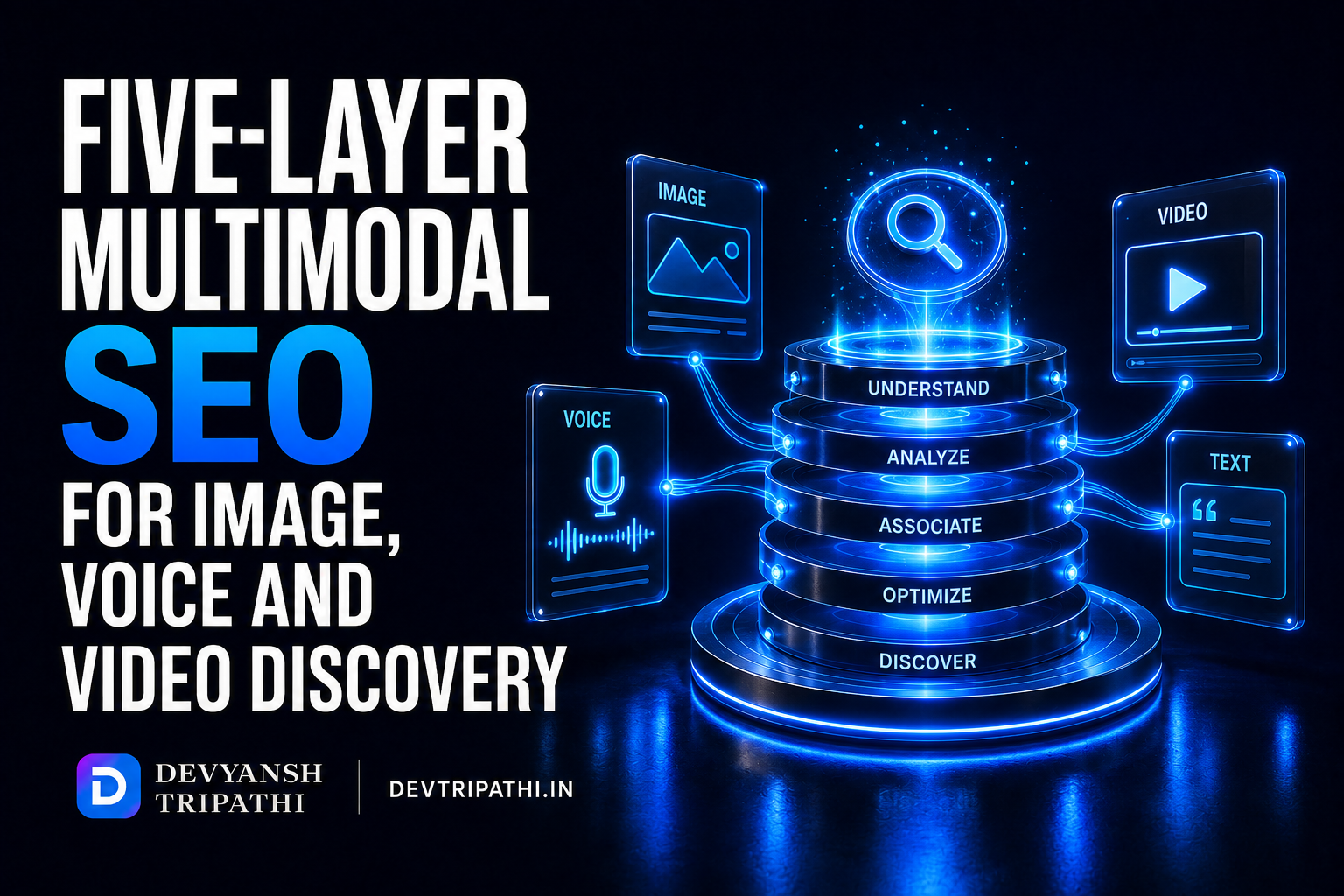
Five-Layer Multimodal SEO for Image, Voice and Video Discovery
20 June 2026
Multimodal Search Optimization is the practice of preparing content, images, video, and audio assets so that AI-powered search systems that process text, visual, and audio inputs simultaneously can discover, understand, and cite your content across Google Lens, Google AI Mode, voice assistants, and generative AI platforms that no longer require typed queries to deliver results.
This guide covers the complete Multimodal Search Optimization framework for 2026: the data behind Google Lens reaching 20 billion monthly visual searches, the five content layers that multimodal AI systems evaluate simultaneously rather than in sequence, the technical optimization checklist for images, video, and audio assets, the schema markup stack that signals visual and multimodal content to AI retrieval systems, and the platform-specific strategies for Google Lens, Google AI Mode, and voice search. You will also find the competitive intelligence showing why more than one in six AI Mode searches is now non-text input and image-input queries are growing at 40% month over month since AI Mode launched.
Free Multimodal Search Audit
Is Your Visual Content Visible in the 26% of Google Searches That Are Now Image-Based?
Get a complete multimodal search audit covering your image metadata quality, video transcript completeness, structured data for visual content, Google Lens optimization status, and the specific gaps preventing your visual assets from appearing in AI Mode and Google Lens results.
Get My Multimodal Search AuditWhat Multimodal Search Optimization Is and Why It Now Demands Action
Multimodal Search Optimization is the discipline of making your content discoverable across every input type, including text, images, voice, and video, so that AI search engines that see, hear, and read simultaneously can find, understand, and cite it. Modern engines accept photographs, screenshots, spoken questions, and video, often in a single interaction, and AI models can now analyze your product images, listen to your audio, and process your video frames to understand context independently of the surrounding text.
The urgency is no longer theoretical. Google Lens processes over 20 billion visual searches per month as of March 2026, up 43% from its 2024 average. Image-based searches now represent 26% of all Google queries. Google Images alone drives 22% of all web searches. And more than one in six AI Mode searches is non-text input, with image-input queries growing at 40% month over month since AI Mode launched. Brands treating SEO as a text-only discipline are already missing over a quarter of all search interactions.
The most commercially significant aspect of this shift is Google Lens’s shopping integration. Approximately 20% of all Lens queries are shopping-related, meaning a user who photographs a competitor’s product is actively searching for alternatives to buy right now. Brands with optimized product images and complete Product structured data appear in these high-intent Lens results. Brands without them are invisible at the moment of maximum purchase intent. For the complete modern SEO framework that multimodal optimization sits within, see our Modern SEO Strategies guide.
20BGoogle Lens monthly visual searches as of March 2026, up 43% from 14B in 2024 (Amra & Elma 2026)
26%of all Google queries are now image-based searches (Amra & Elma 2026)
22%of all web searches come from Google Images (Digital Applied 2026)
1 in 6AI Mode searches are multimodal non-text input, growing 40% MoM (Google AI Mode Stats 2026)
How Multimodal AI Engines Evaluate Content Differently
Traditional search engines ranked pages primarily based on text signals: keyword frequency, backlink authority, and meta tags. Multimodal AI engines evaluate content across five simultaneous channels: the text on the page, the images and their metadata, any video frames and their transcripts, audio quality and context where applicable, and the structured entity data that links all assets to a coherent brand identity.
For a product image, Google Lens runs object detection to identify the main item, predicts commercial intent based on object type and scene context, and matches it against the Product structured data associated with that image. A product shown in a lifestyle setting provides more contextual data points than a product on a white background alone because the AI can understand scale, use case, and environment. An image named “IMG_4892.jpg” with generic alt text gives the AI almost nothing to work with. An image named “mens-running-shoes-size-10-blue-lightweight.webp” with descriptive alt text and Product schema gives it everything it needs to surface that product in camera-based shopping queries.
This is why multimodal optimization and GEO optimization reinforce each other directly. AI assistants including ChatGPT and Perplexity decide what to cite based on comprehensive signals that include schema markup, image metadata, and video transcripts — the same assets multimodal optimization improves. For the complete GEO strategy that benefits from multimodal asset optimization, see our GEO Advanced Playbook.
The Five Content Layers of Multimodal Search Optimization
Multimodal search optimization requires building each of five distinct content layers that AI systems evaluate simultaneously. Weakness in any single layer reduces the effectiveness of all others because multimodal AI relies on corroborating signals across every asset type to build confidence in its content understanding before selecting it for visual or voice search results.
| Content Layer | What AI Evaluates | Primary Optimization Action | Schema Required |
|---|---|---|---|
| Text Content | Surrounding context for image and video relevance | Descriptive captions, entity-rich surrounding paragraphs | Article, FAQPage |
| Image Assets | Visual clarity, file name, alt text, metadata | Descriptive filenames, semantic alt text, AVIF/WebP format | ImageObject, Product |
| Video Content | Transcripts, thumbnails, chapter markers | Complete transcripts, video schema, descriptive thumbnails | VideoObject |
| Audio Content | Spoken content for voice search matching | Speakable schema on key answer sections | Speakable |
| Structured Entity Data | Brand identity linking all assets to one entity | Organization sameAs, consistent brand mentions across all assets | Organization, Product |
Layer 1: Image Asset Optimization
Image asset optimization in 2026 has four non-negotiable elements that most sites still have not implemented. First, file naming: rename every image using descriptive, hyphenated keywords that describe the image content specifically. “blue-running-shoes-mens-lightweight-2026.webp” outperforms “IMG_4892.jpg” in every visual search scenario. Second, semantic alt text: write alt text that describes the image content naturally and includes key entities including people, brands, locations, and product specifications, without keyword stuffing. Third, modern image format: serve images in AVIF as the primary format with WebP fallback using the HTML picture element. AVIF delivers 25 to 35% smaller files than JPEG at equivalent quality, improving Core Web Vitals and AI crawler accessibility simultaneously. Fourth, image structured data: implement ImageObject schema and, for product images, Product schema with all required properties including name, description, brand, and image URL.
According to Digital Applied’s 2026 image SEO research, Google Images now drives 22% of all web searches and Google Lens queries are growing at 30% annually. This makes image SEO one of the highest-leverage untapped SEO opportunities available for most sites: the channel is large, growing, and systematically underoptimized relative to text-based search.
Layer 2: Google Lens Optimization
Google Lens optimization differs from traditional image SEO because it relies on visual matching rather than text signals alone. Lens uses computer vision to identify objects in images and matches them against its product and information index. Sites that rank well in Lens results have images that are visually clear, shot with sufficient resolution for AI feature extraction, accurately associated with Product or ImageObject structured data, and matched by name and description to the product catalog information in Google’s index.
For e-commerce brands, Lens optimization is the highest-ROI multimodal investment available. With 20% of Lens queries being shopping-related and Lens processing 20 billion monthly searches, appearing in Lens shopping results exposes your products to users actively searching for exactly what you sell, at the moment of highest purchase intent, through a channel where most competitors are not yet optimized. Submit a product image feed through Google Merchant Center, implement Product schema on all product pages, and ensure every product image URL is indexed and accessible to Googlebot.
Layer 3: Video Transcript and Schema Optimization
Video content is the fastest-growing multimodal search surface in 2026, driven by Google AI Mode’s integration of video results and YouTube’s status as the second-largest search engine globally. AI systems including Gemini use video transcripts to extract the core meaning of video content and match it to user queries. A video without a complete transcript is processed only on its thumbnail, title, and surrounding text, missing the majority of its semantic content for AI retrieval purposes.
Publish complete transcripts for every video on your website and YouTube channel. Add them as visible text beneath the video or as a downloadable resource. Implement VideoObject schema on all video pages with required properties including name, description, thumbnailUrl, contentUrl, and duration. Add video chapter markers for videos longer than five minutes: chapters allow AI systems to retrieve specific sections of a video for targeted query matching rather than treating the entire video as a single undifferentiated content block.
Layer 4: Voice Search Content Optimization
Voice search optimization is the conversational text layer of multimodal search. Approximately 27% of mobile users search with voice commands, and voice queries average 7 to 10 words versus 2 to 3 words for typed search, requiring content structured around natural question formats rather than keyword fragments. For the complete voice and conversational search strategy, see our Conversational Search Optimization guide.
Implement Speakable schema on content sections you want selected for voice delivery. Speakable schema explicitly marks specific sections as suitable for audio reading by Google Assistant, giving AI voice systems a clear extraction target rather than requiring them to identify appropriate voice content independently. Combine Speakable schema with 30-word answer blocks that read naturally aloud without losing coherence.
Google AI Mode and Multimodal Search: The Billion-User Opportunity
Google AI Mode has surpassed one billion monthly active users globally and is the fastest-growing search surface in 2026. AI Mode queries have more than doubled every quarter since launch. The average AI Mode query is three times longer than a traditional search query. And more than one in six AI Mode searches is already non-text input, with image-input queries growing at 40% month over month since launch.
This growth rate has a direct implication for multimodal optimization timing. At 40% month-over-month image input growth, multimodal queries in AI Mode will represent a dramatically larger share of all searches within 12 months than they do today. Brands investing in multimodal optimization now are building the indexed asset library, structured data foundation, and visual content quality standards that will determine their AI Mode visibility as this surface scales.
AI Mode Multimodal Optimization Requirements
AI Mode evaluates content across all five content layers simultaneously and generates responses that may include visual elements alongside text citations. Content with strong, relevant visual assets is more likely to appear in AI Mode responses that include visual components, creating a new axis of AI Overview and AI Mode optimization that purely text-focused strategies miss entirely.
The three most impactful AI Mode multimodal actions are: ensuring every key product and topic image has descriptive alt text and ImageObject schema so AI Mode can surface it in visual response components, publishing video transcripts that allow AI Mode to extract and cite specific video sections for relevant queries, and maintaining consistent entity data across all visual and audio assets that links them to your Organization schema entity so AI Mode treats them as part of a coherent, trusted brand source rather than orphaned media files.
Build Multimodal Search Visibility Before Competitors Do
Google Lens Grows 30% Annually. AI Mode Image Queries Grow 40% Monthly. Your Competitors Mostly Have Unnamed Image Files.
Book a strategy session and get a complete multimodal search optimization roadmap covering your image asset audit, Lens optimization for your product category, video transcript implementation plan, schema stack deployment, and the specific format migrations that will immediately improve your Core Web Vitals and visual search visibility.
Book My Multimodal Strategy SessionThe Multimodal SEO Technical Checklist
Multimodal search optimization has a clear technical foundation that produces measurable results before any content creation or digital PR investment is made. The following checklist addresses the highest-impact technical changes that improve visual search visibility across Google Lens, Google Images, AI Mode, and voice search simultaneously.
Multimodal SEO Implementation Checklist
Image File Names
Rename all images from generic names (IMG_4892.jpg) to descriptive hyphenated strings that include the product name, key attributes, and category. This is the single most underimplemented image SEO action available with zero technical complexity required.
Alt Text Audit
Review all existing alt text for three failure patterns: missing entirely, duplicated from file names, or keyword-stuffed. Rewrite all three to descriptive natural language that includes entity references (brand, product name, location, person) without exceeding 125 characters.
Format Migration
Migrate all JPEG and PNG images to AVIF as primary format with WebP fallback using the HTML picture element. AVIF delivers 25 to 35% smaller files than JPEG at equivalent quality, improving Core Web Vitals LCP scores and AI crawler accessibility simultaneously.
Image Schema Deployment
Deploy ImageObject schema on all primary content images. Deploy Product schema with required properties (name, description, brand, image) on all product images. Validate using Google's Rich Results Test after deployment to confirm eligibility for visual rich results.
Video Transcripts
Publish complete transcripts as visible page text beneath every embedded video on your website. Submit to YouTube as closed captions. Add VideoObject schema with all required properties. Add chapter markers for videos over five minutes to enable section-level AI retrieval.
Image Sitemap
Create or update your image sitemap to include all indexable images with their location, title, caption, and geo-location where applicable. Submit to Google Search Console. An image sitemap ensures Google's image crawler discovers all visual assets, not only those near the top of your page content.
Frequently Asked Questions About Multimodal Search Optimization
What is Multimodal Search Optimization?
Multimodal Search Optimization is the practice of preparing content, images, video, and audio assets so that AI-powered search systems processing text, visual, and audio inputs simultaneously can discover, understand, and surface your content across Google Lens, Google AI Mode, voice assistants, and generative AI platforms. It addresses the growing share of search interactions that no longer involve typed text queries, making visual and audio asset optimization as important as text-based SEO in 2026.
How many visual searches does Google Lens process per month?
According to Amra and Elma’s 2026 Google search statistics research, Google Lens processes over 20 billion visual searches per month as of March 2026, representing a 43% increase from its 2024 monthly average of 14 billion. This growth was largely driven by e-commerce product discovery and AI-powered visual recognition improvements introduced in Google’s Gemini 2.0 update. Approximately 20% of Lens queries are shopping-related, making it a high-commercial-intent discovery channel for product brands.
What percentage of Google searches are now image-based?
Image-based searches have grown to represent 26% of all Google queries in 2026, according to Amra and Elma’s 2026 research. Google Images alone drives 22% of all web searches according to Digital Applied’s 2026 analysis, and Google Lens queries are growing at 30% annually. Together, these three data points confirm that image-based discovery has crossed from niche opportunity to primary search traffic channel requiring systematic optimization rather than afterthought treatment.
What is the most important image SEO action available in 2026?
The most important and most underimplemented image SEO action is descriptive file naming. Renaming images from generic names like IMG_4892.jpg to descriptive hyphenated strings like blue-mens-running-shoes-lightweight-breathable.webp gives Google’s image crawler, Lens matching algorithm, and AI retrieval systems the primary text signal they use to understand visual content. Combined with semantic alt text and ImageObject schema, descriptive file naming transforms invisible image assets into indexable visual search ranking opportunities with no image quality change required.
Why do video transcripts matter for multimodal search optimization?
AI systems including Gemini use video transcripts to extract the core meaning of video content and match it to user queries during multimodal search. A video without a complete transcript is evaluated only on its thumbnail, title, and surrounding text, missing the majority of its semantic content for AI retrieval purposes. Publishing complete visible transcripts alongside videos allows AI Mode, YouTube search, and voice assistants to identify specific sections of video content that match targeted queries, producing section-level citation eligibility rather than whole-video evaluation.
How does Google Lens optimization differ from traditional image SEO?
Traditional image SEO relies primarily on text signals: file names, alt text, captions, and surrounding page text. Google Lens optimization relies on visual matching: computer vision identifies objects in images and matches them against Google’s product and information index using visual features rather than text. Lens-optimized images are visually clear with sufficient resolution for AI feature extraction, show products in lifestyle context that provides environmental data points, and are accurately associated with Product structured data that matches the product information in Google’s commercial index.
What image format should I use for multimodal SEO in 2026?
AVIF is the highest-performance format for 2026, delivering 25 to 35% smaller files than JPEG at equivalent quality with broad browser support. Serve AVIF as the primary format with a WebP fallback using the HTML picture element with format-specific srcset attributes. Both AVIF and WebP significantly outperform JPEG and PNG for Core Web Vitals scores and AI crawler accessibility. Slow-loading images hurt both Core Web Vitals and how effectively visuals are indexed in Google Lens and AI Mode visual discovery results.
What is Speakable schema and how does it help multimodal SEO?
Speakable schema is a structured data type that explicitly marks specific content sections as suitable for audio reading by Google Assistant and other voice interfaces. It gives AI voice systems a clear extraction target for voice query matching rather than requiring them to identify appropriate voice content independently. Apply Speakable schema to your most important answer sections, definition paragraphs, and FAQ answers. Combine it with 30-word voice-optimized answer blocks that read naturally aloud without losing coherence when delivered by a voice assistant.
How does AI Mode change multimodal search optimization requirements?
Google AI Mode surpassed one billion monthly active users with image-input queries growing at 40% month over month since launch, and more than one in six AI Mode searches already being non-text input. AI Mode evaluates content across all five content layers simultaneously and generates responses that include visual elements alongside text citations. Content with optimized images, video transcripts, and structured visual data is more likely to appear in AI Mode visual response components, creating an optimization axis that purely text-focused strategies miss entirely.
How does multimodal optimization connect to GEO and AI citation performance?
Multimodal optimization and GEO reinforce each other because AI assistants including ChatGPT, Perplexity, and Gemini decide what to cite based on comprehensive signals that include schema markup, image metadata, and video transcripts, which are the same assets multimodal optimization improves. A brand with well-optimized images, complete video transcripts, and ImageObject and VideoObject schema provides more high-confidence contextual signals for AI citation than a brand with equivalent text content but unoptimized visual and audio assets.
Is multimodal search optimization relevant for service businesses without physical products?
Yes. Service businesses benefit from multimodal optimization through three specific channels. Team and culture photography with descriptive alt text and ImageObject schema improves branded image search visibility and AI Mode entity recognition. Explainer videos with complete transcripts improve AI citation eligibility for informational queries where video content is preferred. Infographic and data visualization content with ImageObject schema creates visual search discovery for research queries where statistical visualizations carry higher citation authority than text descriptions of the same data.
What is the minimum viable multimodal SEO implementation?
The minimum viable multimodal SEO implementation for any site is: rename all existing images with descriptive hyphenated filenames, add meaningful alt text to every image, convert top-page images to WebP format (AVIF with WebP fallback as the ideal), deploy ImageObject schema on primary content images, and publish complete transcripts for any embedded videos. These five actions require no design changes, no new content creation, and no new tools. They address the five highest-impact gaps in most sites’ current multimodal optimization status and produce measurable improvements in Google Images and Lens visibility within 2 to 4 weeks of implementation.
Ready to Win Multimodal Search?
Get a Complete Multimodal Search Optimization Roadmap Built for Your Content Library and Industry
Free strategy session covering your image asset audit, Lens optimization priority list, video transcript plan, schema stack deployment for all five content layers, image format migration, and the measurement framework that tracks multimodal search visibility improvements across Google Images, Google Lens, and AI Mode simultaneously.
Get My Free Multimodal SEO StrategyConclusion
Multimodal Search Optimization is no longer optional for brands that want comprehensive search visibility in 2026. Google Lens processes 20 billion monthly visual searches, up 43% from 2024. Image searches represent 26% of all Google queries. Google Images drives 22% of all web traffic. AI Mode’s image-input queries grow at 40% month over month. One in six AI Mode searches is already non-text. These are not trend forecasts. They are the current state of how people search for the products and information your brand provides.
The implementation path is clear and the competitive window is still wide. Most sites still serve images named IMG_4892.jpg with missing alt text in JPEG format without ImageObject schema, video without transcripts, and no Speakable schema on voice-optimized content. Brands that complete the five-layer multimodal checklist this quarter are building the indexed visual asset library and structured data foundation that will compound into significant Lens, Google Images, and AI Mode visibility advantage as these surfaces continue their current growth trajectories.
Start with the image asset audit this week. List your 50 most important images. Rename them descriptively. Write semantic alt text. Convert to WebP minimum, AVIF preferred. Deploy ImageObject schema. Validate in Google Search Console image report. For the complete AI citation strategy that multimodal asset optimization feeds into, see our AI Citation Optimization guide.

Devyansh Tripathi
I’m Devyansh Tripathi, an SEO strategist and digital growth expert, helps businesses and individuals rank higher and drive organic traffic. Through DevTripathi., he shares cutting-edge SEO insights, content strategies, and marketing hacks. Passionate about digital success, he’s on a mission to make SEO simple, effective, and result-driven!
Posts
- What Google’s New AI Search Documentation Means for SEO Teams
- Google I/O 2026 Search: AI Agents, Gemini 3.5 and the Unified Box
- Google’s AI Optimization Guide: The Technical and Content Checklist
- July 2026 SEO Update: AI Overviews, llms.txt and Search Console
- Prompt Optimization Beyond Page One: The Position-21 Citation Opportunity
Categories
- AI Citation Optimization
- AI Search Optimization (AISEO)
- AI Visibility Tracking
- Answer Engine Optimization (AEO)
- Brand Authority SEO
- Brand SERP Optimization
- Community Signal SEO
- Conversational Search Optimization
- Generative Engine Optimization (GEO)
- Knowledge Graph Optimization
- Modern SEO Strategies
- Multimodal Search Optimization
- Prompt Optimization
- SEO Trends
- Social Search Optimization
- Topical Authority SEO
- Uncategorized
- Video Search SEO
- Visual Search Optimization
- Voice Engine Optimization (VEO)
- Zero Click Search Optimization
Latest News
Text Widget
Empowering brands with insights, strategies, and stories that drive digital growth.