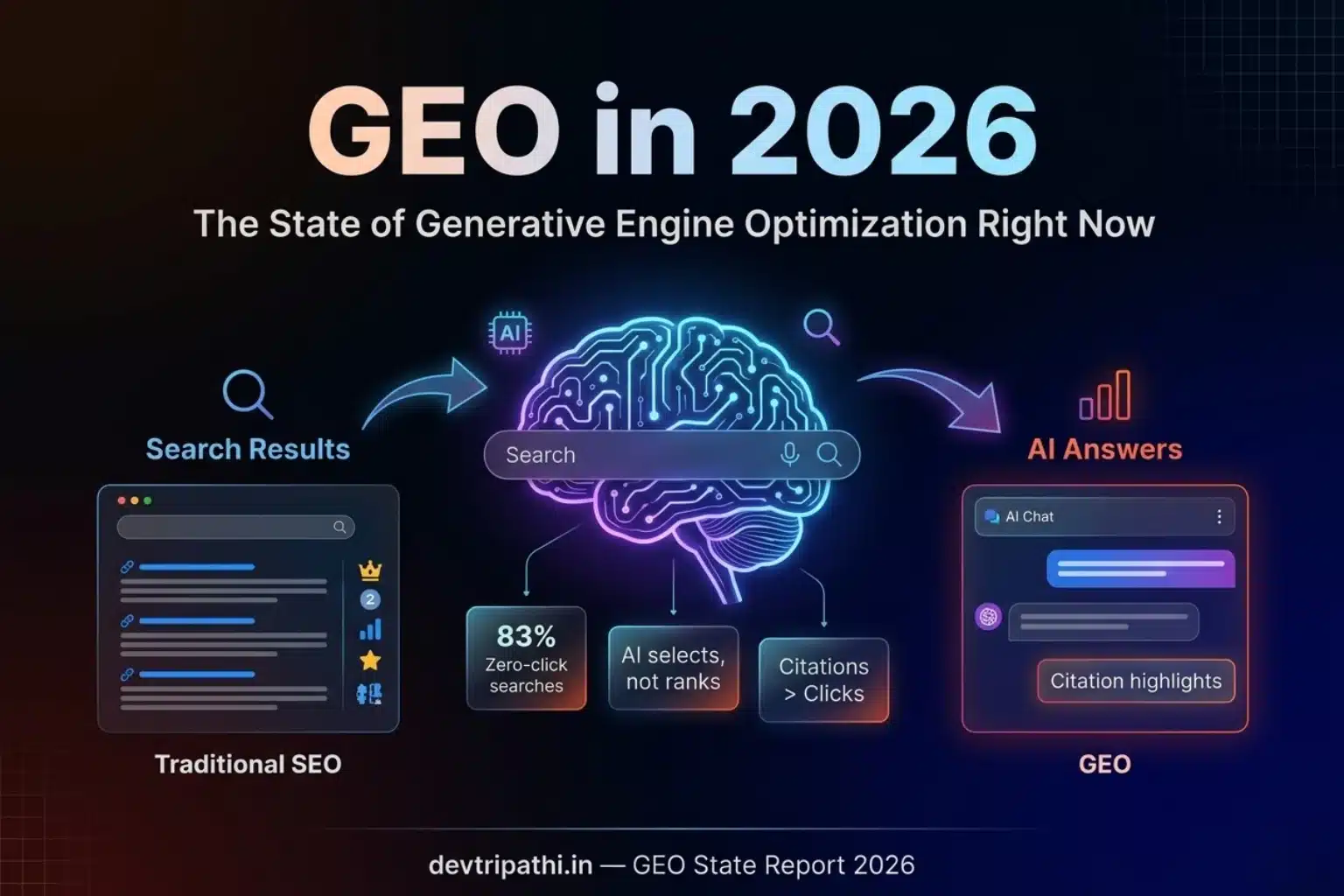
GEO 2026: The State of Generative Engine Optimization Right Now
22 March 2026
GEO Has Crossed the Tipping Point
For most of 2024 and early 2025, Generative Engine Optimization was a forward-looking strategy. Something you planned for. Something smart brands started experimenting with while cautiously maintaining their traditional SEO investments.
That era is over.
In Q1 2026, GEO is not experimental. It is operational. Google AI Overviews now appear in 25.11% of all searches. ChatGPT reaches 2.8 billion monthly active users globally. AI referral traffic has grown 527% year-over-year. Ninety-eight percent of CMOs are investing in Answer Engine Optimization. The brands sitting on the sidelines are no longer being cautious – they are falling behind.
But here is the thing: the data from Q1 2026 is also more nuanced and more useful than the early hype. We now have real benchmarks. Real citation patterns. Real conversion data. We know which content formats get cited most. We know how each platform behaves differently. We know what has changed since 2025 – and what has stayed stubbornly the same.
This article is a comprehensive state-of-the-market report on GEO in 2026. It pulls from Superlines, Conductor, Semrush, Ahrefs, BrightEdge, SE Ranking, and first-party AI monitoring data – to give you the clearest, most current picture of where GEO stands and where it is going. Whether you are just starting or looking to refine an existing strategy, what follows is the most useful single document you can read on GEO right now.
✪ Quick Summary – The State of GEO in Q1 2026: AI Overviews trigger on 25% of searches | ChatGPT holds 87% of AI referral traffic | AI-referred visitors convert 4.4x higher | 98% of CMOs now invest in AEO/GEO | GEO market valued at $848M, projected $33.7B by 2034 | 40-60% of cited sources rotate monthly – freshness is now mandatory |
1. The Numbers: Key GEO Benchmarks for Q1 2026
These are the verified benchmarks that define the state of GEO as of Q1 2026. Every number comes from a named source with a specific date – because vague claims are not useful for strategy decisions.
AI Search Adoption – How Big Is This Really?
2.8 Billion Source: ChatGPT monthly active users globally – AI Rank Lab, March 2026 |
- Google AI Overviews now appear in 25.11% of all Google searches – up 57% from Q4 2025 (Conductor, 2026 Benchmarks)
- 57.9% of question-based queries now display an AI Overview (Position Digital, 2026)
- AI Mode has 100 million monthly active users in the US and India combined (Semrush, 2026)
- Perplexity AI handles an estimated 1.2 to 1.5 billion queries per month with 370% year-over-year growth (SEOmator, 2026)
- 65% of informational queries are now resolved entirely within AI interfaces without a traditional click (EEATMinds, 2026)
Traffic and Conversion Reality
4.4x Higher Conversion Rate Source: AI-referred visitors vs standard organic visitors – Semrush, July 2025 |
- AI referral traffic now accounts for 1.08% of all website traffic across 10 major industries (Conductor, 2026)
- ChatGPT accounts for 87.4% of all AI referral traffic (Conductor, 2026)
- AI-referred sessions grew 527% year-over-year in Jan-May 2025 vs Jan-May 2024 (Search Engine Land, August 2025)
- AI visitors spend 68% more time on websites than traditional search visitors (SE Ranking, 2025)
- 93% of AI Mode searches end without a click – compared to 43% for AI Overviews (Semrush, September 2025)
- Being cited in AI Overviews increases organic CTR by 35% compared to non-cited brands on the same page (Seer Interactive/Dataslayer, 2025)
The Competitive Landscape
- 98% of CMOs are now investing in Answer Engine Optimization strategies (Conductor, 2026)
- GEO tools market has attracted $31M+ in venture funding with 20+ dedicated platforms at an industry average of $337/month (Conductor, Rankability)
- GEO market valued at $848 million in 2025, projected to reach $33.7 billion by 2034 at 50.5% CAGR (Superlines/Dimension Market Research)
- 47% of brands still lack any dedicated GEO strategy – the competitive gap is real (Digital Applied, 2026)
External reference: Superlines – The State of GEO in Q1 2026
2. How the AI Search Landscape Has Shifted Since 2025
GEO in early 2025 looked different to GEO in Q1 2026. If your strategy has not been updated, it may be optimizing for a landscape that no longer exists.
What Changed: Google AI Overviews
In 2025, Google AI Overviews were treated as an experimental feature requiring careful SEO management. In Q1 2026, they are standard infrastructure. BrightEdge data shows AI Overviews grew 58% from February 2025 to February 2026 and now trigger on 48% of all searches according to Google’s own data (ALM Corp, February 2026).
The citation overlap picture has also shifted dramatically. The oft-cited figure that ‘76% of AI Overview citations come from top-10 organic results’ has evolved: a 2026 seoClarity study found 99.5% of AI Overview sources are from top-10 results for that specific query, while BrightEdge reports 54.5% of AI Overview citations now match top organic URLs – up from 32% in 2024. This means SEO foundations are becoming more important for Google AI Overview visibility, not less.
What Changed: ChatGPT and Open AI Search
ChatGPT’s search capabilities expanded significantly through 2025. From basic Browse mode to fully integrated ChatGPT Search, the platform now competes directly with Google for informational queries. Critically, 28.3% of ChatGPT’s most cited pages have zero organic visibility on Google – meaning ChatGPT is building its own citation ecosystem separate from traditional SERP rankings (Position Digital, 2026).
This represents both a threat and an opportunity: you can earn ChatGPT citations without ranking on Google, but you need to understand ChatGPT’s citation preferences specifically – which differ significantly from both Google AI Overviews and Perplexity.
What Changed: Citation Volatility
40-60% Monthly Citation Rotation Source: Cited sources in AI responses rotate this frequently – Semrush AI Visibility Index, 2026 |
Perhaps the most important shift from 2025 to 2026 is the recognition that AI citations are not permanent positions. Semrush’s AI Visibility Index shows 40 to 60% of cited sources rotate every month. AirOps data confirms that AI Overview content changes roughly 70% of the time for the same query – and when the answer updates, almost half of the citations are replaced.
This fundamentally changes GEO strategy. A one-time optimization effort is not sufficient. GEO in 2026 requires ongoing content monitoring, regular freshness updates, and continuous citation tracking – more like a performance marketing channel than a set-it-and-forget-it SEO task.
→ Related on devtripathi.in: how AI Mode is changing search behaviour
3. Platform-by-Platform State of Play in 2026
Google AI Overviews – Growing Faster Than Anyone Expected
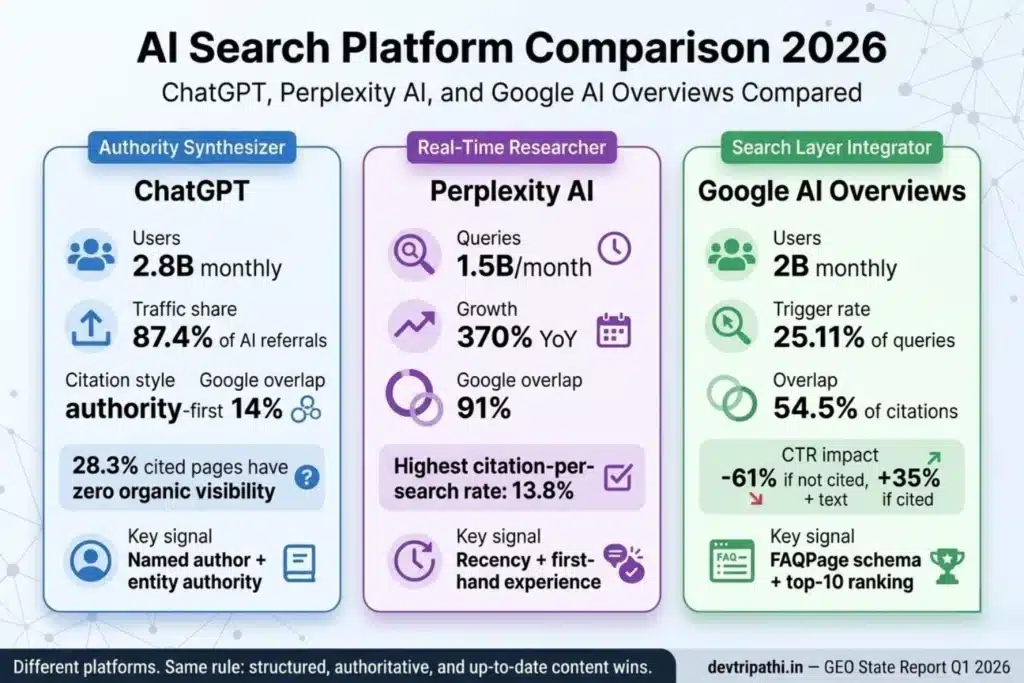
Google AI Overviews are now the most important AI search surface for most brands. They appear on 25.11% of all searches (Conductor) and according to Google’s own data, closer to 48-50% of queries (BrightEdge/ALM Corp). Over 2 billion monthly users engage with them globally (SEOmator, 2026).
The CTR impact is substantial and cuts both ways. AI Overviews reduce CTR by 61% for organic results – from 1.76% to just 0.61% (Seer Interactive, 2025). But being the cited source inside the AI Overview increases your CTR by 35% compared to non-cited brands on the same page. This is why the goal of GEO is not just to avoid being displaced – it is to become the cited source.
ChatGPT – The Traffic Driver, But Citation Patterns Are Unique
ChatGPT drives 87.4% of all AI referral traffic to websites, making it the primary platform for raw traffic generation from AI search. But its citation patterns are strikingly different from Google. Only 14% of URLs cited by ChatGPT rank in Google’s top 10 for the same query. 80% of ChatGPT citations do not rank in Google’s top 100 at all (Ahrefs, August 2025).
This means ChatGPT is building a citation ecosystem based primarily on content structure, authority signals, and semantic relevance – not traditional Google rankings. Wikipedia, Reddit, and authoritative industry sources dominate ChatGPT citations. For brands, this creates a genuine opportunity: well-structured, authoritative content can earn ChatGPT citations even without strong Google rankings.
Perplexity – High Citation Quality, Strong Google Correlation
Perplexity handles the most research-intensive queries and has the highest citation-per-search rate – 13.8% versus ChatGPT’s 0.7% (Superlines, Q1 2026). Its users are decision-makers, researchers, and high-intent information seekers. Perplexity has a 91% correlation with Google’s top-10 results for citations – meaning strong SEO directly translates to Perplexity visibility more than any other platform.
Perplexity’s fastest-growing positioning as an AI search engine is backed by 370% year-over-year growth. As we covered in our deep dive on how AI Mode is changing search behaviour, platforms like Perplexity are increasingly the starting point for complex research queries – making it a priority platform for B2B and high-consideration consumer brands.
→ Related: measuring your GEO performance
4. What Content Is Actually Getting Cited in 2026
This is the question every GEO practitioner wants answered: not what should theoretically work, but what is actually getting cited right now, validated through real monitoring data.
Content Format – What Gets Cited Most
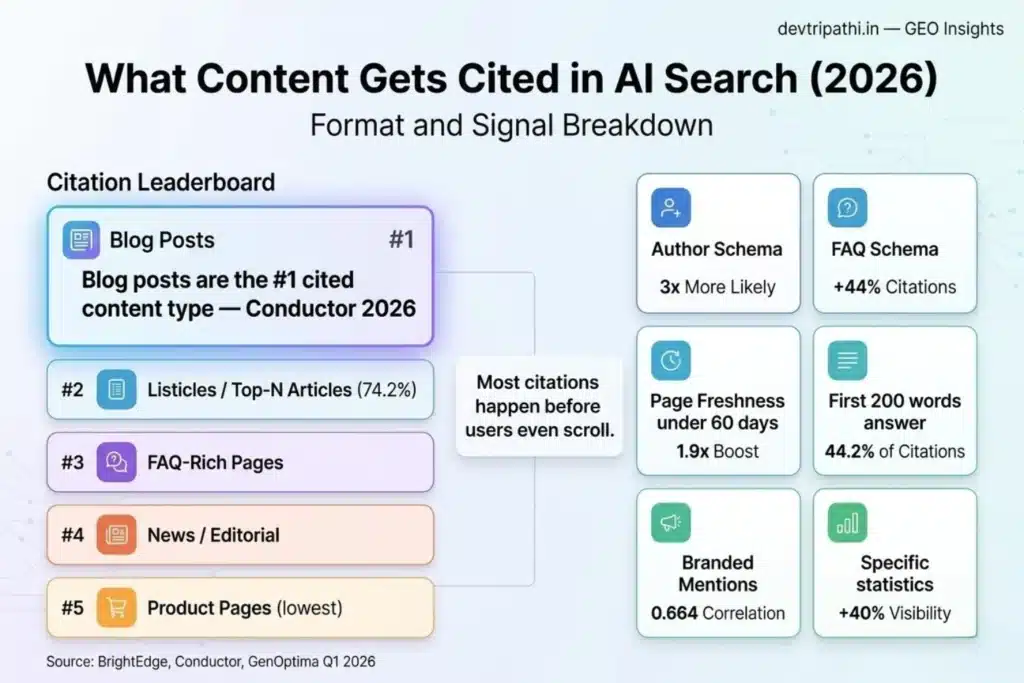
- Blog content is the #1 page type cited in AI Overviews – outperforming product pages, service pages, and landing pages (Conductor, 2026)
- 74.2% of all AI citations come from structured list-format content – ‘Top N’ articles with numbered entries (GenOptima first-party data, Q1 2026)
- Pages with structured comparison data, specific statistics, and transparent methodology get cited most frequently (Superlines, Q1 2026)
- 53.4% of cited pages are under 1,000 words – debunking the assumption that longer content is always better (Ahrefs/SE Ranking analysis)
- Brand service pages, standalone case studies, and pure methodology pages receive zero AI citations in monitored data (GenOptima, 2026)
Content Signals That Drive Citation
- 44.2% of all LLM citations are pulled from the first 30% of the article text – front-loading answers is now a technical requirement (Growth Memo, 2026)
- Pages with structured FAQ blocks saw 44% increase in AI search citations after implementation (BrightEdge, 2026)
- Websites with author schema are 3x more likely to appear in AI answers (BrightEdge)
- Pages updated within 60 days are 1.9x more likely to appear in AI answers (BrightEdge)
- Branded web mentions have the strongest correlation (0.664) with AI Overview appearances – much higher than backlinks (0.218) (Position Digital, 2026)
- Sites implementing structured data and FAQ blocks saw 44% increase in AI search citations (BrightEdge)
What Freshness Really Means in 2026
Content freshness has moved from a best practice to a citation requirement. BrightEdge data shows pages updated within 60 days are 1.9x more likely to appear in AI answers. Perplexity’s citation data shows 76.4% of its highly cited pages were updated within 30 days (Security Boulevard, 2026).
The practical implication: a one-time optimized article that is not updated will gradually lose AI citations over weeks and months – even if the underlying information is still accurate. Build quarterly refresh cycles into your editorial calendar for all GEO-priority content. When refreshing, update the statistics with current-year sources, add new FAQ questions based on recent user queries, and update the visible ‘Last updated’ timestamp.
→ Related: refreshing old content for better rankings
5. The Citation vs Mention Distinction – Why It Matters Now
One of the most important practical distinctions that has emerged in GEO measurement in 2026 is the difference between a mention and a citation. Understanding this difference changes how you evaluate your GEO performance.
What Is the Difference?
- A mention is when an AI says your brand name in its response – ‘According to Dev Tripathi…’ – without providing a clickable link to your content
- A citation is when an AI provides an inline clickable link to your specific URL as a supporting source for its answer
ClickRank explains the strategic significance: ‘A mention is good. A citation is better. A citation proves that the AI doesn’t just know your content exists – it trusts it enough to vouch for it to the user.’ Mentions build brand awareness. Citations build measurable referral traffic and conversion opportunities.
Why This Matters for Your GEO Strategy
Most current GEO monitoring tools now distinguish between mentions and citations, and the data is revealing. Platforms like Ahrefs Brand Radar track over 260 million monthly prompts and distinguish between content appearing in the main AI summary (highest value), appearing as a source link (citation), or being named without a link (mention).
For your content strategy, the implication is that the same content can deliver very different GEO value depending on how it is cited. Structured content with clear, extractable facts earns inline citations. Brand-level authority without specific extractable content earns mentions. The tactics that convert mentions to citations are exactly those covered in this series: structured FAQ sections, specific data with attribution, and question-format headings.
“A citation is the new backlink. In a GEO world, you must monitor how often AI engines like Perplexity, ChatGPT, and Google AI Overviews link to your content as a supporting source. Unlike traditional rankings, citations prove that the AI doesn’t just know your content exists – it trusts it enough to vouch for it.” – ClickRank.ai – GEO: The Ultimate 2026 Guide to Generative Engine SEO |
6. The Top 5 GEO Trends Shaping Strategy in 2026
These are the five trends identified across the most current GEO research and monitoring data – the shifts that are actively changing what top-performing brands are doing right now.
Trend 1: Topic Targeting Is Replacing Keyword Targeting
One of the biggest GEO shifts from SEO is the move from keyword targeting to topic targeting. As SEO.com’s 2026 GEO trends analysis explains: ‘Keywords don’t matter as much in generative engines. While they can help provide context, it is the topic and subsequent information covered that is being considered.’ AI systems evaluate whether your content comprehensively covers a topic – not whether it contains a specific keyword at a specific density.
Brands winning in GEO in 2026 are building comprehensive topic clusters – 20+ interconnected articles covering every angle of their core subject – rather than chasing individual keyword rankings. As we covered in our guide on optimizing your content for AI Mode, topical authority is the GEO equivalent of domain authority.
Trend 2: Brand Entity Optimization Is Becoming Central
Since generative engines do not use traditional rankings, brand entity signals are becoming the primary trust mechanism. Branded web mentions have the strongest correlation (0.664) with AI Overview appearances – significantly higher than backlinks at 0.218 (Position Digital, 2026). The top five domains cited in all AI responses – Wikipedia, YouTube, Reddit, Google Properties, and Amazon – account for 38% of all AI citations (The Digital Bloom, 2025).
For brands, this means building your entity presence across the web: guest blogging, thought leadership articles in industry publications, building genuine Reddit and Quora community presence, and ensuring your Wikipedia page (if applicable) and Google Knowledge Panel are accurate and comprehensive.
Trend 3: Content Freshness as a Competitive Weapon
With 40 to 60% of cited sources rotating monthly, brands that have built consistent refresh workflows are gaining sustainable citation advantages over competitors publishing once and leaving content static. GenOptima’s first-party monitoring data recommends 7-14 day content freshness cycles for high-priority GEO pages – more aggressive than most traditional SEO refresh schedules.
Brands implementing weekly or bi-weekly content updates on their top-performing GEO pages consistently maintain citation positions that static-content competitors lose within two to three months. This is the operational reality of GEO in 2026 – it is a continuous performance channel, not a project.
Trend 4: Multi-Platform GEO Is Replacing Single-Platform Optimization
In 2025, many brands focused GEO efforts almost exclusively on Google AI Overviews. In 2026, the most sophisticated brands are optimizing for ChatGPT, Perplexity, Gemini, and Microsoft Copilot simultaneously – because the citation patterns across these platforms are different enough that single-platform optimization leaves significant visibility on the table.
The practical shift: each major piece of content should be evaluated against the citation criteria of each platform. For ChatGPT, that means encyclopedic structure and named author authority. For Perplexity, it means recency signals and first-hand specificity. For Google AI Overviews, it means FAQPage schema and top-10 organic alignment. As we analyzed in our deep dive on Gemini 2.5 and Deep Search optimization, even within Google’s ecosystem, different AI products have different citation biases.
Trend 5: AI Search Performance Tracking Is Becoming a Standard Practice
In Q1 2026, 98% of CMOs are investing in AEO strategies (Conductor). The GEO tools market has grown to 20+ dedicated platforms with an average cost of $337/month. Tools like AthenaHQ (founded by ex-Google Search and DeepMind engineers), Ahrefs Brand Radar, Semrush AI Visibility Toolkit, OmniSEO, Otterly.ai, and Rankscale now track AI citation share, citation sentiment, and zero-click displacement across all major platforms.
For smaller teams without enterprise budgets, the free starting point is Google Search Console monitoring combined with manual monthly citation testing across ChatGPT, Perplexity, and Google AI Overviews for your top 10 target queries.
→ Related: measuring your GEO performance in Search Console
7. What the Winning Brands Are Doing Differently in 2026
The gap between brands winning at GEO and those struggling is increasingly clear in Q1 2026. Here is what the data and case studies show separates the top performers.
Publishing Velocity With Quality
Enrich Labs’ analysis of top-performing GEO brands found that those publishing 10 to 20 high-quality articles per month in a focused topic cluster build citation authority significantly faster than brands publishing two to three articles per month. Volume at quality matters – the topical depth signals compound over time as AI systems recognize your domain as a comprehensive authority on your core subject.
This does not mean writing thin, AI-generated filler content at scale. The GenOptima playbook is explicit: content without first-hand data, expert quotes, or original research earns zero citations regardless of volume. The winning formula is structured, data-rich content published consistently within a tight topical cluster.
Triple Schema Stacking
GenOptima’s first-party monitoring data from February-March 2026 shows that pages deploying triple JSON-LD schema stacking – Article + ItemList + FAQPage in a single JSON-LD block – receive 1.8x more citations than pages with Article schema alone. This represents a significant structural advantage that requires minimal content changes but delivers measurable citation improvements.
For WordPress users, Rank Math Pro enables all three schema types simultaneously. Implement Article schema (with author, date, and organization), FAQPage schema on all FAQ sections, and where applicable, ItemList schema for list-format content. As we covered in our guide on essential SEO fundamentals, schema markup is no longer optional for competitive content.
Original Data and First-Hand Research
The most consistently cited content in Q1 2026 contains something AI systems cannot get elsewhere: original research, survey data, first-hand test results, or proprietary analysis. EEATMinds notes: ‘Information Gain – unique statistics, original research, or expert insight unavailable elsewhere – is the primary differentiator between content that gets cited and content that does not.’
For bloggers and smaller brands, ‘original research’ does not require a $50,000 survey. It means: documenting your own test results, publishing your specific experience with numbers, sharing proprietary client data (anonymized), or conducting a small-scale survey (even 50 responses produces citable data when the methodology is transparent).
✓ The Single Most Impactful Change for Most Brands in Q1 2026: Adding a quick answer block in the first 200 words of content. GenOptima data shows first-200-word quick answer blocks – numbered lists or direct answers without images or links that break extraction – generate the highest citation rates of any content element. This single structural change can be applied to existing content in minutes. |
→ Related: a structured long-term SEO plan
8. The Biggest GEO Mistakes Brands Are Still Making in 2026
Mistake 1: Treating GEO as a One-Time Project
The most common and most damaging GEO mistake in 2026 is treating it as a project to complete rather than a channel to manage. With 40 to 60% of cited sources rotating monthly, static content loses AI citations within weeks. GEO requires the same ongoing attention as paid search – continuous monitoring, regular updates, and responsive content creation based on citation data.
Mistake 2: Optimizing Only for Google AI Overviews
Google AI Overviews get the most attention because they are the most visible – but ChatGPT drives 87.4% of AI referral traffic and uses completely different citation criteria. Brands that optimize only for Google AI Overviews miss the majority of AI-driven traffic opportunity. Build a multi-platform strategy that addresses the distinct signals of each major AI search platform.
Mistake 3: Ignoring the Citation Volatility Risk
Many brands celebrate their first AI Overview citation and move on. They do not realise that 70% of the time, when a query’s AI answer updates, the citations change – and they may not be included in the next version. The winning brands track citation frequency over time, not just whether they appeared once.
Mistake 4: Generic, Unattributed Content
Branded web mentions correlate at 0.664 with AI visibility. Backlinks correlate at 0.218. This data from Position Digital (2026) confirms that brand entity authority – being mentioned and cited across the web by other sources – is significantly more powerful than link acquisition for GEO. Yet many brands continue investing primarily in link building while neglecting brand mention campaigns, PR outreach, and community participation on Reddit and Quora.
Mistake 5: Not Checking for AI Crawler Blocks
▲ Still Happening in Q1 2026: A significant number of sites running Cloudflare are still blocking AI crawlers by default – GPTBot, PerplexityBot, Google-Extended, and ClaudeBot. If these crawlers cannot access your content, no amount of GEO optimization has any effect. Check your robots.txt and Cloudflare Bot Management settings before any other GEO activity. |
→ Related: critical SEO mistakes that hurt rankings
9. GEO Measurement in 2026 – Tools, Metrics, and KPIs
The measurement infrastructure for GEO has matured significantly since 2025. Here is the complete picture of how to track GEO performance in Q1 2026.
The Core GEO KPIs for 2026
KPI | What It Measures and Why |
AI Citation Share | How often your brand is cited vs competitors in AI answers for your target queries – the primary GEO success metric |
Citation Sentiment | How favourably AI systems describe your brand when they cite it – positive vs neutral vs negative framing |
Mention vs Citation Ratio | What % of your AI appearances include a clickable link vs just a name mention |
Zero-Click Displacement | Traffic lost or gained from AI answer formats replacing traditional clicks |
AI Referral Sessions | Direct visits from chatgpt.com, perplexity.ai, copilot.microsoft.com tracked in GA4 |
AI Referral Conversion Rate | Conversion rate of AI-referred visitors – should be 4.4x+ versus organic average |
GSC Impression Growth | Rising impressions for question-based queries in GSC – indirect AI Overview indicator |
Content Freshness Index | % of GEO-priority pages updated within 60 days – freshness requirement for citation maintenance |
Tools for GEO Tracking in 2026
- AthenaHQ – comprehensive AI citation monitoring across ChatGPT, Perplexity, Claude, Gemini, and more
- Ahrefs Brand Radar – tracks 260 million monthly prompts, shows citation positions and gaps
- Semrush AI Visibility Toolkit – monitors Share of Voice across AI platforms
- SE Ranking AI Overviews tracker – specific to Google AI Overview citation monitoring
- OmniSEO / Otterly.ai / Rankscale – dedicated GEO tracking platforms
- Google Search Console – free, reliable for indirect AIO indicators (impression patterns)
- GA4 with AI referral segment – track chatgpt.com, perplexity.ai, copilot.microsoft.com as referral sources
The Free GEO Measurement Stack (No Budget Required)
- Step 1: Set up GA4 custom segment for AI referrers – add chatgpt.com, perplexity.ai, copilot.microsoft.com, gemini.google.com as referral sources
- Step 2: Monitor GSC weekly – watch impressions for question-based queries; rising impressions with flat CTR indicates AI Overview appearances
- Step 3: Manual monthly citation audit – search your top 10 target queries in ChatGPT, Perplexity, and Google AI Overviews; document citation appearances in a spreadsheet
- Step 4: Track branded search volume in GSC – increasing branded searches indicate growing AI citation awareness
- Step 5: Set up Google Alerts for your brand + domain – monitor mentions across the web that build entity authority
Superlines – 60+ AI Search Statistics 2026
- What Is GEO? The Complete 2026 Guide →
- GEO vs SEO: What’s the Difference and Why You Need Both →
- How Generative Engine Optimization Works: A Deep Dive →
- Google AI Mode: Transforming Search and SEO Strategies in 2025 →
- AI Mode vs Traditional Search: Comparing User Experiences →
- Understanding AI Mode Analytics: Measuring GEO Success →
- Optimizing for AI Mode: New SEO Strategies →
- The Impact of AI Mode on Website Traffic →
- Deep Search and Gemini 2.5: Enhancing Content Visibility →
- Google December 2025 Core Update Analysis →
- Why a Structured SEO Plan Is Essential for Long-Term Success →
- How to Update Old Content for SEO →
- 20 Common SEO Mistakes You Must Avoid →
11. Frequently Asked Questions About GEO in 2026
What is conversational content in SEO? ▼
Conversational content is writing that mirrors how people naturally speak and ask questions – using plain language, question-based headings, direct answers at the start of each section, active voice, and a second-person address. AI search engines are trained on natural human language, which means they can parse and cite conversational writing far more reliably than formal, keyword-stuffed text.
Why do AI search engines prefer conversational writing? ▼
Large language models like Gemini, GPT-4, and Perplexity’s engine are trained primarily on human conversation and natural writing. When your content mirrors those patterns – question heading, direct answer, plain explanation – the AI can extract a clean, trustworthy response without ambiguity. Formal, jargon-heavy writing forces more interpretive work and is more likely to be passed over in favour of a cleaner source.
Is conversational content actually worth the effort in 2026? ▼
Yes – and the data makes a strong case. Google AI Overviews now appear in 25.11% of all searches, and 99.5% of their cited sources come from pages that are already well-structured and readable. Pages with question-based headings are 2.8x more likely to earn AI citations. Conversational content is not a trend – it is the structural requirement for visibility in both traditional and AI search in 2026.
Does conversational content work for technical or B2B niches? ▼
It works better in technical niches than anywhere else – because the competition sets such a low bar. Most B2B and technical content is still jargon-dense and formally written. A clear, plain-language explanation of a complex topic immediately stands out. B2B companies using conversational, voice-optimised content have reported up to a 21% conversion improvement. Simplifying your language does not reduce your expertise – it makes it accessible.
How is conversational content different from regular blog writing? ▼
Traditional SEO blog writing was optimised for keyword-matching: exact phrases placed in headings and opening paragraphs. Conversational content is optimised for intent and natural language understanding. The key differences are question headings vs. topic-label headings, direct answers first vs. preamble first, second-person vs. passive voice, and semantic keyword variety vs. exact-match repetition.
How do I write conversationally without sounding unprofessional? ▼
Write the way a knowledgeable colleague would explain something over a meeting – not the way a textbook would describe it. Use short sentences. Say ‘you’ instead of ‘the user’. Define technical terms in the same sentence they appear. Read every paragraph aloud: if you stumble or slow down, rewrite it. Conversational writing is harder than formal writing – it requires real understanding of your subject, not just vocabulary.
What does conversational content actually look like – can you give a real example? ▼
Here is the difference in practice. Formal: ‘Content marketing initiatives enable organisations to derive substantial benefits in terms of organic search visibility.’ Conversational: ‘A blog post you publish today can bring in qualified traffic for years – and unlike paid ads, it does not stop working the moment you stop paying.’ Same information. The second version is what AI systems extract and cite, and what human readers actually read to the end.
How long should a conversational blog post be to rank well? ▼
Voice search pages that rank well average 2,312 words. But for AI citation purposes, depth matters more than length – a focused 1,600-word post that comprehensively answers its question will outperform a padded 3,200-word post. Interestingly, 53.4% of AI-cited pages are under 1,000 words, which suggests that focused, well-structured shorter content often outperforms long-form in AI citation. Write until the question is genuinely answered, then stop.
How do I know if my writing is conversational enough? ▼
The fastest test: read it aloud. If you pause, restart, or mentally untangle a sentence, rewrite it. If it sounds like something you would genuinely say to a colleague, it is conversational. Formally, aim for a Flesch Reading Ease score above 60 (approximately Grade 9 reading level). You can check this in Hemingway Editor or in the readability section of tools like Yoast or Rank Math.
Do I need to rewrite my entire blog to use conversational content? ▼
No – start with your top five most-visited posts and apply three core changes: rewrite H2 headings as questions, add a direct answer in the first sentence of each section, and add a conversational FAQ at the end. These changes alone will improve both human readability and AI citation potential without requiring a full rewrite of every post.
How quickly will I see results after switching to conversational content? ▼
For AI citation improvements, most sites begin seeing changes in Google Search Console impressions within 30 to 60 days of updating key pages. Voice search visibility can shift faster – sometimes within two to three weeks for pages that gain featured snippet placement. Traditional organic ranking changes take longer, typically 60 to 90 days, because they depend on recrawling and reindexing timelines.
What tools can help me write more conversationally? ▼
Hemingway Editor highlights long sentences and passive voice in real time – it is the most direct tool for conversational writing audits. Yoast and Rank Math both include readability scoring inside WordPress. AnswerThePublic and AlsoAsked.com generate real user questions for heading inspiration. For checking your Flesch Reading Ease score, both Hemingway and the Yoast SEO plugin show it automatically as you write.
How do I find the right questions to use as headings? ▼
Use four sources in combination: Google’s People Also Ask box, AlsoAsked.com (maps the full question tree around any topic), AnswerThePublic (shows question volume and phrasing patterns), and Reddit threads in your niche. Your own reader emails and blog comments are also a goldmine – real questions from real readers are always the most valuable heading source you have.
Is conversational content the same as Answer Engine Optimization (AEO)? ▼
Conversational content is the writing foundation of AEO – but AEO also includes technical elements like schema markup, page speed, structured data, and topical authority signals. Think of conversational writing as the visible layer of your AEO strategy. The full AEO stack includes your writing style, your FAQ sections with schema markup, your author credentials, and your internal linking structure.
Can small blogs actually compete with big authority sites using conversational content? ▼
Yes – and research specifically confirms this. SE Ranking’s analysis found that for smaller domains, content depth and quality have roughly 65% more relative impact on AI citations than they do for large authority domains. A focused, well-written 2,500-word post from a niche specialist can consistently outperform a thin page from a high-authority generalist site. Conversational content is one of the clearest paths for independent bloggers to compete on quality rather than domain authority.
Does conversational content help with Google AI Overviews specifically? ▼
Yes – directly. Google AI Overviews now appear in 25.11% of all searches, and 99.5% of their cited sources come from pages already ranking in top-10 organic results. Pages with question-based headings and direct answer blocks are 2.8x more likely to be cited in AI Overviews. Adding a structured FAQ section with FAQPage schema markup has been shown to increase AI citation rates by 44% (BrightEdge, 2025).
What is an answer island and why does every blog section need one? ▼
An answer island is a self-contained passage that directly answers a specific question without requiring surrounding context to make sense. It is the structural unit AI systems extract when generating citations. Every section of your blog should contain at least one answer island – typically the first 50-75 words below each heading. When your content is built from answer islands, AI systems can reliably pull clean, accurate citations from your page rather than approximating or skipping it.
Should I use conversational content for YouTube scripts and social media too? ▼
Absolutely – and it works even better on video and social because those formats are inherently spoken. A YouTube script written conversationally keeps viewer retention higher because it sounds like a person talking, not a document being read. For social media, conversational copy consistently outperforms formal copy in engagement and click-through rates. The same principles apply: direct opening, second-person address, short sentences, and a clear answer before any build-up.
Does AI-generated content count as conversational content? ▼
No – and this is one of the most common misconceptions. AI writing tools consistently produce the opposite of conversational content: hedge-heavy, passive-voice, jargon-dense prose. Phrases like ‘In today’s rapidly evolving digital landscape’ are hallmarks of unedited AI output. Real conversational content has a specific human voice, original examples, and a genuine point of view. You can use AI as a drafting tool, but the conversational quality only comes from human editing and rewriting.
How does conversational content affect bounce rate and time on page? ▼
Positively – and measurably. Conversational writing reduces cognitive load, which keeps readers on the page longer. Short paragraphs, clear headings, and direct answers all reduce the friction that causes readers to leave. Sites that shift to conversational content typically report improvements in average session duration and pages-per-session alongside their search visibility gains – because the same qualities that help AI parse your content also make it more enjoyable for humans to read.
Is conversational content better for mobile and voice search users? ▼
Significantly so. Over 60% of searches now happen on mobile devices, and 40% of all online searches happen through voice interfaces (Building Brands Marketing, 2025). Voice search queries average 29 words – far longer and more conversational than typed keywords. Short paragraphs, question headings, and direct answers are optimised for how mobile users actually scroll and read, and they exactly match the natural phrasing patterns that voice search captures.
What is the role of conversational content in a full GEO strategy? ▼
Conversational content is the writing layer of GEO – but GEO also requires schema markup, topical authority through content clusters, E-E-A-T signals, and content freshness. Think of it as five stacked layers: conversational writing makes your content parseable, schema markup signals its structure to AI, topical clusters prove your authority, E-E-A-T validates the human expertise behind it, and regular updates keep it within the AI citation window. Start with conversational writing because it affects every piece of content you produce.
How do I update old blog posts to be more conversational without starting from scratch? ▼
Follow this five-step audit: first, rewrite every H2 and H3 heading as a full question. Second, add a direct 50-75 word answer in the first sentence below each heading. Third, break any paragraph longer than four sentences into two shorter ones. Fourth, flip passive-voice sentences to active voice throughout. Fifth, add a 5-7 question FAQ section at the end with FAQPage schema. This process takes 30-45 minutes per post and produces measurable improvements within 30-60 days.
How do I measure whether my conversational content is actually getting cited by AI? ▼
Start with free methods: search your target keywords in incognito mode monthly and check whether your content appears in AI Overview citation links. In Google Search Console, rising impressions with flat CTR is a strong signal of AI Overview appearances. For systematic tracking, tools like Ahrefs Brand Radar, Semrush AI Visibility, and AthenaHQ provide automated citation monitoring across ChatGPT, Perplexity, and Google AI Overviews. Set up a GA4 segment filtering referral traffic from ChatGPT and Perplexity to track AI-referred sessions directly.
What is the competitive window for conversational content and GEO in 2026? ▼
The window is real but narrowing. 47% of brands still have no dedicated GEO strategy (Digital Applied, 2026), meaning most competitors have not started. But early movers are building citation authority and topical depth that becomes harder to displace over time. Citation positions are beginning to concentrate around first movers in many niches. The practical advantage of starting now: establishing topical authority before your competitors do, before dominant citation positions calcify around the brands that moved first.
Conclusion: The State of GEO Is Now – Not Coming Soon
The numbers from Q1 2026 tell a clear story. AI search has crossed the threshold from emerging channel to core infrastructure. Google AI Overviews appear on one in four searches. ChatGPT is the fourth most visited website on the internet. AI-referred visitors convert at more than four times the rate of traditional organic visitors. Ninety-eight percent of CMOs are already investing in this space.
The state of GEO in 2026 is not that it has replaced SEO. It is that it has added a second visibility channel that now runs alongside traditional search – with its own citation patterns, its own success metrics, and its own optimization requirements. Brands that understand this are building strategies that win in both environments simultaneously. Brands that do not are watching their informational query visibility erode while their rankings hold.
The competitive window is still open. Most of your competitors have not built a comprehensive GEO strategy. The brands that establish topical authority, citation velocity, and content freshness cycles now will be the ones the AI quotes next year – and the year after that.
The state of GEO is not coming soon. It is now. The only question is whether you are building for it.

Devyansh Tripathi
I’m Devyansh Tripathi, an SEO strategist and digital growth expert, helps businesses and individuals rank higher and drive organic traffic. Through DevTripathi., he shares cutting-edge SEO insights, content strategies, and marketing hacks. Passionate about digital success, he’s on a mission to make SEO simple, effective, and result-driven!
Posts
- What Is EEAT and How It Connects to GEO in 2026 (Blogger’s Guide)
- How to Make Your Blog Appear in Google AI Overviews
- Traditional SEO Is Not Dead – But It Needs GEO to Survive
- What Is an AI Overview and How Does It Affect Your Blog Traffic?
- 10 GEO Terms Every Blogger Must Know in 2026 – Plain English Glossary
Latest News
Text Widget
Empowering brands with insights, strategies, and stories that drive digital growth.