
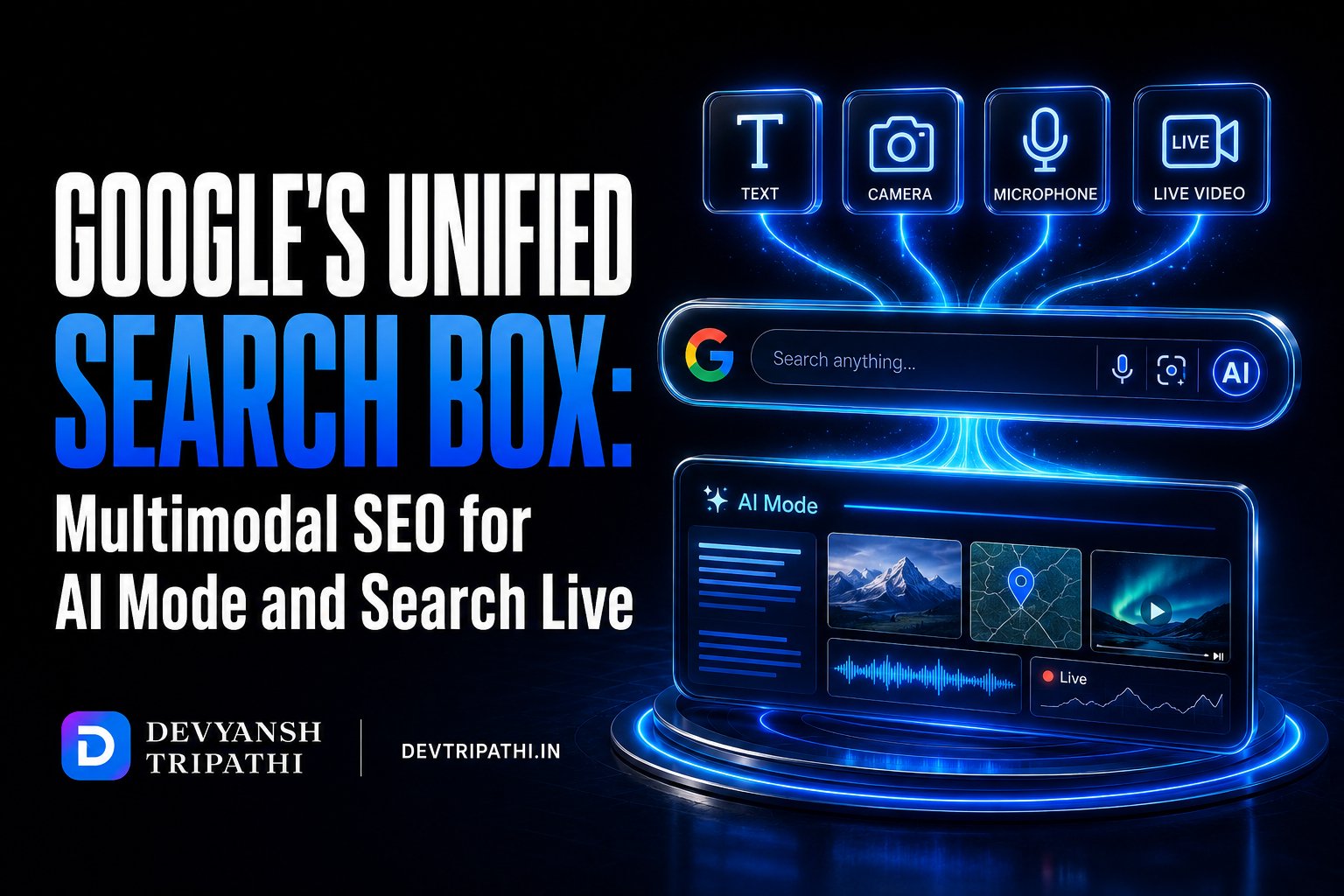
Google’s Unified Search Box: Multimodal SEO for AI Mode and Search Live
27 July 2026
Multimodal search optimization entering the second half of 2026 must respond to what Google itself describes as the biggest search upgrade in more than 25 years: a redesigned Search box, announced at Google I/O 2026, that dynamically expands as users type, accepts text, images, files, videos, and Chrome tabs as inputs within a single unified query, and critically, reasons across all of those inputs together rather than treating an image and accompanying text as two separate, independent lookups, running on the Gemini 3.5 Flash model and rolling out on desktop and mobile across every country and language where AI Mode is available.
This Cycle 4 guide covers multimodal search optimization built on this structural redesign and the newest supporting behavioral data: the complete architecture of the unified search box and why “reasoning together” rather than processing inputs separately fundamentally changes optimization requirements, the specific AI Mode multimodal scale data confirming more than one in six AI Mode searches are now non-text and image-input searches growing more than 40% month over month, the new cursor-tracking attention data revealing how AI Overview presence changes user behavior even before any click occurs, the emerging Search Live real-time camera interaction feature and its optimization implications, and the practical five-element implementation checklist for ensuring text, image, and structured data assets are all machine-readable enough to be reasoned over together rather than evaluated in isolation.
Google Now Reasons Across Your Text, Images, and Video Together in a Single Query. Is Your Content Ready?
Get a complete multimodal search audit covering your readiness for Google's unified I/O 2026 Search box, image and structured data completeness for combined-input reasoning, AI Mode multimodal citation testing, and Search Live real-time interaction readiness for the specific surfaces where your audience is most active.
Get My Multimodal Search AuditThe Unified Search Box: Reasoning Together, Not Separately
The most structurally significant multimodal search development of 2026 is Google’s redesigned Search box, announced at Google I/O 2026 as the biggest upgrade to Search in over 25 years. The interface dynamically expands as users type, offers AI-powered suggestions beyond traditional autocomplete, and accepts text, images, files, videos, and Chrome tabs as inputs within a single, unified query, running on the Gemini 3.5 Flash model and rolling out on desktop and mobile in every country and language where AI Mode is currently available.
The critical technical distinction that reshapes optimization strategy is how the system processes these combined inputs: it reasons across those inputs together rather than treating a photograph and its accompanying typed question as two separate, independently evaluated lookups. This means a user photographing a product and asking “is this a good value compared to alternatives” is not generating two isolated queries, an image search and a text search, that happen to be submitted at the same time. It is generating a single, unified reasoning process where the visual content and the textual question inform and constrain each other simultaneously, requiring optimization that ensures both the visual and textual signals a brand controls are coherent and mutually reinforcing rather than optimized independently as separate channels.
1 in 6AI Mode searches are now multimodal, spanning voice, image, video, and Live Search (Google, May 2026)
40%+month-over-month growth in image-input searches since AI Mode's launch
44%of the time users keep their cursor still when an AI Overview is present, vs 29% without one
3xlonger average AI Mode query length compared to a traditional search query (Google, May 2026)
What the Unified Box Means for Content Architecture
Capconvert’s practical guidance for optimizing content specifically for the Google I/O 2026 unified Search box centers on four coordinated requirements that reflect the reasoning-together architecture described above.
Requirement 1
Tie Product Images to Complete Structured Product Data
For shopping and visual-match resolution specifically, product images must be tied to complete Product schema so that when the unified box reasons over a photographed item alongside a typed question, it has access to the structured pricing, availability, and specification data needed to generate an accurate, useful combined response rather than relying on visual matching alone.
Requirement 2
Reinforce Entity Clarity Across Organization, Product, and Person Schema
Organization, Product, and Person schema combined with complete sameAs links ensure that when the unified system reasons across a combined image-and-text query, it can confidently resolve exactly which brand, product, or individual entity is being referenced, connecting directly to the entity home framework covered in our Knowledge Graph Optimization Cycle 4 guide.
Requirement 3
Place Every Visual Asset in Topically Relevant Context
Every image or video asset should be surrounded by supporting copy that explicitly describes what the visual shows, providing the textual anchor that helps the combined-reasoning system correctly interpret and cite the visual content alongside its surrounding context rather than evaluating the image in isolation from the page's broader topical relevance.
Requirement 4
Re-Audit Quarterly as Multimodal Share Continues Rising
Because the multimodal share of queries is rising and the surfaces keep expanding, with image-input searches growing more than 40% month over month, a one-time multimodal optimization implementation is insufficient. Quarterly re-auditing ensures continued alignment as Google's specific multimodal features and reasoning capabilities continue to evolve at their current rapid pace.
The Cursor-Tracking Attention Discovery
One of the most novel behavioral findings in 2026 multimodal and AI search research comes from new cursor-tracking data on AI Overviews: users kept their cursors still 44% of the time when an AI Overview is present, compared with only 29% of the time when no AI Overview is shown. This represents a genuinely new category of engagement measurement beyond traditional click-through rate and session duration metrics, capturing a passive attention signal that occurs before any click decision is made.
The practical interpretation of this finding is that AI Overview presence measurably changes how users physically engage with a page, with the higher cursor-stillness rate suggesting more sustained reading and attention when an AI-generated summary is present compared to the more active, exploratory cursor movement pattern associated with scanning a traditional list of organic results. This provides an additional behavioral data point supporting the broader 2026 finding, covered throughout Cycle 3 and Cycle 4 research, that AI-referred and AI-exposed user engagement differs qualitatively from traditional organic engagement patterns, reinforcing why session-based click metrics alone provide an incomplete picture of true user engagement in AI-mediated search environments.
Voice Commerce Is Growing 24% Annually Toward a $164 Billion 2028 Market. Is Your Content Voice-Ready?
Dev Tripathi builds complete multimodal search optimization programmes covering unified search box readiness, product schema for combined image-and-text reasoning, Google Lens and visual commerce optimization, and voice commerce content structure for the rapidly growing conversational shopping surface.
Build My Multimodal Search StrategyAI Mode Query Behavior: Length, Vocabulary, and Conversational Depth
Google’s own May 2026 data provides specific vocabulary and length benchmarks that directly inform content structure decisions for multimodal search optimization. The average AI Mode query is three times longer than a traditional search query, with people having genuine back-and-forth conversations and fully expressing what they need through longer, more complex questions rather than submitting brief keyword fragments.
The specific vocabulary data provides additional structural guidance: top query keywords in AI Mode include Information, Identify, Find, Explain, and Summarize, while top first words include What, How, I, Is, and Can. This vocabulary pattern confirms AI Mode users predominantly submit identification and explanation-seeking queries phrased as complete, natural questions, reinforcing the answer-first, Q&A-formatted content structure covered throughout Cycle 3 and Cycle 4 prompt optimization research as directly applicable to multimodal query contexts as well, not only text-only AI search interactions.
| Multimodal Feature | 2026 Status | Primary Optimization Requirement |
|---|---|---|
| Unified Search Box | Rolling out globally, Gemini 3.5 Flash powered | Coherent text, image, and structured data reasoning together |
| Google Lens | ~20B monthly searches, 20% shopping intent | Product schema, high-resolution multi-angle imagery |
| Search Live | 200+ countries, real-time camera interaction | Entity clarity for real-time visual and voice recognition |
| Voice Commerce | $164B projected by 2028, 24% annual growth | Conversational, natural-language product and service content |
Search Live and the Real-Time Camera Interaction Frontier
Google Search Live, offering real-time voice and video conversational search through a phone camera, is now available in more than 200 countries according to Digital Applied’s research. Press coverage of the unified search box rollout describes an accompanying “Talk” option and a “plus” menu for attaching images from the gallery or camera and for attaching documents directly within the search interface, with trade reporting suggesting continued expansion of these real-time interaction capabilities, though specific feature details should be treated as evolving until fully documented by Google directly.
The optimization implication of Search Live’s real-time camera interaction capability is that entity clarity becomes even more critical than in static image or text-based multimodal queries: a user pointing their camera at a physical object or environment in real time and asking a spoken question requires the system to correctly identify and match that live visual input to relevant brand and product entities instantaneously, without the benefit of a static, previously-indexed image to reference. This reinforces the entity clarity and structured data requirements covered throughout this guide as the foundational prerequisite for visibility across every multimodal surface, from static Google Lens queries through to Search Live’s emerging real-time interaction capability. For the complete conversational search framework addressing the broader behavioral shift toward extended, natural-language query interaction, see our Conversational Search Optimization Cycle 4 guide.
Frequently Asked Questions About Multimodal Search Optimization in 2026
What is Google's unified multimodal Search box announced at I/O 2026?
Google's redesigned Search box, announced at Google I/O 2026 as the biggest search upgrade in over 25 years, dynamically expands as users type, offers AI-powered suggestions beyond autocomplete, and accepts text, images, files, videos, and Chrome tabs as inputs within a single unified query. It runs on the Gemini 3.5 Flash model and reasons across all these input types together rather than processing them as separate, independent lookups, rolling out globally on desktop and mobile across every country and language where AI Mode is available.
What does "reasoning across inputs together" mean and why does it matter for optimization?
Reasoning across inputs together means the system treats a photographed item and an accompanying typed question as a single, unified query rather than two separate, independently evaluated lookups, an image search and a text search happening to occur simultaneously. This matters for optimization because it means a brand's visual and textual signals must be coherent and mutually reinforcing, complete Product schema paired with high-quality imagery and clear surrounding textual context, rather than optimized as separate, disconnected channels that happen to both exist on the same page.
How significant is the growth in AI Mode multimodal query volume?
More than one in six AI Mode searches are now multimodal, spanning voice, image, video, and Live Search, with image-input searches specifically growing more than 40% month over month since AI Mode's launch according to Google's own May 2026 data. This confirms multimodal query volume represents a substantial and rapidly accelerating share of total AI Mode usage rather than a marginal or experimental use case, making multimodal readiness a mainstream optimization requirement rather than a specialized, forward-looking consideration.
What does the cursor-tracking data reveal about AI Overview engagement?
New cursor-tracking data found users kept their cursors still 44% of the time when an AI Overview is present, compared with only 29% of the time when no AI Overview is shown, representing a novel behavioral attention signal beyond traditional click-through rate metrics. This suggests AI Overview presence produces more sustained reading and attention compared to the more active, exploratory cursor movement associated with scanning traditional organic results, reinforcing that AI-mediated search engagement differs qualitatively from traditional search interaction patterns even before any click decision occurs.
Why is the average AI Mode query three times longer than a traditional search query?
The average AI Mode query length reflects that people are having genuine back-and-forth conversations and fully expressing what they need through longer, more complex questions rather than submitting brief keyword fragments, a natural consequence of AI Mode's conversational interface design compared to traditional search's keyword-input model. This has direct content structure implications, requiring comprehensive content that addresses full contextual intent rather than content optimized primarily around abbreviated keyword targeting.
What are the top query vocabulary patterns in AI Mode according to Google's data?
Google's May 2026 data identifies Information, Identify, Find, Explain, and Summarize as the top query keywords in AI Mode, with What, How, I, Is, and Can as the top first words used in queries. This vocabulary pattern confirms AI Mode users predominantly submit identification and explanation-seeking queries phrased as complete natural questions, directly supporting the answer-first, Q&A-formatted content structure that both text-based and multimodal AI search optimization research consistently recommends.
What is Google Search Live and how does it change multimodal optimization requirements?
Google Search Live offers real-time voice and video conversational search through a phone camera, now available in more than 200 countries, allowing users to interact with search in real time by pointing their camera at objects or environments while speaking questions. This raises entity clarity requirements significantly compared to static multimodal queries, since the system must correctly identify and match live visual input to relevant brand and product entities instantaneously, without the benefit of a static, previously-indexed reference image to work from.
How large is Google Lens's current search volume and shopping share?
Google Lens now handles close to 20 billion visual searches each month, with approximately 20% tied to shopping intent specifically, and remains among the fastest-growing query types on Search overall, with particularly strong adoption among users aged 18 to 24. This scale confirms Google Lens has moved well beyond experimental status into a mainstream, high-volume search surface requiring dedicated product image and structured data optimization from any brand in a visually-driven product category.
How large is the projected voice commerce market by 2028?
Voice commerce is projected to reach $164 billion by 2028, growing at 24% annually, driven by the convergence of improved natural language understanding, voice biometric payment authentication, and smart speaker penetration now reaching 42% of US households. This growth trajectory confirms voice-initiated commerce represents a genuinely significant and rapidly scaling channel requiring dedicated conversational, natural-language content optimization rather than a niche consideration limited to a small segment of early-adopter consumers.
What are the four practical requirements for optimizing content for Google's unified Search box?
The four requirements are tying product images to complete structured Product schema for shopping and visual-match resolution, reinforcing entity clarity through Organization, Product, and Person schema combined with complete sameAs links, placing every visual asset in topically relevant context with supporting descriptive copy, and re-auditing quarterly given the continued rapid rise in multimodal query share and the ongoing expansion of Google's specific multimodal feature set throughout 2026.
How does multimodal search optimization connect to the broader entity clarity framework?
Multimodal search optimization depends fundamentally on the same entity clarity foundation covered in Knowledge Graph Optimization research, since the unified search box's ability to reason accurately across combined image, text, and video inputs requires confident entity resolution to correctly match visual content to the specific brand, product, or individual entity being referenced. Without strong entity signals, even high-quality visual and textual content may fail to be correctly interpreted and cited within the combined-reasoning architecture that now governs Google's primary multimodal search surface. For the complete entity foundation this multimodal optimization depends on, see our Knowledge Graph Optimization Cycle 4 guide.
Build for the Search Box That Reasons Across Text, Image, and Video Together
Get a complete multimodal search optimization programme covering unified Search box readiness through Product, Organization, and Person schema completeness, Google Lens and visual commerce optimization, Search Live entity clarity preparation, and voice commerce content structure for the rapidly growing $164 billion conversational shopping market.
Start My Multimodal Search ProgrammeConclusion
Multimodal search optimization in the second half of 2026 must respond to Google’s most significant search interface redesign in over 25 years: a unified Search box that accepts text, images, files, videos, and Chrome tabs as inputs within a single query and, critically, reasons across those inputs together rather than processing them as separate, independent lookups. With more than one in six AI Mode searches now multimodal and image-input queries growing more than 40% month over month, this is not a marginal feature addition but a structural reshaping of how the majority of AI-mediated search traffic will increasingly function.
The practical response requires coordinated investment across four areas: complete Product schema tied to high-quality imagery for combined visual-textual reasoning, comprehensive entity clarity through Organization, Product, and Person schema with complete sameAs links, topically relevant context surrounding every visual asset, and quarterly re-auditing given the continued rapid pace of feature expansion. Combined with the emerging Search Live real-time camera capability and the accelerating $164 billion voice commerce market, brands that build genuine multimodal readiness now, rather than treating text-based AI search optimization as sufficient on its own, are positioned to capture the growing share of search interaction that no longer begins with a typed keyword at all. For the complete video-specific optimization framework that complements this broader multimodal strategy, see our Video Search SEO Cycle 3 guide.

Devyansh Tripathi
I’m Devyansh Tripathi, an SEO strategist and digital growth expert, helps businesses and individuals rank higher and drive organic traffic. Through DevTripathi., he shares cutting-edge SEO insights, content strategies, and marketing hacks. Passionate about digital success, he’s on a mission to make SEO simple, effective, and result-driven!
Posts
- What Google’s New AI Search Documentation Means for SEO Teams
- Google I/O 2026 Search: AI Agents, Gemini 3.5 and the Unified Box
- Google’s AI Optimization Guide: The Technical and Content Checklist
- July 2026 SEO Update: AI Overviews, llms.txt and Search Console
- Prompt Optimization Beyond Page One: The Position-21 Citation Opportunity
Categories
- AI Citation Optimization
- AI Search Optimization (AISEO)
- AI Visibility Tracking
- Answer Engine Optimization (AEO)
- Brand Authority SEO
- Brand SERP Optimization
- Community Signal SEO
- Conversational Search Optimization
- Generative Engine Optimization (GEO)
- Knowledge Graph Optimization
- Modern SEO Strategies
- Multimodal Search Optimization
- Prompt Optimization
- SEO Trends
- Social Search Optimization
- Topical Authority SEO
- Uncategorized
- Video Search SEO
- Visual Search Optimization
- Voice Engine Optimization (VEO)
- Zero Click Search Optimization
Latest News
Text Widget
Empowering brands with insights, strategies, and stories that drive digital growth.