
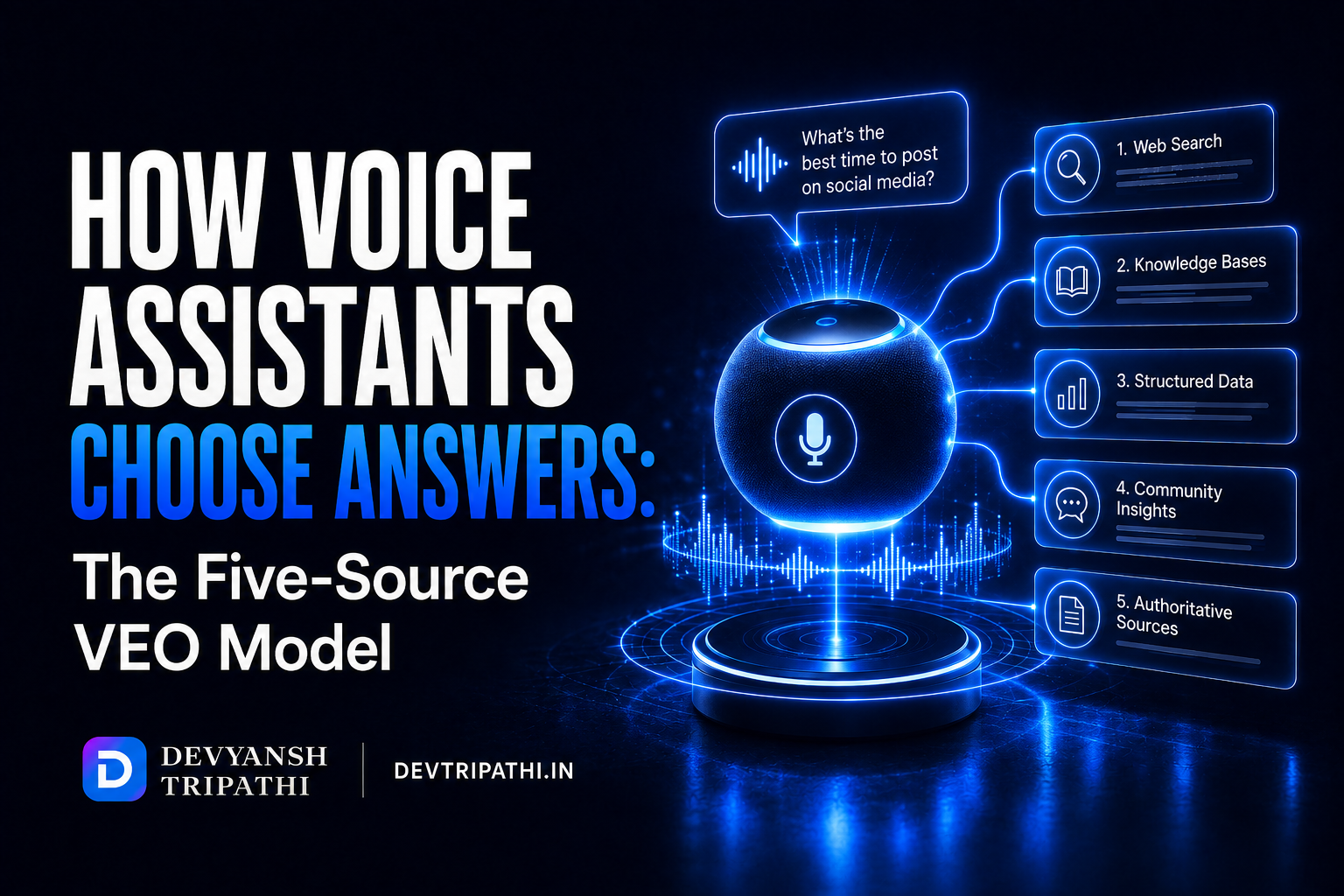
How Voice Assistants Choose Answers: The Five-Source VEO Model
09 June 2026
These are not projections. They are the current-state numbers from verified data sources as of 2026.
The specific behaviors driving this scale are equally striking. Over 58% of users turn to voice search to find local businesses. Nearly 90% of users find voice search easier than typing. Around 91% of brands are already investing heavily in voice search, and 66% report that voice-based interactions can improve conversions and revenue. Websites with voice optimization see an average 28% increase in organic traffic from voice searches according to BrightEdge data.
For SEO professionals, these numbers mean one thing: voice search is not a secondary consideration to address after traditional search is optimized. It is a primary discovery channel with specific, well-documented optimization requirements that differ meaningfully from traditional text-based SEO.
This guide covers the complete 2026 Voice Engine Optimization framework: the current scale of voice search, how voice assistants select their answers, and the specific tactics that earn voice answer selection across Google Assistant, Siri, Alexa, and AI voice interfaces.
8.4 billion voice assistants are now active worldwide, more than the global human population. Voice is no longer an alternative channel.
Over 58% of users rely on voice search to find local businesses, making local VEO the highest commercial-intent optimization area for any business with geographic presence.
50% of voice search results come directly from featured snippets, making Position Zero targeting the single most impactful VEO tactic available.
Pages that rank for voice search load 52% faster than the average page, confirming that Core Web Vitals compliance is a VEO prerequisite, not just a nice-to-have.
The average voice search result is 29 words long, defining the precise answer length target for VEO-optimized content.
Domain Authority of voice search results averages 76.8, higher than for regular search results, confirming that brand authority directly feeds voice search eligibility.
Long-tail keywords perform 2.5 times better for voice search optimization than short-tail equivalents because voice queries are conversational by nature.
[CTA — Beginning]
Is your website optimized for the 10 billion daily voice queries your potential customers are submitting? Get a free VEO audit at devtripathi.in/contact/ and find out exactly where you are visible and where you are missing.
What Is Voice Engine Optimization (VEO)?
Voice Engine Optimization is the practice of structuring your web content so that AI-powered voice assistants including Google Assistant, Siri, Alexa, and Cortana select it as the spoken answer when a user submits a voice query.
Unlike traditional SEO, which optimizes for position in a list of results that users see and click, VEO optimizes for a single outcome: becoming the one answer the assistant reads aloud. Traditional SEO competes for positions one through ten. VEO competes for one position only, and that position is the spoken response itself.
The mechanism: voice assistants process a spoken query, identify the most relevant, authoritative, and clearly-structured answer available, and read it aloud. No list is shown. No second chance. The brand whose content is selected earns the impression. The brands whose content is not selected are completely absent from the interaction.
This winner-takes-all dynamic is what makes VEO simultaneously high-stakes and high-opportunity. Voice search is one of the fastest-growing search channels, yet it remains under-optimized by most brands. The first brands to systematically address VEO requirements in their niche build citation advantages that compound as voice search volume continues growing.
The Voice Search Landscape: Current Data Every VEO Practitioner Needs
Voice search statistics tell a story of scale that demands strategic urgency.
The 8.4 billion active voice assistants worldwide now exceed the global population. Every smartphone, smart speaker, vehicle infotainment system, and wearable device contributes to a voice-first ecosystem processing over 10 billion queries per day.
Among specific assistants: Siri is estimated to have 500 million users worldwide, with approximately 86.5 million US users relying on Siri. Alexa has about 77.2 million users globally. Google Assistant is projected to reach 92 million US users and holds a 36% global market share alongside Siri. US users overall are expected to reach 157.1 million voice assistant users by the end of 2026.
The commercial dimension is growing rapidly. Voice commerce is projected to reach $164 billion by 2028 growing at 24% annually. 44% of voice purchases are reorders of previously purchased products. 66% of brands investing in voice report that voice-based interactions can improve conversions and revenue.
Local commercial intent drives a disproportionate share of voice queries. 76% of smart speaker users conduct local searches each week. 46% look up local businesses by voice every day. 22% of all voice search queries relate to local topics. Over 58% of consumers use voice search to find nearby businesses.
These numbers confirm that for any business with a local dimension, VEO is the highest commercial-priority optimization area in their search strategy.
How Voice Assistants Select Answers: The 5-Source Model
Voice assistants do not perform the same source selection process for every query. They draw from different data sources depending on the query type. Understanding which source a given query draws from is the foundation of effective VEO.
| Query Type | Primary Source | Key Optimization Signal |
|---|---|---|
| General informational queries | Featured snippets, top-3 organic results | Direct 29-word answer, Position Zero targeting |
| Local business queries | Google Business Profile, Apple Maps, Yelp | NAP consistency, GBP completeness, reviews |
| Product and commercial queries | Google Shopping, review platforms | Product schema, structured pricing data |
| How-to and instructional queries | HowTo schema-marked content | Step-by-step numbered structure, HowTo schema |
| Brand and entity queries | Knowledge Graph, Wikipedia, Wikidata | Entity registration, Organization or Person schema |
More than 80% of voice search answers on Google Assistant come from the top three search results. Approximately 50% of voice search results come directly from a featured snippet. Domain Authority of voice search results averages 76.8, higher than for regular search results.
The practical implication: strong traditional SEO is the prerequisite for VEO, just as it is for AI Overview citations. Voice assistants overwhelmingly draw from sources that already rank well in Google’s traditional index. VEO optimization without a strong traditional SEO foundation cannot produce sustained voice search visibility.
For the foundational traditional SEO strategy, see: Modern SEO Strategies: The Complete Guide to What Works in 2026 at https://devtripathi.in/blogs/modern-seo-strategies-complete-guide/
The 7 Core VEO Strategies for 2026
Strategy 1: Target the Optimal 29-Word Answer Format
The average voice search result is 29 words in length. This is not a guideline. It is a data-derived target from Backlinko’s analysis of voice search results. Voice assistants select answers that are long enough to completely address the query but short enough to deliver conversationally without losing the listener’s attention.
Structure your key pages using this specific pattern:
H2 or H3 header written as a spoken question: “How Do I Optimize for Voice Search in 2026?”
Direct answer paragraph: approximately 29 words delivered as a complete, standalone sentence. “To optimize for voice search in 2026, structure your content around natural questions, write 29-word direct answer blocks, deploy FAQPage and Speakable schema, and ensure your page loads in under 2.5 seconds on mobile.”
Expansion detail: supporting context, examples, and additional depth for users who continue reading.
This two-tier structure serves both voice search and traditional SEO simultaneously. The 29-word answer block earns featured snippet eligibility and voice answer selection. The expansion detail builds topical authority and provides value for human readers who want the full context.
Strategy 2: Win Featured Snippets to Own Voice Answers
50% of voice search results come directly from featured snippets. Winning a featured snippet for a target query means owning the voice answer for that query on every Google Assistant device simultaneously. Featured snippet optimization is the highest-leverage VEO investment available for most brands.
The three featured snippet formats and their VEO approach:
Paragraph snippets for definition and explanation queries: Use a question-format H2 or H3 header, followed by a 29-word direct paragraph in Subject Is Predicate sentence structure. Never begin the answer with “I” or with the question restated.
List snippets for process and step queries: Use a question-format header, followed by a numbered list with each item starting with an action verb and containing one clear instruction per line. HowTo schema reinforces list snippet eligibility.
Table snippets for comparison queries: Use a clean HTML table with clear headers and concise cell content. Comparison tables with three to five rows outperform longer tables for snippet selection.
For each priority query, identify which snippet format is most commonly shown for that query type in current Google results, then engineer content specifically in that format.
Strategy 3: Optimize for Conversational Long-Tail Queries
Long-tail keywords perform 2.5 times better for voice search than short-tail equivalents. Voice queries are structurally different from typed queries: they are longer, more conversational, more complete in their phrasing, and typically structured around the five W questions plus How.
A user typing might enter: “best SEO tool small business.”
The same user speaking might say: “What is the best SEO tool for a small business with a limited budget?”
Content targeting only the typed keyword form misses the spoken query. Expand keyword research to include the natural language question variants that real users speak. Use Google’s People Also Ask box, search autocomplete (which now reflects conversational phrasing), and Google Search Console long-tail query data filtered for six or more words.
For the complete conversational content strategy, see: Conversational Search Optimization: The Complete Guide at https://devtripathi.in/blogs/conversational-search-optimization-complete-guide/
Strategy 4: Implement the VEO Schema Stack
Structured data directly communicates to voice assistants what your content is, what questions it answers, and how it should be delivered. Without schema markup, voice assistants must infer all of this from page content, reducing reliability and citation confidence.
The VEO schema stack for 2026:
FAQPage schema: Maps each question-answer pair as a distinct, machine-readable unit. Voice assistants can extract individual FAQ entries as standalone answers for matching voice queries without needing to process the surrounding article.
HowTo schema: Structures step-by-step instructions for audio delivery. Voice assistants can read numbered steps aloud as a clear sequence for how-to voice queries.
LocalBusiness schema: Provides verified business information for local voice queries including name, address, phone number, opening hours, and service area. Google Assistant and Siri draw from structured business data for local commercial voice responses.
Speakable schema: The most voice-search-specific schema type available. It explicitly marks specific content sections as suitable for audio delivery. Google Assistant uses Speakable markup to identify which sections from a page to read aloud, making it the most direct VEO technical signal available.
Organization or Person schema with sameAs property: Provides entity recognition signals that help voice assistants confidently respond to brand-specific voice queries.
Validate all schema using Google’s Rich Results Test after implementation.
Strategy 5: Dominate Local Voice Search
Local commercial intent drives the highest-value voice queries for most businesses. 76% of smart speaker users conduct local searches weekly. 58% of consumers use voice search to find nearby businesses. 46% look up local businesses by voice every day.
For each local voice query category your business addresses, implement these specific requirements:
Google Business Profile completeness: Every field populated including category, service area, opening hours, attributes, photos, and business description. Google Assistant draws from GBP data for local voice responses and for the agentic booking capabilities announced at Google I/O 2026.
NAP consistency across all platforms: The same Name, Address, and Phone number format across Google Business Profile, your website’s LocalBusiness schema, Apple Maps, Yelp, JustDial, and all relevant directories. Even minor formatting differences reduce voice assistant confidence in your business data.
Review volume and sentiment: Voice assistants factor review ratings into local answer selection, particularly for best or top-rated queries. Actively generate and maintain a positive review profile across Google, Yelp, and relevant industry platforms.
Location-specific content pages: Create dedicated landing pages for each service area with the geographic name included naturally in the page title, H1, and content. Voice assistants processing location-specific queries need clear geographic signals within your content to make confident answer selections.
For the complete local AI search strategy, see: Zero Click Search Optimization: The Complete Guide at https://devtripathi.in/blogs/zero-click-search-optimization-complete-guide/
Strategy 6: Mobile Speed as a VEO Prerequisite
Pages that rank for voice search load 52% faster than the average page. 70.4% of voice search results come from HTTPS pages. Domain Authority of voice search results averages 76.8. Voice search is dominated by mobile devices, with smartphones accounting for over 56% of all voice search device usage in 2025.
These numbers confirm that mobile performance and technical quality are not separate from VEO strategy. They are prerequisites for voice search eligibility.
VEO technical requirements:
LCP under 2.5 seconds on mobile devices
HTTPS everywhere (no exceptions for pages targeting voice)
No mobile rendering errors or content overflow issues
Text readable without zooming
Touch targets appropriately sized for mobile interaction
Measure mobile Core Web Vitals weekly using Google Search Console’s Core Web Vitals report and Google PageSpeed Insights. Fix any LCP failures first as LCP is the most commonly failing metric and the most directly correlated with voice search result eligibility.
Strategy 7: Build a VEO-Optimized FAQ Section on Every Key Page
FAQ sections are the most directly actionable VEO content structure available. Voice assistants frequently use FAQ content as the source for spoken answers because it is pre-structured as a question followed by a clear, standalone answer, exactly the format voice delivery requires.
VEO-optimized FAQ requirements:
A minimum of 10 real questions per key page sourced from Google’s People Also Ask box, voice query research tools, Search Console long-tail data, and actual community discussions in your niche
Each question written in the natural language phrasing a user would speak aloud, not the abbreviated keyword form
Each answer written as a standalone 29-word paragraph that makes complete sense without surrounding context
FAQPage JSON-LD schema applied to all FAQ content so voice assistants can extract answers without processing the full article
The Siri and Alexa factor: both platforms use Bing, not Google, as their primary web retrieval source. Ensure your content is indexed in Bing by submitting your sitemap to Bing Webmaster Tools. A page that ranks in Google but not in Bing is completely absent from Siri and Alexa voice responses regardless of how well optimized its FAQ content is.
VEO for Different Assistants: Platform-Specific Priorities
| Voice Assistant | Market Position | Primary Data Sources | Highest-Priority VEO Action |
|---|---|---|---|
| Google Assistant | 36% global market share, 92M projected US users | Featured snippets, Google Business Profile, Google index | Featured snippet optimization, Speakable schema, GBP completeness |
| Siri | 36% global market share, 86.5M US users | Bing index, Apple Maps, Yelp, Wikipedia | Bing indexing, Apple Maps listing, Yelp profile completeness |
| Amazon Alexa | 77.2M global users | Bing index, Yelp, Wikipedia, Amazon data | Bing sitemap submission, FAQPage schema, structured answer blocks |
| Microsoft Cortana | Microsoft ecosystem | Bing index, LinkedIn | Bing indexing, LinkedIn Company Page optimization |
Measuring VEO Performance
Featured Snippet Ownership: Use Semrush, Ahrefs, or SERPWatcher to monitor your featured snippet positions for target queries. Track the specific queries where you own snippets and which snippet formats you have won. Featured snippet ownership is the primary indicator of voice answer eligibility for Google Assistant.
Google Search Console Voice Query Segment: Filter your Search Console Performance report for queries beginning with “who,” “what,” “where,” “when,” “why,” “how,” “best,” and “near me.” Track impressions and average position for these conversational queries separately. Monitor month-over-month trend in impressions and CTR for this segment.
Local Pack Visibility: Monitor your appearance in Google’s local three-pack for local intent queries using Moz Local or BrightLocal. Local pack positions correlate directly with local voice answer selection frequency.
Page Speed Monitoring: Track Core Web Vitals weekly in Google Search Console. Maintain LCP compliance as a non-negotiable threshold. Sites that drop below LCP thresholds see voice search citation probability decline.
Structured Data Validation: Validate FAQPage, HowTo, LocalBusiness, Speakable, and Organization schema quarterly using Google’s Rich Results Test. Fix all errors immediately.
Frequently Asked Questions About Voice Engine Optimization
What is Voice Engine Optimization (VEO) and why does it matter in 2026?
Voice Engine Optimization is the practice of structuring web content so that voice assistants including Google Assistant, Siri, and Alexa select it as the spoken answer to user queries. It matters in 2026 because there are 8.4 billion active voice assistants worldwide processing over 10 billion daily queries, over 58% of users rely on voice search to find local businesses, and voice commerce is projected to reach $164 billion by 2028. Voice is now a primary commercial discovery channel, not a niche alternative.
What is the optimal answer length for voice search?
The average voice search result is 29 words in length, based on Backlinko’s analysis of voice search results. Write direct answer paragraphs of approximately 29 words immediately following question-format H2 or H3 headers. This length is complete enough to fully answer most queries and concise enough to deliver conversationally without losing the listener’s attention.
How does voice search differ from traditional text search?
Voice search queries are structurally different from typed queries in several key ways. They are longer and more conversational (long-tail keywords perform 2.5 times better for voice), they are phrased as complete natural language questions rather than abbreviated keyword strings, they are predominantly mobile-initiated, they expect a single direct spoken answer rather than a list of results to click through, and they have significantly higher local commercial intent.
Do all voice assistants use the same sources?
No, and this is one of the most commonly missed VEO requirements. Google Assistant primarily uses Google’s featured snippets and index, Google Business Profile, and the Knowledge Graph. Siri uses Bing search, Apple Maps, and Yelp, not Google. Amazon Alexa uses Bing, Yelp, Wikipedia, and Amazon data. Microsoft Cortana uses Bing and LinkedIn. Any brand that is not indexed in Bing is invisible to Siri, Alexa, and Cortana regardless of its Google ranking.
What is Speakable schema and how does it help VEO?
Speakable schema is a JSON-LD structured data type that explicitly marks specific sections of a page as suitable for audio delivery by Google Assistant and other voice-capable platforms. It tells the voice assistant precisely which content on the page to read aloud in response to a relevant query. Implementing Speakable schema on your direct answer paragraphs, summary sections, and FAQ answers is the most direct VEO technical signal available.
How important is page speed for voice search ranking?
Pages ranking for voice search load 52% faster than average pages. Voice search is predominantly mobile-initiated, and mobile page performance is a direct factor in voice search result eligibility. Target LCP under 2.5 seconds on mobile. Verify HTTPS across all pages, as 70.4% of voice search results come from HTTPS-secured pages. Fix any Core Web Vitals failures on priority pages before investing in other VEO optimizations.
What local SEO actions most directly improve voice search?
Complete your Google Business Profile with every available field populated. Ensure NAP (Name, Address, Phone) consistency across every platform where your business is listed. Build and maintain a strong review profile on Google, Yelp, and Trustpilot. Create dedicated service area content pages with geographic names included naturally in headings and content. Implement LocalBusiness JSON-LD schema on your location and contact pages with consistent data matching your GBP exactly.
Can VEO help B2B businesses or is it primarily for B2C local queries?
VEO applies to B2B businesses, though the query patterns differ from consumer local searches. B2B voice queries tend to focus on industry definitions, process explanations, software comparisons, and professional information queries. Optimizing FAQ sections, HowTo content for professional processes, and clear structured answers to common industry questions improves voice search visibility for B2B brands. LinkedIn presence also matters specifically for Microsoft Cortana B2B voice queries.
What is the relationship between VEO and AEO?
VEO (Voice Engine Optimization) and AEO (Answer Engine Optimization) share nearly identical foundational principles because voice search is a specific modality of answer engine behavior. Both require concise direct answers, FAQPage schema, question-format headers, and featured snippet optimization. VEO adds the specific requirements of Speakable schema, optimal 29-word answer length for audio delivery, and voice assistant platform-specific source requirements (particularly Bing indexing for Siri and Alexa).
How does Google I/O 2026 affect voice search strategy?
Google I/O 2026 announced Personal Intelligence integration with AI Mode, allowing Google’s systems to incorporate personal Gmail, Photos, and Calendar context into responses. The agentic booking capabilities announced allow Google to complete local service bookings within Search for select categories. Both developments make Google Business Profile completeness, entity authority, and structured data quality more commercially important for local voice search than ever before.
Conclusion
Voice search has moved from a channel to monitor to a channel to optimize for systematically. 8.4 billion active voice assistants. 10 billion daily queries. 58% of users using voice for local business discovery. Voice commerce approaching $164 billion by 2028. The scale is no longer hypothetical.
The VEO framework is clear and implementable. Write 29-word direct answer blocks after question-format headers. Win featured snippets, which power 50% of all voice answers. Deploy FAQPage, HowTo, LocalBusiness, and Speakable schema. Complete your Google Business Profile and ensure NAP consistency. Submit your sitemap to Bing Webmaster Tools. Achieve mobile LCP under 2.5 seconds.
Each of these actions independently improves traditional search performance in addition to voice search eligibility. VEO is not a separate track requiring a separate budget. It is the natural extension of quality SEO into the conversational, audio-delivered search channel that is now reaching every smartphone, every smart speaker, and every connected device your potential customers use every day.
Start with the featured snippet audit. Identify your top 20 target queries. Check which ones already have featured snippets and whether you own them. The ones you do not own are the highest-priority VEO optimization opportunities. Address them this month.
Backlinko Voice Search Study: https://backlinko.com/voice-search-seo-study
Google Schema — Speakable Documentation: https://developers.google.com/search/docs/appearance/structured-data/speakable
Bing Webmaster Tools: https://www.bing.com/webmasters
DemandSage Voice Search Statistics 2026: https://www.demandsage.com/voice-search-statistics/
Digital Applied Voice Search Statistics: https://www.digitalapplied.com/blog/voice-search-statistics-2026-data-points
Answer Engine Optimization (AEO): https://devtripathi.in/blogs/answer-engine-optimization-aeo-complete-guide/
Conversational Search Optimization: https://devtripathi.in/blogs/conversational-search-optimization-complete-guide/
Zero Click Search Optimization: https://devtripathi.in/blogs/zero-click-search-optimization-complete-guide/
Modern SEO Strategies: https://devtripathi.in/blogs/modern-seo-strategies-complete-guide/
Brand Authority SEO: https://devtripathi.in/blogs/brand-authority-seo-complete-guide/
[CTA — End]
Ready to build a voice search strategy that earns spoken recommendations across Google Assistant, Siri, and Alexa? Book a free VEO strategy session at devtripathi.in/contact/ and get a customized action plan for your business.

Devyansh Tripathi
I’m Devyansh Tripathi, an SEO strategist and digital growth expert, helps businesses and individuals rank higher and drive organic traffic. Through DevTripathi., he shares cutting-edge SEO insights, content strategies, and marketing hacks. Passionate about digital success, he’s on a mission to make SEO simple, effective, and result-driven!
Posts
- What Google’s New AI Search Documentation Means for SEO Teams
- Google I/O 2026 Search: AI Agents, Gemini 3.5 and the Unified Box
- Google’s AI Optimization Guide: The Technical and Content Checklist
- July 2026 SEO Update: AI Overviews, llms.txt and Search Console
- Prompt Optimization Beyond Page One: The Position-21 Citation Opportunity
Categories
- AI Citation Optimization
- AI Search Optimization (AISEO)
- AI Visibility Tracking
- Answer Engine Optimization (AEO)
- Brand Authority SEO
- Brand SERP Optimization
- Community Signal SEO
- Conversational Search Optimization
- Generative Engine Optimization (GEO)
- Knowledge Graph Optimization
- Modern SEO Strategies
- Multimodal Search Optimization
- Prompt Optimization
- SEO Trends
- Social Search Optimization
- Topical Authority SEO
- Uncategorized
- Video Search SEO
- Visual Search Optimization
- Voice Engine Optimization (VEO)
- Zero Click Search Optimization
Latest News
Text Widget
Empowering brands with insights, strategies, and stories that drive digital growth.