March 2026 Core Update: 7 SEO Shifts That Matter
20 May 2026
For SEO professionals managing brand visibility in this environment, understanding which trends actually matter and which are noise is the most valuable skill available right now.
This guide covers the most significant SEO trends of 2026: what changed, why it matters, what the data shows, and the specific actions that separate brands gaining ground from brands losing it.
The March 2026 Google Core Update: What Actually Happened
The most significant algorithmic event of the year so far was the Google Core Update that began rolling out on March 27, 2026. The scale of its impact was exceptional by any historical measure.
According to SE Ranking data shared exclusively with Search Engine Land, nearly 80% of top-three search results shifted positions during the rollout. Almost 1 in 4 pages that had been ranking in the top 10 fell entirely out of the top 100. Only 20.5% of top-three positions held their exact ranking, down from 33.1% after the December 2025 core update. Stability dropped sharply across every ranking tier.
The March update closely followed a spam update that completed just days earlier, which amplified volatility and made attribution more complex. However, the directional signals from the data are clear.
Sites that maintained strong topical authority, structured content, and high-value information were more likely to retain or improve visibility. Sites with weaker differentiation, misaligned search intent, or thin content that existed primarily to rank for a keyword saw the most significant declines.
According to Amsive analysis of the update, the March 2026 update read as a first-party, official-source correction: Google tilted visibility toward authoritative, brand-owned, and government domains — and away from user-generated content aggregators, comparison sites built on third-party inventory, and content built primarily for search visibility rather than genuine user value.
The direction Google is heading is unmistakable: rank sites that earn authority through genuine helpfulness and penalize sites that game signals without delivering value.
For a historical record of how Google algorithm updates have evolved, see: Google December 2025 Core Update: What Changed at https://devtripathi.in/blogs/google-december-2025-core-update/
The Top 7 SEO Trends Every Professional Must Know in 2026
Trend 1: AI Overviews Are Now a Primary Traffic Signal
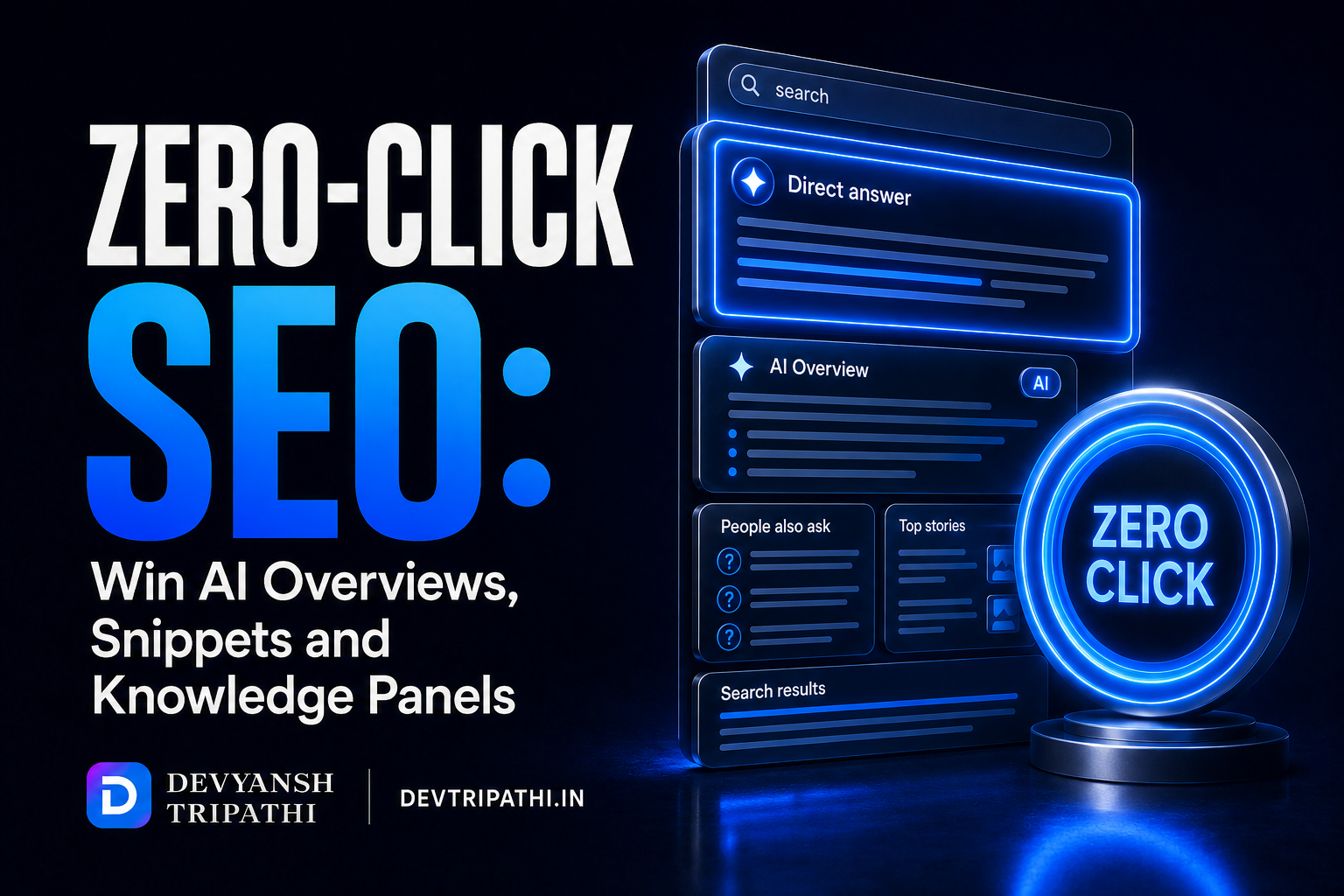
Google AI Overviews now appear in more than 55% of all Google searches and reach nearly 1 billion users globally. This is no longer a feature in limited rollout. It is mainstream search behavior.
The SEO implication is significant: for informational queries where an AI Overview is present, click-through rates on traditional blue-link results decline sharply. Research shows that roughly 60% of all Google searches now end without a click at all. AI Overviews satisfy the user’s intent directly on the results page.
However, being cited inside an AI Overview is itself a high-value visibility outcome. Research shows a 92% correlation between domains ranking in the traditional top 10 and domains cited in AI Overviews. The formula is: strong traditional SEO gets you into the AI Overview source pool, and structured content with answer-first formatting gets you cited.
For a dedicated guide on appearing in AI Overviews, see: How to Appear in Google AI Overviews at https://devtripathi.in/blogs/how-to-appear-in-google-ai-overviews/ and What Is Google AI Overview and How It Affects Blog Traffic at https://devtripathi.in/blogs/what-is-google-ai-overview-blog-traffic/
Trend 2: Topical Authority Has Replaced Keyword Targeting as the Core Content Strategy
The March 2026 core update reinforced a trend that has been building for several years: Google is rewarding domain-level topical authority, not page-level keyword optimization.
Topical authority means deep, consistent, comprehensive coverage of a subject area across an interconnected set of pages. A single well-optimized page on a topic provides far less ranking power today than a coordinated cluster of pages that together demonstrate genuine expertise across every dimension of that topic.
This shift has three practical implications:
First, content gaps hurt you more than they used to. If your site covers a topic broadly but misses important subtopics that competitors address, Google recognizes the gap and it reduces confidence in your overall authority signal.
Second, internal linking is now a topical authority signal. Well-structured internal links between cluster pages demonstrate to Google how your content is related and reinforce your expertise signal across the entire topical silo.
Third, thin or low-value pages across a domain reduce the entire domain’s authority signal. Google’s Helpful Content System, now integrated into core updates, evaluates site-level helpfulness, not just individual page quality. A domain with many thin or unhelpful pages will see ranking pressure across its entire content library, including on individually strong pages.
For a detailed breakdown of how topical authority connects to AI search citation, read: Entity SEO, GEO, and Topic Authority in AI Search at https://devtripathi.in/blogs/entity-seo-geo-topic-authority-ai-search/
Trend 3: E-E-A-T Is Now Algorithmically Enforced, Not Just a Quality Guideline
Experience, Expertise, Authoritativeness, and Trustworthiness have been part of Google’s Quality Rater Guidelines for years. In 2026, Google’s algorithms now use AI to actively evaluate and enforce E-E-A-T signals across ranked content.
Websites with anonymous content, vague author credentials, unverified expertise claims, or inconsistency between on-site and off-site entity signals are experiencing measurable ranking pressure. Websites with verifiable author credentials, consistent brand entity presence across the web, original first-hand experience in their content, and multi-platform authority signals are gaining ground.
The practical implications for SEO professionals are:
Every published article should have a clearly identified, credentialed author whose expertise in the topic can be verified. Author bio pages should link to off-site references that corroborate expertise.
Original first-hand experience must be woven into content: what the author tested, found, fixed, or observed personally — not just a synthesis of what other sources say.
Brand entity consistency across Google Business Profile, LinkedIn, industry directories, Wikipedia (where applicable), and major review platforms strengthens the trust signals Google’s AI-based quality evaluation now looks for.
For a detailed guide on how E-E-A-T connects to both traditional rankings and AI citation, see: What Is E-E-A-T and How It Connects to GEO at https://devtripathi.in/blogs/what-is-eeat-and-how-it-connects-to-geo/
Trend 4: Search Intent Alignment Is Now More Important Than Keyword Density
Google’s natural language understanding capabilities have advanced to the point where keyword density and keyword frequency carry far less ranking weight than intent alignment. Modern ranking systems parse entities, relationships, and search intent. Real users search in ways that keyword tools often miss: as problems, as scenarios, as questions in natural language.
If a page targets a keyword but the content does not match what top-ranking pages actually deliver for that query, Google will reduce visibility regardless of how technically optimized the page appears. Intent satisfaction is now the primary relevance signal.
The practical shift for SEO professionals: shift from keyword research as the starting point to intent research. Analyze what users actually want when they search a query — what format, what level of detail, what specific information — then engineer content to satisfy that intent completely.
For a deep exploration of how user intent should drive GEO and SEO content strategy, see: User Intent vs Keywords in GEO and SEO at https://devtripathi.in/blogs/user-intent-vs-keywords-geo-seo/
Trend 5: GEO and AI Citation Optimization Are Now Core SEO Skills
Generative Engine Optimization is no longer an experimental discipline that forward-thinking SEOs are testing. It is a core component of a complete search strategy for any brand that depends on organic discovery.
The reason is simple: AI-driven discovery is not supplementing traditional search. It is capturing an increasing share of it. As Gartner projects, traditional search engine volume is declining as users shift to AI-powered tools. The brands that earn AI citations build visibility in the channel where search is growing while simultaneously reinforcing their authority in traditional search.
According to Princeton University research published at KDD 2024, specific GEO strategies can improve AI visibility by 30 to 40%. The highest-impact tactics — expert quotes with attribution, statistics with specific data, and source citations — are also excellent traditional SEO content quality signals. GEO and SEO optimization strategies increasingly reinforce each other.
For comprehensive guides on integrating GEO into your SEO practice, see: Generative Engine Optimization (GEO): Complete Strategy Guide at https://devtripathi.in/blogs/generative-engine-optimization-geo-strategy-guide/ and Traditional SEO vs GEO at https://devtripathi.in/blogs/traditional-seo-vs-geo-2026/
Trend 6: Backlinks Are Quality-Gated, Not Volume-Dependent
The era of accumulating large numbers of backlinks to drive domain authority is definitively over. The March 2026 core update and the spam update that preceded it reinforced Google’s focus on link relevance, trustworthiness, and contextual authority rather than link volume.
What matters now: backlinks from contextually relevant, trusted publications in your specific topic area. A single backlink from a recognized industry publication in your sector delivers more ranking benefit than dozens of links from general or tangentially related sources.
What can hurt you now: manipulative link profiles, over-optimized anchor text, rapid spikes in link acquisition from low-quality domains, and site reputation abuse. Google’s spam enforcement has intensified, and algorithmic detection of manipulative link patterns has improved significantly.
The shift for SEO professionals: invest in digital PR and earned media rather than link-building campaigns. Focus on building genuine relationships with relevant publications. Create content that earns links naturally because it contains unique data, original research, or expert insight no other source offers.
Trend 7: Technical SEO Performance Is a Tie-Breaker Between Equally Good Content
Core Web Vitals, mobile usability, and clean site architecture remain foundational ranking requirements in 2026. However, the role of technical SEO has shifted from a primary differentiator to a tie-breaker. Between two pages with equivalent content quality and authority signals, the page with better technical performance wins.
The practical implication: if your site already passes Core Web Vitals, fixing technical issues is unlikely to produce significant ranking gains on its own. If your site fails Core Web Vitals or has structural technical problems, fixing them is a prerequisite for any content or authority investment to reach its full ranking potential.
Technical SEO priorities for 2026: Core Web Vitals compliance (LCP under 2.5 seconds, INP under 200 milliseconds, CLS under 0.1), mobile rendering quality, clean JavaScript execution for AI crawler compatibility, structured data implementation, and canonical tag hygiene across large content libraries.
What Is No Longer Working in 2026: SEO Tactics to Stop
Understanding what has stopped working is as important as knowing what is gaining traction.
Generic listicles with no original evaluation: “Top 10 SEO tools” articles with no testing criteria, no real opinions, and no original analysis are being actively suppressed by Google’s Helpful Content System. These performed well in earlier algorithm versions. They are now a liability for domain authority.
Rewritten content without added insight: Pages that rewrite existing top-ranking content without adding new data, original perspective, or deeper coverage do not satisfy Google’s comparative value threshold. The March 2026 update penalized this category significantly.
AI-generated content without expert review: Content produced entirely by AI with no expert review, no original data, and no first-hand perspective is increasingly flagged by Google’s automated quality evaluation systems. AI-assisted content with human expert review performs well. AI-only content performs poorly and degrades domain authority when published at scale.
Keyword-stuffed meta descriptions and title tags: Keyword repetition in meta elements provides no ranking benefit and often triggers quality penalties. Write meta titles and descriptions to earn clicks from real users, not to maximize keyword density.
Backlink quantity campaigns without quality filtering: Link volume without relevance and authority is now a risk factor, not a benefit. Any SEO campaign still prioritizing link quantity over link quality should be restructured immediately.
The SEO Strategy That Consistently Wins in 2026
Across every major algorithm update and every emerging AI search platform, one consistent pattern holds: brands that win combine genuine topical expertise with structured, accessible content and verifiable off-site authority.
High-quality content, backlinks, and search intent remain the top three ranking factors in 2026. But what these terms mean in practice has evolved significantly. Google is rewarding credibility, clarity, and focused depth. Brands that have been optimizing for the algorithm alone are losing ground to brands that are genuinely and demonstrably helpful.
The SEO strategy for 2026 has three layers working simultaneously:
Layer 1 — Traditional SEO Foundation: Technical health, Core Web Vitals compliance, authoritative backlinks from relevant sources, strong internal linking, comprehensive meta data, and site architecture clarity.
Layer 2 — Content Authority: Topical depth through content clusters, intent-aligned content structure, E-E-A-T signals including author credentials and first-hand experience, and regular content freshness updates.
Layer 3 — AI Search Visibility (GEO and AEO): Direct answer blocks in the first 150 words, question-format headers, expert quotes with full attribution, statistics and specific data, FAQPage schema, triple JSON-LD schema stacking, and multi-source off-site entity authority.
Brands operating at all three layers simultaneously are the ones gaining durable visibility through every algorithm update and every evolution in AI search behavior.
For a complete guide to the AI-specific layer, see: AI Search Optimization (AISEO): The Complete Guide at https://devtripathi.in/blogs/ai-search-optimization-aiseo-complete-guide/
Frequently Asked Questions About SEO Trends
What were the biggest Google algorithm changes in 2026 so far?
The March 2026 Google Core Update was the most significant algorithmic change of the year so far, beginning its rollout on March 27, 2026. It was more volatile than the December 2025 core update, with nearly 80% of top-three positions shifting and 24.1% of top-10 pages falling out of the top 100 entirely. The update reinforced Google’s focus on first-party authoritative sources, topical depth, and genuine content helpfulness.
Are keywords still important for SEO in 2026?
Yes, but they function differently. Keywords are now topical signals rather than the whole strategy. Modern ranking systems parse entities, relationships, and search intent rather than keyword frequency. The key shift is from keyword research as the starting point to intent research: understanding what users actually want when they search a query, then building content that satisfies that intent completely.
How important is E-E-A-T for rankings in 2026?
Extremely important. Google’s algorithms now use AI to evaluate and enforce E-E-A-T signals algorithmically, not just through human quality raters. Websites with verifiable author credentials, first-hand experience in their content, consistent brand entity presence, and multi-platform authority signals are gaining ground. Websites with anonymous content or unverified expertise claims are experiencing measurable ranking pressure.
What is the impact of AI Overviews on organic traffic?
AI Overviews appear in more than 55% of all Google searches and, for many informational queries, they satisfy user intent directly on the results page without requiring a click. However, being cited inside an AI Overview is a high-value visibility outcome that reaches users at the exact moment they are forming opinions and decisions. The traffic that does click through from an AI-informed search is typically higher-quality and further along in the consideration process.
How should I adjust my content strategy for topical authority?
Build content clusters rather than standalone articles. For every major topic your brand covers, create a pillar page that provides comprehensive overview coverage, and satellite cluster pages that go deep on each subtopic. Connect the cluster pages to the pillar with descriptive internal links. Identify and fill any content gaps that competitors address but your site does not. Remove or substantially improve thin or low-value pages that may be degrading your overall domain authority signal.
Are backlinks still a ranking factor in 2026?
Yes, but quality has entirely replaced quantity as the relevant dimension. A single contextually relevant backlink from a trusted, authoritative publication in your specific topic area delivers more ranking benefit than dozens of links from general or tangentially related domains. Manipulative link profiles are actively penalized. Focus on earning links through digital PR, original research, and genuinely useful content rather than link-building campaigns.
How do I check if the March 2026 update affected my site?
Compare your Google Search Console impressions and average ranking position data from before March 27 versus after April 10, 2026 (approximate rollout completion date). Identify which pages gained or lost visibility. Look for patterns: pages with thin content, misaligned intent, or weak authority signals will show the most significant declines. Pages with strong topical coverage and genuine expertise signals tend to show gains or stability.
What content types are winning in 2026 from an SEO perspective?
Content types consistently performing well include: comprehensive guides with deep topical coverage and original expert perspective, data-driven articles with proprietary research or aggregated statistics, FAQ-rich content structured for AI extraction, content with clearly credentialed authors and first-hand experience, and comparison or listicle content with genuine evaluation criteria rather than generic lists.
Is technical SEO less important in 2026?
Technical SEO remains foundational but has become a qualifying standard rather than a primary differentiator. Sites that fail Core Web Vitals or have significant technical issues cannot compete effectively regardless of content quality. Sites that pass technical standards compete primarily on content quality, topical authority, and E-E-A-T signals. Maintaining technical health is non-negotiable; it simply no longer wins on its own.
What is the relationship between traditional SEO and GEO in 2026?
Traditional SEO and GEO are complementary layers of a unified strategy. Strong traditional SEO provides the foundation that feeds AI retrieval systems: indexability, domain authority, and topical relevance. GEO adds the specific signals that convert that retrieval eligibility into actual AI citations: structured answer blocks, expert quotes, statistics, schema markup, and multi-source brand authority. The most effective search strategies in 2026 invest in both simultaneously.
How should I measure SEO success in 2026?
Expand your measurement framework beyond keyword rankings and organic traffic. Track AI citation frequency across major platforms, AI-referred traffic in GA4, Share of Model versus competitors, featured snippet and People Also Ask inclusion rates, branded search query growth, and content page experience signals including scroll depth and time on page. Keyword rankings alone tell an increasingly incomplete story about your actual search visibility.
What should I prioritize if I can only work on one thing this week?
If you can only focus on one thing: conduct a topical authority audit. Identify the 3 to 5 most important topics for your brand. Map your current content against those topics. Find the most significant content gap between your coverage and your top competitors’ coverage. Create a comprehensive, expert-authored article to fill that gap, optimized for intent alignment and structured with answer-first formatting, question-format headers, FAQPage schema, and a minimum of 10 real FAQ entries. This single piece of work advances traditional SEO, topical authority, and GEO simultaneously.
Conclusion
The SEO landscape in 2026 is more demanding than in any previous year. The March 2026 Google Core Update was a clear signal that Google’s tolerance for content that exists primarily to rank — rather than to genuinely help users — has reached a definitive threshold. AI Overviews are capturing a growing share of search intent directly on the results page. GEO has moved from an emerging discipline to a core operational requirement for any brand dependent on organic discovery.
But the underlying principle that has always defined durable SEO success has not changed: build the most genuinely useful, expert, and well-structured content in your space, make it technically accessible to both humans and machines, and earn authority signals from trusted third-party sources.
The brands gaining ground right now are the ones that have internalized this principle deeply enough to execute it at scale — across content creation, technical infrastructure, off-site authority building, and AI citation optimization simultaneously.
The competitive window in GEO is still open. The quality threshold in traditional SEO has never been more clearly defined. The measurement tools to track AI visibility are available today.
The work is clear. The only remaining variable is which brands start it now and which ones wait.
Google Search Central — Core Update Documentation: https://developers.google.com/search/updates/core-updates
Search Engine Land — March 2026 Core Update Analysis: https://searchengineland.com/march-2026-google-core-update-what-changed-474397
SE Ranking — Core Update Volatility Data: https://seranking.com
Gartner — AI Search Volume Prediction: https://www.gartner.com/en/newsroom/press-releases/2024-02-19-gartner-predicts-search-engine-volume-will-drop-25-percent-by-2026
Neil Patel — Google Algorithm Update History: https://neilpatel.com/blog/the-ultimate-google-algorithm-cheat-sheet/

Devyansh Tripathi
I’m Devyansh Tripathi, an SEO strategist and digital growth expert, helps businesses and individuals rank higher and drive organic traffic. Through DevTripathi., he shares cutting-edge SEO insights, content strategies, and marketing hacks. Passionate about digital success, he’s on a mission to make SEO simple, effective, and result-driven!
Posts
- What Google’s New AI Search Documentation Means for SEO Teams
- Google I/O 2026 Search: AI Agents, Gemini 3.5 and the Unified Box
- Google’s AI Optimization Guide: The Technical and Content Checklist
- July 2026 SEO Update: AI Overviews, llms.txt and Search Console
- Prompt Optimization Beyond Page One: The Position-21 Citation Opportunity
Categories
- AI Citation Optimization
- AI Search Optimization (AISEO)
- AI Visibility Tracking
- Answer Engine Optimization (AEO)
- Brand Authority SEO
- Brand SERP Optimization
- Community Signal SEO
- Conversational Search Optimization
- Generative Engine Optimization (GEO)
- Knowledge Graph Optimization
- Modern SEO Strategies
- Multimodal Search Optimization
- Prompt Optimization
- SEO Trends
- Social Search Optimization
- Topical Authority SEO
- Uncategorized
- Video Search SEO
- Visual Search Optimization
- Voice Engine Optimization (VEO)
- Zero Click Search Optimization
Latest News
Text Widget
Empowering brands with insights, strategies, and stories that drive digital growth.