
Measure AI Visibility: 5 Metrics, Platforms and Tracking Tools
26 May 2026
They answer a different question almost not at all: how visible is your brand in AI-generated answers?
When a potential client asks ChatGPT “who are the best SEO consultants in India,” does your brand appear? When a B2B buyer queries Perplexity for “top GEO agencies,” is your firm cited? When someone uses Google AI Mode to research “AI search optimization strategies,” does your content get referenced?
These questions cannot be answered by a keyword ranking report. They require a completely different measurement framework. That framework is AI Visibility Tracking.
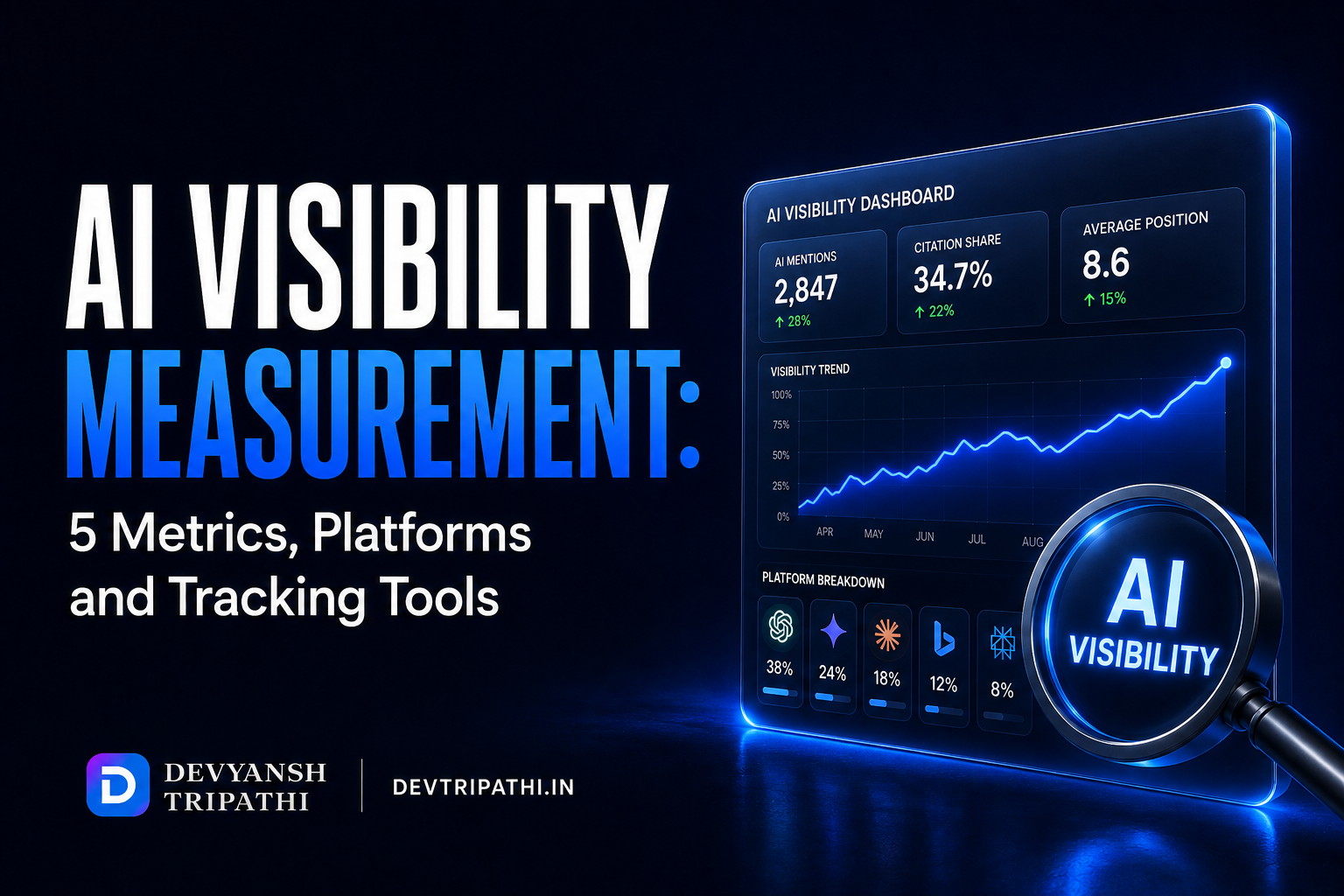
AI Visibility Tracking is the practice of systematically monitoring how often, how prominently, and how accurately your brand appears in AI-generated responses across all major AI search platforms. It is the measurement layer that makes Generative Engine Optimization (GEO) accountable, measurable, and improvable.
This guide covers the key metrics, the major platforms to track, the best tools available, and the complete process for building an AI visibility measurement system that gives you actionable data on your brand’s position in the AI search ecosystem.
For the optimization strategies that AI Visibility Tracking measures, see: Generative Engine Optimization (GEO): Complete Strategy Guide at https://devtripathi.in/blogs/generative-engine-optimization-geo-strategy-guide/ and AI Search Optimization (AISEO): The Complete Guide at https://devtripathi.in/blogs/ai-search-optimization-aiseo-complete-guide/
Why Traditional Rank Tracking Does Not Capture AI Search Visibility
Traditional rank tracking tools monitor where your pages appear in a list of ten blue links on a Google SERP for a given keyword. This measurement is meaningful for traditional organic search but is structurally blind to how AI search platforms operate.
AI search platforms do not produce a ranked list of ten results. They produce a synthesized, conversational response that may mention zero brands, one brand, or several brands depending on the query. The metric that matters is not position in a list. It is whether your brand is included in the response at all, how prominently it appears, and whether it is cited with a link.
According to Profound’s analysis of 27 million citations across ChatGPT, Gemini, and AI Overviews, owned content (your own website) represents only 4.3% of citations on category-level queries. The remaining 95.7% of citations come from earned media, PR wire content, institutional sources, social platforms, and other external sources. This means a brand that measures only its own website’s organic rankings misses over 95% of the citation surface that AI systems actually use to build responses about it.
AI search also has a fundamental measurement challenge: AI responses are probabilistic. The same query submitted to ChatGPT twice may produce different responses with different brand mentions depending on timing, geographic context, and model version. This non-determinism means manual spot-checking is not a reliable measurement method. Systematic, repeatable, large-sample tracking is required to produce statistically meaningful AI visibility data.
The 5 Core AI Visibility Metrics Every SEO Professional Must Track
Metric 1: Brand Mention Rate (AI Visibility Score)
Brand Mention Rate is the percentage of relevant AI search responses that include your brand name, across a defined set of target queries. This is the primary AI visibility metric and the direct equivalent of Share of Voice in traditional media measurement.
When tracking Brand Mention Rate, segment your prompt set by: topic cluster (awareness-stage queries versus decision-stage queries), query type (informational, commercial, comparison), and AI platform (ChatGPT, Perplexity, Gemini, Google AI Overviews). A brand might have 66% visibility on awareness-stage queries but only 33% at the decision stage. Tracking aggregate visibility without this segmentation obscures the most actionable insights.
According to Daily Emerald’s AI tracker analysis, tracking at a category level rather than individual prompts produces more reliable patterns due to the non-deterministic nature of AI language models.
Metric 2: Citation Rate (Linked vs. Unlinked)
Citation Rate distinguishes between two types of AI brand presence: a linked citation (where the AI includes a hyperlink to your domain as a source) and an unlinked mention (where your brand is referenced in the response text without a link).
Both matter but measure different outcomes. Linked citations drive measurable referral traffic. Unlinked mentions build brand association without clicks. According to Otterly’s 2026 AI Citations Report, based on over one million citations across ChatGPT, Perplexity, and Google AI Overviews, ChatGPT frequently mentions brands without linking to them, while Perplexity’s citation-to-mention ratio is more balanced. Google AI Overviews showed the strongest brand preference with 59.8% of citations going to brand domains.
Track linked citation rate and unlinked mention rate separately for each AI platform to understand whether your brand is appearing as a cited source (with traffic value) or as a contextual mention (with brand awareness value).
Metric 3: Share of Model (SoM)
Share of Model is the GEO equivalent of Share of Voice in traditional marketing. It measures what percentage of AI-generated responses for your target queries include your brand, compared to the total number of brands mentioned for those same queries.
If your brand appears in 4 out of 10 AI responses for your target query set and your top competitor appears in 7 out of 10, your Share of Model is 40% and your competitor’s is 70%. Tracking SoM weekly provides a competitive benchmark that makes your AI visibility progress relative to the market, not just absolute.
Share of Model is particularly valuable because it surfaces competitive gaps: the queries where competitors dominate AI responses while your brand is absent. These gaps identify exactly which topics need content investment or digital PR effort to improve citation rate.
Metric 4: Position and Prominence
Within any AI-generated response that mentions your brand, position matters significantly. A brand mentioned first in an AI response receives disproportionately more exposure and consideration than a brand mentioned eighth in a long list. Research from daily Emerald confirms that earlier mentions in AI responses receive substantially more engagement than later ones.
Track not just whether your brand appears but where it appears: is it the first recommendation, the primary example used, a secondary mention, or a footnote at the end of a long list? Improving prominence within AI responses is a distinct optimization goal from improving inclusion rate.
Metric 5: AI-Referred Traffic in GA4
AI-referred traffic is the click-through component of AI citation performance. When a user sees your brand cited in a ChatGPT, Perplexity, or Google AI Overview response and clicks through to your site, that session is recorded in Google Analytics 4 with a referral source from the AI platform’s domain.
Set up a custom channel group in GA4 that captures all AI-referred sessions by including source filters for: chatgpt.com, perplexity.ai, bing.com (for Copilot), gemini.google.com, and any other AI platform referrers appearing in your acquisition data. Monitor this channel monthly. AI-referred traffic grew 527% year over year through mid-2025 according to Previsible’s AI Traffic Report, and it typically converts at significantly higher rates than standard organic traffic because AI-referred visitors have already had an intent-qualifying interaction with the AI before clicking through.
The Major AI Platforms to Track and Their Measurement Characteristics
Google AI Overviews
Google AI Overviews appear in an estimated 33 to 55% of all Google searches depending on query type. They show the strongest brand preference of all AI platforms: 59.8% of AI Overview citations go to brand domains rather than third-party sources, according to Otterly’s data. Google AI Overviews are the highest-traffic AI citation channel for most brands because they appear inline within standard Google searches.
Measurement approach: Use Google Search Console to monitor impressions for queries where AI Overviews are likely to appear (informational queries with clear answer-layer structure). Test target queries in Google AI Mode manually weekly. Track AI Overview citation frequency for your top 20 target queries.
ChatGPT Search
ChatGPT processes over 800 million weekly queries. It frequently mentions brands without linking to them (unlinked mention rate is higher than citation rate). It draws from Bing’s web index for real-time search capability.
Measurement approach: ChatGPT responses are highly non-deterministic. Manual testing of the same query multiple times will produce different results. Use dedicated AI visibility tools that query ChatGPT programmatically across large sample sizes to produce statistically reliable mention rates. Otterly.AI and Profound both provide ChatGPT-specific monitoring at scale.
Perplexity
Perplexity processes 780 million monthly queries. Its citation-to-mention ratio is more balanced than ChatGPT, meaning it links more consistently when it mentions a brand. Around 60% of Perplexity citations overlap with Google’s top 10 organic results.
Measurement approach: Perplexity provides more consistent source citations than ChatGPT, making manual testing more reliable for initial audits. For ongoing monitoring, use dedicated tools. Track both the citation rate (linked) and the quality of the framing: is your brand cited as the primary recommendation or as one of many options?
Gemini
Google’s Gemini processes a large and growing volume of queries through Google’s ecosystem. It analyzes multimodal content including video, images, and text. For brands with strong YouTube presence and Google-indexed structured data, Gemini citations can be significant.
Measurement approach: Test Gemini separately from Google AI Overviews since they use slightly different retrieval logic. Use Semrush’s AI Visibility Checker for Google ecosystem AI visibility monitoring.
Microsoft Copilot
Copilot leans heavily on LinkedIn for B2B queries and on Bing for general web queries. For B2B brands, Copilot citation tracking is particularly important because it reaches professional buyers in the context of Microsoft productivity tools.
Measurement approach: Bing Webmaster Tools provides some visibility into Bing-indexed content performance, which feeds Copilot. Manual testing of B2B decision-stage queries in Copilot weekly. Monitor LinkedIn presence as the primary Copilot authority signal for professional queries.
The Best AI Visibility Tracking Tools in 2026
Based on publicly available information as of early 2026, the following tools represent the strongest options for different tracking needs:
Profound: Analyzed 27 million citations across ChatGPT, Gemini, and AI Overviews. Offers an eight-category citation taxonomy (Owned, Competition, Earned Media, PR Wire, Institution, Social, Other, Custom). Described as the most mature taxonomy in the market for AI visibility measurement. Strong at category-level Share of Model analysis.
Otterly.AI: Based on over one million citations across ChatGPT, Perplexity, and Google AI Overviews. Provides linked versus unlinked citation segmentation by platform. Well-suited for ongoing citation monitoring across multiple AI platforms simultaneously.
Semrush AI Visibility Checker: Free tool from Semrush that checks brand presence across ChatGPT, AI Overviews, and Gemini. Appropriate for initial audits and periodic manual checks. Less suited for daily or weekly systematic monitoring.
AthenaHQ: Focused on Share of Model tracking and competitive benchmarking across AI platforms. Strong for competitive gap analysis.
Geoptie: AI citation monitoring with a focus on GEO-specific metrics. Free tier available for initial assessment.
Visiblie: Covers branded query monitoring, sentiment analysis, and platform-level citation breakdown. Strong for personal brand and single-domain monitoring.
GA4 (Custom Channel Groups): Not an AI-specific tool, but the most reliable way to measure actual traffic generated by AI citations. Essential as the conversion-layer measurement complement to brand-level AI visibility tools.
Google Search Console: Provides impression data for queries where AI Overviews appear. Not a direct AI citation tracker, but the best available signal for AI Overview source eligibility in your traditional search data.
Building Your AI Visibility Tracking System: A 4-Step Process
Step 1: Define Your Prompt Set
Create a structured set of 20 to 50 queries that represent the AI search interactions most relevant to your business. Organize them into categories:
Category queries: “[your industry] + tool,” “[your industry] + consultant,” “best [your service].” These measure category-level brand inclusion.
Comparison queries: “[your brand] vs [competitor],” “alternatives to [competitor].” These measure competitive positioning in AI responses.
Informational queries: “[key topic you want to own].” These measure content-level citation performance.
Decision queries: “should I use [your service type],” “how to choose [your service].” These measure consideration-stage AI visibility.
Maintain the same prompt set over time so tracking data is comparable week over week. Rotate in new prompts quarterly as your strategy evolves.
Step 2: Establish Your Baseline
Before beginning any GEO optimization, measure your current AI visibility across your full prompt set. For each query, record: whether your brand appears, whether the mention is linked or unlinked, your position within the response, and which competitors appear.
This baseline tells you your current Share of Model, identifies your most critical citation gaps, and provides the comparative reference against which all future optimization results are measured.
Step 3: Run Weekly Tracking Cycles
Test your full prompt set in ChatGPT, Perplexity, Gemini, and Google AI Mode on a consistent weekly schedule. For large prompt sets, use automated AI visibility tools to handle the testing volume. For smaller sets (under 20 prompts), manual testing is feasible but should be done consistently on the same day and time each week to minimize variability.
Record results in a standardized tracking sheet or within your chosen AI visibility tool. Track each metric separately: mention rate, citation rate, position, and competitor presence for each query on each platform.
Step 4: Connect AI Visibility to Business Outcomes
The final step is connecting AI visibility metrics to downstream business outcomes. Set up your GA4 custom channel group for AI-referred traffic. Track branded search query volume in Google Search Console monthly. Monitor conversion rates from AI-referred sessions versus standard organic sessions.
According to research from GetReviewFast, AI-referred visitors convert at 4.4 times higher rates than traditional organic traffic. If your AI visibility tracking shows improving citation rates alongside growing AI-referred traffic and improving branded search volume, you have confirmation that your GEO strategy is producing measurable business results.
For the GEO optimization strategies that improve the metrics you are tracking, see: GEO Checklist Before Publishing a Blog Post at https://devtripathi.in/blogs/geo-checklist-before-publishing-blog-post/
Frequently Asked Questions About AI Visibility Tracking
What is AI Visibility Tracking and why is it different from traditional rank tracking?
AI Visibility Tracking is the systematic measurement of how often, how prominently, and how accurately your brand appears in AI-generated responses across platforms like ChatGPT, Perplexity, Gemini, and Google AI Overviews. It differs from traditional rank tracking because AI platforms do not produce ranked lists of results. They produce synthesized responses that either include your brand or do not. The metric is not position in a list but presence, prominence, and citation type within a conversational answer.
What is Share of Model (SoM)?
Share of Model is the AI search equivalent of Share of Voice in traditional media. It measures what percentage of AI-generated responses for your target queries include your brand, compared to the total brands mentioned for those same queries. For example, if your brand appears in 4 of 10 AI responses for your target query set, your Share of Model is 40%. It is the most useful competitive AI visibility benchmark available.
How do I track AI-referred traffic in Google Analytics 4?
Create a custom channel group in GA4 under Admin, then Data Display, then Channel Groups. Add a new channel called “AI Search” and include session source conditions matching the domains of major AI platforms: chatgpt.com, perplexity.ai, bing.com (for Copilot), and gemini.google.com. Apply the custom channel group to your reports and monitor sessions, conversion rates, and revenue attributed to this channel monthly.
Are AI responses consistent enough to measure reliably?
AI responses are probabilistic and non-deterministic. The same query can produce different responses from the same platform at different times. This is why individual spot-checks are not reliable indicators of AI visibility performance. Reliable measurement requires systematic, repeated testing across large query samples. Professional AI visibility tools account for this non-determinism by averaging results across multiple query iterations and time periods to produce statistically meaningful visibility scores.
What is the difference between a linked citation and an unlinked mention?
A linked citation is when an AI platform includes a hyperlink to your domain as a source within its generated response. This drives measurable referral traffic to your website. An unlinked mention is when your brand name is referenced in the AI response text without a hyperlink. This builds brand awareness without generating direct traffic. Both have value, but linked citations produce measurable traffic outcomes and should be tracked separately from unlinked mentions.
How often should I run AI visibility tracking?
Weekly tracking is the recommended frequency for most SEO professionals managing active GEO strategies. Weekly data allows you to correlate content updates and digital PR activities with citation rate changes within a reasonable timeframe. Monthly tracking is a minimum for any brand monitoring its AI search presence. Daily tracking is appropriate only for brands managing significant AI-referred traffic volume or operating in highly competitive categories where citation rates shift frequently.
Which AI platform should I prioritize for visibility tracking?
Google AI Overviews should be the primary tracking priority for most brands because they appear inline in standard Google searches and reach the largest audience. ChatGPT is second because of its 800 million weekly user base. Perplexity is third because of its high citation-to-mention ratio and its value to research-oriented audiences. Prioritize platforms where your target audience is most active, then expand tracking coverage as your measurement capacity grows.
Can AI visibility tracking reveal competitor strategy?
Yes. Tracking which competitors appear in AI responses for your target queries reveals which brands have stronger entity authority, better content structure, or more extensive digital PR programs in your category. Competitor citation patterns identify the specific topics and platforms where competitors have citation advantages, providing a direct content and PR gap analysis that informs your GEO strategy priorities.
What is the Profound citation taxonomy and why does it matter?
Profound’s eight-category citation taxonomy classifies AI citations by source type: Owned (your own website), Competition, Earned Media, PR Wire, Institution, Social, Other, and Custom. It matters because it reveals that only 4.3% of AI citations at a category level come from brand-owned content. Understanding which source types AI systems prefer for your category reveals where to invest optimization effort. If AI systems in your category heavily cite earned media and PR wire content, that is where your off-site brand authority investment should focus.
What should I do if my brand is not appearing in any AI responses?
If your brand has zero AI visibility across your target queries, the likely causes are: your content is not indexed in the major AI retrieval systems (check Bing indexing via Bing Webmaster Tools), your entity is ambiguous or inconsistently represented across platforms (run an entity consistency audit), your content lacks the structural signals AI systems favor (add direct answer blocks, expert quotes, statistics, and FAQPage schema), or your topic authority is insufficient (build content clusters covering your key topics comprehensively). Start with the entity and indexing checks, then move to content optimization.
How does AI visibility tracking connect to ROI measurement?
Connect AI visibility tracking to ROI through three downstream metrics. First, AI-referred traffic in GA4 (tracks click-through revenue from AI citations). Second, branded search volume growth in Google Search Console (tracks the brand recall effect of unlinked AI mentions that convert to direct searches). Third, pipeline attribution in your CRM (connects AI-referred sessions to lead and revenue outcomes). According to GetReviewFast research, AI-referred visitors convert at 4.4 times higher rates than traditional organic traffic, making this a high-ROI traffic channel worth tracking precisely.
Conclusion
AI Visibility Tracking is no longer optional for SEO professionals managing brand visibility in a complete modern search environment. As AI platforms capture an increasing share of discovery interactions, a strategy that measures only keyword rankings and organic clicks is measuring an incomplete picture of your brand’s true search presence.
The metrics are now defined. Brand Mention Rate, Share of Model, Citation Rate, Position and Prominence, and AI-Referred Traffic in GA4 together provide a complete view of how your brand performs in the AI search ecosystem. The tools are available at multiple price points, from free manual testing and Semrush’s AI checker to enterprise-grade platforms like Profound and Otterly.AI.
The brands that build systematic AI visibility measurement now will have compounding data advantages over competitors who begin measuring months later. They will identify citation gaps faster, correlate optimization actions with citation changes more reliably, and build a historical performance record that makes their GEO strategy increasingly precise over time.
Build your prompt set today. Establish your baseline. Run your first weekly tracking cycle. Then connect the data to your GEO optimization priorities and your downstream business metrics.
In a world where 800 million people weekly ask AI systems about products, services, and experts in your field, measurement is the foundation of every other strategic advantage.
Previsible AI Traffic Report: https://previsible.io
Otterly.AI — AI Citation Monitoring: https://otterly.ai
Semrush AI Visibility Checker (Free): https://www.semrush.com/free-tools/ai-search-visibility-checker/
Google Analytics 4 — Custom Channel Groups: https://support.google.com/analytics/answer/9756891
Profound — AI Citation Research: https://www.helloprofound.com

Devyansh Tripathi
I’m Devyansh Tripathi, an SEO strategist and digital growth expert, helps businesses and individuals rank higher and drive organic traffic. Through DevTripathi., he shares cutting-edge SEO insights, content strategies, and marketing hacks. Passionate about digital success, he’s on a mission to make SEO simple, effective, and result-driven!
Posts
- What Google’s New AI Search Documentation Means for SEO Teams
- Google I/O 2026 Search: AI Agents, Gemini 3.5 and the Unified Box
- Google’s AI Optimization Guide: The Technical and Content Checklist
- July 2026 SEO Update: AI Overviews, llms.txt and Search Console
- Prompt Optimization Beyond Page One: The Position-21 Citation Opportunity
Categories
- AI Citation Optimization
- AI Search Optimization (AISEO)
- AI Visibility Tracking
- Answer Engine Optimization (AEO)
- Brand Authority SEO
- Brand SERP Optimization
- Community Signal SEO
- Conversational Search Optimization
- Generative Engine Optimization (GEO)
- Knowledge Graph Optimization
- Modern SEO Strategies
- Multimodal Search Optimization
- Prompt Optimization
- SEO Trends
- Social Search Optimization
- Topical Authority SEO
- Uncategorized
- Video Search SEO
- Visual Search Optimization
- Voice Engine Optimization (VEO)
- Zero Click Search Optimization
Latest News
Text Widget
Empowering brands with insights, strategies, and stories that drive digital growth.