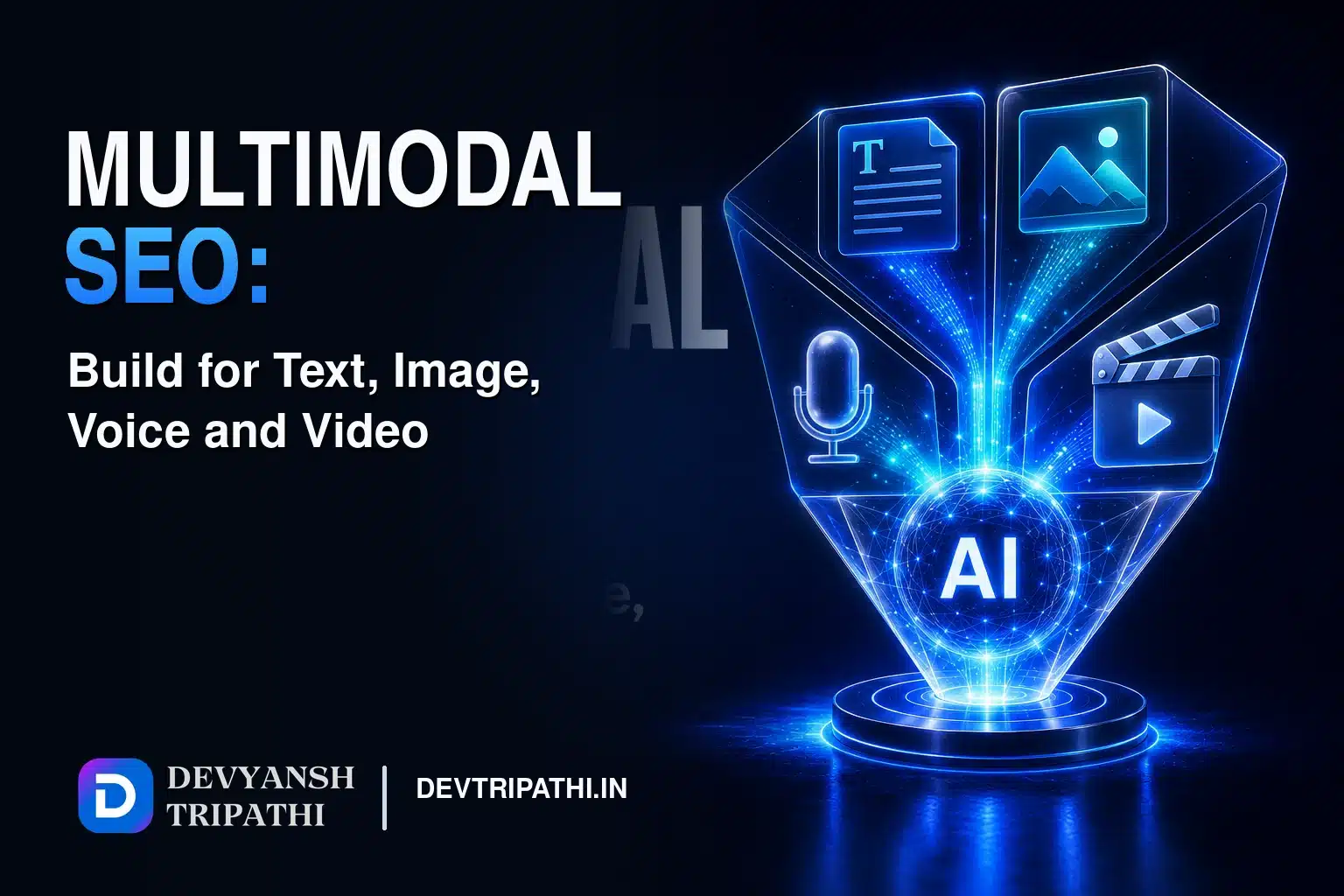
Multimodal SEO: Build for Text, Image, Voice and Video
03 June 2026
In 2026, that single-channel reality no longer exists.
AI models like Google Gemini, GPT-4o, and Claude can now see your product images, hear your podcast audio, and watch your video demonstrations to understand context. Users point their cameras at products to find pricing, speak questions to voice assistants to get recipes, and search YouTube for tutorials the same way they used to search Google for articles. Visual search has experienced a 73% jump in usage and voice search now accounts for 30% of all web browsing sessions. Google Lens handled roughly 20 billion visual searches per month in the past year, and short-form videos deliver 41% ROI compared to other video formats.
A text-only SEO strategy in this environment is a strategy for declining visibility.
Multimodal Search Optimization is the practice of ensuring your brand is discoverable and citable across every modality through which users now search: text, image, voice, video, and the combinations of all four that modern AI systems process simultaneously. Multimodal AI search is Google’s new standard for 2026. To rank, your content must be readable across text, images, video, layout, and context, optimized for AI Overviews, supported by strong entity signals, structured with schema, and formatted clearly for LLM interpretation.
This guide covers the complete Multimodal Search Optimization framework: what it is, how AI systems process multiple content modalities, and the specific strategies that maximize your visibility across every major search surface simultaneously.
What Is Multimodal Search Optimization?
Multimodal Search Optimization is the discipline of optimizing your content across text, image, video, and voice formats so that AI-powered search systems can understand, connect, and surface your brand regardless of how a user initiates their search.
Multimodal AI search combines text, image, video, and voice to deliver richer, more contextual answers instead of relying on just one format. Brands that optimize across text, image, and video will dominate AI-driven visibility — this is not just about ranking on Google, it is about becoming the source AI trusts to answer user queries.
Traditional SEO optimized a single modality: written text on web pages. Multimodal Search Optimization extends that discipline to cover every format through which users now search and every format through which AI systems now interpret content. It is not about creating content in every possible format for its own sake. It is about ensuring that every important piece of information your brand offers is accessible to both human users and AI systems regardless of which modality the user initiates their search in.
For the foundational AI search strategy that Multimodal Search Optimization builds on, see: AI Search Optimization (AISEO): The Complete Guide at https://devtripathi.in/blogs/ai-search-optimization-aiseo-complete-guide/ and Generative Engine Optimization (GEO): Complete Strategy Guide at https://devtripathi.in/blogs/generative-engine-optimization-geo-strategy-guide/
Why Multimodal Search Matters: The Scale Shift
The numbers driving the urgency of Multimodal Search Optimization are significant across every modality.
In 2026, search is no longer limited to typing a few words into a search bar. Users now search with images, voice, video, and text, often all in one interaction. People take photos and ask questions about what they see. They watch short videos and expect instant answers. They speak to AI assistants and want natural, spoken responses.
AI models now process text, images, video, audio, and real-world signals simultaneously. Voice search, AI assistants, and wearable devices are accelerating zero-interface search. Queries will be longer, more natural, and context-aware.
The vector space reality: Modern search engines store data as vectors — mathematical coordinates. Text, images, and audio are all converted into numbers in the same space. “Apple” (the word), a picture of an apple, and the sound of a crunch are all stored close together in this vector space. This means that a brand that builds a rich, consistent presence across text, image, and video creates a denser vector signal around its core topics, making it more likely to be retrieved across every modality a user might search in.
How Google Gemini Processes Multimodal Queries
Google Gemini is the AI system most central to Multimodal Search Optimization because it is natively multimodal: trained on and capable of processing text, images, video, and audio simultaneously. When a user submits a query to Google AI Mode or Google AI Overviews, Gemini evaluates not just text content but image metadata, video transcripts, and structured data all at once.
This shift means your brand must be optimized for how AI systems see, hear, and understand content, not just how crawlers read text.
For your brand to rank well in Gemini-powered experiences, every content asset you publish must carry consistent entity signals across modalities. The text on your website, the alt text on your images, the transcript of your YouTube video, and the metadata on your podcast episode should all consistently reference the same entities, use the same terminology, and point back to the same brand identity. Inconsistency across modalities reduces Gemini’s confidence in your entity, just as entity inconsistency across platforms reduces Knowledge Graph confidence.
For the complete entity optimization framework, see: Knowledge Graph Optimization: The Complete Guide at https://devtripathi.in/blogs/knowledge-graph-optimization-complete-guide/
The Multimodal Cluster Strategy: The Most Powerful Tactic in Multimodal SEO
Do not just write a blog post. Embed a video on the exact same topic. Add an infographic with the exact same data. By reinforcing the same concept across three different modalities (text, video, image), you create a dense vector signal. The AI becomes highly confident that your URL is the definitive source for that topic.
This is the Multimodal Cluster Strategy, and it is the highest-leverage single tactic in Multimodal Search Optimization.
For every major topic in your content cluster, create content that addresses that topic across all four modalities:
Text layer: A comprehensive written article with answer-first structure, question-format headers, expert quotes, statistics, and FAQPage schema. This is the foundational layer and feeds text-based AI retrieval.
Image layer: High-quality infographics, diagrams, and visual assets with descriptive alt text, WebP format, and ImageObject schema. These feed Google Lens, Google Images, and Gemini’s visual processing layer.
Video layer: A YouTube or embedded video covering the same topic with keyword-optimized title, accurate transcript, VideoObject schema, and chapter markers. This feeds YouTube search, Google Video results, and Gemini’s video analysis layer.
Voice layer: A directly extractable 40 to 60 word answer block in the text content with FAQPage and Speakable schema markup. This feeds voice assistants and the conversational AI search layer.
When all four layers are present for a single topic cluster, AI systems processing any modality-specific query encounter your brand as a comprehensive, multi-dimensional reference for that topic.
For the content cluster architecture that structures Multimodal Clusters, see: Topical Authority SEO: The Complete Guide at https://devtripathi.in/blogs/topical-authority-seo-complete-guide/
The 4 Pillars of Multimodal Search Optimization
Pillar 1: Text Optimization — The Foundation Layer
Text remains the foundation of all multimodal search. Without a strong, semantically rich textual base, it is difficult for search engines to understand the context of your images and voice content. Every image, video, and audio asset you publish needs strong text-based context surrounding it: descriptive captions, transcript text, structured data, and topically authoritative page content that gives AI systems the semantic grounding to interpret the non-text assets correctly.
Text-layer requirements for Multimodal Search Optimization:
Answer-first content structure with direct answer blocks in the first 150 words
Question-format H2 and H3 headers matching real user query patterns
Expert quotes with full attribution and specific statistics with source references
FAQPage, Article, and ItemList JSON-LD schema deployment
Topical cluster architecture with systematic internal linking
E-E-A-T signals through credentialed author pages and verifiable expertise
For the complete text optimization foundation, see: Modern SEO Strategies: The Complete Guide to What Works in 2026 at https://devtripathi.in/blogs/modern-seo-strategies-complete-guide/
Pillar 2: Image Optimization — The Visual Layer
Images are the second most important multimodal search signal for most websites. Images account for over 30% of all Google search results page real estate, yet most SEO strategies treat image optimization as an afterthought.
Image layer requirements for Multimodal Search Optimization:
Descriptive alt text on every image (50 to 150 characters, specific entity and attributes)
Keyword-rich file names using hyphens as separators
WebP or AVIF format as the primary image format
Explicit width and height attributes to prevent CLS
ImageObject or Product schema on all commercially important images
Image sitemap submitted through Google Search Console
Consistent visual brand identity so Google Lens can associate your images with your brand entity
For the complete image optimization strategy, see: Visual Search Optimization: The Complete Guide at https://devtripathi.in/blogs/visual-search-optimization-complete-guide/
Pillar 3: Video Optimization — The Engagement Layer
Video is one of the fastest-growing multimodal search channels. AI search engines like ChatGPT and Perplexity cite sources based on comprehensive signals including schema markup, image metadata, and video transcripts.
Video content feeds multimodal search through three distinct mechanisms: YouTube search (the world’s second-largest search engine), Google Video Results (video carousels in standard Google SERPs), and AI transcript analysis (Gemini and other AI systems analyze video transcripts to understand video content for citation purposes).
Video layer requirements for Multimodal Search Optimization:
Keyword-optimized video titles with the primary keyword in the first 5 words
Detailed descriptions of at least 200 words with natural keyword inclusion
Accurate full transcripts uploaded to the video hosting platform
Chapter markers with keyword-relevant section titles
VideoObject JSON-LD schema on all video-hosting pages
Custom thumbnails with high contrast, readable 3 to 5 word text, and expressive visuals
Speakable schema on the most important answer content adjacent to each video
A landmark Milestone Research study found that rich results including video rich snippets achieved 58% CTR compared to 41% for non-rich results. VideoObject schema implementation is one of the most accessible paths to rich result eligibility.
For dedicated video search optimization strategy, see: Video Search SEO: The Complete Guide at https://devtripathi.in/blogs/video-search-seo-complete-guide/
Pillar 4: Voice Optimization — The Conversational Layer
27% of mobile users now search with voice commands, and AI search engines cite sources based on schema markup and conversational patterns. Voice search feeds Multimodal Search Optimization through two channels: voice assistants (Google Assistant, Siri, Alexa) and the conversational AI layer where users speak to ChatGPT, Gemini, and Perplexity using voice input.
Voice layer requirements for Multimodal Search Optimization:
Direct 40 to 60 word answer blocks after every question-format header
FAQPage schema on all FAQ content
Speakable schema explicitly marking voice-suitable content sections
HowTo schema for step-by-step instructional content
Conversational sentence structure (Subject Is Predicate, active voice, second person)
Page LCP under 2.5 seconds on mobile (voice search is predominantly mobile-initiated)
NAP consistency across all platforms for local voice queries
For the complete voice optimization strategy, see: Voice Engine Optimization (VEO): The Complete Guide at https://devtripathi.in/blogs/voice-engine-optimization-veo-complete-guide/
Measuring Multimodal Search Performance
Traditional SEO metrics capture only part of the multimodal search picture. Comprehensive measurement requires tracking visibility across text, voice, image, and AI search channels simultaneously.
Text search performance: Google Search Console Performance report, filtered by web search. Track impressions, clicks, CTR, and average position for primary keywords.
Image search performance: Google Search Console filtered by “Search type: Image.” Track image impressions, clicks, and which images are driving the most visual search traffic.
Video search performance: YouTube Studio analytics for YouTube-specific metrics (watch time, CTR, retention). Google Search Console for video-rich result appearances in standard Google search.
Voice search performance: Google Search Console filtered for conversational queries of 6 or more words. Track featured snippet ownership as the primary voice answer eligibility indicator.
AI citation performance: AI citation tracking has emerged as a critical metric. Services like Passionfruit Labs, BrightEdge, and specialized tools now monitor how often your content appears in ChatGPT, Perplexity, Google AI Overviews, and other AI-generated responses.
For the complete AI visibility measurement framework, see: AI Visibility Tracking: The Complete Guide at https://devtripathi.in/blogs/ai-visibility-tracking-complete-guide/
Frequently Asked Questions About Multimodal Search Optimization
What is Multimodal Search Optimization?
Multimodal Search Optimization is the practice of optimizing your content across text, image, video, and voice formats so that AI-powered search systems can understand, connect, and surface your brand regardless of how a user initiates their search. It ensures your brand has strong, consistent signals in every modality that modern AI systems process, from Google Gemini’s image and video analysis to ChatGPT’s text retrieval to voice assistant answer selection.
Why is multimodal optimization important in 2026?
Visual search has experienced a 73% jump in usage, voice search accounts for 30% of all browsing sessions, Google Lens processes billions of visual queries monthly, and AI systems like Gemini natively process text, images, video, and audio simultaneously. A brand that only optimizes its text content is invisible to the growing portion of searches initiated through other modalities. Multimodal optimization ensures complete search visibility across every discovery channel.
What is the Multimodal Cluster Strategy?
The Multimodal Cluster Strategy is the practice of covering every major topic in your content library across all four search modalities simultaneously: a comprehensive text article, infographics with proper alt text, a YouTube video with accurate transcript, and voice-optimized FAQ content with Speakable schema. When all four modalities are present for a single topic, AI systems encounter your brand as a dense, multi-dimensional reference source, increasing citation confidence and retrieval probability across every type of search query.
How does Google Gemini process multimodal content?
Google Gemini is natively multimodal, trained on and capable of processing text, images, video, and audio simultaneously. When powering Google AI Mode and AI Overviews, Gemini evaluates your text content, image alt text and metadata, video transcripts and chapter markers, and structured data all at once. Brands with consistent entity signals across all these modalities receive higher citation confidence from Gemini than brands with strong text content but missing image, video, or voice optimization layers.
Does multimodal optimization replace traditional SEO?
No. Text remains the foundation of all multimodal search. Without strong, semantically rich text content as the base layer, AI systems struggle to understand the context of associated image, video, and voice assets correctly. Multimodal optimization extends traditional SEO rather than replacing it. Every multimodal optimization tactic builds on the foundational text SEO layer: topical authority, E-E-A-T signals, schema markup, and answer-first content structure.
What schema markup is needed for multimodal search?
The complete schema stack for Multimodal Search Optimization includes: Article schema (text layer), ImageObject or Product schema (image layer), VideoObject schema (video layer), FAQPage schema (voice and conversational layer), Speakable schema (voice delivery layer), and HowTo schema (instructional voice content). Deploying all relevant schema types across a single page creates explicit machine-readable signals for every modality the page addresses.
How important are video transcripts for multimodal SEO?
Video transcripts are essential for multimodal search because they convert spoken video content into indexed text that AI systems can retrieve, analyze, and cite. Without accurate transcripts, the spoken content of a video is invisible to text-based AI retrieval systems. Upload custom transcripts to YouTube and embed transcript text on video-hosting pages. AI systems including Gemini analyze video transcripts alongside visual frames and audio to understand video content for citation purposes.
Can small websites implement multimodal optimization effectively?
Yes. The multimodal optimization priority for a small website is straightforward: start with the text and voice layers (answer-first content structure, FAQPage and Speakable schema, question-format headers) since these require only content restructuring with no additional media creation. Then add the image layer by optimizing existing images (alt text, file names, WebP format, schema). Add the video layer as resources allow, starting with one optimized YouTube video per major topic cluster. The Multimodal Cluster Strategy can be built incrementally over time.
How does voice search fit into a multimodal strategy?
Voice search is the conversational layer of Multimodal Search Optimization. It is optimized with the same content signals that improve AI citation performance: 40 to 60 word direct answer blocks, FAQPage schema, question-format headers, and Speakable schema. The additional voice-specific requirement is Core Web Vitals performance on mobile (LCP under 2.5 seconds), since voice search is predominantly initiated on mobile devices. Optimizing the voice layer simultaneously strengthens AI Overview citation eligibility.
What tools help measure multimodal search performance?
For text search: Google Search Console Performance report. For image search: Google Search Console filtered by image search type. For video: YouTube Studio analytics and Google Search Console video rich results report. For voice: Google Search Console filtered for 6-plus word conversational queries and featured snippet tracking. For AI citation: Passionfruit Labs, BrightEdge, Otterly.AI, and Profound for cross-platform AI visibility monitoring. For overall multimodal audit: Search Everywhere Optimization (SE Blog) and Lumar’s GEO Toolkit.
What is the single most impactful multimodal optimization action?
The highest-ROI single multimodal optimization action is embedding an accurately transcribed, chapter-marked YouTube video on your highest-traffic text articles. This single action adds the video layer to an existing strong text layer, creates VideoObject schema eligibility, improves page dwell time (a text search engagement signal), feeds Gemini’s video analysis layer, and creates a YouTube search traffic channel — all from one piece of content that addresses the same topic your text article already covers.
Conclusion
Multimodal Search Optimization is the natural evolution of SEO into the environment that already exists: one where AI systems can see images, hear audio, watch videos, and read text simultaneously, and where users initiate searches through all four modalities depending on the context of their need.
The core principle is the same as it has always been in SEO: ensure that the most relevant, most authoritative answer to your target user’s query is accessible to the systems that match queries to answers. In 2026, those systems process four modalities at once, and a brand visible in only one of them is leaving three channels of discovery unreached.
The Multimodal Cluster Strategy makes this achievable without requiring an overwhelming content production increase. Build the strongest text article you can on your most important topics. Optimize every image on those pages with proper alt text, format, and schema. Create companion videos with accurate transcripts and VideoObject schema. Add voice-optimized FAQ content with Speakable markup. Measure visibility across all four channels.
The brands that build dense, consistent multimodal signals around their core topics become the sources AI systems trust and cite first, across every modality their users search in.
Google Gemini Documentation — Multimodal Capabilities: https://deepmind.google/technologies/gemini/
Google Search Central — Video SEO Best Practices: https://developers.google.com/search/docs/appearance/video
Schema.org Speakable: https://schema.org/speakable
Schema.org VideoObject: https://schema.org/VideoObject
NEURONwriter — Multimodal SEO Guide: https://neuronwriter.com/multimodal-seo-guide/

Devyansh Tripathi
I’m Devyansh Tripathi, an SEO strategist and digital growth expert, helps businesses and individuals rank higher and drive organic traffic. Through DevTripathi., he shares cutting-edge SEO insights, content strategies, and marketing hacks. Passionate about digital success, he’s on a mission to make SEO simple, effective, and result-driven!
Posts
- What Google’s New AI Search Documentation Means for SEO Teams
- Google I/O 2026 Search: AI Agents, Gemini 3.5 and the Unified Box
- Google’s AI Optimization Guide: The Technical and Content Checklist
- July 2026 SEO Update: AI Overviews, llms.txt and Search Console
- Prompt Optimization Beyond Page One: The Position-21 Citation Opportunity
Categories
- AI Citation Optimization
- AI Search Optimization (AISEO)
- AI Visibility Tracking
- Answer Engine Optimization (AEO)
- Brand Authority SEO
- Brand SERP Optimization
- Community Signal SEO
- Conversational Search Optimization
- Generative Engine Optimization (GEO)
- Knowledge Graph Optimization
- Modern SEO Strategies
- Multimodal Search Optimization
- Prompt Optimization
- SEO Trends
- Social Search Optimization
- Topical Authority SEO
- Uncategorized
- Video Search SEO
- Visual Search Optimization
- Voice Engine Optimization (VEO)
- Zero Click Search Optimization
Latest News
Text Widget
Empowering brands with insights, strategies, and stories that drive digital growth.