Optimize Multi-Turn AI Mode Sessions with Query Architecture
03 July 2026
Conversational search optimization in 2026 requires a fundamentally more advanced approach than query phrasing alignment and FAQ section deployment. With Google AI Mode surpassing one billion monthly active users, the average ChatGPT prompt reaching 23 words versus Google’s 3.37, and one in six AI Mode searches now being non-text multimodal input, the optimization target has expanded from matching text-based conversational queries to preparing content for multi-turn sessions, proactive Information Agent monitoring, and image-based conversational queries that never involve any typed text at all.
This advanced guide covers the 2026 conversational search landscape that goes beyond the foundation: the four-layer conversational query architecture that maps query complexity across single-turn, multi-turn, multimodal, and proactive agent interactions, the AI Mode session optimization framework that maximizes citation presence across multi-turn research conversations rather than optimizing for individual queries, the Information Agents content cadence that prepares content for the proactive conversational layer Google launched at I/O 2026, and the conversational intent gap analysis methodology that identifies where your content fails at the specific turn in a research conversation where users most frequently abandon your content for competitor sources.
Is Your Content Optimized for AI Mode Multi-Turn Sessions or Only for Single-Query Keywords?
Advanced conversational search optimization requires content that serves complete research conversations, not just single query matches. Get a complete conversational search audit covering your multi-turn session coverage, AI Mode citation rate, Information Agent readiness, multimodal content optimization, and the conversational intent gap analysis for your highest-value topic categories.
Get My Conversational Search AuditThe Four-Layer Conversational Query Architecture
Conversational search optimization in 2026 must address four distinct query interaction layers that have emerged as AI Mode has scaled and users have developed more sophisticated search behaviors. Each layer requires different content architecture, different schema signals, and different performance measurement approaches.
Layer 1
Single-Turn Conversational Queries
Single-turn conversational queries are complete natural language questions submitted once without follow-up: "What is the best GEO content strategy for a SaaS brand with a limited content team?" The 23-word average ChatGPT prompt reflects this layer. Content optimized for single-turn queries must answer the complete intent including all contextual qualifiers in the prompt, not only the abbreviated keyword core that traditional SEO would target. Single-turn optimization is the foundation covered in the previous conversational search guide at conversational search optimization.
Layer 2
Multi-Turn Research Sessions
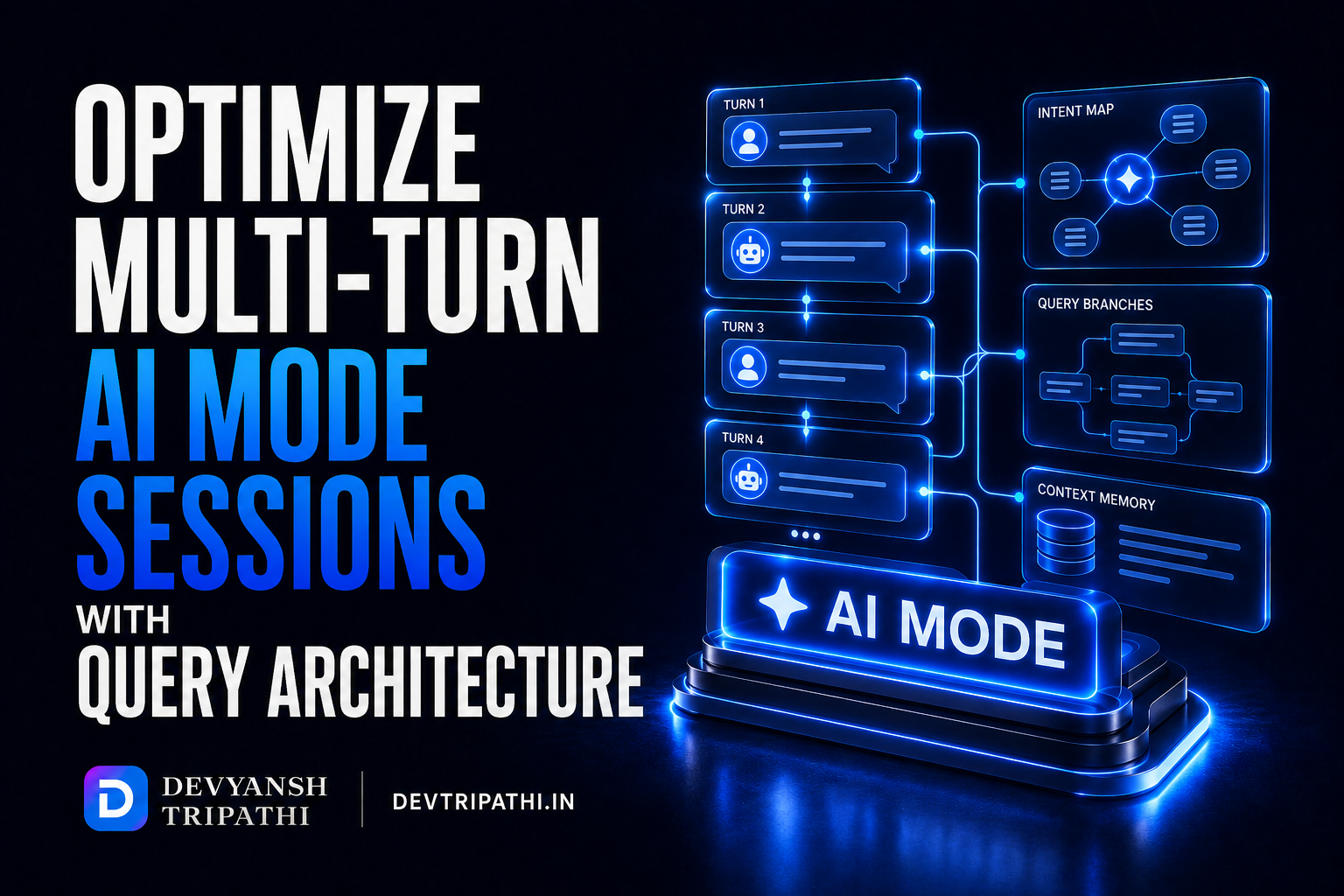
Multi-turn research sessions involve three to seven sequential queries where each subsequent prompt builds on the previous response. A user begins with "what is AI search optimization," follows with "how does GEO differ from traditional SEO," then "which GEO tactics work fastest," then "how do I measure GEO results," progressing through a complete research arc within a single AI Mode session. Content that only addresses the entry query but fails the follow-up turns loses the user to a competitor source at the point where the information gap appears. Multi-turn session optimization requires mapping the complete research arc for each priority topic and ensuring your content addresses every predictable turn in the conversation.
Layer 3
Multimodal Conversational Queries
With more than one in six AI Mode searches being non-text multimodal input, users are increasingly submitting images, screenshots, documents, or combinations of image plus text to initiate AI Mode conversations. A user photographing a competitor's pricing page and asking "how does this compare to similar services in this category" has submitted a conversational query that contains no typed keywords whatsoever. Content preparation for multimodal conversational queries requires optimized image assets, complete product and pricing structured data, and entity-clear descriptions that allow AI Mode to associate your brand with comparison queries triggered by competitor visual inputs.
Layer 4
Proactive Agent Queries (Information Agents)
Information Agents, launched at Google I/O 2026, represent the most structurally new layer: proactive conversational AI that monitors the web on users' behalf and delivers source-linked updates without any user query being required. When a user tells an Information Agent to monitor updates on a specific topic, the agent evaluates content on a verification cadence rather than a one-time publication basis. Content that is never updated after initial publication fails this layer entirely because Information Agents prefer verified, maintained content over static publications regardless of initial quality. For the complete AEO framework addressing Information Agents, see our AEO Advanced Strategies guide.
23words — average ChatGPT prompt vs 3.37 for Google search (Growth Memo via Omnibound 2026)
1B+monthly active users on Google AI Mode (Google, 2026)
1 in 6AI Mode searches is multimodal non-text input, growing 40% MoM (AEO Vision 2026)
13.7%URL overlap between AI Mode and AI Overviews for same queries (Ahrefs, 540K pairs)
AI Mode Session Optimization: The Multi-Turn Research Arc Framework
AI Mode session optimization is the practice of preparing content to serve complete multi-turn research conversations rather than optimizing for individual query matches. A user who receives a satisfying answer to their entry query from your content is likely to submit follow-up queries within the same AI Mode session. If AI Mode sources your content for the entry response but switches to a competitor for the second-turn follow-up because you have no equivalent coverage there, you have lost the most engaged visitor at the most critical point of their research journey.
Mapping the Research Arc for Priority Topics
Map the complete research arc for each priority topic by submitting your target entry query to Google AI Mode and recording every follow-up query suggestion the system generates in response. AI Mode’s suggested follow-up queries reveal the natural progression that users take through multi-turn sessions on that topic. Each suggested follow-up represents a turn in the research arc where your content either maintains citation presence or loses the user to an alternative source.
For an AI search optimization topic, the research arc typically progresses through five turns: what it is and why it matters, how it differs from traditional SEO, what specific actions to take, how to measure results, and which tools to use for implementation. Content that addresses all five turns with equal depth and structure maintains AI Mode citation presence across the complete arc. Content that addresses only the first two turns in detail is abandoned at the third turn when the user’s research moves to implementation specifics your content does not cover adequately.
The Two-Source Session Problem
The two-source session problem occurs when AI Mode cites your content for the entry query but switches to a competitor for the second turn because the competitor’s content addresses the follow-up topic with greater depth or clarity. This represents a significant citation loss scenario because AI Mode tends to maintain source consistency across a session once it establishes a preferred source, meaning the competitor that earns the second-turn citation often retains citation advantage through subsequent turns even when your content would be technically adequate for those later turns.
Prevent the two-source session problem by auditing your content coverage against the complete research arc for each priority topic. Identify the turns where your coverage depth falls below competitor standards. Prioritize content development that closes those specific gaps rather than creating new entry-point content for topics where you already have strong first-turn coverage but weak follow-up coverage. For the topical authority cluster architecture that prevents these coverage gaps systematically, see our AISEO Cycle 3 guide.
Information Agents: The Proactive Conversational Layer
Google’s Information Agents create a conversational search surface that has no precedent in search history: persistent AI monitoring that delivers brand citations to users without any active query being submitted. A user who tells an Information Agent to monitor new developments in AI search optimization will receive proactive notifications when relevant content is published, with source links attached, creating a referral channel from content to reader that bypasses the traditional search query entirely.
What Information Agents Evaluate for Source Selection
Information Agents select sources for proactive notification delivery based on three content characteristics that differ from standard search citation selection. Content currency is the primary signal: agents prefer recently verified and updated content over static publications because agent recommendations reflect on Google’s judgment, and out-of-date source recommendations damage user trust in the agent’s reliability. Content specificity is the second signal: agents prefer content that matches the user’s monitored topic with high precision rather than broadly relevant content that tangentially addresses the topic. Content authority is the third signal: agents prefer sources that AI systems already recognize as authoritative for the monitored topic rather than new or unknown sources regardless of content quality.
The Content Verification Cadence for Information Agents
Building content that Information Agents reliably select for proactive notification delivery requires establishing a verification cadence rather than a publication cadence. The distinction is significant: publication cadence tracks when content was created; verification cadence tracks when content was last confirmed to be current and accurate. Agents respond to verification signals (visible last-updated dates, refreshed statistics with current dates, newly cited sources) even when the underlying content has not materially changed, because the verification action confirms that the content has been evaluated for current accuracy rather than simply left unmodified.
The recommended verification cadence for content targeting Information Agent selection is monthly for fast-moving topic areas such as AI search developments, quarterly for moderately evolving topics such as established SEO tactics, and semi-annual for highly stable topics such as foundational search principles. Each verification cycle should update at minimum the most time-sensitive statistic in the content with a current-year source, add any significant developments that have occurred since the last update, and refresh the visible last-updated date to signal the verification action to Information Agents scanning for content currency signals.
Content That Never Gets Updated Gets Dropped by Information Agents
Information Agents reward verified, maintained content over static publications. Dev Tripathi designs conversational search content systems with built-in verification cadences, multi-turn arc coverage, and AI Mode session optimization that keeps your content cited across the full research conversation rather than only at the entry point.
Build My Conversational Search SystemMultimodal Conversational Query Optimization
With more than one in six AI Mode searches being non-text multimodal input growing at 40% month over month, content preparation for multimodal conversational queries has become a practical requirement rather than a future consideration for brands in visual product categories, professional service categories where users submit screenshots for analysis, and any category where users photograph competitor products, pricing, or marketing materials as the basis for AI Mode comparison queries.
The Competitive Visual Query Scenario
When a user photographs a competitor’s pricing page and asks AI Mode “what are my alternatives to this and how do they compare in value,” the AI must identify your brand as a relevant alternative from its entity knowledge and product data without any typed reference to your brand name. Brands that appear in this scenario have achieved three things simultaneously: entity recognition strong enough for AI Mode to associate them with the competitor’s category, complete pricing and feature structured data that enables the AI to generate a useful comparison, and content authority for the relevant feature comparison criteria that makes the AI confident in including them as a recommended alternative.
Optimize for competitive visual queries by maintaining complete Product schema on all product and pricing pages, ensuring your Organization schema entity is associated with all relevant category terms through sameAs references and content topic coverage, and publishing comprehensive comparison content that addresses the specific evaluation criteria users submit when conducting visual competitor analysis. The voice search and VEO dimension of this optimization is covered in depth in our VEO Strategy guide.
The AI Mode Fan-Out and Topical Cluster Coverage
AI Mode decomposes complex conversational queries into multiple parallel sub-searches through its fan-out mechanism. A query like “what is the most cost-effective approach to building AI search visibility for a 20-person SaaS startup in 2026” generates sub-queries covering AI search basics, budget-appropriate AI search tactics, SaaS-specific AI search considerations, and implementation timelines for small teams as four separate retrieval operations before synthesizing a response. Your content must address all four sub-query dimensions to appear in the fan-out retrieval pool for the complete primary query, making topical cluster coverage the essential foundation for conversational search optimization at scale. For the zero-click implications of this fan-out coverage requirement, see our Zero-Click Search Optimization guide.
The Conversational Intent Gap Analysis
The conversational intent gap is the specific turn in a multi-turn research session where users switch from your content to a competitor’s because your coverage of that turn’s topic is insufficient, less structured, or less current than the alternative. Identifying and closing conversational intent gaps is the highest-value conversational search optimization action available because it addresses the precise moment where research momentum and brand consideration are lost rather than attempting to optimize broadly across all possible query variations.
How to Conduct a Conversational Intent Gap Analysis
Conduct a conversational intent gap analysis by mapping the research arc for your five highest-value topic categories, then testing AI Mode through the complete arc sequentially while recording at which turn your content stops appearing as a primary citation. The turn where your citation disappears marks the conversational intent gap. Analyze what content is cited at that turn instead: what does the alternative source cover that yours does not, what structural format does it use, and what specific information is it providing that makes it preferable to your coverage of the same topic dimension.
Close conversational intent gaps through targeted content additions to existing pages rather than new page creation wherever possible. Adding a section that addresses the specific sub-topic that represents the gap turn, structured with the answer-first format and FAQ schema that increases citation probability, typically produces measurable AI Mode citation improvement at that turn within 4 to 6 weeks of indexing. Track citation recovery by re-testing the complete research arc monthly after implementing gap closure content to confirm that the alternative source no longer displaces yours at the previously identified gap turn. For the complete conversational search foundation this advanced framework builds on, see our previous Conversational Search guide.
| Conversational Query Layer | Primary AI Platform | Content Requirement | Key Schema | Optimization Priority |
|---|---|---|---|---|
| Single-Turn | ChatGPT, Perplexity, AI Overviews | Complete contextual answer with all qualifiers addressed | FAQPage, Article | Foundation — prerequisite for all other layers |
| Multi-Turn Sessions | Google AI Mode, ChatGPT | Full research arc coverage, every predictable follow-up turn | Article cluster, HowTo, FAQPage | High — highest citation retention opportunity |
| Multimodal | Google AI Mode (1 in 6 searches) | Complete Product schema, entity clarity, comparison content | Product, Organization, ImageObject | High and growing at 40% MoM |
| Information Agents | Google AI Mode (Ultra tier expanding) | Verified, maintained content on regular cadence | Article with updated date signals | Strategic — proactive referral surface |
Frequently Asked Questions About Conversational Search Optimization
What is advanced conversational search optimization in 2026?
Advanced conversational search optimization in 2026 is the practice of preparing content to serve all four conversational query interaction layers: single-turn natural language queries, multi-turn AI Mode research sessions, multimodal queries submitted as images or document uploads, and proactive Information Agent monitoring that delivers source-linked content to users without any active query. It extends beyond single-query optimization to address the complete conversational research journey that users conduct across multiple interactions with AI search systems.
Why does the 23-word average ChatGPT prompt matter for content strategy?
The 23-word average ChatGPT prompt versus 3.37 words for Google reveals that AI search users express complete contextual questions rather than abbreviated keyword fragments. Content structured for 3-word keywords cannot address the full contextual intent of a 23-word query that includes audience qualifiers, budget constraints, geographic scope, and specific use case details. Conversational search optimization requires content depth, specificity, and contextual sensitivity that keyword-density-optimized content cannot provide.
What is the multi-turn research arc and why does it matter for AI Mode optimization?
The multi-turn research arc is the natural progression of follow-up queries that users submit in sequence within a single AI Mode session to explore a topic progressively from introduction through implementation. It matters because AI Mode tends to maintain source consistency once it establishes a preferred citation source, meaning the brand whose content earns the entry query citation is likely to retain citation advantage through subsequent turns if its follow-up coverage is adequate. Brands that lose citation at any turn typically lose it for all subsequent turns in that session.
What are Information Agents and how do they change content strategy?
Information Agents, launched at Google I/O 2026, are background AI systems that monitor the web on users' behalf and deliver proactive source-linked notifications when relevant content appears or updates. They change content strategy by making verification cadence as important as publication cadence: agents prefer content maintained on a regular update schedule over static publications regardless of initial quality. Content that is never updated after publication fails Information Agent selection because agents prioritize verified current sources over historically well-written but potentially outdated ones.
What is the conversational intent gap and how do I identify it?
The conversational intent gap is the specific turn in a multi-turn AI Mode research session where your content stops being cited and a competitor's content takes over. Identify it by testing AI Mode through the complete research arc for a priority topic sequentially, recording at which turn your citation disappears. The turn where your citation drops marks the gap. Analyze what the alternative source provides at that turn that yours does not, then close the gap through targeted content additions to existing pages addressing that specific sub-topic dimension.
How does multimodal search affect conversational optimization requirements?
With more than one in six AI Mode searches being non-text multimodal input, users increasingly submit images, screenshots, and documents as the basis for conversational queries. Brands that appear in responses to visual competitor queries achieve entity recognition strong enough for AI Mode to associate them with competitor categories, complete Product schema enabling AI-generated comparisons, and content authority for relevant evaluation criteria. Multimodal optimization requires complete structured data, clear entity signals, and comparison content rather than keyword-based text optimization alone.
How do I optimize content for Information Agent selection?
Optimize for Information Agent selection through three practices. Establish a topic-specific verification cadence (monthly for fast-moving areas, quarterly for moderate evolution, semi-annual for stable topics) and execute each cycle by updating statistics with current-year sources and refreshing visible last-updated dates. Structure content around specific, narrow topics that match the precision of monitoring requests users configure in their Information Agents rather than broad topic coverage. Maintain entity authority signals that make your content a recognized source for the monitored topic category before Information Agents begin prioritizing your content for notification delivery.
Why do AI Mode and AI Overviews cite the same URLs only 13.7% of the time?
AI Mode and AI Overviews cite only 13.7% of the same URLs because they use different retrieval mechanisms. AI Overviews draw from Google's standard search index using direct extraction from top-ranking pages. AI Mode uses query fan-out, issuing multiple parallel sub-searches, and synthesizes across a broader source pool that reflects the multi-dimensional intent of longer conversational queries. The difference means that optimizing only for AI Overviews leaves 86.3% of AI Mode citation opportunities unaddressed, requiring a separate content and structural optimization track for AI Mode multi-turn session performance.
What is query fan-out and how should it influence content architecture?
Query fan-out is AI Mode's mechanism of decomposing a complex conversational query into multiple parallel sub-searches that are retrieved simultaneously before synthesis. A single conversational query may generate three to seven sub-queries covering different dimensions of the primary intent. Content architecture must ensure that topical clusters cover every predictable sub-query dimension rather than only the primary topic, because fan-out retrieval selects the best available source for each sub-query independently. Brands with comprehensive cluster coverage match more sub-queries per primary query and earn broader, more consistent AI Mode citation presence.
How does conversational search optimization connect to voice search?
Conversational search optimization and voice search optimization share the natural language query format requirement: both require content structured for complete spoken or typed questions rather than keyword fragments. Voice search is the most purely conversational format, with users speaking complete natural language questions and expecting a single concise spoken answer. The 30-word voice answer tier and Speakable schema that optimize for voice delivery also improve AI Mode citation eligibility for single-turn conversational queries by providing directly extractable answer blocks in the content format AI systems prefer for spoken response generation. For the complete voice search strategy, see our guide to voice engine optimization.
What content length performs best for multi-turn AI Mode session optimization?
Comprehensive pillar pages covering a topic from definition through implementation through measurement in a single well-structured piece perform best for multi-turn AI Mode session optimization because they provide complete research arc coverage from a single URL. This gives AI Mode a single authoritative source to maintain across multiple session turns rather than switching sources between turns. However, depth must be combined with structural clarity: FAQ sections, numbered process steps, comparison tables, and direct answer blocks at each section ensure AI Mode can extract specific answers at each session turn without needing to present the entire article.
How do I measure conversational search optimization performance?
Measure conversational search performance across four dimensions monthly. AI Mode citation rate for complete research arcs tested turn by turn identifies exactly where your citation coverage holds and where it drops. Single-turn citation rate across conversational query phrasings in ChatGPT and Perplexity measures broader conversational platform performance. Branded search volume growth downstream of AI Mode exposure sessions measures the brand recall impact of multi-turn citation presence that does not always produce direct clicks. Information Agent selection rate for monitored topic categories measures proactive conversational referral performance as that layer expands beyond early adopters to mainstream AI Mode users throughout 2026.
Build Content That Serves Complete Conversational Research Journeys, Not Just Entry Queries
Advanced conversational search optimization requires four-layer content architecture covering single-turn, multi-turn, multimodal, and Information Agent interaction patterns. Dev Tripathi designs conversational search content systems that maintain citation presence across complete AI Mode research arcs and prepare your content for the proactive search layer that Information Agents represent.
Build My Conversational Search StrategyConclusion
Conversational search optimization in 2026 has expanded from matching natural language queries to preparing content for a four-layer interaction architecture spanning single-turn queries, multi-turn AI Mode research sessions, multimodal image-based inputs, and proactive Information Agent monitoring. With AI Mode surpassing one billion monthly users, average ChatGPT prompts reaching 23 words, and one in six AI Mode searches being non-text input, the scope of what conversational search optimization addresses has grown more significantly in the past twelve months than in the preceding three years.
The highest-leverage actions in this landscape are research arc mapping for multi-turn session optimization, conversational intent gap analysis and closure for retaining AI Mode citation across complete research sessions, content verification cadence implementation for Information Agent eligibility, and multimodal content structure that enables AI Mode to cite your brand in response to visual competitor queries. Together these four practices address the full conversational search opportunity that single-query optimization alone cannot capture in the 2026 AI search environment. For the foundational GEO framework that conversational search optimization operates within, see our Generative Engine Optimization guide.

Devyansh Tripathi
I’m Devyansh Tripathi, an SEO strategist and digital growth expert, helps businesses and individuals rank higher and drive organic traffic. Through DevTripathi., he shares cutting-edge SEO insights, content strategies, and marketing hacks. Passionate about digital success, he’s on a mission to make SEO simple, effective, and result-driven!
Posts
- What Google’s New AI Search Documentation Means for SEO Teams
- Google I/O 2026 Search: AI Agents, Gemini 3.5 and the Unified Box
- Google’s AI Optimization Guide: The Technical and Content Checklist
- July 2026 SEO Update: AI Overviews, llms.txt and Search Console
- Prompt Optimization Beyond Page One: The Position-21 Citation Opportunity
Categories
- AI Citation Optimization
- AI Search Optimization (AISEO)
- AI Visibility Tracking
- Answer Engine Optimization (AEO)
- Brand Authority SEO
- Brand SERP Optimization
- Community Signal SEO
- Conversational Search Optimization
- Generative Engine Optimization (GEO)
- Knowledge Graph Optimization
- Modern SEO Strategies
- Multimodal Search Optimization
- Prompt Optimization
- SEO Trends
- Social Search Optimization
- Topical Authority SEO
- Uncategorized
- Video Search SEO
- Visual Search Optimization
- Voice Engine Optimization (VEO)
- Zero Click Search Optimization
Latest News
Text Widget
Empowering brands with insights, strategies, and stories that drive digital growth.