Prompt-Led SEO: Map Fan-Out Queries to Brand Recommendations
31 May 2026
These are not the same question. And the gap between them explains why many brands that rank well in Google are still invisible in AI-generated responses.
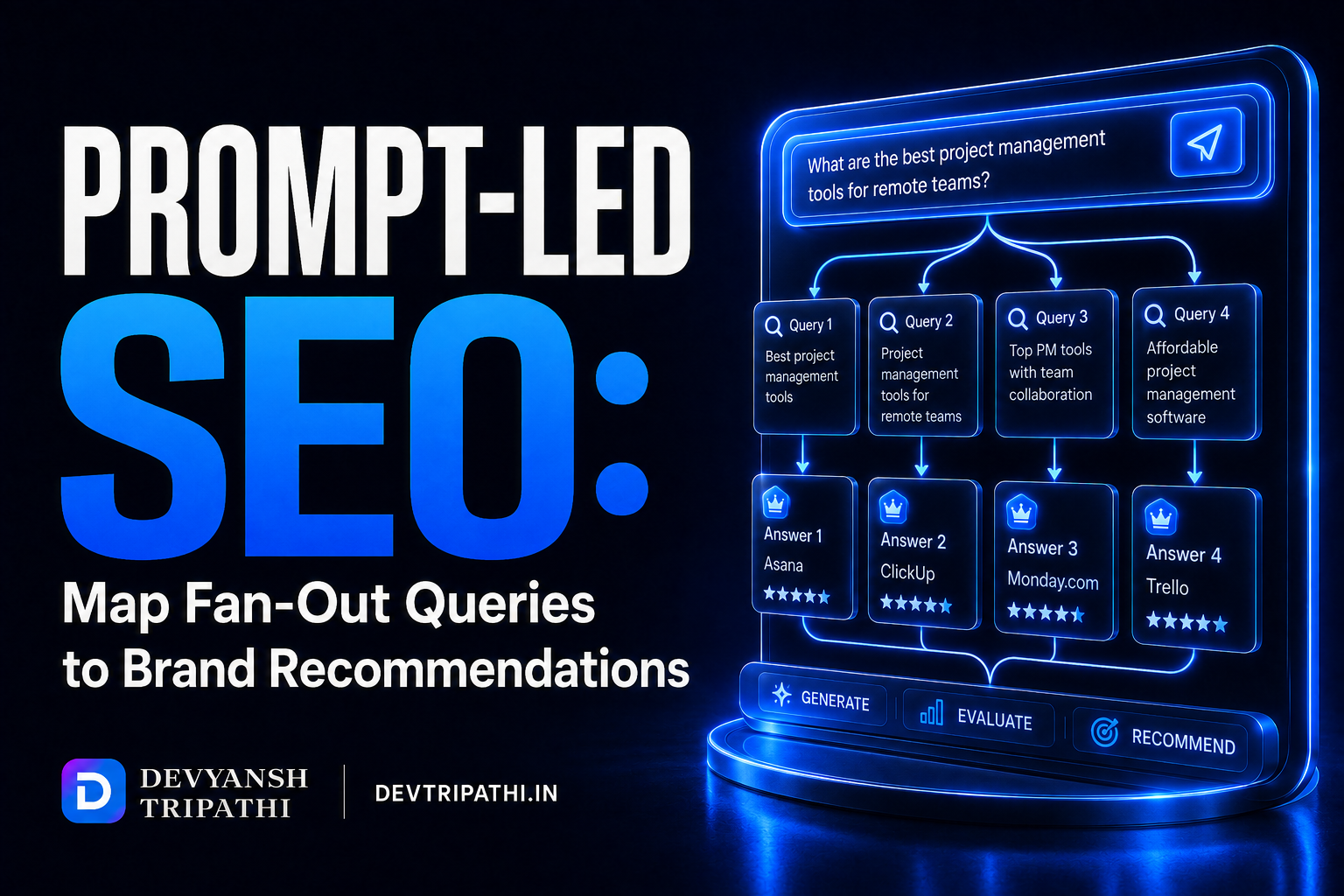
When a user asks ChatGPT “what is the best SEO tool for tracking keyword rankings on a budget,” ChatGPT does not search for that full phrase. It breaks the query into sub-components: “affordable SEO tools,” “keyword rank tracking software,” and “budget SEO tools comparison.” It runs separate searches for each sub-query and synthesizes the results. This internal process is called a fan-out query, and it is the mechanism that determines which content gets retrieved and ultimately cited.
Prompt Optimization is the discipline of structuring your content, building your topical coverage, and establishing your entity authority so that your pages are retrieved and cited across the full range of sub-queries an AI system generates — not just the top-level user prompt.
This guide covers exactly how AI prompt processing works, why prompt-based visibility requires a different optimization approach than keyword-based SEO, and the specific strategies that make your content the answer across the AI recommendation layer of modern search.
What Is Prompt Optimization in SEO?
Prompt Optimization in SEO is the practice of structuring digital content and brand presence to align with the natural language prompts users submit to AI search systems, and specifically with the sub-queries those AI systems generate internally when processing those prompts.
Ranking in Google requires matching keywords. Being cited in AI responses requires matching the semantic sub-queries AI systems generate when they try to answer user prompts. These sub-queries are never typed by any human. They are generated by the AI itself based on its interpretation of user intent, context, and the full range of information needed to generate a comprehensive response.
Understanding this distinction is the foundation of effective prompt optimization. A brand that only optimizes its content for the keywords users type will match the surface query but miss the sub-queries the AI generates. A brand that builds comprehensive topical coverage matching all natural sub-queries of its target topic becomes the citation source the AI selects across the full breadth of its retrieval process.
Prompt Optimization sits at the intersection of several established disciplines: GEO (Generative Engine Optimization), AEO (Answer Engine Optimization), and topical authority SEO. It is the application layer that specifically addresses how AI internal query generation determines citation eligibility.
For the foundational disciplines that Prompt Optimization builds on, see: Generative Engine Optimization (GEO): Complete Strategy Guide at https://devtripathi.in/blogs/generative-engine-optimization-geo-strategy-guide/ and Topical Authority SEO: The Complete Guide at https://devtripathi.in/blogs/topical-authority-seo-complete-guide/
How AI Systems Process User Prompts: The Fan-Out Query Mechanism
The most important concept in prompt optimization is the fan-out query. Understanding it transforms how you think about content planning for AI search.
When a user submits a complex natural language prompt to an AI search platform, the AI does not submit that full prompt to its retrieval system as a single query. Instead, it breaks the user’s intent into multiple smaller, more specific sub-queries and runs separate searches for each one.
For example, if a user asks Perplexity “I run a small B2B SaaS and want to know whether investing in GEO is worth it compared to continuing to focus on traditional SEO,” the AI might internally generate these sub-queries:
“GEO vs SEO comparison B2B SaaS”
“Generative Engine Optimization ROI”
“Traditional SEO value in 2026”
“B2B SaaS content marketing strategy”
“AI search optimization for small businesses”
Your content needs to be retrievable across multiple of these sub-queries to maximize the probability that you are cited in the final synthesized response. A single page optimized for “GEO strategy” will match only one of five sub-queries. A comprehensive content cluster covering GEO vs SEO, GEO ROI, AI search for SaaS, and topical comparisons will match three or four of them, dramatically increasing citation probability.
According to Citation Labs research, concentrated efforts on 15 to 20 high-value prompts outperformed broader tracking sets of 100 or more lower-quality prompts by 73% in terms of conversion-driven traffic generation. Quality of prompt coverage beats quantity.
For context on how fan-out query matching connects to AI citation rate, see: AI Citation Optimization: The Complete Guide at https://devtripathi.in/blogs/ai-citation-optimization-complete-guide/
Building a Prompt Research Framework
Prompt research is the foundation of effective prompt optimization. It is the equivalent of keyword research but conducted at the level of AI query generation rather than user typing behavior.
The goal of prompt research is to identify: the natural language prompts your target audience submits to AI platforms, the sub-queries those prompts generate, and the content gaps in your current library that prevent you from matching those sub-queries.
Step 1: Identify High-Value Prompts for Your Brand
Begin by listing the natural language questions your ideal customer would ask an AI assistant about your category. Go beyond short keywords to full-sentence prompts:
“What is the best [your service] for [use case]?”
“How does [your approach] compare to [alternative]?”
“Is [your service category] worth it for [business type]?”
“What should I look for when choosing a [your service]?”
“How do I [task you help with] without [common obstacle]?”
Use these sources to generate comprehensive prompt lists: customer support tickets and sales calls (natural language questions from real buyers), Reddit threads in your niche (questions posed in community conversations), Google’s People Also Ask box (natural language variants Google has identified as high-frequency), and Google Search Console query data filtered for 6 or more word queries (the conversational queries most likely to be submitted to AI platforms in similar form).
According to research from LLMrefs and automated prompt tools, some platforms auto-generate prompts from real user conversations. The prompt dataset from 4.5 million real ChatGPT user conversations is used by advanced AI visibility tools to identify exactly which prompts users are submitting to AI platforms in your category.
Step 2: Map Sub-Queries to Content Gaps
For each high-value prompt, manually run the prompt in ChatGPT and Perplexity and observe what topics appear in the response. These topics represent the sub-queries the AI generated. Compare each sub-query topic to your existing content library.
Sub-query topics that match existing cluster pages represent content you already have working for prompt coverage. Sub-query topics with no matching page in your library represent content gaps that prevent full prompt coverage. Prioritize content creation to fill the highest-value gaps in your prompt coverage first.
A site with comprehensive content across all major sub-query patterns for its target prompts achieves what prompt optimization practitioners call full prompt coverage: the ability to be retrieved and cited across the full range of sub-queries any realistic user prompt in your category might generate.
Step 3: Build Prompt-Specific Landing Pages
For very high-value prompts representing significant buyer intent, consider creating dedicated landing pages specifically structured to match that prompt’s full semantic intent. These pages are not traditional keyword-targeted articles. They are comprehensive resources that address the full decision context behind the prompt:
The specific use case mentioned in the prompt
The comparison or alternative evaluation implied by the prompt
The objections or concerns the user likely has when asking that prompt
The specific outcome or next step the user wants after getting their answer
Adobe’s LLM Optimizer research found that brands with comprehensive product structured data achieved 41% higher recommendation rates for purchase-intent prompts compared to brands with minimal structured markup. Prompt-specific pages should include ItemList schema for comparison content, FAQPage schema for objection-handling content, and HowTo schema for process-oriented prompts.
The 6 Core Prompt Optimization Strategies
Strategy 1: Cover Topic Clusters That Match Full Prompt Families
Each major prompt your target audience submits belongs to a prompt family: a cluster of related prompts that share core intent but vary in specificity, use case, or comparison focus. Building a comprehensive content cluster that covers the full breadth of a prompt family ensures your site is retrievable across all the sub-queries any prompt in that family might generate.
For a B2B SaaS SEO brand, the “GEO vs SEO” prompt family includes: GEO vs SEO comparison, GEO ROI for B2B, when to start GEO, GEO for small businesses, and how to measure GEO performance. A content cluster with dedicated pages for each of these subtopics achieves full coverage of the prompt family and maximum citation probability across all of its variants.
Strategy 2: Write Content That Directly Answers the Implied Decision
Every prompt represents a user at a specific decision point. The user asking “is GEO worth it for a small business” is at an investment decision point: they need enough information to decide whether to allocate time and resources. Content optimized for this prompt must directly address the investment decision, not just explain what GEO is.
Structure prompt-optimized content around the decision implied by the prompt: state the direct answer first (yes, no, or it depends with clear criteria), provide the evidence supporting that answer, address the most likely objections, and provide a clear next step. This decision-centered structure is more citable by AI systems than information-centered structure because AI systems responding to decision prompts need content that models the decision reasoning.
Strategy 3: Match the Language Patterns of Real Prompts
AI systems are optimized to understand and retrieve content that matches the language patterns users actually use. Content written in formal, keyword-dense, or marketing-inflected language fails to match the natural conversational phrasing of real AI prompts.
Review your content against real prompts from your category. If your content uses the phrase “optimizing content for generative AI platforms” while real users prompt “how do I get ChatGPT to recommend my website,” your content may be semantically correct but stylistically misaligned with the prompts AI retrieval systems need to match.
Use the language of your audience: the specific terminology, the common objections, the exact phrasing of their problems as they naturally describe them. This is the same principle as conversational search optimization, applied specifically to the AI prompt layer.
For a full guide on matching content to natural language query patterns, see: Conversational Search Optimization: The Complete Guide at https://devtripathi.in/blogs/conversational-search-optimization-complete-guide/
Strategy 4: Use Structured Data to Signal Prompt-Relevant Content Types
Different prompt types retrieve different content formats. Recommendation prompts (“what is the best X for Y”) retrieve listicle and comparison content. How-to prompts (“how do I do X”) retrieve HowTo schema-marked instructional content. Decision prompts (“is X worth it for Y”) retrieve comparative analysis with a direct recommendation. Definition prompts (“what is X”) retrieve definition content with clear Subject Is Predicate answers.
Match your schema markup to the prompt type you are targeting:
FAQPage schema for question-and-answer prompt patterns
HowTo schema for process and instructional prompt patterns
ItemList schema for recommendation and comparison prompt patterns
Article schema for analytical and educational prompt patterns
Deploying the correct schema type for each content type significantly improves AI retrieval accuracy for prompt-matched content because AI systems use schema signals to identify the content format most relevant to a specific prompt structure.
Strategy 5: Build the Topical Graph That Covers Full Prompt Families
Prompt optimization at scale requires a comprehensive topical graph: an interconnected set of pages where every important sub-query pattern in your target prompt families has a dedicated, linked page. The topical graph is the content architecture that maximizes prompt coverage across an entire category.
Building the topical graph requires: completing your topical map with all major prompt-relevant subtopics, creating dedicated cluster pages for each subtopic, connecting all cluster pages through systematic internal linking with descriptive anchor text, and regularly auditing the graph for gaps as new prompt patterns emerge in your category.
The topical graph is the structural foundation on which all other prompt optimization strategies build. Without it, individual pages can match individual sub-queries but cannot achieve the comprehensive prompt family coverage that maximizes AI citation rate across a full topic category.
Strategy 6: Monitor Prompt Performance with AI Visibility Tools
Prompt optimization is measurable. The key metric is prompt coverage rate: what percentage of high-value prompts in your category result in your brand being cited in the AI-generated response.
Test your top 20 high-value prompts weekly in ChatGPT, Perplexity, Gemini, and Google AI Mode. Record citation presence, citation position, and which sub-topics the AI response covers. Identify which prompts you consistently win, which you consistently lose, and which you occasionally win. Focus optimization effort on “occasionally win” prompts first — these represent opportunities where you are close to consistent citation and a targeted content improvement can close the gap.
For the complete AI visibility measurement framework, see: AI Visibility Tracking: The Complete Guide at https://devtripathi.in/blogs/ai-visibility-tracking-complete-guide/
Prompt Research Tools and Resources
Effective prompt optimization requires tools that connect keyword and AI data in ways traditional SEO tools do not.
Manual AI Platform Testing: Testing your target prompts directly in ChatGPT, Perplexity, Gemini, and Google AI Mode is the most accessible starting point. Record which brands get cited, what sub-topics the response covers, and what content format the AI uses. Free and requires no additional tools.
Google Search Console Query Report: Filter for queries of 6 or more words. These long-tail, conversational queries are the closest proxy for AI prompt patterns available in traditional analytics. Identify which of these you are generating impressions for without ranking well — these are high-priority prompt coverage gaps.
AnswerThePublic: Maps natural language question variants across who, what, where, when, why, how, and comparison patterns for any seed topic. Excellent for initial prompt family mapping.
Ahrefs Content Gap Tool: Identifies topics driving competitor traffic that your site ranks for nothing on. These competitor-covered topics represent prompt family sub-queries you are missing.
Dedicated AI Visibility Platforms: Otterly.AI, Profound, AthenaHQ, and Geoptie all provide automated prompt tracking across AI platforms at scale. These platforms convert your target prompt list into systematic citation rate measurements without requiring manual testing.
Research by Citation Labs found that concentrated efforts on 15 to 20 high-value prompts with complete topical cluster coverage outperformed broad tracking of 100 or more prompts by 73% in conversion-driven traffic. Quality of prompt selection and coverage depth matter far more than breadth.
Frequently Asked Questions About Prompt Optimization for SEO
What is prompt optimization in the context of SEO?
Prompt Optimization for SEO is the practice of structuring content and building topical coverage to match the sub-queries that AI systems generate internally when processing user prompts. When a user submits a complex natural language prompt to ChatGPT, Perplexity, or Google AI Mode, the AI breaks the prompt into multiple smaller sub-queries and retrieves sources for each one. Prompt optimization ensures your content library covers the full range of sub-queries any target prompt in your category might generate, maximizing citation probability across the AI recommendation layer.
What is a fan-out query?
A fan-out query is the internal process by which AI systems decompose a complex user prompt into multiple simpler sub-queries and run separate retrieval operations for each one. The user never types these sub-queries. The AI generates them as part of its reasoning process. For example, “what is the best GEO strategy for a startup” might fan out into “GEO strategy guide,” “generative engine optimization for startups,” and “AI search optimization budget strategy.” Content that matches multiple fan-out sub-queries has higher citation probability than content matching only the full original prompt.
How is prompt optimization different from keyword research?
Keyword research identifies the words and phrases users type into search engines and optimizes content to rank for those terms. Prompt optimization identifies the natural language prompts users submit to AI platforms and the sub-queries those prompts generate, then structures content to match those sub-queries. Keyword research operates at the surface query level. Prompt optimization operates at the AI interpretation level, which is a layer deeper than human typing behavior.
Which AI platforms use fan-out query decomposition?
All major AI search platforms use some form of query decomposition when processing complex user prompts. Perplexity and ChatGPT Search perform the most observable fan-out behavior, as they make multiple web searches visible in their interface during response generation. Google AI Mode uses Google’s multi-step reasoning capabilities which involve similar query decomposition. Claude and Gemini apply comparable internal reasoning decomposition when processing research-oriented prompts.
How many prompts should I track for effective prompt optimization?
Research by Citation Labs found that concentrated efforts on 15 to 20 high-value prompts outperformed broader tracking of 100 or more lower-quality prompts by 73% in conversion-driven traffic generation. Quality and relevance of prompt selection matters far more than quantity. Start with 15 to 20 prompts that represent your highest-value buyer intent queries. Track these consistently weekly before expanding to broader prompt coverage.
Can I do prompt optimization without paid tools?
Yes. Manual testing of your target prompts across ChatGPT, Perplexity, Gemini, and Google AI Mode is free and provides direct citation visibility data. Google Search Console query data filtered for 6-plus word queries is a free proxy for AI prompt patterns. AnswerThePublic provides free (with limits) question-format prompt mapping. Ahrefs and Semrush both have limited free tiers for content gap analysis. For small budgets, manual testing combined with GSC and AnswerThePublic provides enough data to build a functional prompt optimization strategy.
How does prompt optimization connect to topical authority?
Topical authority is the structural foundation of prompt optimization. A site with high topical authority covering all major sub-topics within a category automatically achieves strong prompt coverage because every fan-out sub-query generated from any prompt in that category has a matching page in the content library. Building topical authority is effectively building prompt coverage at scale. Prompt optimization and topical authority SEO are complementary disciplines that produce the same structural outcome from different strategic entry points.
What is “full prompt coverage” and why is it the goal?
Full prompt coverage is the state where every major sub-query any realistic user prompt in your target category might generate has a matching, well-optimized page in your content library. A brand with full prompt coverage for its category is retrievable across the complete range of sub-queries AI systems generate when answering questions in that category, maximizing citation probability for any prompt a user might submit. Full prompt coverage is the prompt optimization equivalent of topical authority: both represent comprehensive, structured coverage of a subject area from slightly different strategic angles.
How do I identify which prompts my target audience is submitting to AI platforms?
The most reliable sources for identifying real AI prompts from your target audience are: customer support tickets and sales call recordings where buyers describe their problems in natural language, Reddit threads and Quora questions in your niche (which mirror AI prompt language closely), Google Search Console queries of 6 or more words, Google’s People Also Ask box for your target topics, and AnswerThePublic for systematic question variant mapping. Advanced practitioners use AI visibility platforms that build prompt lists from aggregated real user query data across major AI platforms.
What structured data is most important for prompt optimization?
The most important schema types for prompt optimization match content format to prompt type: FAQPage schema for question-and-answer prompt patterns, HowTo schema for process and instructional prompts, ItemList schema for recommendation and comparison prompts, and Article schema for analytical and educational prompts. Deploying prompt-type-matched schema helps AI retrieval systems identify which of your pages is most relevant to which type of prompt, improving precision in citation selection.
Conclusion
Prompt Optimization is the strategic evolution of keyword research for the AI search era. It shifts the optimization target from the words users type to the sub-queries AI systems generate when they process user prompts, and it builds the content coverage needed to be retrieved and cited across that full sub-query landscape.
The fan-out query mechanism explains why many brands with strong Google rankings are underperforming in AI search. Their content matches surface keywords but misses the semantic sub-queries AI systems generate when trying to comprehensively answer complex user prompts. Closing that gap requires comprehensive topical cluster coverage, prompt-specific content structure, and schema markup that matches content type to prompt type.
The brands winning in AI recommendations are not necessarily the most famous brands in their category. They are the brands with the most comprehensive, most clearly structured, and most frequently updated coverage of their target topic families. Those are the brands AI systems retrieve across the widest range of sub-queries when processing any relevant user prompt.
Build your prompt research library. Map your content gaps against the sub-queries your target prompts generate. Create cluster pages to fill those gaps. Measure your prompt citation rate weekly. The brands that do this systematically will build compounding citation authority that makes them the default recommendation across their category in AI search responses.
Citation Labs — Prompt Portfolio Research: https://almcorp.com/blog/prompt-research-for-ai-seo-complete-guide/
AnswerThePublic: https://answerthepublic.com/
Google Search Console — Query Research: https://search.google.com/search-console/
Ahrefs Content Gap Tool: https://ahrefs.com/site-explorer/content-gap
LLMrefs — LLM SEO Guide: https://llmrefs.com/llm-seo

Devyansh Tripathi
I’m Devyansh Tripathi, an SEO strategist and digital growth expert, helps businesses and individuals rank higher and drive organic traffic. Through DevTripathi., he shares cutting-edge SEO insights, content strategies, and marketing hacks. Passionate about digital success, he’s on a mission to make SEO simple, effective, and result-driven!
Posts
- What Google’s New AI Search Documentation Means for SEO Teams
- Google I/O 2026 Search: AI Agents, Gemini 3.5 and the Unified Box
- Google’s AI Optimization Guide: The Technical and Content Checklist
- July 2026 SEO Update: AI Overviews, llms.txt and Search Console
- Prompt Optimization Beyond Page One: The Position-21 Citation Opportunity
Categories
- AI Citation Optimization
- AI Search Optimization (AISEO)
- AI Visibility Tracking
- Answer Engine Optimization (AEO)
- Brand Authority SEO
- Brand SERP Optimization
- Community Signal SEO
- Conversational Search Optimization
- Generative Engine Optimization (GEO)
- Knowledge Graph Optimization
- Modern SEO Strategies
- Multimodal Search Optimization
- Prompt Optimization
- SEO Trends
- Social Search Optimization
- Topical Authority SEO
- Uncategorized
- Video Search SEO
- Visual Search Optimization
- Voice Engine Optimization (VEO)
- Zero Click Search Optimization
Latest News
Text Widget
Empowering brands with insights, strategies, and stories that drive digital growth.