Prompt Research for SEO: Fan-Out Queries and Four Citation Tactics
21 June 2026
Prompt Optimization is the practice of structuring content to appear in AI-generated responses when users submit natural language prompts to ChatGPT, Perplexity, Google AI Mode, and Gemini, requiring a shift from matching keyword fragments to matching the full question patterns, constraint qualifiers, and intent depths that AI search users actually submit to these platforms daily.
This guide covers the complete Prompt Optimization framework for AI search visibility in 2026. You will learn why AI queries average 10.9 words versus 3 to 4 words for traditional Google search and why this difference demands an entirely different content planning methodology. The guide covers prompt research as the replacement for keyword research, the fan-out sub-query mechanism and how to optimize content for AI-generated sub-queries rather than only the primary prompt, the four data-driven content tactics that produce measurable citation improvements including Q&A headings that double citation rates and freshness signals that produce 3.2 times more citations, and the platform-specific prompt optimization requirements for ChatGPT, Perplexity, Claude, and Google AI Mode independently.
Free Prompt Visibility Assessment
Do You Know Which AI Prompts Your Buyers Use and Whether Your Brand Appears in the Responses?
Get a complete prompt visibility baseline covering your current citation rate across target AI prompts in ChatGPT, Perplexity, Google AI Mode, and Gemini, your Q&A heading audit, content freshness gaps, and the specific platform-specific gaps suppressing your brand from decision-stage AI answers.
Get My Prompt Visibility BaselineWhat Prompt Optimization Means for SEO in 2026
Prompt Optimization is the evolution of keyword research into a fundamentally different discipline required by a fundamentally different search environment. Traditional SEO matched content to keyword fragments averaging 3 to 4 words. Prompt Optimization matches content to full natural language questions averaging 10.9 words that include context, constraints, qualifiers, and specific intent depth that traditional keyword tools cannot capture or model.
The practical difference is not incremental. A user who types “email marketing platform” into Google and a user who asks ChatGPT “What is the most affordable email marketing platform for a 5,000-subscriber B2B newsletter that integrates with HubSpot CRM and has good deliverability scores?” have the same underlying intent but submit queries that are structurally incompatible with the same content strategy. Prompt Optimization addresses the full natural language question form with its specific constraints and intent depth, not just the two-word keyword fragment.
The competitive implication is significant. Traditional search engine volume is projected to decline 25% by 2026 while AI platforms capture an increasing share of informational and commercial queries, according to Gartner research cited by ALM Corp’s February 2026 prompt research guide. Brands that have not built prompt-based content strategies are already missing an increasing portion of the most high-intent discovery interactions in their category. For the foundational GEO framework that prompt optimization operates within, see our GEO Advanced Playbook.
10.9words — average AI query length vs 3-4 words for traditional Google search (Wellows 2026, 11.1M citation analysis)
2xmore AI citations from Q&A-formatted headings vs generic headings (Kevin Indig, 1.2M citations)
3.2xmore AI citations for content published within the last 30 days (Kevin Indig, 1.2M citations)
5%of cited sources are shared across AI platforms for the same query — confirming platform-specific optimization is essential (Wellows 2026)
Prompt Research: Replacing Keyword Research for AI Search
Prompt research is the systematic process of identifying the specific questions and constraints users submit to AI systems in your category. It differs from keyword research in four ways: it captures full natural language question syntax rather than abbreviated keyword fragments, it maps constraint qualifiers that determine which brands AI systems recommend as alternatives, it identifies decision-stage prompts where users are ready to make a choice rather than only awareness-stage informational queries, and it reveals the fan-out sub-query patterns that AI systems generate internally from user prompts.
Prompt research produces a fundamentally different content brief than keyword research. A keyword research brief says “target the query ’email marketing platform’ with 2,400 monthly searches.” A prompt research brief says “build content that addresses the full prompt ‘best affordable email marketing platform for small B2B newsletter with HubSpot integration’ and all its natural question variants, targeting the decision-stage buyer who is comparing platforms and needs a specific recommendation rather than an educational overview.” The content produced from a prompt research brief appears in AI recommendation responses. The content from a keyword research brief appears in traditional ranked results. Both are needed. Only one is being built by most brands.
How to Conduct Prompt Research
Effective prompt research draws from five sources that traditional keyword research tools cannot capture. First, People Also Ask boxes on Google for your core topic keywords: these are the closest available approximation of natural language question patterns at scale. Second, Reddit and Quora threads in your category where users phrase their actual decision questions in full natural language with constraints. Third, sales team call recordings and support tickets where prospects describe their problems in their own words without the abbreviation that typed search produces. Fourth, AI platform testing: submit your primary topic to ChatGPT and Perplexity and observe what follow-up questions the AI generates in its response, then reverse-engineer those as user prompt patterns. Fifth, competitor AI monitoring: submit category queries to AI platforms and note which competitor positions appear, then analyze the specific prompt patterns that trigger those recommendations.
The output of this research is a prompt library: a structured database of the specific AI prompts most likely to trigger category recommendations, organized by decision stage (awareness, consideration, decision), constraint type (budget, size, integration, geography, use case), and target AI platform. For the complete conversational intent mapping methodology that governs how to structure content around these prompts, see our Conversational Search Optimization guide.
The Fan-Out Sub-Query Mechanism: Why Prompt Optimization Requires Cluster Coverage
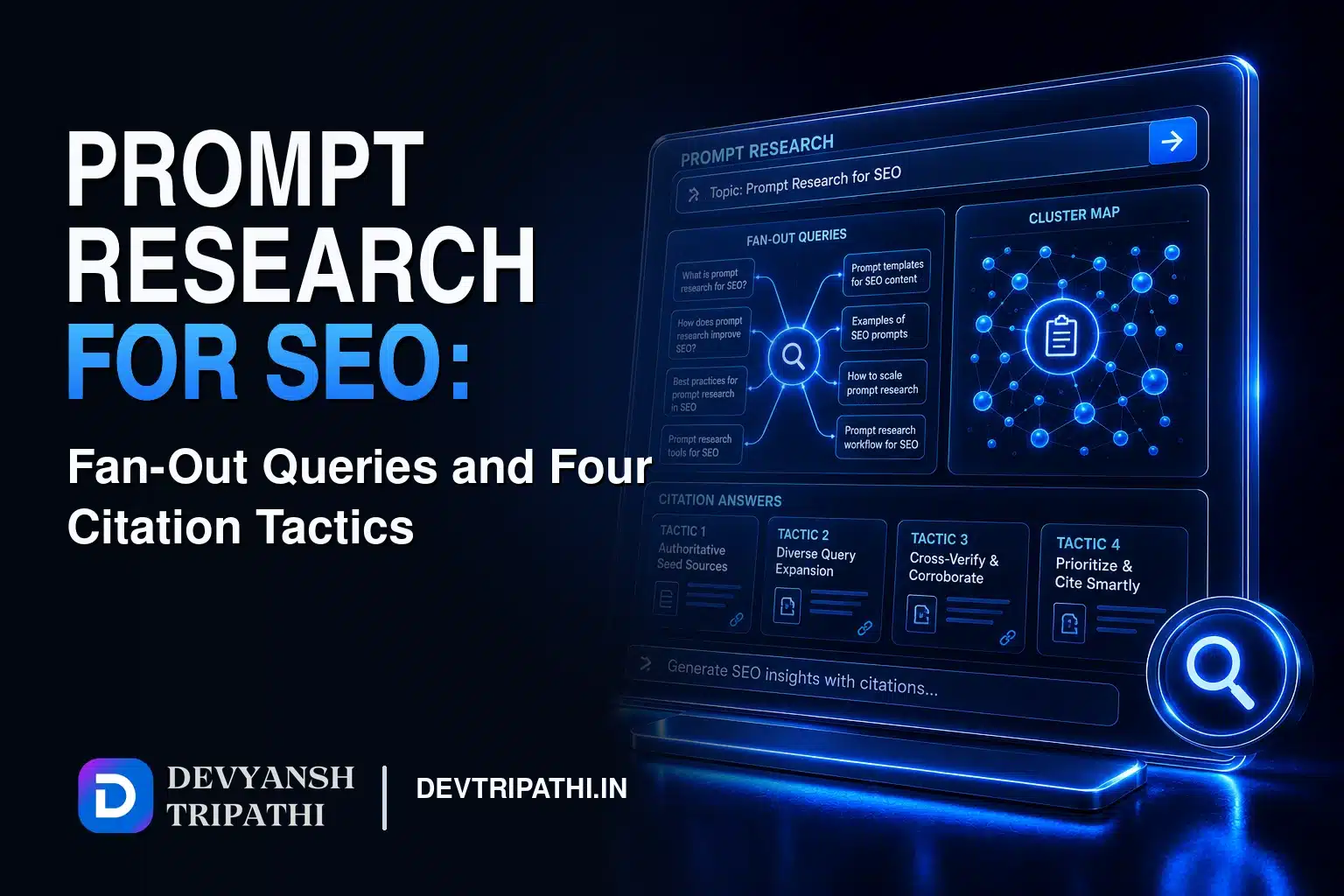
The fan-out mechanism is the most important technical concept in prompt optimization. When a user submits a complex natural language prompt to ChatGPT, Perplexity, or Google AI Mode, the AI does not search for the full prompt verbatim. It breaks the prompt into multiple shorter sub-queries and searches for each one separately through its retrieval system. The AI then synthesizes the retrieved content from all sub-queries into a coherent generated response.
For example, the prompt “What is the best project management tool for a remote team of 50 people on a tight budget?” generates three AI sub-queries: “best project management software 2026,” “project management remote teams,” and “project management tools pricing 50 users” as three separate retrieval operations according to LLMrefs’ technical LLM SEO analysis. Your content must rank for these shorter sub-queries rather than only the full prompt. Effective prompt optimization therefore targets both the full question and all its likely sub-query fragments simultaneously.
This is why topical authority clusters, pillar pages interconnected with cluster pages covering every important subtopic, outperform isolated pages for prompt-based AI citation. A domain with ten interconnected pages covering every sub-query generated from a category of user prompts matches more fan-out sub-queries and earns more citations across more prompts than a domain with one strong isolated page, even if that single page is excellent quality. For the complete topical cluster architecture, see our Topical Authority SEO guide.
The Four Highest-Impact Prompt Optimization Content Tactics
The citation research published in 2025 and 2026 has produced four specific, quantified content tactics that produce measurable improvements in AI prompt citation rates. Each is supported by large-scale citation data rather than practitioner opinion, making them the most evidence-based starting point for prompt optimization content investment.
Tactic 1: Q&A-Formatted Headings (+100% Citation Rate)
Q&A-formatted headings produce two times more AI citations than generic descriptive headings according to Kevin Indig’s analysis of 1.2 million citations. The mechanism is direct: AI systems generate fan-out sub-queries as questions. When your page has headings formatted as questions that mirror those sub-query patterns, the retrieval system can match them as exact or near-exact answers with high confidence. A generic heading like “Benefits of Email Marketing” gives the AI no question-match signal. A Q&A heading like “What Are the ROI Benefits of Email Marketing for B2B Brands?” matches multiple fan-out sub-queries with high precision.
The implementation requires auditing your most important pages and converting all generic H2 and H3 headings to question-format equivalents. Use the same natural language phrasing that appears in your prompt research as the heading text. AI systems are designed to match user questions to content that answers them. The closer your heading mirrors the question structure of target prompts, the higher your citation probability for those prompts. For the complete heading structure guidance within conversational search optimization, see our Answer Engine Optimization guide.
Tactic 2: Content Freshness (3.2x Citation Rate Within 30 Days)
Content published within the last 30 days receives 3.2 times more AI citations than older content according to Kevin Indig’s 1.2 million citation analysis. This is not a small preference for newer content. It is a 220% citation rate advantage for fresh content over stale content covering the same topic. The implication for prompt optimization is that a freshness update strategy for your highest-priority commercial pages is simultaneously a prompt citation eligibility maintenance program.
Build a structured freshness cadence for all pages targeting high-value commercial prompts. Monthly freshness updates should include: refreshing statistics with the current year’s data and updating source citations, adding new expert quotes or perspectives that reflect the current state of the topic, updating internal links to reflect any new related content published since the last update, and updating the visible “last updated” timestamp so users and AI crawlers can identify the recency signal. Perplexity is the platform most sensitive to content freshness, with a particularly strong preference for pages updated within the past 30 to 90 days.
Tactic 3: Schema Markup Deployment (82% of Cited Domains)
82% of ChatGPT-cited domains have schema markup deployed according to Digital Bloom research. This does not mean schema markup guarantees citation. It means that the domains that achieve ChatGPT citations have schema markup at 82% compared to the average website’s significantly lower schema adoption rate. Schema markup signals structured information to AI retrieval systems, enabling them to identify specific content types and extract them reliably for citation purposes.
The minimum schema stack for prompt optimization covers five types: FAQPage for question-answer pairs that match common prompt patterns, Article for E-E-A-T verification that makes content eligible for AI citation credibility checks, HowTo for step-by-step process content that matches process-type prompts, Organization with sameAs for entity clarity that establishes brand identity across platforms, and Product for commercial query prompts where AI recommends specific products or services. Deploy all five as a single interconnected JSON-LD block on every pillar page targeting decision-stage prompts.
Tactic 4: Answer-First Paragraph Structure
44.2% of ChatGPT citations come from the first 30% of page text according to Search Engine Land research. This data confirms that the extraction priority AI systems apply to the opening section of a page is dramatically higher than the body. Answer-first paragraph structure, placing the direct answer to the target prompt in the first 150 words before any context-building introduction, produces consistently higher citation probability by giving AI retrieval systems an immediate, high-confidence extraction target at the location where they apply the most extraction weight.
Apply answer-first structure at two levels. At the page level, the first paragraph should provide a direct 40 to 60 word answer to the primary prompt the page targets. At the section level, every H2 and H3 section should open with a direct 1 to 2 sentence answer to the section heading’s question before expanding into supporting detail. Both practices together maximize the density of high-confidence extraction targets across the full page while respecting the 44.2% first-30% extraction priority observed in large-scale citation data.
Platform-Specific Prompt Optimization
AI platforms agree on under 5% of cited sources for the same query according to Wellows’ citation analysis. This near-zero overlap between platform citation pools means that platform-specific prompt optimization is a requirement for comprehensive AI search visibility, not a refinement for advanced practitioners. Each major platform has distinct retrieval mechanics that determine which content it selects as a citation source when processing user prompts.
| Platform | Primary Retrieval Source | Top Citation Signal | Specific Prompt Optimization Action |
|---|---|---|---|
| ChatGPT | Bing index (87% overlap with Bing top-10) | Bing ranking, entity authority, schema markup | Submit sitemap to Bing Webmaster Tools, deploy Organization sameAs, build Wikidata entry |
| Perplexity | Own crawler plus supplementary sources | Content freshness (within 30 days), statistics, multi-source corroboration | Monthly freshness updates, named statistics with source links, last-updated timestamp visible |
| Google AI Mode | Google's own search index | Traditional Google ranking, structured data, Shopping Graph for product prompts | FAQPage and Article schema, top-10 traditional ranking prerequisite, Product schema for commerce |
| Gemini | Google Knowledge Graph, Google ecosystem | Knowledge Panel, YouTube companion content, multimodal signals | Knowledge Panel establishment, YouTube video with transcript, Organization schema entity clarity |
| Claude | Brave Search, long-form content preference | Comprehensive depth, academic-style attribution, logical structure | Long-form comprehensive guides, cited expert references, clear section hierarchy for sub-query extraction |
The Analyze-Plan-Act-Adapt Cycle for Prompt Optimization
Prompt optimization is an ongoing operational practice rather than a one-time implementation project. AI platform citation patterns change as models update, competitor content improves, and user prompt patterns evolve. The Analyze-Plan-Act-Adapt cycle provides the operational framework for sustaining and improving prompt visibility over time.
The Analyze phase covers weekly prompt testing across your target prompt library in each major AI platform, recording citation presence, position within the response, and accuracy of any brand description. The Plan phase covers identifying the highest-priority citation gaps, the specific content or platform optimization actions most likely to close each gap, and the sequencing of those actions by expected impact and implementation effort. The Act phase covers implementing the planned content updates, schema changes, or digital PR actions, with clear timestamps recorded for A/B comparison. The Adapt phase covers comparing citation rates before and after each action to identify which specific changes produced the highest measurable improvement, then scaling the successful patterns across more content and platforms.
Build Prompt Visibility That Drives Decision-Stage Citations
Buyers Are Using AI Platforms to Research Alternatives and Make Decisions — Is Your Brand in Those Answers?
Book a strategy session and get a complete Prompt Optimization roadmap covering your prompt library development, Q&A heading audit, freshness cadence plan, schema stack deployment, platform-specific optimization for ChatGPT, Perplexity, and Google AI Mode, and the Analyze-Plan-Act-Adapt measurement cycle for your specific industry.
Book My Prompt Optimization StrategyFrequently Asked Questions About Prompt Optimization
What is Prompt Optimization in SEO?
Prompt Optimization is the practice of structuring content to appear in AI-generated responses when users submit natural language prompts to ChatGPT, Perplexity, Google AI Mode, and Gemini. It replaces traditional keyword research, which matched content to 3 to 4 word fragments, with prompt research that maps the full 10.9-word average natural language questions users actually submit to AI platforms. The goal shifts from ranking for a keyword to being cited in the AI response generated from a specific prompt.
How is prompt research different from keyword research?
Keyword research identifies high-volume search terms for traditional ranking optimization. Prompt research identifies the specific full natural language questions and constraints that users submit to AI systems and maps which prompts trigger brand recommendations. Prompt research produces content briefs targeting decision-stage buyers with specific constraints (budget, size, integration needs, geographic requirements), while keyword research produces content targeting awareness-stage informational queries. Both disciplines are needed in 2026, but they serve different search surfaces with almost no overlapping citation pool.
Why do Q&A headings produce 2x more AI citations?
AI systems generate fan-out sub-queries in question format when processing user prompts. When your page has headings that mirror those question patterns, the retrieval system can match them as exact or near-exact question-answer pairs with high citation confidence. A generic heading like “Benefits of Email Marketing” provides no question-match signal. A Q&A heading like “What Are the Measurable ROI Benefits of Email Marketing for B2B Companies?” matches multiple fan-out sub-queries with high precision, producing the 2x citation rate difference observed in Kevin Indig’s 1.2 million citation analysis.
Why does content freshness produce 3.2x more AI citations?
AI systems weight content recency because outdated information reduces the reliability and accuracy of generated responses. Content published within the last 30 days receives 3.2 times more AI citations than older content, per Kevin Indig’s 1.2 million citation analysis. The practical implication is that pages targeting high-value commercial prompts should be refreshed monthly with updated statistics, new expert quotes, and a visible last-updated timestamp. This freshness signal is particularly significant on Perplexity, which shows the strongest platform-level preference for recently updated content among all major AI search platforms.
What is the fan-out sub-query mechanism?
When a user submits a complex prompt to ChatGPT, Perplexity, or Google AI Mode, the AI breaks it into multiple shorter sub-queries and searches for each separately rather than searching the full prompt verbatim. A prompt like “best project management tool for a remote team of 50 on a tight budget” generates sub-queries including “best project management software,” “project management remote teams,” and “project management tools pricing small teams” as three separate retrieval operations. Content must rank for these shorter fan-out sub-queries to appear in the synthesized AI response, not only for the full original prompt.
Why do AI platforms share only 5% of cited sources for the same query?
Each AI platform uses a distinct retrieval mechanism that produces an almost entirely different set of citation sources for the same user query. ChatGPT citations overlap 87% with Bing’s top-10. Perplexity uses its own crawler with strong freshness weighting. Google AI Mode draws from Google’s own search index. Claude uses Brave Search with preference for long-form authoritative depth. These different retrieval systems produce near-zero source overlap, confirmed by Wellows’ analysis finding under 5% shared citations across platforms. Comprehensive AI search visibility therefore requires platform-specific optimization rather than a single unified content strategy.
How should I build a prompt library for my brand?
Build a prompt library by combining five research sources: Google’s People Also Ask boxes for your core topics, Reddit and Quora discussions where prospects describe decisions in full natural language, sales call recordings and support tickets where customers describe their problems conversationally, AI platform follow-up questions generated when you submit your primary topic to ChatGPT and Perplexity, and competitor AI monitoring where you submit category queries and analyze which prompt patterns trigger competitor citations. Organize the resulting prompts by decision stage, constraint type, and target platform to create an actionable content planning and citation monitoring framework.
How does schema markup improve prompt citation rates?
82% of ChatGPT-cited domains have schema markup deployed while the average website’s schema adoption rate is significantly lower. Schema markup signals structured information to AI retrieval systems, enabling reliable identification and extraction of specific content types including question-answer pairs, process steps, product specifications, and expert attributions. The minimum prompt optimization schema stack covers FAQPage, Article, HowTo, Organization with sameAs, and Product where applicable. Deployed as interconnected JSON-LD on all pillar pages targeting decision-stage prompts, this schema stack provides AI systems with a complete machine-readable map of the content’s citation-relevant elements.
What is prompt visibility tracking and how do I set it up?
Prompt visibility tracking is the weekly monitoring of which target prompts in your prompt library produce AI responses that cite your brand across ChatGPT, Perplexity, Google AI Mode, and Gemini. Set it up by selecting 20 to 50 high-value prompts from your prompt library, testing each in each platform weekly, and recording citation presence, response position, and brand description accuracy. This manual baseline approach is supplemented by automated tools including Wellows, Profound, and Otterly.AI that track citation frequency and Share of Model across AI platforms at scale without manual testing.
How does prompt optimization connect to traditional SEO?
Sites that lose Google rankings see ChatGPT citations fall by up to 49%, according to Lily Ray’s study of 11 websites in early 2026. This confirms that Google ranking and AI citation are complementary rather than competing optimization targets. Traditional Google ranking creates the retrieval eligibility that prompt optimization converts into AI citation selection. Prompt optimization improves which ranked pages get cited and on which prompts. Abandoning traditional SEO in favor of prompt-only optimization would eliminate the retrieval pool membership that makes prompt optimization possible on most major AI platforms.
How do I optimize specifically for Perplexity prompts?
Perplexity optimization requires three specific actions that differ from Google AI Overview or ChatGPT optimization. First, content freshness: update target pages monthly with current statistics, new expert perspectives, and visible last-updated timestamps, as Perplexity shows the strongest freshness preference among all major AI platforms. Second, multi-source statistics: every key claim should cite a named, verifiable source with an inline link because Perplexity’s mandatory citation model rewards content that itself demonstrates multi-source verification. Third, community presence: Perplexity draws on Reddit as a supplementary source, and brands with active Reddit community presence appear in a wider range of Perplexity responses than brands present only on their own domain.
What is the minimum viable prompt optimization implementation?
The minimum viable prompt optimization implementation has four components: convert your five most important H2 headings on highest-traffic commercial pages from generic descriptive format to Q&A question format (2x citation lift from heading format alone), update those same pages with current statistics and a visible last-updated timestamp to activate the freshness signal (3.2x citation lift for content within 30 days), deploy FAQPage and Article JSON-LD schema on those pages (82% of ChatGPT-cited domains have schema), and submit your sitemap to Bing Webmaster Tools if not already done (required for ChatGPT citation eligibility). These four actions are executable in a single week and address the four highest-impact prompt optimization gaps simultaneously.
Ready to Build Prompt Visibility That Earns Decision-Stage AI Citations?
Get a Complete Prompt Optimization Strategy Built on Your Current Content Library and Target AI Platforms
Free strategy session covering your prompt library development for your specific industry, Q&A heading audit and rewriting plan, freshness cadence implementation, schema stack deployment checklist, platform-specific optimization priorities, and the weekly Analyze-Plan-Act-Adapt tracking cycle that improves citation rates systematically over time.
Get My Free Prompt Optimization StrategyConclusion
Prompt Optimization is the content strategy discipline that closes the gap between how brands have been optimizing content and how AI platforms actually select content for citation. The data is specific and actionable: AI queries average 10.9 words versus 3 to 4 for traditional Google search. Q&A headings double citation rates. Content within 30 days earns 3.2 times more citations. 82% of ChatGPT-cited domains have schema markup. AI platforms share under 5% of cited sources, requiring platform-specific strategies. And Google ranking is still the prerequisite for AI citation eligibility on most platforms.
The implementation path starts this week. Build your 20-prompt baseline. Test each prompt in ChatGPT, Perplexity, and Google AI Mode. Record your current citation rate. Convert your five highest-traffic commercial page H2 headings to Q&A format. Update those pages with current statistics and a visible last-updated timestamp. Deploy FAQPage and Article schema. Submit your sitemap to Bing Webmaster Tools. These seven actions address the highest-impact prompt optimization gaps simultaneously and establish the measurement baseline that makes all future prompt optimization improvements trackable against a documented starting point.
For the AI visibility measurement framework that tracks prompt citation improvements into branded search growth and revenue attribution, see our AI Visibility Tracking guide.

Devyansh Tripathi
I’m Devyansh Tripathi, an SEO strategist and digital growth expert, helps businesses and individuals rank higher and drive organic traffic. Through DevTripathi., he shares cutting-edge SEO insights, content strategies, and marketing hacks. Passionate about digital success, he’s on a mission to make SEO simple, effective, and result-driven!
Posts
- What Google’s New AI Search Documentation Means for SEO Teams
- Google I/O 2026 Search: AI Agents, Gemini 3.5 and the Unified Box
- Google’s AI Optimization Guide: The Technical and Content Checklist
- July 2026 SEO Update: AI Overviews, llms.txt and Search Console
- Prompt Optimization Beyond Page One: The Position-21 Citation Opportunity
Categories
- AI Citation Optimization
- AI Search Optimization (AISEO)
- AI Visibility Tracking
- Answer Engine Optimization (AEO)
- Brand Authority SEO
- Brand SERP Optimization
- Community Signal SEO
- Conversational Search Optimization
- Generative Engine Optimization (GEO)
- Knowledge Graph Optimization
- Modern SEO Strategies
- Multimodal Search Optimization
- Prompt Optimization
- SEO Trends
- Social Search Optimization
- Topical Authority SEO
- Uncategorized
- Video Search SEO
- Visual Search Optimization
- Voice Engine Optimization (VEO)
- Zero Click Search Optimization
Latest News
Text Widget
Empowering brands with insights, strategies, and stories that drive digital growth.