Ranking vs Citation: The Dual-System SEO Strategy for Mid-2026
09 July 2026
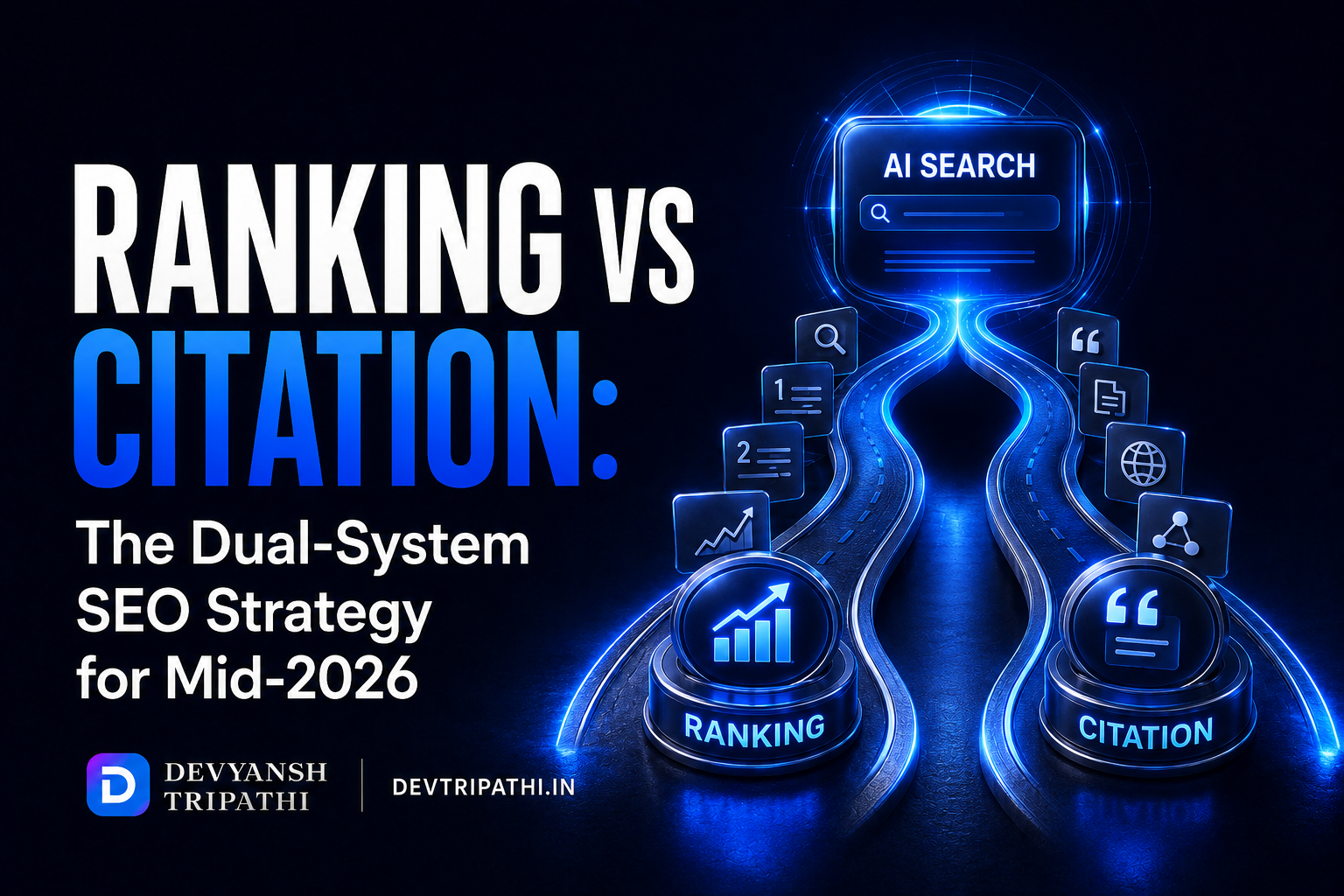
The defining SEO trend of mid-2026 is the confirmed decoupling of traditional search rankings from AI citation selection: only 14% of URLs and 21.9% of domains now rank in both systems simultaneously, and the overlap between top-10 Google rankings and AI-cited sources has collapsed from approximately 75% in mid-2025 to between 17% and 38% by early 2026, confirming that search has split into two parallel systems that reward measurably different signals and require independently managed optimization strategies.
This mid-2026 trends report covers the data confirming the dual-system reality and what it demands of SEO strategy going forward: the ranking-citation decoupling data from Rankability’s 48-month analysis and its strategic implications, the click-through rate collapse continuing to accelerate through 2026, Google’s July 2026 shift to generating images directly within AI Overviews rather than only pulling indexed images, the earned media citation lift data that has been refined with tighter methodology since earlier 2026 reports, the brand mention correlation data confirming branded signals outperform backlinks by a wide and now well-documented margin, and the practical implications for SEO teams that must now operate genuinely separate optimization tracks rather than treating AI visibility as an extension of traditional ranking work.
Is Your SEO Strategy Built for One Search System or Two?
With ranking-citation overlap collapsing to as low as 17%, optimizing only for traditional rankings addresses a shrinking share of total search visibility. Get a complete dual-system SEO assessment covering your traditional ranking performance, AI citation rate, and the specific strategy gaps between the two systems.
Get My Dual-System SEO AssessmentThe Ranking-Citation Decoupling: The Defining Trend of Mid-2026
Rankability’s analysis of 48 months of search data produced the single most consequential SEO trend finding of 2026: the overlap between top-10 Google rankings and the sources cited in AI-generated answers collapsed from approximately 75% in mid-2025 to between 17% and 38% by early 2026. This is not a gradual drift. It is a structural collapse that occurred within roughly a year, confirming that AI citation systems have moved decisively away from using traditional ranking position as their primary retrieval signal.
The practical meaning of this collapse is direct: a page holding the number-one organic position for its target keyword now has a meaningfully reduced probability of also being the source AI systems select when generating an answer to the same underlying question. Viacon’s complementary finding that only 14% of URLs and 21.9% of domains rank in both systems simultaneously confirms the same conclusion from a different data angle. Search has split into two systems that reward measurably different signals, and treating AI visibility as an automatic byproduct of strong traditional rankings is a strategic assumption that the 2026 data no longer supports.
17-38%ranking-citation overlap in early 2026, down from ~75% in mid-2025 (Rankability, 48-month data)
14%of URLs rank in both traditional and AI search systems simultaneously (Viacon 2026)
239%median AI citation lift from earned media distribution (Position Digital, July 2026)
58.5%of Google searches now end without a click (Goodfirms 2026 survey)
The Continuing Click-Through Rate Collapse
The click-through rate erosion that began accelerating in 2024 and 2025 has continued through mid-2026 without showing signs of stabilization. Viacon’s research found that position-one click-through rate for informational keywords has dropped from 7.6% to 3.9% since 2023, a collapse of nearly half in under three years. This decline compounds with the broader zero-click trend, where 58.5% of Google searches now end without any click according to Goodfirms’ survey of practicing SEO professionals.
The CTR collapse is not uniform across query types. Commercial and transactional queries, where users have clear purchase intent that AI-generated summaries cannot fully satisfy, retain meaningfully higher click-through rates than purely informational queries where a complete AI-generated answer often resolves the user’s need without requiring a website visit. This divergence has direct strategic implications: content teams should expect informational content to increasingly serve a citation and brand visibility function rather than a direct traffic function, while commercial and transactional content retains stronger traditional traffic-driving value even as AI search adoption continues to grow. For the complete zero-click optimization framework addressing this shift, see our Zero-Click Search Optimization guide.
Google’s July 2026 Visual Search Investment
As of mid-July 2026, Google began generating images directly within AI Overviews rather than exclusively pulling existing images from indexed pages, a development that Numinix’s July 2026 SEO news analysis identifies as a rare example of Google actively working to route engagement back toward richer, more visual search experiences rather than only summarizing existing web content. Alongside this change, Google redesigned the Image Search homepage, moving from a simple search box format to a scrollable gallery experience.
Together these changes confirm that Google continues investing significantly in visual discovery as a standalone search behavior distinct from text-based query resolution. For businesses that depend on product or lifestyle imagery to drive discovery and traffic, this represents both an opportunity and a signal to prioritize visual content quality and structured image data. The July 2026 update did not bring a dramatic core algorithm shakeup, but it reinforced that the search results page itself continues evolving faster than any single discrete ranking update, requiring continuous technical monitoring rather than periodic algorithm-update-triggered reviews alone. For the complete multimodal optimization framework addressing this visual search investment, see our Multimodal Search Optimization guide.
Trend 1
Dual-System Optimization Becomes Mandatory, Not Optional
With ranking-citation overlap as low as 17% to 38%, brands must build and measure two separate optimization tracks: traditional ranking performance and AI citation performance, rather than assuming strong performance in one predicts strong performance in the other.
Trend 2
Earned Media Becomes a Core SEO Line Item, Not a PR Afterthought
The 239% median AI citation lift from earned media distribution, combined with journalistic sources accounting for nearly 25% of all LLM citations, confirms that earned media investment now belongs in the core SEO budget rather than being treated as a separate marketing function.
Trend 3
AI Citation Measurement Moves from Single-Query to Probabilistic Tracking
With less than a 1 in 100 chance of identical AI responses across repeated identical queries, brands must test each priority query multiple times and track citation rate as a probability across many attempts rather than treating any single AI response as a definitive visibility measurement.
Trend 4
Visual Search Investment Signals a Broader Multimodal Shift
Google's July 2026 shift to generating images directly within AI Overviews, combined with the Image Search homepage redesign, confirms that visual and multimodal search continues receiving significant platform investment beyond text-based query resolution.
The Brand Mention Correlation Confirmation
Position Digital’s 2026 research confirms with independent methodology what earlier 2026 studies from MR Research and other sources had already established: branded web mentions show the strongest correlation with AI Overview appearances at 0.664, dramatically higher than backlinks at 0.218. The consistency of this finding across multiple independent research efforts using different methodologies through 2026 has effectively settled what was, as recently as late 2025, still an emerging and contested claim in SEO practitioner discussion.
For SEO strategy, the practical implication is now well-established rather than speculative: budget allocation should reflect the roughly three-times-stronger correlation that brand mention building shows over additional backlink acquisition for brands that have already achieved reasonable domain authority and traditional ranking stability. This does not mean abandoning link building, which remains necessary for the traditional ranking system that continues to determine 39.8% of organic click share at position one. It means recognizing that incremental investment in brand mention building now produces a demonstrably higher return for AI citation performance specifically. For the complete brand authority framework built on this confirmed correlation data, see our GEO Cycle 3 guide.
| Signal | Correlation with AI Citations | 2026 Research Source | Strategic Priority |
|---|---|---|---|
| Branded Web Mentions | 0.664 | Position Digital 2026, MR Research June 2026 | High — build through earned media and PR |
| YouTube Mentions | 0.737 | MR Research June 2026 (independent finding) | High — build through owned and earned video presence |
| Backlinks | 0.218 | Position Digital 2026, multiple confirming sources | Maintain for traditional ranking, not primary AI citation lever |
| Traditional Ranking Position | Decoupled: 17-38% overlap with citations | Rankability, 48-month analysis, June 2026 | Necessary but no longer sufficient for AI citation eligibility |
Only 14% of Marketers Currently Track AI Visibility. Do Not Be Left Measuring the Wrong System.
Dev Tripathi builds complete dual-system SEO programmes that measure and optimize traditional rankings and AI citation performance as genuinely separate, independently tracked systems, reflecting the confirmed decoupling documented across 2026's most rigorous search research.
Build My Dual-System SEO ProgrammeWhat the Dual-System Reality Requires of SEO Teams in the Second Half of 2026
The confirmed decoupling of traditional ranking and AI citation systems requires a structural change in how SEO teams organize their measurement, reporting, and strategic planning for the remainder of 2026 and beyond. Teams that continue reporting a single blended visibility metric are obscuring the reality that they may be winning decisively in one system while losing significant ground in the other.
Building Genuinely Separate Measurement Tracks
Practical implementation requires two independent measurement tracks reported separately rather than blended into a single dashboard. The traditional track covers Google Search Console rankings, organic click-through rate, and traditional conversion data. The AI citation track covers citation rate tested across ChatGPT, Perplexity, and Google AI Mode independently, since the 2% cross-platform citation overlap means even AI citation performance cannot be treated as a single unified metric across platforms. Reporting both tracks with equal prominence, rather than treating AI citation as a supplementary footnote to a primarily traditional-ranking-focused report, reflects the actual scale of the dual-system reality that 2026 research has confirmed.
Reallocating Budget for the Confirmed Correlation Data
With branded mentions and YouTube presence now confirmed across multiple independent 2026 studies as stronger AI citation predictors than backlinks, budget reallocation toward earned media, brand mention building, and video presence represents a data-supported strategic shift rather than a speculative bet. The 239% median AI citation lift from earned media distribution provides a specific, citable business case for budget reallocation conversations with stakeholders who require quantified justification before shifting established SEO spending patterns toward newer AI-citation-focused investments. For the complete integrated strategy that operationalizes this budget reallocation, see our Modern SEO Strategies Cycle 3 guide.
Frequently Asked Questions About Mid-2026 SEO Trends
What is the dual-system search reality that defines 2026 SEO trends?
The dual-system search reality refers to the confirmed decoupling of traditional Google search rankings from AI citation selection, where only 14% of URLs and 21.9% of domains rank in both systems simultaneously and the overlap between top-10 rankings and AI-cited sources has collapsed from approximately 75% in mid-2025 to between 17% and 38% by early 2026. This means traditional SEO and AI search optimization now function as genuinely separate systems requiring independent strategy, measurement, and investment rather than one being an automatic extension of the other.
How much has the ranking-citation overlap actually declined?
According to Rankability's analysis of 48 months of search data, the overlap between top-10 Google rankings and AI-cited sources collapsed from approximately 75% in mid-2025 to between 17% and 38% by early 2026, representing a structural collapse rather than gradual drift. This means a page ranking first organically now has a meaningfully lower probability of also being selected as an AI citation source for the same query than it did roughly a year earlier, confirming that AI citation systems have moved decisively toward different retrieval signals than traditional ranking algorithms use.
What did Google change in AI Overviews as of July 2026?
As of mid-July 2026, Google began generating images directly within AI Overviews rather than exclusively pulling existing images from indexed web pages, alongside a redesign of the Image Search homepage moving from a simple search box to a scrollable gallery format. These changes signal Google's continued significant investment in visual discovery as a standalone search behavior, requiring businesses dependent on product or lifestyle imagery to prioritize visual content quality and structured image data as part of ongoing 2026 optimization strategy.
Why does earned media now produce a 239% AI citation lift?
Position Digital's July 2026 research found earned media distribution produces a median 239% AI citation lift because journalistic and earned media sources now account for nearly 25% of all citations generated by large language models. AI systems weight independent third-party publication coverage heavily as a credibility and validation signal, and distributing content or securing coverage across multiple authoritative publications simultaneously creates the multi-source corroboration pattern that AI systems favor over single-source, self-published content when selecting citations for generated responses.
Why is AI citation inconsistency significant for measurement strategy?
Position Digital's research found less than a 1 in 100 chance that ChatGPT or Google's AI will return the same list of recommended brands in any two responses to an identical question asked 100 times. This inconsistency means a single AI query test provides an unreliable snapshot of citation performance. Accurate AI visibility measurement requires testing each priority query multiple times across a testing period and tracking citation rate as a statistical probability across many attempts, rather than treating any single AI-generated response as a definitive measurement of visibility status.
Has the branded mention versus backlink correlation finding been confirmed by multiple studies?
Yes. Position Digital's 2026 research independently confirms the branded web mention correlation of 0.664 versus backlinks at 0.218 that MR Research and other 2026 studies previously identified using different methodologies. This convergence across multiple independent research efforts through 2026 has effectively settled what was still an emerging and somewhat contested claim in practitioner discussion as recently as late 2025, providing SEO teams with a well-supported data foundation for reallocating investment toward brand mention building relative to additional backlink acquisition.
Why has position-one click-through rate for informational queries dropped so significantly?
Position-one click-through rate for informational keywords dropped from 7.6% to 3.9% since 2023 primarily because AI Overviews and AI Mode increasingly provide complete answers directly within the search results page, eliminating the need for users to click through for queries where a synthesized AI answer fully satisfies their informational need. This decline is most pronounced for purely informational queries and less pronounced for commercial and transactional queries where AI-generated summaries cannot fully replace the detailed evaluation a user needs before completing a purchase decision.
What percentage of marketers currently track AI visibility?
Only 14% of marketers actively track AI visibility according to Goodfirms' 2026 survey of 100 or more SEO and marketing professionals across 20 or more countries, despite over 58.5% of Google searches now ending without a click and the confirmed decoupling of traditional rankings from AI citations. This substantial measurement gap represents both a significant blind spot for most marketing organizations and a competitive opportunity for brands that build systematic AI visibility tracking ahead of broader industry adoption.
Does the dual-system reality mean traditional SEO no longer matters?
No. Traditional SEO remains essential because it continues to determine organic click share for the queries that do generate clicks, with the first organic position still receiving significantly higher click-through rates than lower positions, and because strong traditional rankings remain a meaningful contributing factor even where they no longer guarantee AI citation. The dual-system reality means traditional SEO is necessary but no longer sufficient on its own: brands must now invest in both systems independently rather than assuming success in one predicts success in the other.
How should SEO reporting change to reflect the dual-system reality?
SEO reporting should present traditional ranking performance and AI citation performance as two genuinely separate, equally prominent tracks rather than blending them into a single visibility metric or treating AI citation as a minor supplementary note. The traditional track should cover Search Console rankings, organic click-through rate, and conversion data. The AI citation track should cover citation rate tested independently across ChatGPT, Perplexity, and Google AI Mode, since even AI citation performance itself varies significantly by platform and cannot be represented by a single aggregate number.
What is the most actionable budget reallocation implied by 2026 SEO trend data?
The most actionable and well-supported budget reallocation implied by 2026 trend data is shifting incremental investment from additional backlink acquisition toward earned media distribution and brand mention building, given the confirmed 0.664 branded mention correlation versus 0.218 for backlinks, and the specific 239% median AI citation lift documented for earned media distribution. This reallocation is most appropriate for brands that have already achieved reasonable domain authority and traditional ranking stability, where additional link building shows diminishing returns relative to the demonstrated returns from brand-level authority investment.
How does the dual-system trend connect to the broader AI search optimization strategy?
The dual-system trend is the empirical confirmation of the strategic premise underlying comprehensive AI search optimization practice: that traditional SEO and AI citation optimization require independent investment and measurement rather than being treated as a single unified discipline. Every major AI search optimization framework published in 2026, including GEO, AEO, and AISEO, is built on the recognition that this decoupling is real and measurable, and the Rankability and Viacon data covered in this trends report provides the most rigorous empirical confirmation of that founding premise available to date.
Ready to Build a Genuinely Dual-System SEO Strategy for the Rest of 2026?
Get a complete dual-system SEO assessment covering your traditional ranking performance, independent AI citation rate testing across all major platforms, earned media investment plan, brand mention building strategy, and the separated measurement dashboard that reflects the confirmed 2026 research on ranking-citation decoupling.
Get My Complete SEO Trends AssessmentConclusion
The defining SEO trend of mid-2026 is now supported by the most rigorous data the discipline has produced to date: ranking and citation have decoupled from approximately 75% overlap to between 17% and 38%, only 14% of URLs succeed in both systems simultaneously, and the specific mechanisms driving each system, branded mentions at 0.664 correlation and earned media at a 239% median citation lift versus backlinks at only 0.218, have been independently confirmed across multiple 2026 research efforts using different methodologies.
Google’s continued investment in visual search, evidenced by the July 2026 shift to generating AI Overview images directly, confirms that the search experience itself continues to evolve on multiple fronts simultaneously rather than converging toward a single stable format. For SEO teams, the practical requirement for the remainder of 2026 is clear: build genuinely separate measurement and investment tracks for traditional rankings and AI citations, reallocate incremental budget toward the confirmed higher-correlation brand authority signals, and close the measurement gap that currently leaves 86% of marketers without systematic AI visibility tracking despite the scale of the shift the 2026 data has now definitively confirmed. For the complete AI citation strategy addressing this dual-system requirement in full operational detail, see our AI Citation Optimization Advanced Guide.

Devyansh Tripathi
I’m Devyansh Tripathi, an SEO strategist and digital growth expert, helps businesses and individuals rank higher and drive organic traffic. Through DevTripathi., he shares cutting-edge SEO insights, content strategies, and marketing hacks. Passionate about digital success, he’s on a mission to make SEO simple, effective, and result-driven!
Posts
- What Google’s New AI Search Documentation Means for SEO Teams
- Google I/O 2026 Search: AI Agents, Gemini 3.5 and the Unified Box
- Google’s AI Optimization Guide: The Technical and Content Checklist
- July 2026 SEO Update: AI Overviews, llms.txt and Search Console
- Prompt Optimization Beyond Page One: The Position-21 Citation Opportunity
Categories
- AI Citation Optimization
- AI Search Optimization (AISEO)
- AI Visibility Tracking
- Answer Engine Optimization (AEO)
- Brand Authority SEO
- Brand SERP Optimization
- Community Signal SEO
- Conversational Search Optimization
- Generative Engine Optimization (GEO)
- Knowledge Graph Optimization
- Modern SEO Strategies
- Multimodal Search Optimization
- Prompt Optimization
- SEO Trends
- Social Search Optimization
- Topical Authority SEO
- Uncategorized
- Video Search SEO
- Visual Search Optimization
- Voice Engine Optimization (VEO)
- Zero Click Search Optimization
Latest News
Text Widget
Empowering brands with insights, strategies, and stories that drive digital growth.