Social Search Visibility: Three Layers Across TikTok, Instagram and YouTube
22 June 2026
Social Search Optimization is the practice of structuring video content, profiles, captions, and engagement signals on TikTok, Instagram, YouTube, LinkedIn, and Pinterest so that your brand ranks in the in-platform search results where younger audiences now begin product discovery, brand research, and buying decisions instead of typing queries into Google.
This guide covers the complete Social Search Optimization framework for 2026: the data confirming that 40% of Gen Z already prefer TikTok or Instagram over Google for search and 73% of buying decisions now start on social and AI platforms rather than traditional search engines, the platform-specific ranking factors for TikTok, Instagram, YouTube, and LinkedIn, the three layers of social search visibility including in-platform search, cross-platform Google indexing, and AI citation contribution, the content format optimization requirements for video, captions, and hashtags, and the measurement framework that tracks social search performance across all platforms where your audience is now beginning their discovery process.
Free Social Search Visibility Audit
Is Your Brand Appearing in the Social Platform Search Results Where 40% of Gen Z Now Begin Their Research?
Get a complete social search audit covering your TikTok search ranking optimization, Instagram Explore and search visibility, YouTube search performance, Pinterest keyword strategy, and the specific content and profile gaps suppressing your brand from social search results.
Get My Social Search AuditWhat Social Search Optimization Is and Why It Now Demands Strategic Investment
Social Search Optimization is the practice of structuring social media content to rank in the search results that exist inside TikTok, Instagram, YouTube, Pinterest, and LinkedIn. It is not social media marketing. Social media marketing optimizes for reach, engagement, and follower growth within algorithmic feeds. Social Search Optimization optimizes for discoverability by users who actively search for specific topics, products, or information within social platforms using the search bar rather than scrolling a feed.
The commercial urgency is confirmed at the highest level. Google’s own internal research found that 40% of young users turn to TikTok or Instagram for things they previously would have searched on Google. 73% of buying decisions now start on TikTok, Amazon, ChatGPT, and Reddit according to 2026 research. And Google usage among Gen Z has dropped by nearly 25% compared to Gen X. These are not marginal behavioral shifts. They represent a structural redistribution of the top-of-funnel discovery interactions that brands have historically captured through Google SEO. Brands that are not visible in social search are invisible to an increasing share of their most valuable prospective buyers at the moment of first discovery.
The opportunity this creates for brands that invest in social search now is compounding rather than linear. A well-optimized TikTok video earns views on day one from algorithmic recommendation. It earns views on day 300 from users searching the same query in TikTok’s search bar. A Google-ranking video on YouTube earns clicks from Google search and from YouTube search simultaneously. Social search assets, unlike paid social content, build long-duration discoverability that standard feed posts cannot deliver. For the complete multi-surface visibility framework that social search contributes to, see our Modern SEO Strategies guide.
40%of Gen Z prefer TikTok or Instagram over Google for search (Google's own internal research, ALM Corp March 2026)
73%of buying decisions now start on TikTok, Amazon, ChatGPT, and Reddit (Neil Patel 2026)
72%of TikTok users discover new products or brands on the platform (Rise at Seven via ALM Corp 2026)
5Bmonthly searches on Pinterest — second-largest social search engine after YouTube (Marketing LTB 2026)
The Three Layers of Social Search Visibility
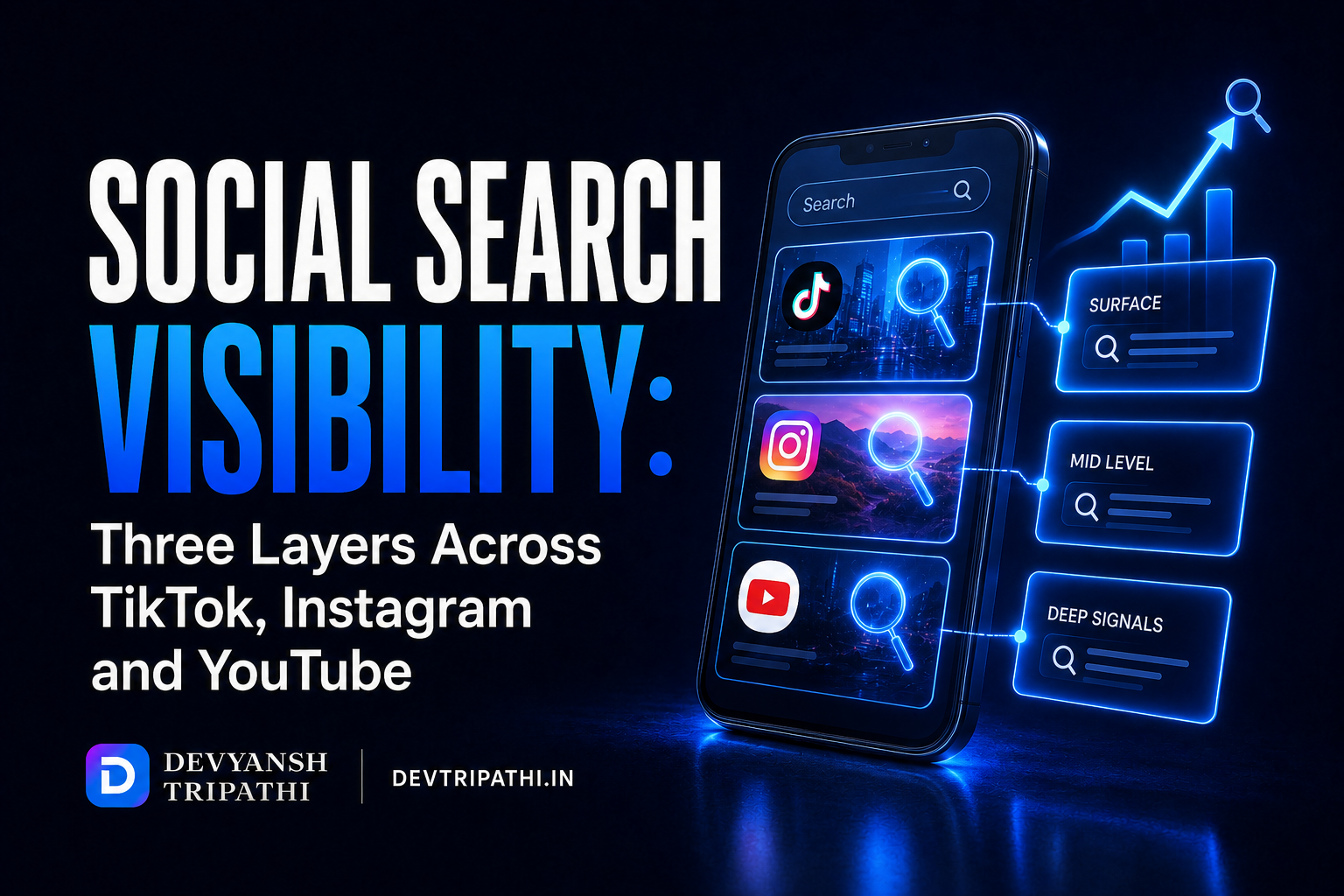
Social Search Optimization operates across three distinct visibility layers that together create the compound discovery benefit that makes it a foundational SEO discipline in 2026 rather than a social media marketing tactic.
The first layer is in-platform search. This is ranking inside TikTok’s search results, Instagram’s Explore and search tab, YouTube’s search bar, Pinterest’s visual search, and LinkedIn’s content search. Each platform has its own ranking algorithm with distinct signals including keyword relevance, completion rate, saves, shares, and account topical consistency. Winning in-platform search produces direct discovery by users actively searching within the platform they are already using.
The second layer is cross-platform Google indexing. YouTube videos, Instagram Reels, and TikToks can appear in Google’s Video, Image, and AI Overview panels when properly optimized. This second layer means social content investment produces traditional SEO returns as well as in-platform search visibility. YouTube videos that rank in YouTube search and embed in relevant blog posts appear in Google AI Overviews when properly tagged with chapters and descriptive metadata. A well-optimized social content strategy can therefore produce simultaneous visibility in five discovery surfaces: in-platform search, Google video results, Google image results, Google AI Overviews, and algorithmic feed recommendations.
The third layer is AI citation contribution. Social content optimized for a coherent topic cluster reinforces topical authority signals across the web, contributing to the entity confidence that AI systems including ChatGPT and Perplexity use when determining which brands to cite for category queries. A brand consistently discussed in TikTok videos, recommended in YouTube reviews, and mentioned in LinkedIn expert posts builds the multi-source corroboration that AI systems treat as citation authority. For the complete community signal strategy that social search feeds into, see our Community Signal SEO guide.
Platform-Specific Social Search Optimization Strategies
Each social platform has a distinct search algorithm, different ranking factors, and a different user intent profile. Applying the same generic strategy across all platforms produces average results on each. Platform-specific optimization, adapted to the particular ranking signals and user behavior of each platform, produces compounding search visibility across the full social search ecosystem.
| Platform | Monthly Active Users | Primary Search Use Case | Top Ranking Signal | Key Content Format |
|---|---|---|---|---|
| YouTube | 2.5 billion | Tutorials, reviews, how-to, in-depth information | Title keyword match, watch time, engagement rate | Long-form video with chapters, timestamps, transcripts |
| TikTok | 1.59 billion | Product discovery, how-to, brand research, Gen Z | Video completion rate (70%+), keyword relevance in audio and captions | Short-form vertical video, 30 to 90 seconds for search |
| 2 billion | Brand vetting, visual product discovery, Reels | Caption keyword relevance, saves, Reels completion | Reels, carousels with keyword-rich captions | |
| Over 500 million | Visual discovery, recipes, fashion, home, travel | Pin title keywords, description text, board organization | Static pins, video pins, idea pins with text overlay | |
| Over 1 billion | B2B professional information, industry insights | Keyword relevance in posts, engagement, creator mode | Long-form posts, carousels, short video for B2B topics |
TikTok Search Optimization Strategy
TikTok search ranks videos on entirely different signals than the For You Page algorithm. TikTok search prioritizes keyword relevance across multiple content layers. The For You Page prioritizes engagement velocity and personalized recommendation. The same video can rank first in search for a target keyword and never appear on the For You Page. This distinction means TikTok search optimization is a separate discipline from standard TikTok content strategy.
Video completion rate is the single most important TikTok search ranking signal in 2026. Videos with 70% or higher completion rate are boosted in both search results and the For You Page according to 2pointagency’s 2026 TikTok algorithm analysis. The counterintuitive implication is that shorter videos (30 to 60 seconds) often rank higher in search than longer videos because shorter videos have structurally higher completion rates. For search-optimized TikTok content, front-load the keyword and the value delivery in the first three seconds, maintain engagement throughout, and end with a clear call to action that drives the completion signal TikTok’s search algorithm rewards.
Keyword optimization on TikTok requires placing your target keyword in five locations simultaneously: the spoken audio in the first five seconds, on-screen text overlay reinforcing the keyword, the caption leading with the keyword in the first sentence, the video hashtags (3 to 5 relevant hashtags maximum), and TikTok’s keyword metadata field available in TikTok Studio. Each of these layers is indexed independently by TikTok’s search algorithm, and pages that appear in search results typically have keyword coverage across all five rather than relying on captions or hashtags alone.
Instagram Search Optimization Strategy
Instagram’s search algorithm indexes four content layers: profile information including display name, bio, and username; caption text with particular weight on the first line; on-screen text overlays in Reels; and closed captions and audio transcripts. According to Instagram head Adam Mosseri, the platform continues investing in search improvements both within the app and externally through search engines, confirming that Instagram search optimization has direct implications for Google indexing of Reels content.
Reels account for half the time users spend on Instagram and are the primary format that Google indexes from Instagram for its Video panel and AI Overview visual content. Optimize Reels for search by front-loading the target keyword in the caption, including the keyword in on-screen text overlays within the first three seconds, adding closed captions that make audio content text-accessible for Instagram’s search indexing, and tagging the Reel with the specific location where local intent queries are relevant. Use saves as the primary engagement signal quality indicator for Instagram search because saves represent active decision to return to content, which Instagram’s algorithm treats as a higher-quality signal than passive likes or views.
YouTube Search Optimization Strategy
YouTube is the second-largest search engine globally, with 57% of people using it to search for information the same way they use Google. YouTube search and Google search are deeply integrated, making YouTube search optimization simultaneously an on-platform search strategy and a Google Video panel strategy. Videos that rank in YouTube search with strong engagement signals are far more likely to surface in Google’s AI Overviews and video panels for the same target queries.
The YouTube search ranking factors that matter most for 2026 are: video title keyword match (the title should lead with the primary keyword phrase in natural language, not manufactured keyword proximity), watch time and average view duration (the most heavily weighted engagement signal in YouTube’s search algorithm), comments that contain keywords related to the video topic (comments are indexed by YouTube and Google and reinforce topical relevance), chapter markers for videos over five minutes (chapters enable section-level indexing that allows specific parts of a long video to surface for specific sub-queries), and description text with 200 or more words including the primary keyword in the first two sentences and secondary topic keywords distributed throughout.
Social Search Profile and Account Optimization
Social search profile optimization is the foundation that determines whether individual content pieces are discoverable. A well-optimized individual post on a poorly-optimized profile receives significantly lower search ranking than the same content on a profile with strong keyword signals, consistent topical focus, and verified business credentials. Profile optimization is the social search equivalent of technical SEO: the prerequisite that makes all other optimization investments more effective.
Profile Optimization Requirements Across All Platforms
Display name and username are the most powerful search fields on TikTok, Instagram, and Pinterest. Both are indexed separately, and both should carry your primary keyword where the brand name alone does not communicate your topical niche. An account named “devtripathi” is less discoverable for SEO-related searches than an account named “Dev Tripathi — AI SEO Specialist.” Use the same consistent username format across all platforms to build the coherent brand entity signal that platform algorithms and AI systems use to classify your account’s topical expertise.
Bio optimization requires including your primary keyword naturally in the first sentence of the bio, stating your specific expertise area rather than generic brand language, and linking to the most relevant destination page for search-intent users rather than defaulting to your homepage. Switch all accounts to business or creator account settings — personal accounts are less likely to be indexed by external search engines and lack the analytics visibility needed to measure which content is driving search discovery.
Content depth and topical consistency are the social equivalent of topical authority cluster building for traditional SEO. Platforms reward accounts that demonstrate consistent expertise in a topic cluster over time. A single viral video produces a spike. A library of 20 or more search-optimized videos on a coherent topic produces compounding discoverability as the platform algorithm gains confidence in your account’s topical relevance for that subject. This is the social search equivalent of the hub-and-spoke content architecture that drives organic SEO performance, operating on the same authority-building logic at the account rather than domain level. For the complete topical authority framework, see our Topical Authority SEO guide.
Build Social Search Visibility That Compounds Over Time
Most Brands Post on Social Media. The Brands Winning in 2026 Are the Ones That Optimize for Social Search.
Book a strategy session and get a complete Social Search Optimization roadmap covering your platform prioritization, TikTok and Instagram search keyword strategy, YouTube title and chapter optimization, Pinterest board architecture, profile optimization across all platforms, and the measurement framework that tracks social search discovery through to conversion.
Book My Social Search StrategySocial Search and AI Citation: The Connection That Matters for GEO
Social search optimization and AI search optimization reinforce each other through the topical authority signal that consistent, search-optimized social content creates. YouTube acts as the central connector between social search and AI citation. Videos optimized for YouTube search, embedded in relevant blog posts, and supported by consistent social promotion are more likely to be cited or summarized in Google AI Overviews. Clear chapter markers, descriptive titles, and complete descriptions help Google link specific video segments to specific sub-questions during the fan-out retrieval process that generates AI Overview responses.
Social content also indirectly influences AI citations through topical authority reinforcement. When TikToks, Reels, and LinkedIn posts consistently align with a specific topic cluster, such as AI search optimization or GEO strategy, they reinforce topical authority signals across the web that contribute to the entity confidence AI systems use when determining which brands to cite for category queries. A brand that is consistently represented in multiple social media formats on a specific topic builds multi-surface topical authority that isolated website content cannot replicate. For the complete AI citation strategy that social search signals feed, see our AI Citation Optimization guide.
Frequently Asked Questions About Social Search Optimization
What is Social Search Optimization?
Social Search Optimization is the practice of structuring social media content, profiles, captions, and engagement signals on TikTok, Instagram, YouTube, Pinterest, and LinkedIn so that your brand ranks in the in-platform search results where users actively search for products, information, and brands. It differs from social media marketing by targeting users who submit active search queries rather than users who passively scroll algorithmic feeds, creating a fundamentally different discoverability model that compounds over time.
Why do 40% of Gen Z prefer TikTok or Instagram over Google for search?
Gen Z prefers visual and video platforms for search because they provide answers in the format they find most useful for practical and product queries: seeing products in real-world use, watching authentic user experiences, and getting recommendations from peers rather than brands. TikTok now ranks as the fourth most helpful platform for finding information online among all consumers. For product discovery, brand research, and how-to queries, short-form video provides more immediately actionable and trust-generating information than traditional text-based search results for this demographic.
What is the most important TikTok search ranking signal in 2026?
Video completion rate is the single most important TikTok search ranking signal in 2026, according to 2pointagency’s 2026 TikTok algorithm analysis. Videos with 70% or higher completion rate receive boosted visibility in both TikTok search results and the For You Page. The counterintuitive implication is that shorter videos often rank higher in search because they have structurally higher completion rates. For search-optimized TikTok content, front-load keyword and value delivery in the first three seconds to maximize the completion rate signal that determines search ranking position.
How does TikTok search differ from the For You Page algorithm?
TikTok search and the For You Page use entirely different ranking signals. TikTok search prioritizes keyword relevance across five content layers: spoken audio in the first five seconds, on-screen text overlay, caption text leading with the keyword, hashtags, and TikTok’s keyword metadata field. The For You Page prioritizes engagement velocity, personalized recommendation history, and geographic patterns. The same video can rank first in search without appearing on the For You Page. Search-optimized TikTok content requires deliberate keyword placement across all five layers rather than relying on the engagement signals that drive For You Page distribution.
Which social platform should I prioritize for social search SEO?
Platform priority depends on your audience demographics and content category. YouTube should be the first priority for most brands targeting audiences over 25 because it is the second-largest search engine globally with 57% of users treating it like Google, and YouTube content simultaneously appears in Google’s Video panels and AI Overviews. TikTok is the first priority for brands targeting Gen Z audiences because 40% prefer it over Google for search. Pinterest is the first priority for brands in visual categories including fashion, beauty, food, home, and travel where it processes 5 billion monthly searches.
How do I optimize Instagram for search in 2026?
Instagram search optimization covers four indexed content layers: profile information including display name, bio, and username; caption text with particular emphasis on the first line; on-screen text overlays in Reels within the first three seconds; and closed captions and audio transcripts. Lead captions with your primary keyword, reinforce it in on-screen text overlay, add closed captions for audio accessibility and search indexing, and optimize your profile display name and bio with topic keywords. Saves are the highest-quality engagement signal for Instagram search, indicating that users are bookmarking content to return to, which Instagram’s algorithm treats as strong search relevance confirmation.
How does YouTube optimization contribute to Google AI Overview citations?
YouTube videos optimized for search that embed in relevant blog posts and receive strong engagement signals are more likely to appear in Google AI Overviews for queries where video content is considered most helpful. Clear chapter markers allow Google to link specific video segments to specific AI sub-queries during fan-out retrieval. Descriptive titles, 200-plus-word descriptions, and keyword-rich transcripts give Google the text signals needed to match video content to text-based informational queries. A well-optimized YouTube video thus contributes simultaneously to YouTube search rankings, Google Video panel appearances, and Google AI Overview visual citations.
What is Search Everywhere Optimization and how does social search fit into it?
Search Everywhere Optimization is the discipline of building systematic visibility across every platform where your target audience begins discovery, including Google, YouTube, TikTok, Instagram, Pinterest, Amazon, Reddit, and AI platforms, rather than focusing exclusively on Google rankings. Social search optimization is the social platform layer of this discipline. With 73% of buying decisions starting on TikTok, Amazon, ChatGPT, and Reddit, Google-only SEO addresses less than half of the discovery interactions that influence purchase decisions. Social search optimization fills the discovery gaps that traditional Google SEO cannot reach.
How does social search content help with AI citation authority?
Social content optimized for a coherent topic cluster reinforces topical authority signals across the web that contribute to the entity confidence AI systems use when determining which brands to cite. YouTube videos embedded in blog posts are increasingly surfaced in Google AI Overviews. TikTok and Instagram content reinforces brand topical relevance. Reddit and LinkedIn community signals contribute to the multi-source corroboration that AI systems treat as citation authority. A brand consistently represented in multiple social formats on a specific topic builds multi-surface topical authority that isolated website content cannot replicate independently.
How should I measure social search optimization performance?
Social search performance measurement requires tracking three signal layers. In-platform search analytics: TikTok Studio’s Search Performance tab shows actual queries driving video traffic for accounts with 1,000 or more followers. YouTube Studio’s Traffic Source report filters for YouTube Search traffic. Instagram Insights shows profile reach from Explore. Second, Google referral tracking: monitor sessions from YouTube, TikTok, and Instagram in Google Analytics 4 as referral traffic. Third, branded search volume growth in Google Search Console as the downstream signal that social search exposure is generating brand recall that converts to direct Google searches over time.
How does social search affect buying decisions?
According to Rise at Seven research, 72% of TikTok users discover new products or brands on the platform, and 74% of weekly Gen Z TikTok users search for more information about products they see in videos. These users frequently complete their research journey within TikTok through search queries after seeing initial content in their feed, purchasing directly through TikTok Shop where available, or moving to Google to search for the brand they discovered socially. The social search discovery moment is therefore often the first touchpoint in a multi-platform purchase journey rather than a siloed channel interaction.
What is Pinterest’s role in social search for product-based businesses?
Pinterest processes over 5 billion monthly searches making it the second-largest social search engine after YouTube for product and visual discovery queries. Unlike TikTok and Instagram where content appears in algorithmic feeds and search, Pinterest is a near-exclusively search-driven platform where 85% of weekly users have made a purchase based on Pins they have seen. For fashion, beauty, food, home, and travel brands, Pinterest search visibility reaches users at active product research and purchase intent stages rather than passive discovery, making it a high-commercial-intent social search channel that most brands significantly underinvest in relative to its discovery scale.
Ready to Build Social Search Visibility That Drives Discovery and Sales?
Get a Complete Social Search Optimization Strategy Built for Your Audience, Your Platforms, and Your Industry
Free strategy session covering your platform prioritization, TikTok and Instagram keyword strategy for your specific niche, YouTube chapter and title optimization plan, Pinterest board architecture, profile optimization across all platforms, and the three-layer measurement framework tracking social search through to revenue attribution.
Get My Free Social Search StrategyConclusion
Social Search Optimization has crossed from trend to foundational discipline in 2026. When 40% of Gen Z prefer TikTok or Instagram over Google for search, when 73% of buying decisions start on social and AI platforms, and when YouTube functions as the second-largest search engine globally, social platform visibility is no longer a social media marketing investment with soft ROI. It is a primary search channel with measurable discovery, consideration, and conversion impacts that traditional Google SEO cannot capture.
The compounding nature of social search investment is its greatest strategic advantage. A search-optimized YouTube video ranked for its target keyword earns views on day one and on day 500. A TikTok video with 70% completion rate that ranks in search for a target keyword attracts new searchers every day without additional promotion spend. A Pinterest board organized around a specific product category compounds monthly search traffic as more Pins are added to the cluster. These compounding returns mirror the long-term SEO benefits of traditional website optimization, applied to the discovery surfaces where your youngest and most valuable audience segments are already actively searching.
Start with the platform where your highest-value audience segments are most concentrated. Build 20 search-optimized pieces of content consistently on that platform before expanding to additional platforms. Optimize your profile with keyword-rich display names and bios. Track in-platform search analytics to identify which content is driving search discovery versus feed views. For the complete brand authority framework that social search signals amplify, see our Brand Authority SEO guide.

Devyansh Tripathi
I’m Devyansh Tripathi, an SEO strategist and digital growth expert, helps businesses and individuals rank higher and drive organic traffic. Through DevTripathi., he shares cutting-edge SEO insights, content strategies, and marketing hacks. Passionate about digital success, he’s on a mission to make SEO simple, effective, and result-driven!
Posts
- What Google’s New AI Search Documentation Means for SEO Teams
- Google I/O 2026 Search: AI Agents, Gemini 3.5 and the Unified Box
- Google’s AI Optimization Guide: The Technical and Content Checklist
- July 2026 SEO Update: AI Overviews, llms.txt and Search Console
- Prompt Optimization Beyond Page One: The Position-21 Citation Opportunity
Categories
- AI Citation Optimization
- AI Search Optimization (AISEO)
- AI Visibility Tracking
- Answer Engine Optimization (AEO)
- Brand Authority SEO
- Brand SERP Optimization
- Community Signal SEO
- Conversational Search Optimization
- Generative Engine Optimization (GEO)
- Knowledge Graph Optimization
- Modern SEO Strategies
- Multimodal Search Optimization
- Prompt Optimization
- SEO Trends
- Social Search Optimization
- Topical Authority SEO
- Uncategorized
- Video Search SEO
- Visual Search Optimization
- Voice Engine Optimization (VEO)
- Zero Click Search Optimization
Latest News
Text Widget
Empowering brands with insights, strategies, and stories that drive digital growth.