The 30-Minute Brand SERP Audit: Fix Seven Critical Components
17 June 2026
Brand SERP Optimization is the practice of deliberately managing and improving every element that appears when someone searches for your brand name on Google, ensuring that the most commercially important page in your digital presence delivers a first impression that is accurate, authoritative, and designed to build trust at every stage of the buyer journey.
This guide covers the complete 2026 Brand SERP framework: the data confirming why your branded search results page is your single most important SEO asset, the seven core components of an optimized Brand SERP and how to win each one, the direct connection between Brand SERP quality and AI citation frequency, and the 30-minute Brand SERP audit process that identifies your highest-priority improvement opportunities immediately. Every section is built on verified 2026 research rather than speculation about where brand search is heading.
Free Brand SERP Audit
What Does Google Show When Your Most Important Prospects Search Your Brand Name?
Get a complete Brand SERP audit covering your Knowledge Panel status, sitelinks, review signals, social profile coverage, AI citation rate for branded queries, and the specific gaps suppressing your branded CTR and trust signals.
Get My Brand SERP AuditWhy Your Brand SERP Is Your Most Important SEO Asset in 2026
Every SEO campaign eventually leads back to the same moment: a prospect who has heard of your brand, a client doing due diligence before a call, a journalist researching a story, or an investor evaluating credibility. Each of them opens Google and types your brand name. What they see in the next three seconds shapes every subsequent interaction with your company.
According to Elite Solution Expert’s 2026 Brand SERP analysis, 81% of consumers research a brand online before making a purchase decision. That research session almost always begins with a branded Google search. The Brand SERP that appears determines whether that session produces trust and consideration or doubt and abandonment.
The 2026 context adds two additional dimensions of urgency. With 65% of all searches ending without a click, your Brand SERP must communicate brand value, build trust, and influence consideration even when users never visit your website at all. And because Brand SERP quality directly feeds the entity signals that determine AI citation eligibility, an unoptimized Brand SERP simultaneously reduces your traditional first impression and your AI search visibility. For the complete brand authority strategy that Brand SERP optimization amplifies, see our Brand Authority SEO guide.
81%of consumers research brand online before purchasing (Elite Solution Expert 2026)
35%higher CTR for brands with optimized Brand SERPs vs unmanaged results
2.8xmore AI citations for brands with Knowledge Panels and optimized Brand SERPs
53.5%AI citation rate for brands with minimal Trustpilot profile vs 1% without (Seer Interactive May 2026)
The Brand SERP as the New First Impression
For most brands, the website homepage is considered the primary first impression. In 2026, the Brand SERP has supplanted it. A user who searches your brand name sees a Knowledge Panel, sitelinks, review stars, social profiles, and recent news coverage before they ever visit your site. That composite first impression shapes the mental model they bring to any subsequent website visit.
This is particularly significant for AI search performance. Brands with optimized Brand SERPs featuring consistent information, positive reviews, and Knowledge Panel entities receive 2.8 times more AI citations than brands without these signals according to Elite Solution Expert. The Brand SERP is not separate from GEO strategy. It is one of its foundational inputs. For the complete AI citation optimization strategy that builds on Brand SERP signals, see our GEO Advanced Playbook.
The Seven Components of an Optimized Brand SERP
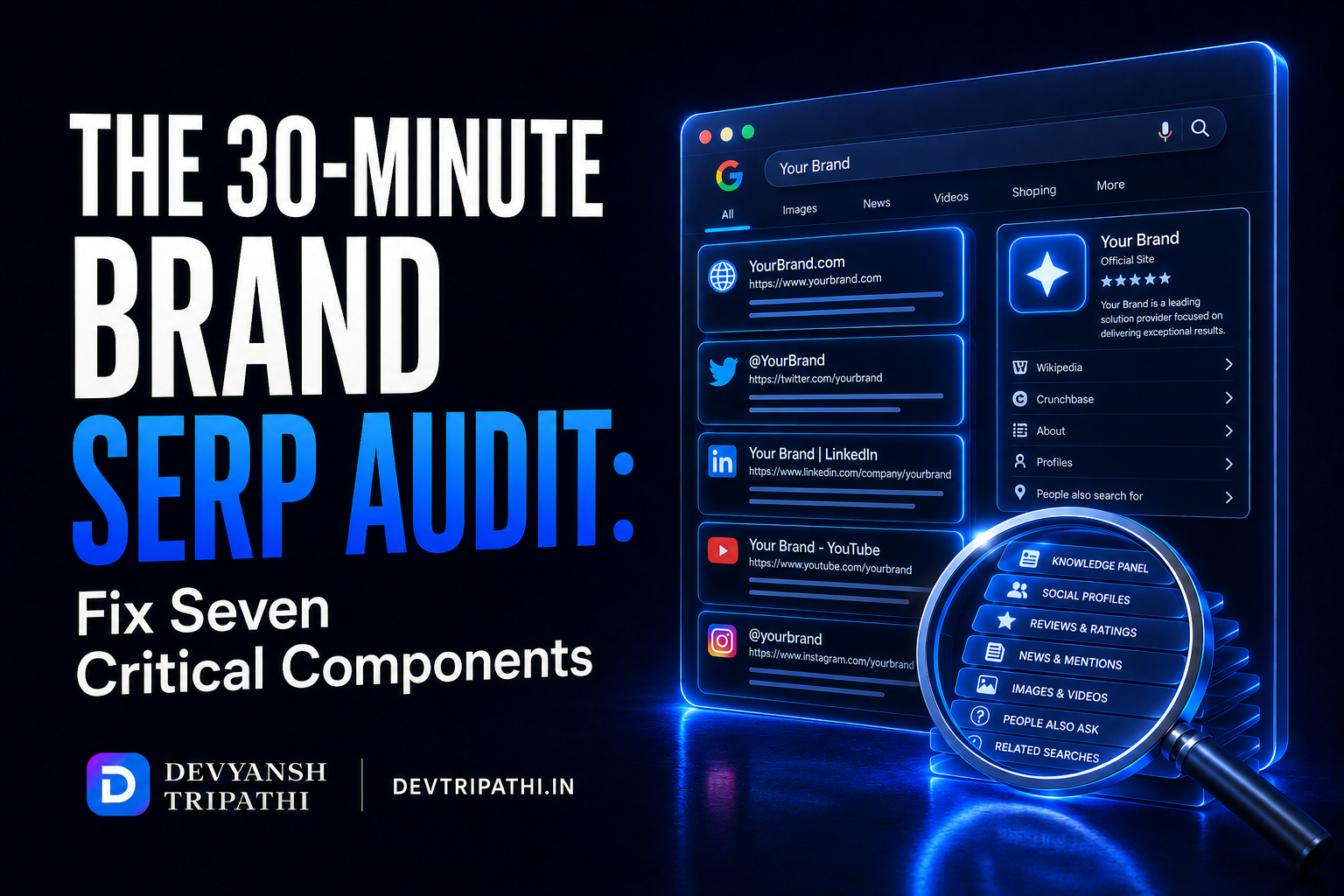
A Brand SERP is not a single result. It is a composite of up to seven distinct elements that together form the complete branded search experience. Each component has different optimization requirements and different commercial significance. The following framework covers every element that appears on a well-optimized Brand SERP and the specific actions required to control each one.
| Component | What It Shows | Primary Optimization Signal | AI Citation Impact |
|---|---|---|---|
| Main Website Listing | Homepage URL, meta title, meta description | Homepage authority, title tag optimization | High — primary owned entity URL |
| Sitelinks | 6 to 8 sub-links to key internal pages | Navigation structure, internal linking, page titles | Medium — reinforces site architecture |
| Knowledge Panel | Logo, description, founding date, social links | Wikidata, Organization schema with sameAs, GBP | Very high — primary entity recognition signal |
| People Also Ask | Common questions about your brand | FAQ content on site, FAQPage schema | High — directly feeds AI answer content |
| Social Profiles | LinkedIn, Twitter, Instagram, YouTube | Consistent username, complete profiles, activity | High — multi-platform entity corroboration |
| Review Listings | Google reviews, Trustpilot, G2, Clutch | Review volume, sentiment, response rate | Very high — 53.5% citation rate with minimal profile |
| News and Media | Recent press coverage and industry mentions | Digital PR, earned media program | High — third-party authority corroboration |
Component 1: The Main Website Listing
Your homepage must rank first for your brand name search. This is usually automatic, but it can be disrupted by weak domain authority, technical indexing issues, or competitor pages that have built high-authority content targeting your brand name. Ensure your homepage title tag begins with your exact brand name, your meta description functions as a clear brand positioning statement, and your homepage has sufficient internal link authority to outrank any third-party page targeting your brand.
Implement WebSite schema on your homepage with your official brand name and a siteLinksSearchBox property. This explicit structured data declaration reinforces your homepage as the canonical entity home for your brand name query and improves Google’s confidence in displaying sitelinks below your main listing.
Component 2: Sitelinks
Sitelinks are the six to eight sub-links that appear below your main listing for established brand queries. They surface your most important internal pages directly in the branded search result, giving users one-click access to high-intent destinations without requiring a homepage visit. Google generates sitelinks algorithmically based on your site’s internal link architecture and page title clarity.
Optimize sitelinks by ensuring your most important pages, specifically About, Services or Products, Pricing, Blog, and Contact, are prominently linked in your main navigation and footer. Use clear, specific page titles rather than generic labels: “GEO Services” rather than just “Services.” You can demote specific sitelinks you do not want displayed through Google Search Console under the Search Appearance section. Monitor which pages appear as sitelinks quarterly and adjust navigation prominence for pages you want added or promoted.
Component 3: Knowledge Panel
The Knowledge Panel is the right-sidebar entity card that appears for recognized brands on desktop and at the top of mobile results. It is simultaneously the clearest indicator of Google Knowledge Graph entity recognition and the most impactful single component for AI citation authority. Brands with Knowledge Panels receive 2.8 times more AI citations because AI systems including Gemini are trained on Knowledge Graph data and treat Knowledge Panel entities as higher-confidence citation sources.
Build Knowledge Panel eligibility through the six-lever entity sequence: consistent entity definition, Wikidata entry with QID, Organization JSON-LD schema with complete sameAs array, verified Google Business Profile, credentialed author pages, and multi-source third-party corroboration. Once a Knowledge Panel appears, claim it through Google Search Console and maintain accurate information quarterly. For the complete entity building sequence, see our Knowledge Graph Optimization guide.
Component 4: Review Platform Listings
Review platforms including Google Business Profile, Trustpilot, G2, Clutch, and JustDial frequently appear on Brand SERPs and provide the third-party social proof that branded searchers are specifically looking for when evaluating whether to trust a brand they have just heard of. The commercial impact is documented: Seer Interactive’s May 2026 research found brands with even a minimal Trustpilot profile of 1 to 13 reviews achieve a 53.5% AI citation rate, compared to a median 1% rate for brands with no profile. That is a 52-percentage-point improvement from one hour of profile setup.
According to BrightLocal’s 2026 Local Consumer Review Survey, 98% of consumers read online reviews for local businesses. Respond to all reviews professionally, both positive and negative. A professional response to a negative review signals brand character and reduces conversion damage far more effectively than allowing it to sit unanswered. Generate reviews systematically by asking satisfied clients at the moment of a positive outcome delivery.
Component 5: Social Profile Coverage
Your active social profiles should appear in the first page of your brand SERP results. LinkedIn, Twitter, Instagram, YouTube, and Facebook pages with complete profiles, consistent branding, and regular content activity rank well for branded queries. Social profiles on your Brand SERP serve three functions: demonstrating active multi-channel presence, providing additional positive brand touchpoints, and occupying positions that would otherwise be available for competitor pages or unflattering third-party content.
Optimize social profiles by using your exact brand name as the username or handle where possible, completing all biographical fields with accurate descriptions including your brand name and category, linking to your official website from every profile, and maintaining consistent posting frequency. Include your social profile URLs in the sameAs array of your Organization schema to create explicit entity connections between your profiles and your website entity.
The Brand SERP and AI Citations: The Direct Connection
The connection between Brand SERP quality and AI citation frequency is not coincidental. It reflects the shared underlying mechanism: entity confidence. When Google’s AI systems evaluate whether to cite your brand in an AI Overview or AI Mode response, they cross-reference the same entity signals that determine your Knowledge Panel quality, review platform presence, and social profile consistency. A strong Brand SERP and high AI citation rates both result from the same entity optimization investment.
The three Brand SERP elements with the highest direct AI citation impact are the Knowledge Panel (because Google’s Gemini is trained on Knowledge Graph data), review platform profiles (because the Seer Interactive 53.5% versus 1% citation rate difference is directly driven by platform presence creating entity corroboration), and earned media coverage in your Brand SERP’s news section (because third-party authoritative mentions are the primary source of 95.7% of AI citations according to Profound’s citation research).
Building these three elements simultaneously creates the multi-source consensus signal that AI systems use to assign high citation confidence. For the complete AI visibility measurement framework that tracks how Brand SERP improvements translate into citation rates, see our AI Visibility Tracking guide.
The 30-Minute Brand SERP Audit
The Brand SERP audit is the fastest SEO action available for identifying high-impact improvement opportunities. It requires no paid tools, takes approximately 30 minutes, and produces a prioritized action list that addresses reputation risks, entity inconsistencies, and citation gaps simultaneously.
Audit Step 1: The Brand Name Search
Open a private browser window to prevent personalization. Search your exact brand name including common variations such as with and without legal entity suffixes. Record every element visible in the first 10 results: Knowledge Panel presence and accuracy, sitelinks appearance and accuracy, review star ratings and platforms showing, social profiles appearing, any news coverage, and any third-party pages that may contain negative, inaccurate, or outdated information about your brand.
Audit Step 2: The Knowledge Panel Check
If a Knowledge Panel appears, verify: the brand description is accurate and current, the logo is your current official version, all social profile links are active and point to your current accounts, the founding date and location are correct, and the entity category accurately reflects your business type. Any inaccuracies in the Knowledge Panel are visible to every user who searches your brand name and should be corrected through the claim process in Google Search Console immediately.
Audit Step 3: The Review Platform Assessment
Check whether Trustpilot, G2, Clutch, Google Business Profile reviews, and any relevant industry-specific review platforms appear in your Brand SERP. For each platform that appears, note the star rating, the review count, and the last review date. Any platform showing below 4.0 stars in the Brand SERP is a trust inhibitor that requires immediate attention: generate more positive reviews to raise the aggregate score while maintaining a professional response strategy on existing negative reviews.
Audit Step 4: The AI Citation Test
Test the following queries in ChatGPT, Perplexity, and Google AI Mode: your brand name alone, your brand name plus your primary service category, and “is [your brand] legitimate” or “what does [your brand] do.” Record whether each response describes your brand accurately, positively, and specifically. Any inaccurate descriptions indicate entity signal gaps that the entity audit steps below will address.
Build a Brand SERP That Builds Trust Automatically
Every Unmanaged Element of Your Brand SERP Is a Trust Signal You Are Leaving to Chance
Book a strategy session and get a complete Brand SERP optimization roadmap covering your Knowledge Panel, sitelinks, review platform strategy, social profile consistency, earned media program, and AI citation accuracy for all major AI platforms.
Book My Brand SERP StrategyFrequently Asked Questions About Brand SERP Optimization
What is Brand SERP Optimization?
Brand SERP Optimization is the practice of deliberately managing every element that appears when users search your brand name on Google. It covers seven components: your main website listing, sitelinks, Knowledge Panel, People Also Ask boxes, social profiles, review platform listings, and news coverage. Optimizing each component ensures branded searches produce a first impression that builds trust and drives consideration, even among the 65% of branded searchers who never click through to your website.
Why do 81% of consumers research brands online before purchasing?
Modern buyers use branded Google searches to independently verify claims, check reviews, assess credibility, and understand what others say about a brand before committing to a purchase. This verification behavior has intensified as review platforms, social media, and AI-generated brand summaries have made independent research faster and more informative. The Brand SERP is the primary surface where this verification research happens, making it the most commercially significant page in your digital presence.
How does a Knowledge Panel affect AI citations?
Google’s Gemini AI is trained on Knowledge Graph data, and brands recognized as Knowledge Graph entities receive higher citation confidence from AI systems. Brands with Knowledge Panels and optimized brand SERPs receive 2.8 times more AI citations than comparable brands without these signals. The Knowledge Panel functions as Google’s official confirmation that your brand is a recognized entity, which AI systems treat as a credibility signal when deciding whether to cite your brand in AI-generated responses.
Why does a minimal Trustpilot profile increase AI citations from 1% to 53.5%?
Review platform profiles provide the multi-source entity corroboration that AI systems require before confidently recommending a brand. A Trustpilot profile with even 1 to 13 reviews creates an independent third-party record of your brand’s existence and quality that AI systems can cross-reference with your website and other entity signals. Without this corroboration, AI systems treat your brand as having insufficient multi-source validation for confident citation, producing the near-zero citation rate that brands without review profiles experience.
How do I get sitelinks to appear under my brand listing?
Sitelinks are generated algorithmically based on your site’s internal link architecture, page title clarity, and overall domain authority. Ensure your most important pages are prominently linked in your main navigation and footer using clear, specific page titles. Submit a comprehensive XML sitemap through Google Search Console. Avoid generic or duplicate page titles that prevent Google from distinguishing between pages in sitelink selection. You can demote unwanted sitelinks through Google Search Console but cannot manually select which pages appear.
What happens if negative content appears in my Brand SERP?
Negative content in positions one through five of your Brand SERP represents a priority suppression target. For inaccurate content, contact the publisher directly for corrections and update source data on Wikidata, Wikipedia where applicable, and your own schema markup. For accurate but damaging content, the most sustainable strategy is a proactive digital PR program generating more authoritative positive coverage that progressively displaces the negative result through organic authority displacement. This takes 3 to 6 months of consistent effort but produces lasting SERP improvement.
How often should I audit my Brand SERP?
Conduct the 30-minute Brand SERP audit monthly for all brands and weekly for brands with active digital PR programs, competitor activity, or reputation management challenges. Knowledge Panel information should be verified quarterly after any significant brand changes including rebrand, leadership changes, or service expansion. Review platform ratings and response status should be monitored weekly using Google Alerts or a dedicated reputation monitoring tool set up for your brand name and key variation searches.
How do social profiles on my Brand SERP help SEO?
Social profiles appearing in Brand SERP results provide three overlapping benefits. They occupy result positions that would otherwise be available for competitor pages or negative third-party content. They demonstrate active multi-channel presence that signals brand vitality to prospective buyers and AI systems evaluating citation confidence. And each profile URL included in your Organization schema sameAs array contributes an explicit entity disambiguation signal that strengthens Knowledge Panel eligibility and AI citation confidence simultaneously.
What is the relationship between Brand SERP and zero-click search?
65% of branded searches end without a click in 2026, meaning your Brand SERP must communicate brand value and build consideration without any website visit. A Knowledge Panel displaying your logo, description, and founding date, combined with positive review stars and active social profiles, delivers a complete brand impression at the SERP level even when users never click. Brands that optimize for zero-click branded search influence the 65% of branded searchers who form their impressions entirely from SERP-level content. For the complete zero-click strategy, see our Zero Click Search Optimization guide.
How does earned media in my Brand SERP affect credibility?
News and media coverage appearing in your Brand SERP provides third-party social proof that review platforms cannot. A Search Engine Journal article, an Economic Times feature, or an industry publication analysis appearing in your Brand SERP signals to prospective buyers and AI systems that independent authoritative voices have covered your brand. AI systems treat earned media mentions as among the highest-confidence entity corroboration signals available, and brands with consistent earned media presence receive significantly higher citation rates than brands whose Brand SERPs show only owned and review content.
What is the single highest-ROI Brand SERP action for most brands?
Claiming and completing a Trustpilot profile if you do not already have one is the highest single-action ROI available based on the Seer Interactive May 2026 research showing a 52-percentage-point lift in AI citation rates. The implementation takes approximately one hour, costs nothing for a basic profile, and produces measurable improvements in both AI citation frequency and Brand SERP review signal coverage within 2 to 4 weeks of the profile being indexed. This single action addresses the largest quantified gap in brand authority for most businesses that lack it.
How do I connect Brand SERP improvements to revenue metrics?
Connect Brand SERP improvements to revenue through three measurable signals. Track branded CTR in Google Search Console monthly: an optimized Brand SERP improves branded click-through rates by up to 35%, and this improvement is directly measurable as a CTR change in Search Console’s branded query filter. Track AI-referred traffic in GA4 using a custom channel group for AI platform referrers: improved AI citation rates from better Brand SERP signals produce measurable session and conversion growth. Track branded search volume growth as a leading indicator of increased brand recognition driven by consistent SERP-level brand exposure.
Ready to Own Your Brand SERP?
Get a Personalised Brand SERP Optimization Roadmap Built on Your Current Audit Results
Free strategy session covering your Brand SERP audit findings, Knowledge Panel building sequence, review platform strategy, social profile optimization, earned media targets, and the AI citation rate improvement plan that connects Brand SERP investment to measurable revenue outcomes.
Get My Free Brand SERP RoadmapConclusion
Your Brand SERP is your most important and most consistently overlooked digital asset. Every day it is assembled by accident rather than managed by strategy, prospective buyers, investors, journalists, and job candidates form their first impression of your brand from content you have not curated and may not be aware of.
The data makes the business case: 81% of buyers research brands online before purchasing, optimized Brand SERPs produce 35% higher CTR, Knowledge Panels generate 2.8 times more AI citations, and a minimal review profile lifts AI citation rates from 1% to 53.5%. None of these improvements require large budgets. They require the systematic 30-minute audit, the Knowledge Panel building sequence, the review platform setup, and the earned media program that together transform your Brand SERP from an accident into a strategic asset.
Start with the audit this week. Search your brand name in a private browser and document everything you see in positions one through ten. Identify which elements you own, which you influence, and which third parties control. Then build the improvement plan one component at a time, starting with the Trustpilot or G2 profile setup that delivers the highest single-action improvement available. For the complete entity and Knowledge Graph strategy, see our Knowledge Graph Optimization guide.

Devyansh Tripathi
I’m Devyansh Tripathi, an SEO strategist and digital growth expert, helps businesses and individuals rank higher and drive organic traffic. Through DevTripathi., he shares cutting-edge SEO insights, content strategies, and marketing hacks. Passionate about digital success, he’s on a mission to make SEO simple, effective, and result-driven!
Posts
- What Google’s New AI Search Documentation Means for SEO Teams
- Google I/O 2026 Search: AI Agents, Gemini 3.5 and the Unified Box
- Google’s AI Optimization Guide: The Technical and Content Checklist
- July 2026 SEO Update: AI Overviews, llms.txt and Search Console
- Prompt Optimization Beyond Page One: The Position-21 Citation Opportunity
Categories
- AI Citation Optimization
- AI Search Optimization (AISEO)
- AI Visibility Tracking
- Answer Engine Optimization (AEO)
- Brand Authority SEO
- Brand SERP Optimization
- Community Signal SEO
- Conversational Search Optimization
- Generative Engine Optimization (GEO)
- Knowledge Graph Optimization
- Modern SEO Strategies
- Multimodal Search Optimization
- Prompt Optimization
- SEO Trends
- Social Search Optimization
- Topical Authority SEO
- Uncategorized
- Video Search SEO
- Visual Search Optimization
- Voice Engine Optimization (VEO)
- Zero Click Search Optimization
Latest News
Text Widget
Empowering brands with insights, strategies, and stories that drive digital growth.