The 34% AI Brand Agreement Problem: Optimize for Every Engine
21 July 2026
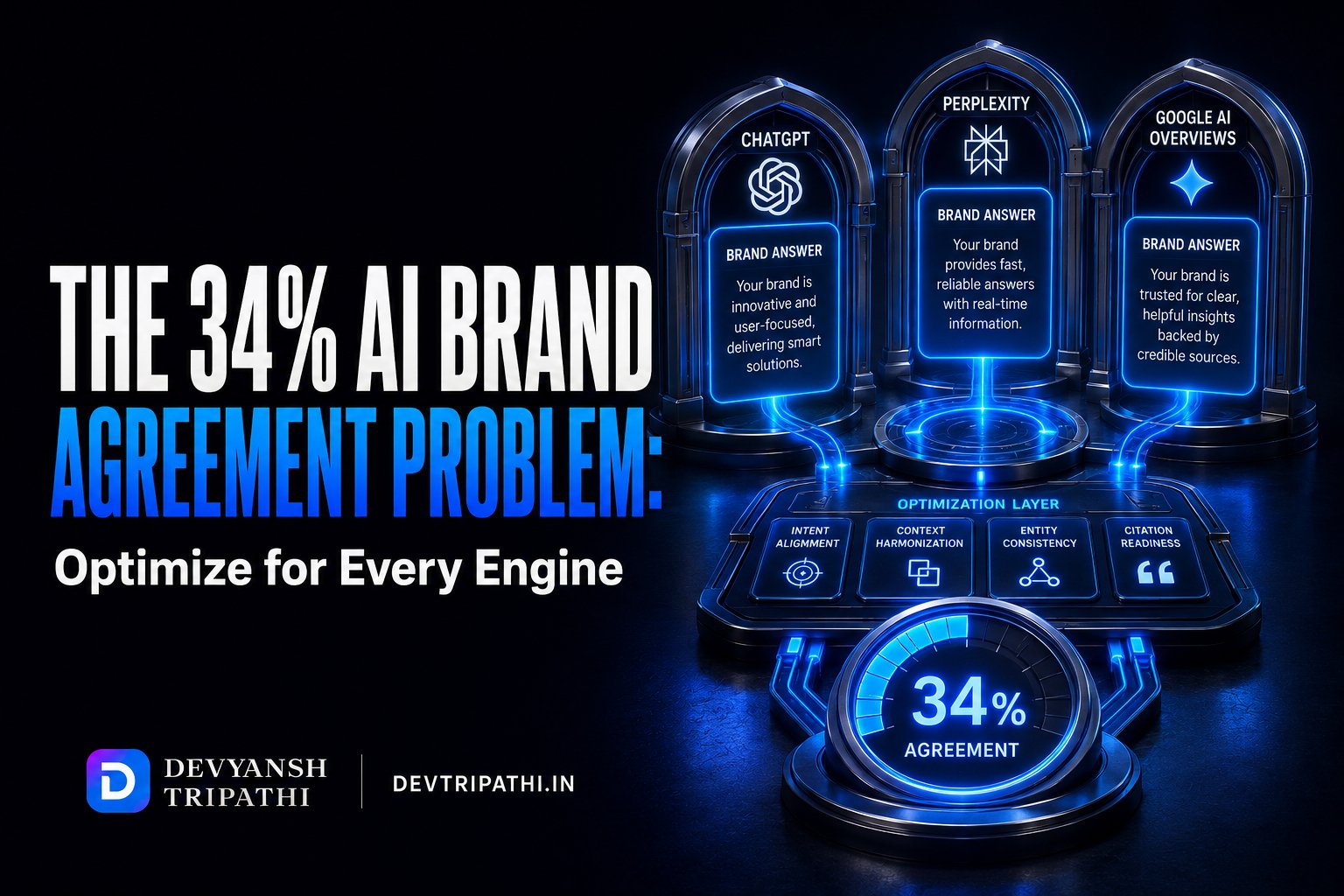
Brand SERP optimization in the second half of 2026 must reckon with a finding that undermines the entire premise of optimizing for a single “AI SERP”: when ChatGPT, Perplexity, Gemini, and Claude were prompted with the same 8,400 commercial queries, the four engines agreed on the single top-cited brand only 34% of the time, meaning there is no unified AI answer a brand can simply “win” the way it once optimized for a single Google position one, while brands that do achieve AI Overview citation see a documented 23% branded search lift within 30 days, an effect that measurably fades as a specific citation persists at the same brand for an average of only 41 days before drifting to a competitor.
This Cycle 4 guide covers the Brand SERP reality defined by engine disagreement and citation impermanence: the complete 8,400-prompt brand tracker data confirming per-engine citation density and the 34% agreement problem, the strengthened citation halo effect showing AI Overview-cited brands now earn approximately 120% more organic clicks per impression than uncited brands, the declining organic-to-AI-Overview ranking correlation that has fallen from 31% to just 17% overlap in a single year, the citation persistence and drift data that redefines Brand SERP monitoring cadence, and Reddit’s continued rise as the second most-cited source after Wikipedia with a documented 2.7 times citation lift for helpful, non-promotional subreddit presence.
Your Brand SERP Now Looks Different in ChatGPT, Perplexity, Gemini, and Claude. Have You Checked All Four?
Get a complete multi-engine Brand SERP audit covering your citation presence and accuracy across ChatGPT, Perplexity, Gemini, and Claude independently, your current AI Overview citation halo status, and the monitoring cadence needed to catch the citation drift that occurs after an average of just 41 days.
Get My Multi-Engine Brand SERP AuditThe 34% Agreement Problem: There Is No Single AI SERP
The most structurally important finding for Brand SERP optimization in 2026 comes from Visionary Marketing’s analysis of 8,400 queries prompted identically across ChatGPT, Perplexity, Gemini, and Claude: the four engines agreed on the single top-cited brand only 34% of the time. This means that for roughly two-thirds of commercial queries tested, a brand achieving the top citation position on one AI engine had no guarantee, and in the majority of cases did not achieve, the equivalent top position on the other three engines simultaneously.
This finding fundamentally reframes what “winning” the Brand SERP means in 2026. The traditional Google organic model, where a brand optimized to hold a single position-one ranking that then served every user identically, does not transfer to the AI-mediated search landscape. There is no single “AI SERP” to optimize for; visibility strategy must be engine-specific, treating each major AI platform as an independent competitive environment requiring its own dedicated citation monitoring and optimization effort rather than assuming success on one platform indicates success across all of them.
34%of the time all four major AI engines agree on the same top-cited brand (8,400-query study)
120%more organic clicks per impression for AI Overview-cited brands vs uncited (Seer 2026)
17%of AI Overview citations now overlap with organic top 10, down from ~31% a year earlier
41days average an AI citation persists at the same brand before drifting to a competitor
Per-Engine Citation Density: Why Perplexity, ChatGPT, Gemini, and Claude Behave Differently
Beyond the 34% agreement problem, the 8,400-query study reveals meaningfully different citation behavior across the four major engines that Brand SERP strategy must account for individually. Understanding each engine’s specific citation density and style allows brands to calibrate expectations and prioritize monitoring effort appropriately across the platform landscape.
84.2% of Responses Cite at Least One Brand
Perplexity: The Most Brand-Dense Engine
Perplexity cites at least one named brand in 84.2% of commercial query responses, the highest rate of any engine tested, partly because its user interface foregrounds source links prominently as a core design feature rather than an incidental element. This makes Perplexity the platform where Brand SERP presence is most consistently achievable across a broad range of commercial queries, and where citation monitoring should be weighted with particular priority given the sheer frequency of brand citation opportunity the platform's design creates.
71.4% of Responses Cite at Least One Brand
ChatGPT: High Density, Broadest Reach
ChatGPT cites at least one named brand in 71.4% of responses, combined with its position as the largest single AI platform by user base, making it the highest-priority platform for total addressable Brand SERP exposure even though its per-response brand citation rate trails Perplexity specifically. Previsible's July 2026 study of 6.77 million LLM-driven sessions across 166 websites over 19 months found ChatGPT commands 92.4% of all standalone AI referral traffic, up from roughly 84% in December 2025, reinforcing its outsized importance for direct referral value even as its share of total AI platform usage has fragmented, as covered in our AISEO Cycle 4 guide.
62.8% and 58.4% Citation Rates
Gemini and Claude: Lower Density, Distinct Behavior
Gemini cites at least one named brand in 62.8% of responses and Claude in 58.4%, with Claude specifically noted as the most prose-led and least brand-dense of the four engines tested, favoring synthesized explanation over explicit named-source citation more than its competitors. This means Brand SERP optimization for Claude specifically may require different success metrics, since even strong topical authority may translate into less frequent explicit brand naming compared to the same underlying authority applied on Perplexity or ChatGPT.
The Strengthening Citation Halo Effect
The commercial case for Brand SERP citation has strengthened measurably within a single year. Brands cited in AI Overviews now earn approximately 120% more organic clicks per impression than uncited brands on the same query, according to Seer Interactive’s updated 2026 analysis, a meaningful increase from the 35% figure reported in earlier 2025 research on the same underlying phenomenon. Per one million impressions on informational queries, Seer’s data shows queries with no AI Overview present generate approximately 33,500 clicks, cited brands within an AI Overview receive approximately 20,743 clicks, and uncited brands on the same AI Overview query receive only approximately 9,445 clicks, a steep and quantified gap between citation winners and citation losers on the identical query.
This citation halo strengthening reinforces the strategic priority of Brand SERP monitoring and optimization: the commercial penalty for being present on a page but not cited has grown more severe over the same period that the reward for citation has grown more valuable, widening the gap between brands that actively manage their AI citation presence and brands that do not. For the complete controllable-source framework that directly addresses citation eligibility, see our AI Citation Optimization Cycle 4 guide.
An AI Citation Lasts an Average of 41 Days Before Drifting. Is Your Monitoring Cadence Fast Enough?
Dev Tripathi builds complete multi-engine Brand SERP monitoring programmes covering weekly citation testing across ChatGPT, Perplexity, Gemini, and Claude independently, structured to catch citation drift before it costs your brand the branded search lift and click halo effect that active citation status provides.
Build My Brand SERP Monitoring ProgrammeThe Declining Organic-to-AI Overview Correlation
A significant shift documented in 2026 data is the declining correlation between traditional organic ranking and AI Overview citation eligibility. Only approximately 17% of sources cited in Google AI Overviews also rank in the organic top 10 for the same query, down from approximately 31% AI Overview citation correlation with top-10 ranking recorded in February 2025. Meanwhile, 40% of sources cited in AI Overviews now rank between positions 11 and 20 on the traditional organic SERP, a range most SEO programmes historically treated as low priority given its limited direct organic click value.
This decline confirms that traditional ranking position has become a measurably weaker predictor of AI Overview citation eligibility than it was even a single year earlier, reinforcing the platform divergence themes covered throughout Cycle 3 and Cycle 4 research. Brand SERP strategy in 2026 must therefore extend monitoring and optimization attention beyond the traditional top-10 positions that historically captured the overwhelming majority of SEO focus, since a meaningful and growing share of AI Overview citation opportunity now originates from pages ranking well outside that traditional priority zone.
Citation Persistence and the 41-Day Drift Window
Perhaps the most operationally significant finding for Brand SERP monitoring cadence is the citation persistence data: once an AI citation is won, it persists at the same brand for an average of only 41 days before drifting to a different source. This finding directly determines how frequently Brand SERP monitoring must occur to remain accurate and actionable, since a monitoring cadence slower than the documented drift window risks missing citation losses for weeks after they have already occurred.
| Metric | 2026 Data Point | Brand SERP Implication |
|---|---|---|
| Engine Agreement Rate | 34% (all four engines agree on top brand) | Monitor each engine independently, no single "AI SERP" target |
| Citation Halo Effect | ~120% more clicks for cited vs uncited brands | Citation status now carries a substantially higher commercial stake |
| Organic-to-AIO Overlap | 17%, down from ~31% a year earlier | Extend monitoring beyond traditional top-10 positions |
| Citation Persistence | 41 days average before drift | Monitoring cadence must be faster than the drift window |
A practical monitoring cadence responding to this 41-day drift window should test priority queries across all four major engines on at least a biweekly basis, with weekly testing recommended for the highest-commercial-value query categories. This cadence provides sufficient lead time to identify and respond to citation drift within the typical persistence window, rather than discovering a citation loss only during a monthly or quarterly review cycle that would allow the full commercial impact of the citation loss to accumulate undetected. For the complete measurement infrastructure supporting this cadence, see our AI Visibility Tracking Cycle 4 guide.
Reddit’s Continued Rise as the Second Most-Cited Source
Reddit accounts for 19.2% of cited sources across AI responses as of Q1 2026, compared to 14.4% for news media, having overtaken news media as a citation source in late 2024 and continuing to climb since. This confirms Reddit’s position as the second most-cited source overall after Wikipedia across the major AI platforms, with the 8,400-query study finding that helpful, non-promotional brand presence on relevant subreddits correlates with a 2.7 times increase in AI citation rate.
For Brand SERP optimization specifically, this reinforces that a brand’s presence in the community conversations AI systems draw from functions as a direct input into Brand SERP outcomes, not merely a supplementary brand awareness channel operating independently of formal citation and ranking metrics. The Brand SERP a prospective customer encounters when they ask an AI engine about a brand or category increasingly reflects the accumulated community discussion happening on Reddit as much as it reflects the brand’s own published content, making authentic Reddit community participation a direct Brand SERP management activity rather than a separate community engagement initiative.
Frequently Asked Questions About Brand SERP Optimization in 2026
What is the 34% agreement problem and why does it matter for Brand SERP strategy?
The 34% agreement problem refers to the finding that when ChatGPT, Perplexity, Gemini, and Claude are prompted with the same commercial queries, they agree on the single top-cited brand only 34% of the time. This matters because it confirms there is no single unified "AI SERP" a brand can optimize for as one target; each of the four major engines represents a genuinely independent competitive environment requiring its own dedicated citation monitoring and optimization strategy rather than assuming success transfers uniformly across platforms.
Which AI engine cites brands most frequently in commercial query responses?
Perplexity cites at least one named brand in 84.2% of commercial query responses, the highest rate among the four major engines tested, partly attributable to its user interface design that foregrounds source links as a core feature. ChatGPT follows at 71.4%, Gemini at 62.8%, and Claude at 58.4%, with Claude noted as the most prose-led and least brand-dense engine, favoring synthesized explanation over explicit named-source citation more than its competitors.
How strong is the current AI Overview citation halo effect on organic clicks?
Brands cited in AI Overviews now earn approximately 120% more organic clicks per impression than uncited brands on the same query according to Seer Interactive's updated 2026 analysis, a strengthened effect compared to the 35% figure reported in earlier 2025 research. Per one million impressions on informational queries, cited brands receive approximately 20,743 clicks compared to only approximately 9,445 for uncited brands on the identical AI Overview query, confirming a widening commercial gap between citation winners and losers.
Why has the organic-to-AI-Overview citation correlation declined so significantly?
Only approximately 17% of AI Overview citations now overlap with organic top-10 results, down from approximately 31% just a year earlier, reflecting AI Overview retrieval systems evolving to draw from a broader range of ranking positions and source signals rather than relying primarily on traditional top-10 ranking as their main selection criterion. With 40% of AI Overview citations now coming from pages ranking between positions 11 and 20, Brand SERP monitoring must extend beyond the traditional top-10 focus that historically captured the majority of SEO attention.
What does the 41-day citation persistence finding mean for monitoring cadence?
The finding that an AI citation persists at the same brand for an average of only 41 days before drifting to a competitor means Brand SERP monitoring must occur more frequently than this drift window to remain actionable. A monthly or quarterly monitoring cadence risks discovering a citation loss weeks after it actually occurred, allowing the commercial impact to accumulate undetected. A biweekly or weekly testing cadence for priority queries provides sufficient lead time to identify and respond to citation drift within the typical persistence window.
Why does Reddit continue rising as an AI citation source?
Reddit's rise to 19.2% of cited sources across AI responses, overtaking news media at 14.4% and continuing to climb since late 2024, reflects AI systems' preference for authentic, experience-based community discussion over purely promotional or corporate-sourced content when generating citations. Helpful, non-promotional brand presence on relevant subreddits correlates with a 2.7 times increase in AI citation rate, confirming Reddit community participation as a direct Brand SERP input rather than a separate brand awareness activity operating independently of formal citation metrics.
How much does FAQ schema improve citation rate according to 2026 data?
FAQ schema lifts citation rate by 38% according to the 8,400-query study, providing one of the most concrete, quantified structured-data returns available in current 2026 Brand SERP and answer engine optimization research. This makes FAQ schema implementation, particularly nested within Article schema as covered in prior GEO research, one of the highest-confidence, most measurable technical investments available for improving Brand SERP citation performance across the major AI platforms.
Why does ChatGPT dominate standalone AI referral traffic despite fragmenting usage share?
Previsible's July 2026 study of 6.77 million LLM-driven sessions found ChatGPT commands 92.4% of all standalone AI referral traffic, up from roughly 84% in December 2025, even as ChatGPT's overall usage market share has declined relative to Gemini and Grok. This apparent contradiction reflects that referral traffic specifically, users clicking through to external websites from AI responses, remains heavily concentrated in ChatGPT even as total platform usage and citation opportunity has diversified across the broader fragmenting platform landscape.
How should Brand SERP monitoring be structured given the per-engine citation density differences?
Brand SERP monitoring should weight testing frequency and priority according to each engine's specific citation behavior: Perplexity warrants close monitoring given its 84.2% brand citation rate and source-link-forward interface design, ChatGPT warrants priority given its combination of high citation rate and outsized referral traffic share, while Gemini and Claude, with lower citation density and Claude's more prose-led response style, may require adjusted success metrics that account for less frequent explicit brand naming even when underlying topical authority is strong.
How does Brand SERP optimization connect to the broader citation concentration reality in AEO research?
Brand SERP optimization operates within the extreme citation concentration documented in broader AEO research, where a small number of dominant domains capture the majority of AI citation volume. The 34% agreement problem adds a further layer of complexity: even within that concentrated landscape, which specific brand gets cited varies significantly by engine, meaning Brand SERP strategy must address both the challenge of achieving citation at all within a concentrated field and the challenge of achieving that citation consistently across multiple, independently-behaving AI engines. For the complete citation concentration analysis, see our AEO Cycle 4 guide.
Build Brand SERP Strategy for Four Independent AI Engines, Not One Unified Target
Get a complete Brand SERP optimization programme covering per-engine citation testing across ChatGPT, Perplexity, Gemini, and Claude, a monitoring cadence fast enough to catch the 41-day citation drift window, FAQ schema implementation for the documented 38% citation lift, and Reddit community strategy for the continued rise in community-sourced citations.
Start My Brand SERP ProgrammeConclusion
Brand SERP optimization in the second half of 2026 requires abandoning the assumption of a single unified AI SERP to optimize for: with the four major engines agreeing on the top-cited brand only 34% of the time, achieving Brand SERP success now means winning citation independently across Perplexity, ChatGPT, Gemini, and Claude, each with distinct citation density, source preferences, and response style. The strengthened citation halo effect, now approximately 120% more organic clicks for AI Overview-cited brands, confirms the commercial stakes of this multi-engine competition have grown substantially even as the traditional organic-ranking predictor of citation eligibility has weakened from 31% to just 17% overlap.
The 41-day citation persistence finding should directly reshape Brand SERP monitoring cadence: brands checking their AI citation status monthly or quarterly are operating with a detection lag that allows citation drift to accumulate unnoticed for a meaningful portion of its total duration. Combined with Reddit’s continued rise to 19.2% of all AI citation sources and the concrete, quantified 38% citation lift from FAQ schema, brands now have both the urgency and the specific tactical levers required to build a genuinely modern, multi-engine, appropriately fast-cadence Brand SERP optimization programme for the remainder of 2026. For the complete brand authority foundation underlying this multi-engine citation performance, see our Brand Authority SEO Cycle 4 guide.

Devyansh Tripathi
I’m Devyansh Tripathi, an SEO strategist and digital growth expert, helps businesses and individuals rank higher and drive organic traffic. Through DevTripathi., he shares cutting-edge SEO insights, content strategies, and marketing hacks. Passionate about digital success, he’s on a mission to make SEO simple, effective, and result-driven!
Posts
- What Google’s New AI Search Documentation Means for SEO Teams
- Google I/O 2026 Search: AI Agents, Gemini 3.5 and the Unified Box
- Google’s AI Optimization Guide: The Technical and Content Checklist
- July 2026 SEO Update: AI Overviews, llms.txt and Search Console
- Prompt Optimization Beyond Page One: The Position-21 Citation Opportunity
Categories
- AI Citation Optimization
- AI Search Optimization (AISEO)
- AI Visibility Tracking
- Answer Engine Optimization (AEO)
- Brand Authority SEO
- Brand SERP Optimization
- Community Signal SEO
- Conversational Search Optimization
- Generative Engine Optimization (GEO)
- Knowledge Graph Optimization
- Modern SEO Strategies
- Multimodal Search Optimization
- Prompt Optimization
- SEO Trends
- Social Search Optimization
- Topical Authority SEO
- Uncategorized
- Video Search SEO
- Visual Search Optimization
- Voice Engine Optimization (VEO)
- Zero Click Search Optimization
Latest News
Text Widget
Empowering brands with insights, strategies, and stories that drive digital growth.