The 6 Brand Authority Signals Google and AI Trust
22 May 2026
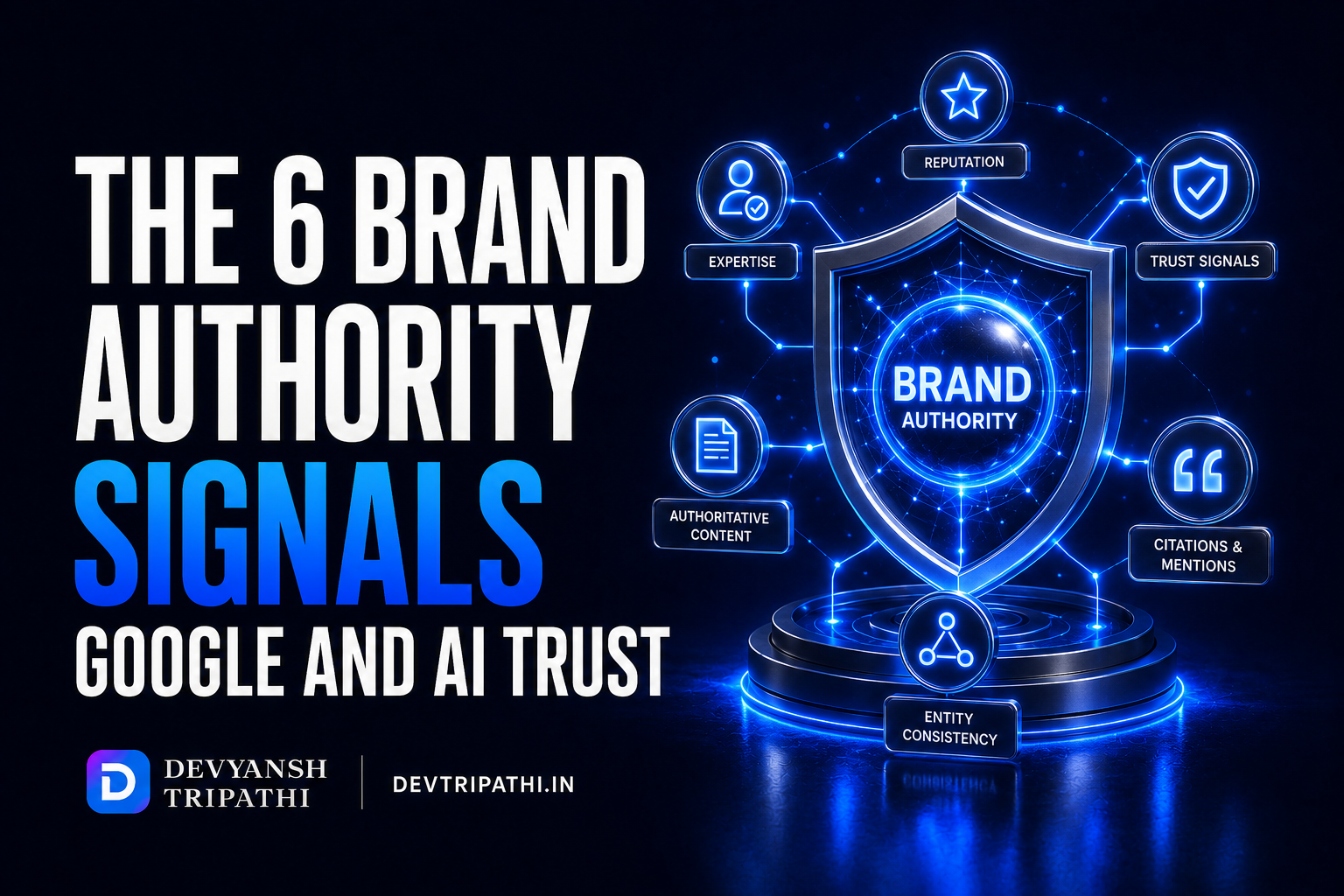
Google’s algorithms in 2026 evaluate brand authority across a much wider set of signals: how often your brand is searched by name, how consistently your entity appears across trusted reference platforms, how many independent sources mention your brand in context, and how much original expertise your content demonstrates compared to the best alternative in your niche.
This shift has created a new discipline called Brand Authority SEO: the strategic practice of building your brand’s credibility, recognition, and trustworthiness in ways that directly feed Google’s ranking algorithms and AI citation systems simultaneously.
This guide covers exactly what brand authority is in the context of modern SEO, how Google evaluates it, why AI systems depend on it for citation decisions, and the specific tactics that build it most efficiently.
What Is Brand Authority in SEO?
Brand Authority in SEO is the level of trust and credibility your business has earned from both users and search engines based on its online presence, reputation, and expertise signals across the web.
It is distinct from Domain Authority, which is a third-party metric based primarily on backlink profiles. Brand authority is broader. It reflects how much Google’s algorithms and AI systems perceive your brand as a genuine, trustworthy entity with real expertise in a specific field.
When your brand has strong authority signals, Google treats your content as inherently more credible. Pages on your site are indexed faster. New content ranks more quickly. Your brand is more resilient to algorithm volatility. And critically, AI platforms including ChatGPT, Google AI Overviews, and Perplexity are significantly more likely to cite your brand in their generated answers.
According to research from Memorable Design, following the early 2026 Google algorithm updates, sites that relied solely on keyword matching and high-volume link building saw significant ranking drops, while brands with genuine real-world footprints surged in visibility.
For a full understanding of how brand authority connects to AI citation performance, read: What Is E-E-A-T and How It Connects to GEO at https://devtripathi.in/blogs/what-is-eeat-and-how-it-connects-to-geo/ and Generative Engine Optimization (GEO): Complete Strategy Guide at https://devtripathi.in/blogs/generative-engine-optimization-geo-strategy-guide/
How Google Evaluates Brand Authority: The 6 Key Signals
Signal 1: Branded Search Volume
Branded search volume is one of the strongest brand authority signals available to Google. When users search for “Dev Tripathi SEO” or “devtripathi.in” instead of just “SEO blog,” Google registers this as a significant vote of confidence. It signals that users specifically want your perspective, not just any content on the topic.
Building branded search volume is the outcome of all other brand authority activities. Users who encounter your brand in AI answers, social media, industry publications, or podcasts subsequently search for your brand name directly. Tracking branded query growth in Google Search Console is one of the leading indicators of brand authority momentum.
Signal 2: Unlinked Brand Mentions (Co-Occurrences)
In 2026, Google’s AI-driven scrapers can identify when your brand is mentioned on high-authority sites even without a hyperlink. These unlinked brand mentions, also called co-occurrences, function as soft citation signals that contribute to Google’s entity trust model.
A mention of your brand name in a Search Engine Journal article, even without a clickable link, registers as an authority signal because it demonstrates that recognized experts in your field reference your brand in context. Building unlinked mentions through digital PR, guest commentary, expert quotes in industry articles, and community participation is a high-leverage brand authority tactic.
Signal 3: Knowledge Graph Entity Recognition
Google’s Knowledge Graph stores information about real-world entities: people, organizations, concepts, and their relationships. When Google’s Knowledge Graph recognizes your brand as a named entity, you receive what is effectively a trust buffer. Your content is indexed faster. Your pages are more protected against minor algorithm fluctuations. And AI systems have higher confidence in citing your brand.
Building Knowledge Graph entity recognition requires: a complete Wikipedia page where warranted, consistent entity information across LinkedIn, Crunchbase, Google Business Profile, official industry directories, and Wikidata. The more sources that consistently describe your brand with the same name, description, category, and founding information, the stronger your entity signal becomes.
Signal 4: E-E-A-T Author and Entity Signals
Google’s E-E-A-T framework (Experience, Expertise, Authoritativeness, Trustworthiness) is now algorithmically enforced through AI-based content quality evaluation. Every article on your website should have a clearly identified, credentialed author whose expertise in the topic can be independently verified through off-site references.
Author bio pages must include high-resolution professional photos, verifiable credentials and qualifications, links to external publications and portfolios, and a clear description of the specific expertise the author brings to the topic. Anonymous content or vague author descriptions actively suppress brand authority signals.
For a complete guide on E-E-A-T implementation, see: What Is E-E-A-T and How It Connects to GEO at https://devtripathi.in/blogs/what-is-eeat-and-how-it-connects-to-geo/
Signal 5: Original Research and Proprietary Data
Publishing original research is one of the most powerful brand authority accelerators available. When your brand is the source of a statistic, case study finding, or original data set, every other piece of content in your niche that references that data must cite you. This creates a compounding brand authority loop: you become the primary source that other authoritative sites reference, which in turn signals to Google and AI systems that your brand is a trusted knowledge source.
Research from Memorable Design confirms this: Google’s Helpful Content system loves data that nobody else has. Original research generates natural high-authority backlinks, increases unlinked brand mentions, improves AI citation rates, and directly builds topical authority simultaneously.
Signal 6: Review Volume and Sentiment
For businesses with any local or consumer-facing presence, review signals are a direct brand authority input. Google’s algorithms evaluate both the volume and sentiment of reviews across Google Business Profile, Trustpilot, G2, and industry-specific review platforms.
Consistent positive reviews signal to Google that real users have genuine positive experiences with your brand. This trust signal feeds into both local search rankings and the broader entity trustworthiness evaluation that influences AI citation decisions.
The 8 Proven Brand Authority SEO Tactics
Tactic 1: Claim and Complete Every Major Business Directory
Register and fully complete your brand profile on every directory and platform Google treats as a trusted reference source: LinkedIn, Crunchbase, Google Business Profile, AngelList, industry-specific directories, Wikipedia (where eligible), Wikidata, and the Indian Business Directory for India-based brands.
Ensure your Name, Address, and Phone number are absolutely consistent across every platform. Even minor inconsistencies in formatting reduce Google’s entity confidence in your brand.
Tactic 2: Publish Original Research and Proprietary Data
Create at least one original research piece per quarter. This does not require a formal academic study. It can be a survey of your existing audience, an analysis of data you already collect through client work, a benchmark study comparing industry performance metrics, or a compilation of first-party observations from your own practice.
Promote the research through your newsletter, social media, and direct outreach to relevant publications. Original data generates natural citations from other authoritative sources, building your brand’s position as a knowledge authority in your niche.
Tactic 3: Build a Digital PR and Earned Media Program
Secure regular mentions in recognized industry publications. For the SEO and digital marketing niche, target publications including Search Engine Journal, Search Engine Land, Ahrefs Blog, Semrush Blog, and relevant Indian marketing publications.
A single link from a top-tier industry publication delivers more brand authority than dozens of links from low-quality sources. Beyond links, the brand mention itself functions as an unlinked co-occurrence signal that strengthens your entity authority in Google’s model.
Tactic 4: Optimize Author Entity Pages
Create a dedicated author page for every content creator on your website. The author page should function as a mini-Wikipedia entry for that person’s expertise: professional credentials, links to external publications, areas of specialization, professional headshot, and a clear description of their experience.
Link every article published by that author to their author page. This creates a clear attribution chain that Google’s E-E-A-T evaluation systems can follow, verifying that the person whose name appears on the article has demonstrable expertise in the topic they are writing about.
Tactic 5: Build Community Authority on Third-Party Platforms
AI systems crawl Reddit, Quora, LinkedIn, and niche community platforms to understand real-world brand sentiment. If your brand is never mentioned in these spaces, or is mentioned negatively, AI citation systems reduce their confidence in recommending you.
Build a genuine, consistent presence in the communities where your target audience discusses their challenges. Answer questions on Quora. Participate in relevant subreddits. Publish LinkedIn articles that demonstrate expertise. The goal is not promotional presence but genuine helpfulness that builds brand recognition among the communities where industry knowledge flows.
For a deeper understanding of how community signals feed into AI citation authority, see: Generative Engine Optimization (GEO): Complete Strategy Guide at https://devtripathi.in/blogs/generative-engine-optimization-geo-strategy-guide/
Tactic 6: Create and Promote Linkable Asset Content
Certain content formats attract natural backlinks and brand mentions at a disproportionately high rate. These are called linkable assets: original research reports, comprehensive industry glossaries, free tools and calculators, definitive guides that become the go-to reference in their niche, and data visualization pieces that other publications embed with attribution.
Building two to three major linkable assets per year and actively promoting them through outreach, social distribution, and PR creates sustained brand authority growth without requiring ongoing link-building campaigns.
For a framework on building topical authority through structured content, see: Entity SEO, GEO, and Topic Authority in AI Search at https://devtripathi.in/blogs/entity-seo-geo-topic-authority-ai-search/
Tactic 7: Monitor and Build Branded Search Volume
Track your branded search query volume monthly in Google Search Console. Establish a baseline and monitor month-over-month trends. Branded search growth is a leading indicator of brand authority momentum: it confirms that your other brand-building activities are reaching real users who remember and seek out your brand specifically.
Activities that accelerate branded search growth: podcast appearances where you are introduced by name, co-marketing collaborations with established brands, video content that builds personal recognition, and consistent social media presence that reinforces name recall.
Tactic 8: Protect and Build Your Online Reputation
Negative reviews, unaddressed brand criticism, or conflicting information about your brand across platforms all weaken your authority signals. Actively monitor your brand mentions using tools like Google Alerts, Mention, or Brand24. Respond professionally to negative reviews. Correct factual inaccuracies in third-party mentions promptly.
Brands with clean, consistent, positive reputation signals across the web earn higher entity trust scores and are more likely to be cited by AI systems and ranked prominently by Google than equally capable brands with messy or inconsistent online reputations.
Brand Authority SEO and AI Citation: The Direct Connection
Brand authority is not only a Google ranking signal. It is one of the primary factors that determines whether AI platforms including ChatGPT, Perplexity, Google AI Overviews, and Gemini cite your brand when generating answers.
AI systems use multi-source corroboration to assign citation confidence. When your brand is mentioned across multiple independent, authoritative sources — a Search Engine Land article, a Reddit thread, a LinkedIn post by an industry expert, a Quora answer — the AI assigns higher confidence that your brand is a trustworthy, citable source in your category.
Brands that invest in Brand Authority SEO simultaneously improve their traditional search rankings and their AI citation frequency. The two goals reinforce each other because they depend on the same underlying signals: genuine expertise, consistent entity presence, original data, and multi-platform authority.
According to research from multiple brand authority studies, AI-referred traffic to websites grew 527% year over year through mid-2025. The brands capturing this traffic are the ones AI systems already recognize as trusted entities in their fields.
For the complete AI citation optimization framework, see: AI Search Optimization (AISEO): The Complete Guide at https://devtripathi.in/blogs/ai-search-optimization-aiseo-complete-guide/
Measuring Brand Authority SEO Performance
Branded Search Volume Growth: Track monthly in Google Search Console. Year-over-year branded query growth above 15% indicates strong brand authority momentum.
Domain Rating and Trust Flow Trends: Monitor in Ahrefs or Majestic. These metrics, while not direct Google inputs, correlate with the backlink quality signals that feed brand authority.
Brand Mention Volume: Track weekly using Google Alerts, Mention, or Brand24. Monitor both linked and unlinked mentions. Growth in unlinked brand mentions is a particularly strong early indicator of increasing brand authority.
AI Citation Frequency: Test your top 10 target queries in ChatGPT, Perplexity, and Google AI Mode weekly. Count how many responses include your brand. Track this as your AI Share of Voice metric.
Knowledge Panel Presence: Check whether your brand has a Google Knowledge Panel. Its presence confirms Google has recognized your brand as a Knowledge Graph entity, which is one of the clearest signals of established brand authority.
Frequently Asked Questions About Brand Authority SEO
What is the difference between Domain Authority and Brand Authority in SEO?
Domain Authority (DA) is a third-party metric developed by Moz that estimates ranking potential based primarily on backlink profiles. Brand Authority in SEO is a broader concept that encompasses how Google and AI systems perceive your brand’s credibility, expertise, and trustworthiness based on branded search volume, entity consistency, original expertise signals, unlinked mentions, review sentiment, and multi-platform presence. Brand authority feeds into actual Google rankings. Domain Authority is a proxy metric.
How long does it take to build brand authority for SEO?
Brand authority is a long-term investment. Meaningful improvements in branded search volume and entity recognition typically begin to show within 3 to 6 months of consistent investment. Significant competitive brand authority in an established niche takes 12 to 24 months of sustained effort across digital PR, original research, community presence, and content quality. The key advantage: once built, brand authority is far more resilient to algorithm changes than any technical optimization alone.
Does brand authority protect rankings during Google algorithm updates?
Yes. Research consistently shows that sites with strong brand authority signals, characterized by high branded search volume, verified entity presence, and multi-source mentions, demonstrate greater stability during core algorithm updates than sites that depend primarily on keyword optimization and backlink volume. Following the March 2026 Google Core Update, sites with genuine brand footprints maintained or gained visibility while sites relying on algorithm gaming saw significant declines.
Can small or new websites build brand authority?
Yes. Brand authority is not exclusively a function of age or size. It is a function of expertise signals, consistency, and genuine value delivered. Small brands can build strong brand authority by: publishing original research in a specific niche, becoming the go-to expert in a narrowly defined topic area, building a consistent presence on relevant community platforms, and earning a small number of high-quality mentions in authoritative publications. Niche authority is more achievable than broad-market authority and can be just as effective for driving rankings and AI citations in a specific domain.
What role does original research play in brand authority SEO?
Original research is one of the most efficient brand authority accelerators available. When your brand publishes data no other source has, you become the primary citation for anyone writing about that topic. This generates natural high-authority backlinks, increases unlinked brand mentions, improves AI citation rates, builds branded search volume, and reinforces topical authority simultaneously. One strong original research piece can generate brand authority signals that would take years to build through other methods alone.
How do unlinked brand mentions affect SEO?
Google’s AI-driven algorithms can now identify brand mentions on authoritative sites even without hyperlinks. These unlinked co-occurrences signal to Google that recognized experts in your field reference your brand in relevant contexts. While linked mentions carry stronger signals, unlinked mentions from high-authority sources contribute meaningfully to Google’s entity trust model and improve AI citation confidence. Building unlinked mentions through digital PR, expert quotes in industry articles, and community participation is a direct brand authority tactic.
How does brand authority affect AI search citations?
AI platforms use multi-source corroboration to assign citation confidence. A brand mentioned positively across multiple independent authoritative sources receives higher citation confidence from AI systems like ChatGPT, Perplexity, and Google AI Overviews. Brand authority SEO directly feeds AI citation frequency by ensuring your brand entity is consistently recognized, positively represented, and cross-referenced across the sources AI models trust most.
Is social media presence part of brand authority SEO?
Social media does not provide direct PageRank signals to Google. However, it contributes to brand authority through several indirect mechanisms: driving branded search volume as followers look up your website directly, generating content that gets indexed and creates brand mentions in social contexts, building the personal recognition of authors and experts whose names appear on your content, and amplifying original research and linkable assets to audiences who then cite you from their own platforms.
What is the fastest way to build brand authority for a new SEO website?
The fastest path for a new SEO-focused website is: (1) define a narrow sub-niche rather than trying to compete across all of SEO, (2) publish one piece of original research with real data, (3) earn one mention in a recognized industry publication, (4) build a complete, credentialed author profile, (5) claim and complete all major business directory listings, and (6) participate consistently in relevant SEO communities on Reddit and Quora. These six actions together create the foundational brand entity signals Google and AI systems need to begin recognizing your brand as an authoritative source.
How important is branded search volume for rankings?
Very important. Branded search volume signals to Google that users specifically want your brand’s content, not just any content on a topic. This user preference signal is one of the strongest brand authority inputs Google’s algorithms process. Brands with growing branded search volume consistently maintain better rankings during core algorithm updates and appear more frequently in AI-generated answers than brands with equivalent content but minimal branded search activity.
Conclusion
Brand Authority SEO is the most durable and algorithm-resilient SEO strategy available in 2026. It cannot be shortcut, gamed, or purchased in bulk. It is built through genuine expertise, consistent entity presence, original knowledge contribution, and earned recognition from independent authoritative sources.
The brands gaining ground in search rankings and AI citations right now are the ones that made strategic investments in brand authority 12 to 24 months ago. The brands that invest in brand authority today will be the ones dominating their categories in search and AI discovery through the next wave of algorithm evolution.
Start by auditing your current brand signals: check your Knowledge Panel presence, review your author entity consistency, measure your branded search volume trend, and assess your unlinked mention frequency. Then build a 12-month brand authority roadmap that includes original research, digital PR, community participation, and entity profile completion across all major reference platforms.
Brand authority compounds. Every mention earned, every research piece cited, every expert credential verified, makes the next one easier and the overall system more resilient. Build it systematically, measure it consistently, and the rankings and AI citations will follow.
Google Search Central — E-E-A-T Quality Guidelines: https://developers.google.com/search/docs/fundamentals/creating-helpful-content
Google Knowledge Graph Information: https://blog.google/products/search/introducing-the-knowledge-graph-things-not/
Wikidata — Entity Registration: https://www.wikidata.org/wiki/Wikidata:Main_Page
Schema.org — Organization Schema: https://schema.org/Organization
Google Search Console — Performance Report: https://search.google.com/search-console/

Devyansh Tripathi
I’m Devyansh Tripathi, an SEO strategist and digital growth expert, helps businesses and individuals rank higher and drive organic traffic. Through DevTripathi., he shares cutting-edge SEO insights, content strategies, and marketing hacks. Passionate about digital success, he’s on a mission to make SEO simple, effective, and result-driven!
Posts
- What Google’s New AI Search Documentation Means for SEO Teams
- Google I/O 2026 Search: AI Agents, Gemini 3.5 and the Unified Box
- Google’s AI Optimization Guide: The Technical and Content Checklist
- July 2026 SEO Update: AI Overviews, llms.txt and Search Console
- Prompt Optimization Beyond Page One: The Position-21 Citation Opportunity
Categories
- AI Citation Optimization
- AI Search Optimization (AISEO)
- AI Visibility Tracking
- Answer Engine Optimization (AEO)
- Brand Authority SEO
- Brand SERP Optimization
- Community Signal SEO
- Conversational Search Optimization
- Generative Engine Optimization (GEO)
- Knowledge Graph Optimization
- Modern SEO Strategies
- Multimodal Search Optimization
- Prompt Optimization
- SEO Trends
- Social Search Optimization
- Topical Authority SEO
- Uncategorized
- Video Search SEO
- Visual Search Optimization
- Voice Engine Optimization (VEO)
- Zero Click Search Optimization
Latest News
Text Widget
Empowering brands with insights, strategies, and stories that drive digital growth.