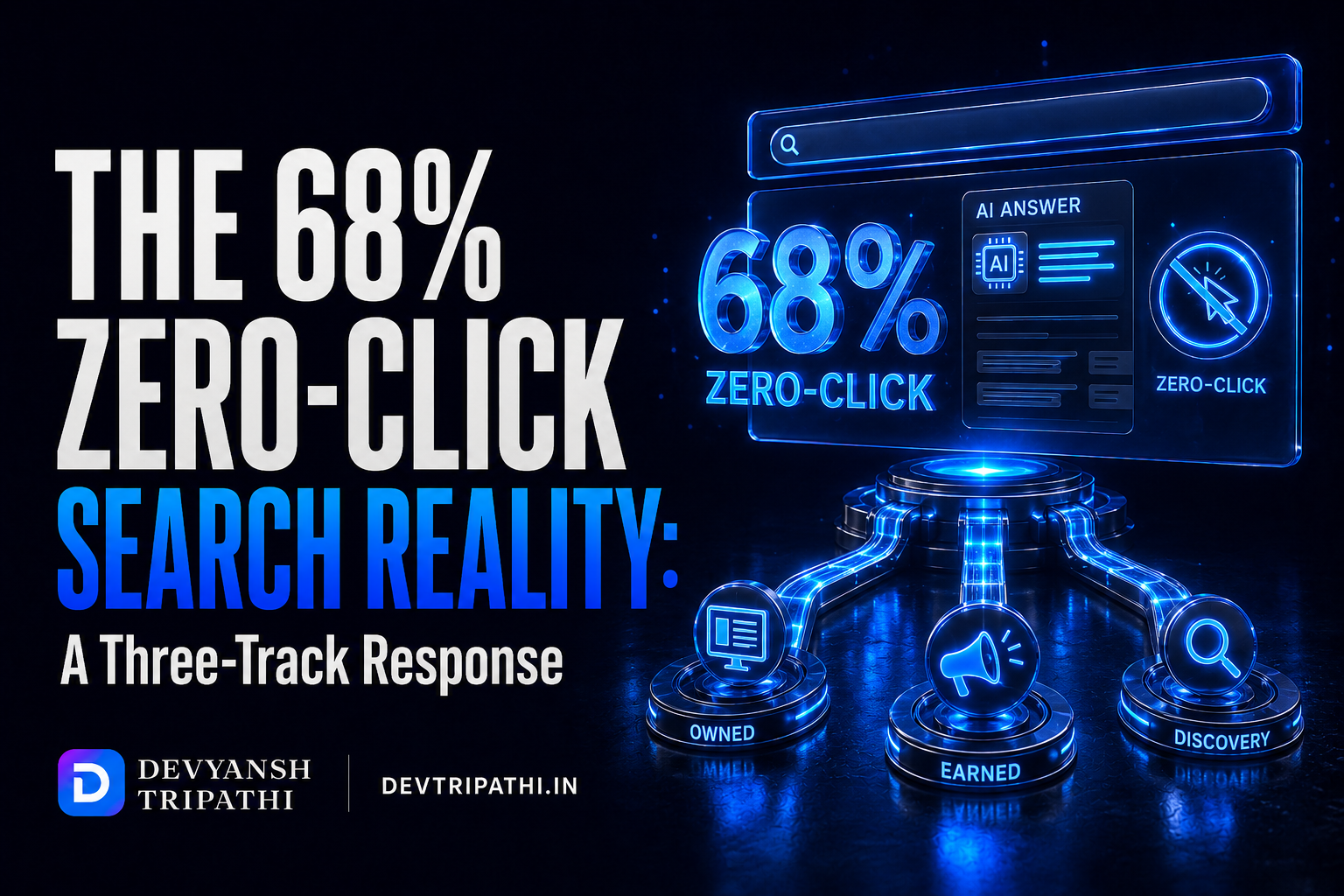
The 68% Zero-Click Search Reality: A Three-Track Response
15 July 2026
Zero-click search optimization in 2026 responds to a defining data point: SparkToro’s June 2026 study found 68% of US Google searches now end without a click to any external website, a figure that climbs to 83% when an AI Overview appears and reaches 93% in Google’s AI Mode specifically, meaning the search results page itself has become the primary destination for the majority of queries rather than a gateway users pass through on their way to a website.
This advanced guide covers the zero-click reality and the citation-first strategy it demands: the complete SparkToro data confirming only 360 of every 1,000 US searches reach the open web, the query-type variance showing informational queries at 74% zero-click against transactional queries at only 31%, the documented commercial upside for brands cited in AI Overviews earning 35% more organic clicks and converting 4 to 9 times higher, the three-track strategic framework that replaces click-only optimization, and the specific measurement shift from traffic-based to visibility-based KPIs that the zero-click reality requires from every SEO programme still measuring success by session count alone.
Is Your SEO Strategy Still Measuring Success by Clicks Alone?
With 68% of searches now ending without a click and 93% in AI Mode specifically, click-based measurement captures a shrinking fraction of your actual search visibility. Get a complete zero-click assessment covering your AI Overview citation rate, brand impression tracking, and the visibility-first measurement framework built for the 2026 search reality.
Get My Zero-Click AssessmentThe Complete 2026 Zero-Click Data Picture
Zero-click search has moved from an emerging concern to the defining structural fact of search in 2026. SparkToro’s June 2026 study, the most current authoritative measurement available, found 68% of US Google searches end without a click, meaning only 276 to 360 of every 1,000 searches reach the open web depending on the specific measurement window. This represents continued acceleration from the 58.5% figure that SparkToro’s earlier 2024 research established, confirming the trend is not stabilizing but continuing to climb as AI-powered search features expand their coverage across query types.
The rate intensifies dramatically in AI-mediated search contexts specifically. When an AI Overview is present on a search results page, the zero-click rate rises to 83% according to Bain and Company’s Generative AI Consumer Survey. In Google’s newer AI Mode specifically, the zero-click rate reaches 93% according to Semrush’s research, meaning fewer than one in ten AI Mode searches produces any click to an external website at all. This progression from 68% baseline to 83% with AI Overviews to 93% in full AI Mode illustrates a clear trajectory: as AI-generated synthesis becomes more comprehensive and more prominently featured, the click-through opportunity for even well-ranked organic content continues to compress further.
68%of US Google searches end without a click (SparkToro, June 2026)
83%zero-click rate when an AI Overview is present (Bain and Company)
93%zero-click rate specifically in Google's AI Mode (Semrush)
35%more organic clicks earned by brands cited in AI Overviews (Strategyc 2026)
Query-Type and Device Variance: Where Clicks Still Happen
The zero-click impact is not uniform across all search behavior, and understanding the specific variance by query type and device is essential for allocating optimization investment intelligently rather than treating all content as equally affected by the zero-click shift. Strategyc’s 2026 data reveals a clear pattern: informational queries show a 74% zero-click rate, while transactional queries remain at only 31% zero-click, confirming that users with clear purchase or action intent continue clicking through to complete their objective even as AI systems increasingly satisfy pure informational curiosity directly on the results page.
Device usage shows a similarly pronounced split, with mobile searches reaching 77% zero-click compared to 46.5% on desktop. This gap reflects both Google’s deliberate surfacing of more on-SERP features specifically on mobile, including local packs, knowledge panels, People Also Ask boxes, and AI Overviews optimized for mobile screen real estate, and the practical reality that mobile users conducting quick, on-the-go queries are more likely to accept an immediate on-screen answer than to navigate to and load a separate website. A mobile search for “best Italian restaurant near me” returning a local pack with ratings, hours, and a map, allowing the user to call directly or get directions without visiting any website, exemplifies this pattern occurring across millions of local queries daily.
The Strategic Implication of Query-Type Variance
This variance data has direct budget allocation implications: content teams should expect informational content to increasingly serve a citation and brand visibility function rather than a direct-traffic function, while commercial and transactional content retains meaningfully stronger click-through value even within the broader zero-click trend. Rather than applying a single uniform zero-click response strategy across an entire content library, brands should segment their content investment based on where each piece falls on the informational-to-transactional spectrum, applying citation-first optimization more heavily to informational content while maintaining strong traditional conversion-focused optimization for transactional and commercial pages.
The Documented Commercial Upside of AI Citation
The most commercially important finding in 2026 zero-click research is not the scale of the click decline itself but the documented, quantified upside available to brands that successfully earn AI citation inclusion. Brands cited in AI Overviews earn 35% more organic clicks and convert visitors at 4 to 9 times higher rates than standard organic traffic, a differential large enough to fundamentally change the ROI calculation for citation-focused optimization investment relative to traditional ranking-focused investment alone.
The mechanism behind this conversion premium is well understood: AI Overviews reduce organic click-through rate by an average of 18%, but the clicks that do survive convert 23% better, because the surviving visitors have already read a complete AI-generated summary and are deliberately seeking deeper information rather than casually browsing search results. This means the users who do click through in a zero-click-dominant environment are systematically higher-intent than the broader population of clicks that occurred before AI Overviews existed, a quality-over-volume shift that favors brands optimized for citation over brands still optimizing purely for volume-maximizing click-through rate tactics.
First-Citation Position: The New Position-One Equivalent
Within an AI Overview’s citation set, position matters just as significantly as it did in traditional organic rankings, though the mechanism differs. Ekamoira’s 2026 analysis found the primary cited source in an AI Overview receives the substantial majority of any remaining click volume, while secondary citations receive almost nothing, a “citation without clicks” phenomenon where being included provides visibility and brand awareness value but not meaningful traffic unless a brand achieves the primary citation position specifically. This makes first-citation position within AI Overview responses the functional equivalent of the traditional position-one organic ranking, requiring the same intensity of optimization focus that brands historically applied to winning the top organic spot.
Citation Is the New Click. Are You Optimizing for the Metric That Actually Matters Now?
Dev Tripathi builds complete zero-click optimization programmes covering AI Overview citation strategy, the three-track framework for informational, transactional, and brand visibility content, and the measurement infrastructure that tracks impressions and citations alongside traditional traffic.
Build My Zero-Click StrategyThe Three-Track Zero-Click Strategic Framework
Responding effectively to the zero-click reality requires operating across three parallel strategic tracks simultaneously rather than attempting a single unified response to what is genuinely a multi-dimensional shift in how search value is created and captured.
Track 1
AI Citation Optimization for Informational Content
For the 74% zero-click informational query category, the strategic objective shifts from traffic generation to citation inclusion, specifically first-citation position within AI Overview responses. This requires the answer-first content structure, complete schema deployment, and entity authority signals covered throughout our AI Citation Optimization Advanced Guide, treating citation rate rather than click-through rate as the primary success metric for this content category.
Track 2
Traditional Conversion Optimization for Transactional Content
For the 31% zero-click transactional query category, traditional organic ranking, compelling meta descriptions, and conversion-focused landing page optimization retain strong direct value, since users with clear purchase intent continue clicking through at meaningfully higher rates than informational searchers. This content should maintain investment in traditional SEO and conversion rate optimization practices rather than being redirected entirely toward citation-focused strategy.
Track 3
Brand Visibility and Entity Authority Building
Across both content categories, sustained investment in entity clarity, structured data, and multi-platform brand presence builds the underlying authority that determines citation eligibility regardless of specific query type. This track connects directly to the brand authority framework covered in our Brand Authority SEO Cycle 3 guide, recognizing that AI Overviews appearing in 89% of brand search results makes brand-level entity authority a prerequisite for citation success across the entire content portfolio.
| Query Type | Zero-Click Rate | Primary Optimization Track | Success Metric |
|---|---|---|---|
| Informational | 74% | AI citation optimization, answer-first structure | Citation rate, first-citation position |
| Transactional | 31% | Traditional SEO, conversion rate optimization | Click-through rate, conversion rate |
| Mobile Searches | 77% | Local pack optimization, structured data | SERP feature ownership, brand impressions |
| Desktop Searches | 46.5% | Balanced traditional and citation optimization | Combined traffic and citation performance |
Measuring Success in a Zero-Click Environment
The click-based traffic model assumed all search value was captured at the moment of click. In a zero-click-dominant environment, significant value accumulates at the citation and impression level even when the click never comes, requiring a fundamentally different measurement framework that captures visibility and brand influence rather than only session-based traffic metrics.
Reframing Brand Search Volume as a Leading Indicator
Users who see a brand featured in an AI Overview, even without clicking, receive a brand impression from what they perceive as a highly trusted, authoritative source. This impression frequently manifests downstream as branded search volume growth, direct navigation traffic, or a delayed return visit days or weeks later, none of which appear in the immediate session that generated the original zero-click AI Overview exposure. If branded search volume is flat or declining while AI citation impressions are growing, that divergence signals that content is achieving visibility without being compelling enough to drive meaningful follow-up brand consideration, a diagnostic insight that pure click-based measurement cannot surface at all.
The Correlation-Based Measurement Approach
Given that individual zero-click AI Overview exposures cannot be directly attributed to specific downstream conversions through standard analytics, the practical measurement approach shifts toward correlation analysis: tracking AI citation rate for priority queries alongside branded search volume, direct traffic, and AI-referred session growth over rolling monthly periods, then evaluating whether citation rate improvements correlate with movement in these downstream indicators over a 60 to 90 day window. This correlation-based approach, rather than direct causal attribution, has become the practical standard for measuring zero-click strategy effectiveness in 2026, since the search results page itself has effectively become an unmeasurable black box for any individual query’s downstream commercial impact. For the complete measurement framework addressing this attribution challenge, see our Modern SEO Strategies Cycle 3 guide.
Frequently Asked Questions About Zero-Click Search Optimization
What is zero-click search optimization in 2026?
Zero-click search optimization is the practice of building brand visibility, citation inclusion, and entity authority specifically to succeed in a search environment where 68% of US Google searches end without a click to any external website, rising to 93% in Google's AI Mode. It shifts the optimization objective from generating website traffic to earning inclusion and, ideally, first-citation position within AI Overviews, featured snippets, and other on-SERP features that now satisfy the majority of search intent directly on the results page.
Why has the zero-click rate reached 68% in 2026?
The zero-click rate reached 68% according to SparkToro's June 2026 study due to the continued expansion of AI Overviews, featured snippets, knowledge panels, and other on-SERP features that increasingly satisfy user intent directly without requiring a website visit. This represents continued acceleration from the 58.5% figure SparkToro's 2024 research established, confirming the trend has not stabilized but continues climbing as AI-generated synthesis becomes more comprehensive and prominently featured across a growing range of query types.
Why does the zero-click rate reach 93% specifically in Google's AI Mode?
Google's AI Mode reaches a 93% zero-click rate according to Semrush's research because AI Mode is specifically designed to synthesize comprehensive, conversational responses that fully address multi-part user queries directly within the AI Mode interface, going further than standard AI Overviews in resolving user intent without requiring any external website visit. This represents the most complete expression of the zero-click trend, where fewer than one in ten AI Mode searches produces any click through to an external website at all.
Why do informational queries show a much higher zero-click rate than transactional queries?
Informational queries show a 74% zero-click rate compared to only 31% for transactional queries because users seeking to understand a concept or fact can typically have that need fully satisfied by an AI-generated summary or snippet, while users with clear purchase or action intent need to complete a specific transaction, compare specific product details, or interact with a specific business, actions that generally still require visiting an external website or service regardless of how comprehensive an on-SERP summary might be.
What commercial advantage do brands cited in AI Overviews actually receive?
Brands cited in AI Overviews earn 35% more organic clicks and convert visitors at 4 to 9 times higher rates than standard organic traffic, a differential that reflects both the credibility transfer from appearing in a trusted AI-generated summary and the higher intent of users who click through after already reading a complete summary. This documented commercial upside provides the quantified business case for prioritizing AI citation optimization investment even in an environment where overall click volume continues declining.
What is the citation without clicks phenomenon?
Citation without clicks describes the pattern where being included in an AI Overview's citation set provides brand visibility and awareness value but generates minimal actual traffic, because the primary cited source receives the substantial majority of any remaining click volume while secondary citations receive almost nothing. This makes achieving first-citation position, not merely appearing anywhere within an AI Overview's source list, the meaningful optimization target, functioning as the AI-era equivalent of winning the traditional position-one organic ranking spot.
How should content strategy differ between informational and transactional pages given zero-click data?
Informational content, facing a 74% zero-click rate, should prioritize answer-first structure, complete schema deployment, and entity authority signals that maximize AI citation eligibility, treating citation rate as the primary success metric rather than click-through rate. Transactional content, facing only 31% zero-click, should maintain strong investment in traditional SEO, compelling meta descriptions, and conversion rate optimization, since users with clear purchase intent continue clicking through and completing transactions at meaningfully higher rates than informational searchers.
Why do mobile searches show a higher zero-click rate than desktop searches?
Mobile searches show a 77% zero-click rate compared to 46.5% on desktop because Google deliberately surfaces more on-SERP features optimized for mobile screen constraints, including local packs, knowledge panels, People Also Ask boxes, and AI Overviews, and because mobile users conducting quick, on-the-go queries are more likely to accept an immediate on-screen answer than navigate to and load a separate website. Local business queries specifically show this pattern clearly, with users calling directly or getting directions from a local pack without ever visiting a website.
How should SEO measurement change to account for the zero-click reality?
SEO measurement should shift from primarily traffic-based metrics toward visibility-based metrics including AI citation rate, brand impression volume, and SERP feature ownership, tracked alongside traditional session-based analytics rather than replacing them. Since individual zero-click AI Overview exposures cannot be directly attributed to specific downstream conversions, correlation-based measurement, tracking citation rate improvements against branded search volume and AI-referred session growth over 60 to 90 day windows, has become the practical standard for demonstrating zero-click strategy effectiveness.
What does AI Overviews appearing in 89% of brand search results mean for brand-level strategy?
AI Overviews appearing in 89% of brand search results according to Goodfirms' 2026 survey means that brand-level entity authority, not just individual page optimization, has become a prerequisite for citation success across a business's entire content portfolio. This makes investment in Knowledge Panel presence, review platform coverage, and consistent entity signals a foundational requirement that benefits AI citation eligibility across every query category, rather than a supplementary consideration separate from page-level content optimization work.
Why do surviving clicks after AI Overview exposure convert 23% better?
Clicks that survive after a user has already seen an AI Overview convert 23% better because those users have already read a complete AI-generated summary of the topic and are deliberately seeking deeper, more specific information rather than casually browsing initial search results. This represents a quality-over-volume shift: AI Overviews reduce overall click-through rate by an average of 18%, but the reduced click volume that remains is systematically higher-intent, favoring brands and content optimized to serve this smaller but more valuable and more conversion-ready audience segment.
How does zero-click search optimization connect to the broader GEO strategy?
Zero-click search optimization and generative engine optimization address the same underlying reality from complementary angles: GEO provides the content structure, schema deployment, and citation eligibility tactics that determine whether a brand is selected for AI Overview inclusion, while zero-click strategy provides the measurement framework and strategic prioritization logic for allocating optimization investment given the documented scale of the zero-click shift. The two disciplines should be implemented together rather than separately, since GEO tactics are the practical mechanism through which zero-click strategic priorities get executed. For the complete GEO implementation framework, see our GEO Cycle 3 guide.
Build a Search Strategy for a World Where 68% of Searches Never Click Through
Get a complete zero-click optimization programme covering the three-track strategic framework, AI Overview first-citation position strategy, query-type content segmentation, and the correlation-based measurement system that tracks brand visibility and citation impact alongside traditional traffic metrics.
Start My Zero-Click Optimization ProgrammeConclusion
Zero-click search optimization in 2026 responds to the most complete and current data available: 68% of US Google searches end without a click, climbing to 83% with AI Overviews present and 93% in Google’s AI Mode specifically, confirming the search results page has become the primary destination for most queries rather than a gateway to the open web. This is not a temporary anomaly but the defining structural shift in how search delivers value, with informational queries at 74% zero-click and transactional queries at only 31% revealing exactly where traditional click-optimization investment still produces strong direct returns and where citation-first strategy has become the only path to meaningful visibility.
The documented commercial upside for brands succeeding at citation, 35% more organic clicks and 4 to 9 times higher conversion rates, provides the clear business case for the three-track strategic framework: AI citation optimization for informational content, traditional conversion optimization for transactional content, and sustained brand authority investment underlying both. Measuring success through correlation-based visibility metrics rather than click-only attribution completes the strategic shift that the 2026 zero-click data demands from every SEO programme still operating on assumptions the numbers no longer support. For the complete answer format architecture that operationalizes citation-first content strategy, see our AEO Advanced Strategies guide.

Devyansh Tripathi
I’m Devyansh Tripathi, an SEO strategist and digital growth expert, helps businesses and individuals rank higher and drive organic traffic. Through DevTripathi., he shares cutting-edge SEO insights, content strategies, and marketing hacks. Passionate about digital success, he’s on a mission to make SEO simple, effective, and result-driven!
Posts
- What Google’s New AI Search Documentation Means for SEO Teams
- Google I/O 2026 Search: AI Agents, Gemini 3.5 and the Unified Box
- Google’s AI Optimization Guide: The Technical and Content Checklist
- July 2026 SEO Update: AI Overviews, llms.txt and Search Console
- Prompt Optimization Beyond Page One: The Position-21 Citation Opportunity
Categories
- AI Citation Optimization
- AI Search Optimization (AISEO)
- AI Visibility Tracking
- Answer Engine Optimization (AEO)
- Brand Authority SEO
- Brand SERP Optimization
- Community Signal SEO
- Conversational Search Optimization
- Generative Engine Optimization (GEO)
- Knowledge Graph Optimization
- Modern SEO Strategies
- Multimodal Search Optimization
- Prompt Optimization
- SEO Trends
- Social Search Optimization
- Topical Authority SEO
- Uncategorized
- Video Search SEO
- Visual Search Optimization
- Voice Engine Optimization (VEO)
- Zero Click Search Optimization
Latest News
Text Widget
Empowering brands with insights, strategies, and stories that drive digital growth.