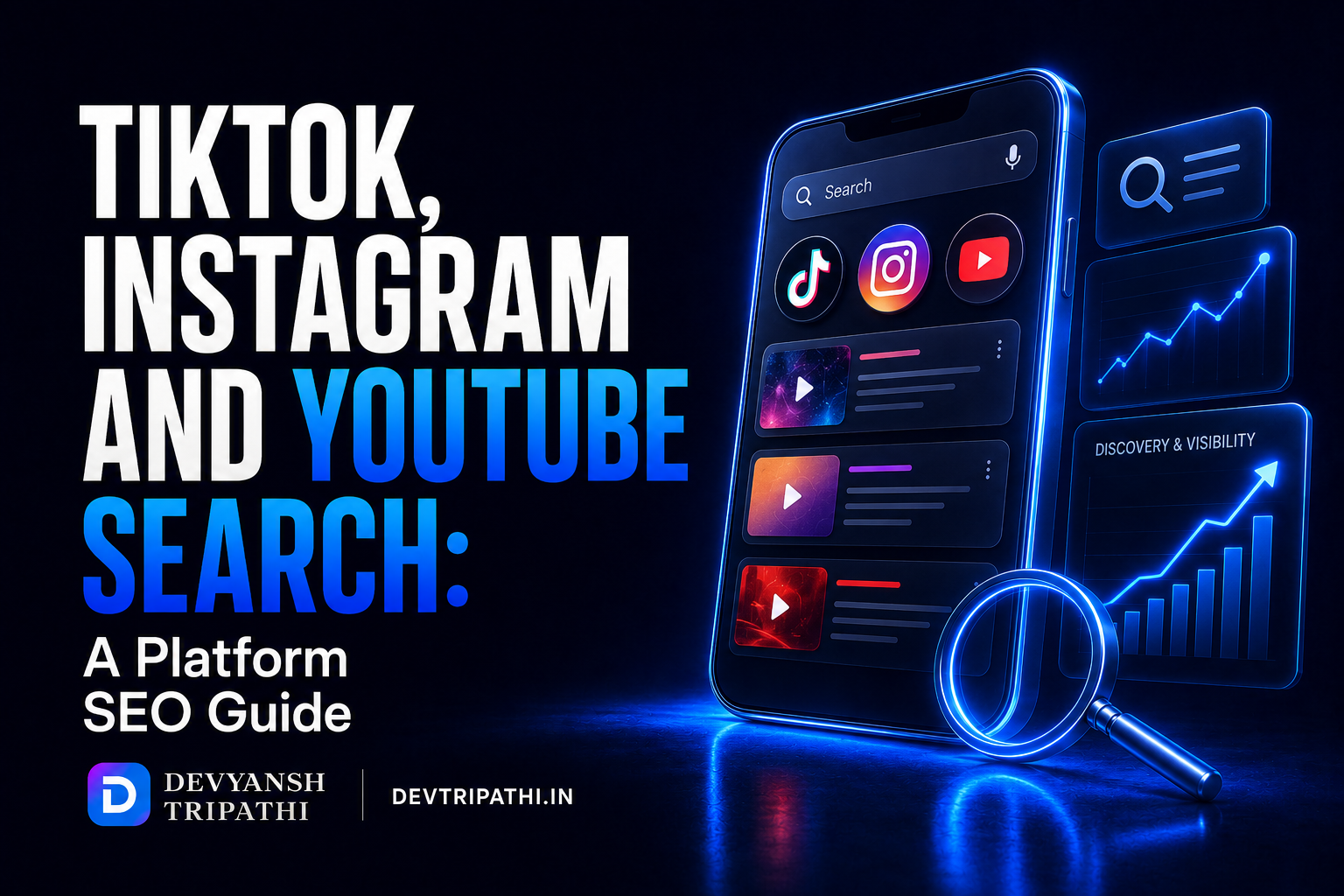
TikTok, Instagram and YouTube Search: A Platform SEO Guide
04 June 2026
In 2026, search is no longer a Google-only game. People ask TikTok for product recommendations, use Instagram to vet brands, and rely on YouTube for in-depth tutorials and reviews. For many audiences, especially under 35, these platforms are now primary search engines in their own right, with their own ranking factors, algorithms, and user expectations.
The numbers are direct. 64% of US Gen Z adults report using TikTok as a search engine. 49% of all US consumers have used TikTok to search for something. YouTube is the second-largest search engine globally with 2.7 billion monthly logged-in users. Google’s own internal research found that 40% of young users turn to TikTok or Instagram for things they might previously have searched on Google. With 5.66 billion global social media users and 43% of them relying on social platforms to find products, Social Search Optimization has moved from a nice-to-have to a core component of complete search visibility strategy.
Social Search Optimization is the practice of structuring and optimizing your content on social platforms so that their in-platform search algorithms surface your brand to users actively searching for your topics, products, or services. It sits at the intersection of classic SEO and social media strategy and determines whether your brand is discoverable across social feeds, in-platform search results, Google AI Overviews, and even in responses from tools like ChatGPT or Perplexity.
This guide covers the ranking factors, platform-specific strategies, and measurement framework for Social Search Optimization across TikTok, Instagram, and YouTube.
What Is Social Search Optimization?
Social Search Optimization (SSO) is the discipline of optimizing content published on social platforms so that those platforms’ internal search systems surface your content to users submitting relevant queries within the platform.
It differs from traditional SEO in one critical way: the ranking algorithm is not evaluating web pages. It is evaluating short-form videos, long-form videos, images, and posts. The ranking signals are not backlinks and domain authority. They are watch time, saves, shares, engagement velocity, and keyword relevance embedded in audio, captions, and on-screen text.
Social SEO in 2026 operates on three layers: in-platform visibility (ranking in TikTok, Instagram, and YouTube search results), Google SERP spillover (social platform content that ranks in Google’s own search results, including Google’s Video carousel and Google’s surfacing of Reddit, TikTok, and YouTube in standard web results), and AI system recognition (AI tools increasingly cite and reference social platform content, particularly TikTok and YouTube, when answering visual or practical queries).
A well-structured, keyword-optimized TikTok video that earns strong engagement creates signals that influence LLM-based search responses and social proof for commercial queries simultaneously. The investment in one well-optimized social search piece has compounding returns across multiple discovery surfaces.
For the community signal layer that complements social search optimization, see: Community Signal SEO: How Reddit, Quora, and Niche Forums Are Reshaping Search Rankings at https://devtripathi.in/blogs/community-signal-seo-complete-guide/
TikTok Search Optimization: The Fastest-Growing Social Search Channel
TikTok has officially stopped being just a viral video app. It is now a full-scale visual search engine. TikTok searches have grown over 200% in the last two years. TikTok now ranks as the fourth most helpful platform for finding information online among all consumers.
Understanding TikTok’s dual-algorithm reality is the foundation of TikTok search optimization. TikTok search ranks videos differently from the For You Page. The For You Page prioritizes engagement velocity: how quickly a new video earns interactions. Search prioritizes keyword relevance across multiple content layers: what the video says, what the captions show, and what the on-screen text displays.
TikTok Search Ranking Factors
Keyword relevance across five layers: TikTok’s search algorithm evaluates keywords in the video title, the spoken audio (via automatic speech recognition), on-screen text overlays, the video caption, and the hashtags. Including your target keyword naturally in all five layers creates maximum keyword relevance signal. Say the keyword early in the audio (within the first 3 seconds) because TikTok’s ASR system weights early keyword mentions more heavily.
Watch time and completion rate: Videos that users watch to completion signal high relevance to TikTok’s algorithm. For search-driven traffic specifically, completion rate matters more than total views because completing a video signals the content matched what the searcher was looking for.
Saves: Saves are the highest-value engagement signal on TikTok because they indicate a user found the content valuable enough to return to. Content optimized for saves (step-by-step instructions, checklists, recommendations the user wants to reference later) performs disproportionately well in TikTok search.
Comment engagement: Comments signal active interest and topic relevance. Content that generates questions in the comments creates a comment-powered SEO signal: each question is a search demand signal that can be addressed with a follow-up video, creating a compounding content loop around the same topic keyword.
TikTok Search Optimization Best Practices
One video, one query: Structure each TikTok video to answer one specific question or address one specific need. Do not mix five topics in one clip. A video structured around the query “how to write FAQ sections for AI search” has a clear, single-topic keyword signal. A video that covers five different SEO tips has diluted keyword relevance for any single search query.
Write captions like mini-answers: Captions should read like a direct answer to a question, not like a promotional headline. “What is GEO and why it matters for your brand” is a search-aligned caption. “Game-changing marketing strategy” is not.
Use TikTok Studio Search Performance data: TikTok Studio (available to accounts with 1,000 or more followers) shows the actual queries driving traffic to your videos. This is more accurate than guessing what your audience searches for and is one of the most underused data sources in social search optimization.
Repurpose the highest-leverage 2026 content strategy: Optimizing the same content idea for both a long-form blog post for Google and an optimized vertical video for TikTok is the highest-leverage content strategy available. The text article builds traditional SEO and AI citation authority. The TikTok video builds social search visibility and feeds LLM training data for visual and practical queries.
Instagram Search Optimization: Beyond Hashtags
Instagram search is real and growing. Instagram’s in-platform search allows users to search by keyword, not just hashtag, and the algorithm evaluates content relevance for those keyword searches differently from how it evaluates feed ranking.
There is no single Instagram algorithm. Instagram employs four distinct ranking systems: Feed, Explore, Stories, and Reels. They cannot be treated equally and must be optimized for each independently.
The strongest algorithmic signals for Instagram search in 2026 are saves and Sends (direct message shares). Likes and comments are engagement signals but carry less algorithmic weight than they did in earlier years. Originality also matters: the algorithm actively reduces distribution for watermarked TikTok reposts, meme aggregators, and unoriginal content.
Instagram Search Ranking Factors
Keyword relevance in caption and bio: Instagram’s search algorithm reads caption text for keyword relevance. Including your target keyword naturally in the first 125 characters of the caption (visible before the “more” cutoff) and in your profile bio improves in-platform search visibility for those keywords.
Save rate: Content that earns saves at high rates signals genuine value to Instagram’s algorithm and is rewarded with expanded distribution in both search results and the Explore feed.
Engagement velocity: Comments, shares, and saves in the first 2 to 4 hours after posting carry more algorithmic weight than later engagement. This makes publishing time and initial community engagement important for Instagram search visibility.
Original native content: Instagram’s algorithm prioritizes content created natively within the app or uploaded in the correct format and aspect ratio for the placement (Reels: 9:16 vertical, Feed: 1:1 square or 4:5 portrait).
Instagram SEO Best Practices
Keyword-optimize your bio and handle: Your Instagram bio and username tell the search algorithm what your account is authoritative on. Include your primary topic keyword in both your bio description and, where possible, your display name.
Write searchable captions: Captions should contain natural, topic-relevant language that mirrors what users would type into Instagram search. For an SEO-focused account, captions covering GEO strategies, AI search tips, and content optimization naturally embed keyword signals that improve search eligibility for those topics.
Use alt text on Instagram images: Instagram allows custom alt text on images (Settings within each post). Adding descriptive, keyword-relevant alt text improves both accessibility and the platform’s ability to categorize your image content for visual search and Explore recommendations.
Consistent topical focus: Accounts that consistently publish content within a defined topic area build topical authority signals that improve how Instagram’s algorithm categorizes and surfaces their content for relevant searches.
YouTube Search Optimization: The Established Giant
YouTube is the world’s second-largest search engine, processing over 3 billion searches daily. YouTube SEO in 2026 centers on two factors above all others: click-through rate (CTR) and watch time. Optimize your thumbnail and title to get clicks, then deliver content that keeps viewers watching.
On most channels, search traffic accounts for 15 to 40% of total views — and it is the most predictable, compounding traffic source available. YouTube’s algorithm in 2026 is a prediction engine: its job is not just to rank videos but to predict what a user is most likely to watch next and for how long.
YouTube Search Ranking Factors
Click-through rate (CTR): CTR is the primary YouTube ranking signal. A video that earns a 10% CTR will dramatically outperform an identical video earning 3% CTR because high CTR signals to YouTube’s algorithm that the thumbnail and title are accurately promising content users want to see. Custom thumbnails with high contrast, readable 3 to 5 word text, and an expressive face outperform standard screenshots by 8 to 15 times in CTR.
Watch time and audience retention: YouTube’s algorithm evaluates retention rate (percentage of the video watched) more than total minutes. A 7-minute video with 85% average view duration ranks higher than a 15-minute video with 50% retention. Videos maintaining 50-plus percent average view duration and 10-plus percent CTR rank significantly higher in search results and suggested videos.
Keyword relevance in title, description, and transcript: The primary keyword should appear in the first 5 words of the video title and in the first sentence of the description. YouTube’s automatic speech recognition (ASR) indexes spoken audio, so saying the keyword naturally within the first 60 seconds of the video reinforces the relevance signal.
Engagement signals in the first 48 hours: Comments and likes within the first 24 to 48 hours of upload carry more weight. The algorithm A/B tests your video against small audiences when first published. If CTR and retention are above average for the topic, distribution expands. Concentrate promotional effort and community engagement in the first 48 hours for maximum algorithmic lift.
YouTube SEO Best Practices
Keyword in the first 5 words of the title: Place the primary keyword within the first 40 characters of the title so it is visible before truncation on mobile. Keep titles under 60 characters when possible. Avoid the temptation to write titles that are creative but vague: clarity and keyword relevance outperform cleverness for search-driven traffic.
Upload accurate custom transcripts: YouTube auto-generates captions but accuracy varies. Upload custom transcripts from tools like Rev or Descript for accurate content. Google indexes transcript text for search ranking, which creates searchable content within your video and improves accessibility for approximately 15% of your potential audience (hearing-impaired viewers), simultaneously increasing average watch time by 7% when captions are enabled.
Add chapter markers: Chapter markers (timestamps in the description) improve user experience by allowing viewers to navigate to relevant sections. They also create additional keyword-relevance signals within the video’s metadata and appear as Jump To sections in Google search results for the video.
Embed videos on your own blog posts: Embedding your YouTube videos on related blog posts improves both YouTube rankings (by adding external watch time) and Google Search video carousel visibility. This cross-platform reinforcement is one of the most underused YouTube SEO tactics available.
For the complete Video Search SEO strategy, see: Video Search SEO: The Complete Guide at https://devtripathi.in/blogs/video-search-seo-complete-guide/
Social Search and Google: The Spillover Effect
Social platform content does not only rank within its own platform. It increasingly ranks in Google’s standard search results, creating a spillover effect that amplifies social search optimization beyond in-platform visibility.
Google’s Video carousel appears for over 20% of queries and pulls from YouTube. TikTok videos appear in Google search results for an increasing number of how-to and product review queries. Instagram Reels appear in Google Image and video results. For brands optimizing social search, this means a well-optimized YouTube video or TikTok contributes to both in-platform search visibility and Google organic search simultaneously.
The implication for SEO professionals: social search optimization is not a separate channel strategy from traditional SEO. It is an extension of it. A TikTok video optimized for the search query “how to build topical authority” that appears in TikTok search for Gen Z users also has the potential to appear in Google search results for the same query, reaching the traditional SEO audience simultaneously.
Measuring Social Search Performance
TikTok Studio Search Performance: Available to accounts with 1,000 or more followers. Shows actual search queries driving traffic to your videos, search traffic volume, and which videos are performing best in search versus For You Page distribution.
Instagram Insights: Monitor reach, saves, and profile visits per post. High save rates relative to impressions are the strongest signal of social search optimization effectiveness on Instagram.
YouTube Studio Analytics: Track impressions CTR, average view duration, audience retention graphs, and traffic source breakdown (search versus browse versus suggested). The Search traffic source percentage is the direct measure of YouTube SEO performance.
Google Search Console Video Results: Filter the Performance report for video-rich result appearances in standard Google search. Track which YouTube videos are appearing in Google’s Video carousel for target keywords.
AI-Referred Traffic from Social Platforms: Monitor GA4 for sessions referred from social platform domains that appear alongside AI citation traffic. TikTok-generated AI citations are an emerging traffic source as LLMs increasingly reference TikTok content.
Frequently Asked Questions About Social Search Optimization
What is Social Search Optimization?
Social Search Optimization is the practice of structuring and optimizing content on social platforms, primarily TikTok, Instagram, and YouTube, so that those platforms’ internal search algorithms surface your brand to users actively searching for relevant topics. It combines SEO principles (keyword research, intent alignment, metadata optimization) with platform-specific engagement signals (watch time, saves, CTR, completion rate) to maximize in-platform search visibility and the Google SERP spillover effect that social content increasingly produces.
Is TikTok really a search engine?
Yes, in all practical terms. 64% of US Gen Z adults report using TikTok as a search engine. 49% of all US consumers have used TikTok to search for something. TikTok has its own search results page with algorithm-ranked content responses to text queries, user intent interpretation, and keyword relevance signals. For Gen Z and millennial audiences, TikTok search is a primary research and discovery behavior for product recommendations, how-to instructions, local business information, and entertainment content.
How is TikTok search ranking different from the For You Page?
The For You Page algorithm prioritizes engagement velocity: how quickly a new video earns interactions after publication. TikTok’s search algorithm prioritizes keyword relevance across multiple content layers: audio, on-screen text, caption, and hashtags. A video can have strong FYP performance without ranking well in search if it lacks clear keyword signals. Conversely, a video with precise keyword optimization can rank consistently in search results for weeks after its FYP momentum has passed, making search optimization the path to compounding TikTok traffic.
What are the strongest Instagram ranking signals in 2026?
The two strongest Instagram ranking signals in 2026 are saves (users bookmarking content for later) and Sends (DM shares of content to other users). These signals indicate genuine perceived value rather than passive engagement. Likes and comments remain meaningful but carry less relative weight than in earlier Instagram algorithm versions. Original, natively created content receives preferential distribution over reposts and watermarked cross-platform content.
How does YouTube CTR affect search rankings?
Click-through rate is the primary YouTube ranking signal because it directly measures whether your thumbnail and title successfully communicate the value of your video to users who see it in search results. YouTube’s algorithm A/B tests new videos against small audiences. Videos with above-average CTR for their topic receive expanded distribution. Videos with below-average CTR see contracted distribution regardless of content quality. Improving thumbnail design (high contrast, readable text, expressive face) is the single fastest way to improve YouTube search performance.
Does social media content rank in Google search results?
Yes, increasingly. YouTube videos appear in Google’s Video carousel for over 20% of queries. TikTok videos appear in Google search results for how-to and product review queries. Instagram Reels appear in Google image and video results. Well-optimized social content has the potential to rank both within its native platform and in standard Google search results simultaneously, amplifying the reach of a single well-optimized piece of social content across multiple discovery surfaces.
What is the highest-leverage social search content strategy for B2B brands?
For B2B brands, YouTube is the highest-leverage social search channel because its content addresses information-seeking queries (tutorials, comparisons, reviews, how-tos) that match B2B buyer research behavior. LinkedIn is the second priority for professional and industry topic search. TikTok is growing as a B2B research channel as younger professionals enter decision-making roles, but YouTube provides the deepest B2B search penetration at the highest scale with the strongest AI citation potential through Gemini’s video analysis capability.
How do video transcripts affect social search performance?
Accurate video transcripts directly improve YouTube search ranking by creating indexable text from spoken content, giving the YouTube and Google algorithms more keyword signal to evaluate. Transcripts also enable AI systems including Gemini to analyze video content for citation purposes. For accessibility, captions increase average watch time by approximately 7%, which directly improves the retention signal that YouTube’s algorithm weighs heavily. Upload custom transcripts to any high-priority YouTube video where the auto-generated captions contain errors.
What is the Save-to-Impression ratio and why does it matter?
The Save-to-Impression ratio is the percentage of users who see a piece of Instagram or TikTok content and save it. It is one of the most direct measures of content perceived value because a save requires active intent. For Instagram specifically, a high Save-to-Impression ratio signals to the algorithm that content is genuinely valuable to the audience, triggering expanded distribution in both the Explore feed and search results. Content types that optimize for saves include checklists, templates, step-by-step instructions, comparison guides, and any content a user would want to reference later.
Can social search optimization improve my traditional SEO rankings?
Indirectly, yes. Social search optimization drives branded search volume as users who discover your brand through TikTok or YouTube search subsequently search for your brand name on Google. Google interprets branded search volume growth as a brand authority signal. Social content that ranks in Google’s Video carousel or standard search results creates additional organic visibility. Community engagement from social platforms can generate natural backlinks as bloggers and journalists reference content they discover through social search. All of these mechanisms contribute to traditional SEO performance.
How long does it take to see results from Social Search Optimization?
TikTok search results are relatively fast: a well-optimized video can begin appearing in TikTok search results within days of publication if keyword signals are strong and early engagement is positive. YouTube search results typically begin showing movement within 2 to 4 weeks for new videos on established channels and 3 to 6 months for new channels building authority. Instagram search visibility builds more gradually, typically requiring 4 to 8 weeks of consistent optimized posting to show measurable improvement in in-platform search reach.
Conclusion
Social Search Optimization is no longer optional for any brand that wants complete search visibility in 2026. The platforms have already made their move: TikTok, Instagram, and YouTube have built full-featured search experiences that process billions of queries daily from users who consider them primary discovery tools rather than entertainment supplements to Google.
The framework is platform-specific but principle-consistent. On TikTok: keyword across all five content layers, one video per query, write captions like mini-answers, and measure with TikTok Studio search performance data. On Instagram: keyword in bio and caption, optimize for saves, publish original native content, and track save rate as the primary effectiveness signal. On YouTube: keyword in the first five words of the title, accurate transcripts, chapter markers, and optimize CTR through thumbnail design as the primary ranking investment.
The brands that build systematic social search optimization across all three platforms simultaneously will capture discovery at the exact moment users are deciding who to trust, which product to choose, and whose advice to follow. That moment is increasingly happening on social platforms, not on Google, for the fastest-growing segments of the consumer market.
Start with the platform where your target audience is most active. Apply the keyword and engagement optimization principles specific to that platform. Measure in-platform search performance weekly. Then expand to the next platform systematically.
The compounding returns from social search discovery are real and they start with the next piece of content you publish.
TikTok Studio — Analytics and Search Performance: https://studio.tiktok.com/
YouTube Studio — Analytics: https://studio.youtube.com/
Instagram Creator Hub: https://creators.instagram.com/
Google Search Central — Video SEO: https://developers.google.com/search/docs/appearance/video
Coalition Technologies — Social SEO Guide: https://coalitiontechnologies.com/blog/social-media-seo-strategies-for-2026-youtube-tiktok-instagram

Devyansh Tripathi
I’m Devyansh Tripathi, an SEO strategist and digital growth expert, helps businesses and individuals rank higher and drive organic traffic. Through DevTripathi., he shares cutting-edge SEO insights, content strategies, and marketing hacks. Passionate about digital success, he’s on a mission to make SEO simple, effective, and result-driven!
Posts
- What Google’s New AI Search Documentation Means for SEO Teams
- Google I/O 2026 Search: AI Agents, Gemini 3.5 and the Unified Box
- Google’s AI Optimization Guide: The Technical and Content Checklist
- July 2026 SEO Update: AI Overviews, llms.txt and Search Console
- Prompt Optimization Beyond Page One: The Position-21 Citation Opportunity
Categories
- AI Citation Optimization
- AI Search Optimization (AISEO)
- AI Visibility Tracking
- Answer Engine Optimization (AEO)
- Brand Authority SEO
- Brand SERP Optimization
- Community Signal SEO
- Conversational Search Optimization
- Generative Engine Optimization (GEO)
- Knowledge Graph Optimization
- Modern SEO Strategies
- Multimodal Search Optimization
- Prompt Optimization
- SEO Trends
- Social Search Optimization
- Topical Authority SEO
- Uncategorized
- Video Search SEO
- Visual Search Optimization
- Voice Engine Optimization (VEO)
- Zero Click Search Optimization
Latest News
Text Widget
Empowering brands with insights, strategies, and stories that drive digital growth.