
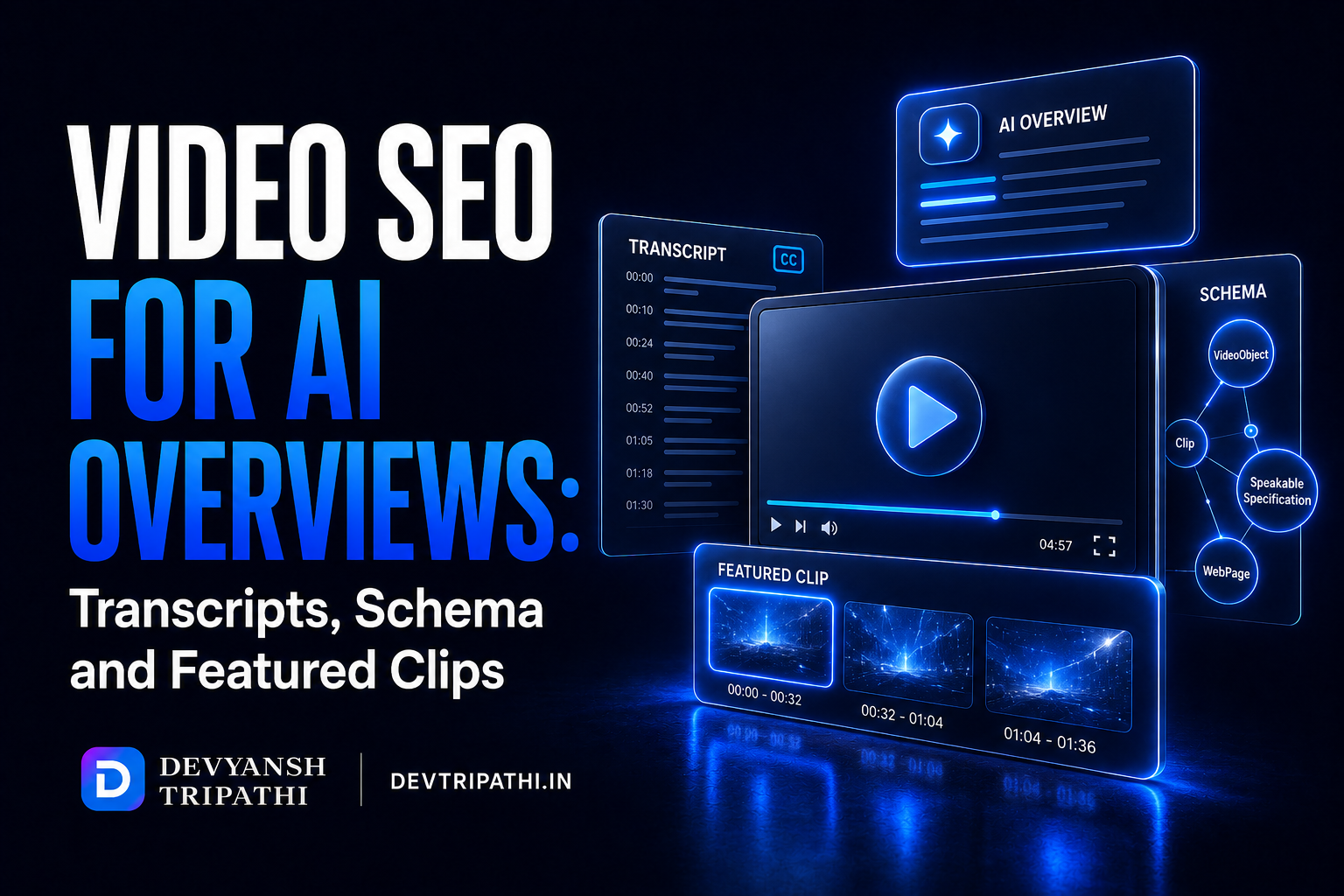
Video SEO for AI Overviews: Transcripts, Schema and Featured Clips
23 June 2026
Video Search SEO is the practice of optimizing video content so that search engines, YouTube’s algorithm, and AI-powered systems can discover, understand, index, and cite it across YouTube search results, Google Video panels, Google AI Overviews, and AI Mode responses, requiring optimization across both the video asset itself and the page where it is embedded on your owned website.
This guide covers the complete Video Search SEO framework for 2026: the data confirming YouTube’s position as the world’s second-largest search engine with 3 billion daily searches, why video rich snippets earn 58% CTR versus 41% for non-rich results, the dual-layer optimization approach covering both YouTube and owned embed pages, the VideoObject schema implementation required for AI Overview Featured Clip inclusion, the transcript and chapter strategy that enables section-level AI retrieval, and the measurement framework in Google Search Console and YouTube Studio that tracks video search performance across all surfaces simultaneously.
Free Video Search SEO Audit
Are Your Videos Ranking in YouTube Search, Google Video Panels, and AI Overview Featured Clips?
Get a complete video search audit covering your YouTube channel optimization, VideoObject schema implementation, transcript quality, chapter structure, Google Video panel inclusion, and AI Overview Featured Clip eligibility for your top video content.
Get My Video Search SEO AuditWhat Video Search SEO Means in 2026
Video Search SEO in 2026 means optimizing two interconnected assets rather than one: the YouTube video itself for YouTube’s search algorithm, and the owned embed page on your website for Google’s crawlability, structured data, transcript access, and AI-search summarization. These two optimization targets share foundational requirements but diverge significantly on technical execution, because you control different elements on each surface.
On YouTube, you control the title, description, thumbnail, chapters, tags, and the viewing experience through audience retention and engagement signals. On your owned embed page, you control the VideoObject schema, the full visible transcript as crawlable HTML, the surrounding contextual text that signals relevance to Google, internal links that distribute authority, and the page speed that determines whether Google can fully render and index the embedded video content efficiently.
The most important shift in Video Search SEO in 2026 is the AI search layer that sits above both surfaces. Google’s Andromeda update unified multiple AI systems into a single model that now reads your video transcripts in real time and parses spoken content for topic understanding. A video with keyword-optimized titles but transcript content that never mentions those keywords receives lower relevance signals than a video where the spoken content, on-screen text, and metadata all reinforce the same topic consistently. For the complete technical SEO foundation that governs embed page optimization, see our Modern SEO Strategies guide.
3Bdaily searches on YouTube — world's second-largest search engine (AutoFaceless April 2026)
58%CTR for video rich snippets vs 41% for non-rich results (Milestone Research, 4.5M queries)
62%of Google searches now show video results in SERPs (ShortsIntel February 2026)
80%higher conversion rates on landing pages with embedded video vs text-only pages
YouTube Search Optimization: The First Surface
YouTube search ranking operates on different signals than Google ranking. Watch time and audience retention are the most heavily weighted engagement signals in YouTube’s search algorithm. The amount of time viewers watch your video and the percentage of the video they complete directly signal to YouTube whether the content satisfied the viewer’s search intent. A video with 70% average view duration consistently outranks a video with superior metadata but 30% average view duration for competitive search queries.
Title Optimization for YouTube Search
90% of top-ranked YouTube videos include the target keyword in the title according to verified statistics. The title optimization framework for YouTube search in 2026 requires three elements working together. The primary keyword must appear in the first three to five words of the title. The title must communicate a specific benefit or outcome rather than a generic topic label, because YouTube’s search algorithm uses click-through rate as a secondary ranking signal after watch time. And the title length should stay within 60 characters to prevent truncation in mobile search results where the majority of YouTube searches now occur.
Effective title construction follows a Subject-Verb-Outcome formula: “[Primary Keyword]: How to [Action] and [Measurable Outcome].” This structure places the keyword first for algorithm matching, communicates specific value for CTR improvement, and sets explicit expectations that improve completion rate by ensuring users know exactly what they will receive from watching.
Description Optimization for YouTube and Google
YouTube video descriptions serve two distinct audiences simultaneously: YouTube’s search algorithm, which reads descriptions to understand topical relevance, and Google’s crawler, which indexes YouTube descriptions as text content available for Google search results and AI Overview sourcing. Write descriptions of a minimum of 200 words with the primary keyword appearing in the first two sentences naturally. Include five to ten secondary topic keywords distributed through the description body without forced repetition. Add chapter timestamps at the top of the description in the format 00:00 Introduction, 02:30 [Next Section], which YouTube automatically converts into chapter navigation and which Google uses for section-level indexing of the video content.
Chapter Markers: The Section-Level Ranking Opportunity
Chapter markers are among the most significant under-utilized Video Search SEO opportunities in 2026. Adding chapters to videos longer than five minutes enables three distinct performance improvements. YouTube surfaces specific chapter sections in search results for sub-queries that match the chapter topic rather than only the full video topic. Google extracts chapter-level content for Google Search video carousels and AI Overview Featured Clips, allowing specific 10 to 15 second moments from your video to appear inside AI-generated answers. And viewer experience improvement reduces bounce rate and improves average view duration because users can navigate directly to the specific section they searched for rather than scrubbing through the full video.
VideoObject Schema: The AI Search Requirement
VideoObject schema is the structured data type that tells search engines and AI systems exactly what a video contains, who created it, when it was published, and how it relates to the surrounding page content. In 2026, VideoObject schema has crossed from an advanced optimization enhancement into a fundamental requirement for three specific high-value placements that are otherwise inaccessible regardless of content quality.
The three placements that require VideoObject schema are Google Video rich results in standard SERP listings (which achieve 58% CTR versus 41% for non-rich results), Google AI Overview Featured Clips where Gemini embeds specific 10 to 15 second moments from videos inside AI-generated answers, and Google AI Mode video carousel results that surface relevant video sections alongside text content in interactive response panels.
The minimum required VideoObject properties are: name (the video title), description (a text description matching the YouTube description), thumbnailUrl (the URL of the video thumbnail image), contentUrl or embedUrl (the URL where the video can be viewed), uploadDate (ISO 8601 format date), and duration (ISO 8601 duration format). Optional but highly recommended properties include transcript (the full text transcript of the video) and hasPart (an array of chapter clips with their startOffsets and endOffsets enabling section-level Featured Clip eligibility). For the complete schema stack that VideoObject integrates with, see our AEO guide.
Transcript Strategy: The Most Impactful Video SEO Action in 2026
Google’s Andromeda update made spoken content in video transcripts a primary ranking signal equal in weight to written metadata. This single change has made transcript optimization the highest-impact Video Search SEO action available in 2026, because the majority of existing videos have no crawlable transcript, creating a significant ranking disadvantage that requires only one implementation to fix permanently.
Why Transcripts Are Now Mandatory for Video Search SEO
A video without a crawlable transcript is evaluated only on its title, description, thumbnail, and surrounding page text. A video with a complete transcript provides the AI with access to every word spoken in the video as indexable text, enabling semantic topic matching across the full content depth rather than only the metadata summary. The semantic richness of spoken content consistently exceeds the description length that creators apply to YouTube videos, making transcript indexing a substantial ranking signal upgrade for most existing video libraries.
Publish transcripts as visible HTML text beneath every embedded video on your owned pages. Visible transcripts are indexed by both Google’s text crawler and AI retrieval systems. Transcripts hidden in collapsible elements or non-indexed components are not reliably picked up. Submit synchronized transcripts to YouTube as closed captions rather than relying on YouTube’s auto-generated captions, which often contain errors that create misleading topic signals in the AI-processed text. For the complete conversational search and voice optimization strategy that transcripts also contribute to, see our Conversational Search Optimization guide.
Google AI Overview Featured Clips: The New Video SERP Frontier
Google’s AI Overviews now embed 10 to 15 second Featured Clips directly inside generative answers for queries where video demonstration or explanation is considered most helpful. A user asking “how do I implement FAQPage schema” receives an AI Overview that may include a specific 30-second clip from a relevant tutorial video playing directly within the generated answer. This creates a new video discovery surface where the most precisely targeted video sections, not entire videos, can appear inside AI-generated responses.
Optimizing specifically for Featured Clip inclusion requires three elements beyond standard VideoObject schema. The hasPart property in VideoObject schema must declare specific clip segments with precise startOffset and endOffset values corresponding to the most answer-complete moments in your video. These declared clip segments should address specific user questions in 15 to 30 second windows that make complete standalone sense without requiring context from the surrounding video. And the surrounding embed page content should include the written answer to the same question that the clip addresses, creating the multi-signal corroboration that AI systems require before embedding video content in generated responses.
Build Video Search Visibility Across YouTube, Google, and AI Overviews
Most Video SEO Stops at YouTube. The Brands Winning in 2026 Optimize for All Three Surfaces Simultaneously.
Book a strategy session and get a complete Video Search SEO roadmap covering your YouTube channel audit, VideoObject schema implementation, transcript strategy, chapter structure, Featured Clip optimization, embed page structure, and the measurement framework that tracks video search performance across Google Search Console and YouTube Studio.
Book My Video SEO Strategy SessionFrequently Asked Questions About Video Search SEO
What is Video Search SEO in 2026?
Video Search SEO is the practice of optimizing video content so that YouTube’s search algorithm, Google’s video indexing systems, and AI-powered search platforms can discover, understand, and surface your videos across YouTube search results, Google Video panels, Google AI Overview Featured Clips, and AI Mode video carousels. It requires dual-layer optimization: the YouTube video asset for in-platform ranking and the owned embed page for Google indexing, structured data, and AI retrieval eligibility.
Why does VideoObject schema matter so much in 2026?
VideoObject schema enables three high-value video search placements that are inaccessible without it: Google Video rich results achieving 58% CTR versus 41% for non-rich results, Google AI Overview Featured Clips where Gemini embeds specific video moments inside AI-generated answers, and Google AI Mode video carousel results. Pages with VideoObject schema are also seeing significant increases in user engagement time in 2026 as Google’s AI surfaces schema-enabled video content more prominently across multiple search surfaces simultaneously.
How did Google’s Andromeda update change video SEO?
Google’s Andromeda update (late 2025) unified RankBrain, BERT, and MUM into a single AI system that now parses video transcripts, captions, and spoken content for topic understanding in real time. Spoken keywords in videos now carry as much ranking weight as written metadata. A video title claiming “keyword optimization tutorial” but never mentioning the actual keywords in spoken content receives a misalignment penalty. This makes transcript quality and spoken keyword consistency the most impactful new Video Search SEO signal introduced in 2026.
What is the optimal YouTube video length for search ranking?
The average video on YouTube’s first page is 14 minutes and 50 seconds long according to analysis of top-ranked YouTube videos. However, length is not the ranking signal: watch time and average view duration percentage are the ranking signals that correlate with longer top-ranking videos. Videos that maintain high audience retention throughout their full length rank higher than shorter videos with poor retention. The optimal length is the minimum required to comprehensively address the topic while maintaining 60% or higher average view duration throughout the entire video.
How should I structure YouTube chapters for search ranking?
Add chapter timestamps to every video longer than five minutes using the format 00:00 followed by the chapter title on a new line in the video description. Each chapter title should contain a relevant keyword or sub-topic label rather than generic labels like “Part 1” or “Introduction.” YouTube automatically converts these into chapter navigation. Google extracts chapters for section-level indexing allowing specific chapters to surface in search results for sub-queries matching the chapter topic. For AI Overview Featured Clip eligibility, declare the same chapter segments as hasPart objects in your VideoObject schema with precise start and end offset values.
What is the connection between video transcripts and AI search rankings?
Video transcripts are now a primary ranking signal for Video Search SEO because Google’s Andromeda AI system can read and process transcript text the same way it processes webpage text. A complete transcript provides AI retrieval systems access to the full semantic depth of the video content, enabling matching against a much broader range of user queries than the title and description alone can cover. Publish transcripts as visible HTML text beneath embedded videos on owned pages, where they are reliably indexed by Google’s text crawler and AI retrieval systems without the errors common in auto-generated captions.
How do I get my videos into Google AI Overview Featured Clips?
Featured Clip eligibility requires three specific implementations. Deploy VideoObject schema with the hasPart property declaring specific clip segments using startOffset and endOffset values corresponding to the most answer-complete moments in your video, ideally 15 to 30 second windows addressing specific user questions. Ensure the surrounding embed page contains the written answer to the same question the clip addresses, creating multi-signal corroboration that AI systems require before embedding video in generated responses. And ensure the video ranks in Google’s top-10 results for the target query, as Featured Clips, like AI Overview citations, draw predominantly from already-ranking content.
How do I measure Video Search SEO performance?
Track Video Search SEO performance across three tools. In Google Search Console, filter the Performance report by Search Appearance set to Videos to see impressions and clicks specifically from video search results. This shows whether VideoObject schema implementation is generating rich result eligibility. In YouTube Studio, check Traffic Sources to measure external Google Search traffic reaching your videos. In Google Analytics 4, compare 60 to 90 day performance between pages with and without embedded optimized video to quantify the conversion rate improvement from video embedding and engagement time differences from VideoObject schema implementation.
What is the dual-layer Video Search SEO approach?
The dual-layer approach recognizes that video search optimization requires optimizing two different assets with different technical controls. The YouTube asset layer covers elements controlled in YouTube Studio: title, description, thumbnail, chapters, tags, and the viewer experience that drives watch time and retention. The owned embed page layer covers elements controlled in your website HTML: VideoObject schema, full visible transcript, contextual surrounding text, internal link structure, and page speed. Both layers must be optimized independently because strong YouTube-layer performance alone does not guarantee Google Video panel inclusion or AI Overview Featured Clip eligibility.
Why is YouTube’s 200 billion daily Shorts view count significant for Video SEO?
YouTube Shorts’ 200 billion daily views represent a distinct search surface with different optimization dynamics than long-form video. Google’s AI Mode now features interactive multimodal carousels that prioritize YouTube Shorts and high-authority vertical video above standard video thumbnails in certain search contexts. Brands producing Shorts on search-relevant topics gain additional video SERP real estate beyond their long-form content, particularly for queries where short-form instructional or demonstration content is the preferred result format. Short-form and long-form video now serve complementary rather than competing roles in a complete Video Search SEO strategy.
How does Video Search SEO connect to AI citation authority?
Well-optimized YouTube videos embedded in relevant blog posts and supported by VideoObject schema contribute to AI citation authority through three mechanisms. YouTube content accounts for a portion of the 26% community and video platform share of Google AI Overview citations. Videos embedded in blog posts that rank in Google’s top-10 are eligible for Featured Clip extraction into AI Overview responses. And consistent video content on a coherent topic cluster reinforces the multi-surface topical authority signals that AI systems including ChatGPT and Perplexity use when determining which brands to recommend for category queries. For the GEO strategy that video content feeds into, see our GEO Advanced Playbook.
Ready to Win Video Search Across Every Surface?
Get a Complete Video Search SEO Strategy Covering YouTube, Google Video, and AI Overview Featured Clips
Free strategy session covering your YouTube channel audit, VideoObject schema implementation plan, transcript strategy for your existing video library, chapter structure optimization, Featured Clip eligibility assessment, and the measurement framework that tracks video search performance in Google Search Console, YouTube Studio, and GA4 simultaneously.
Get My Free Video SEO StrategyConclusion
Video Search SEO in 2026 is both more complex and more rewarding than it has ever been. YouTube processes 3 billion daily searches as the world’s second-largest search engine. Video rich snippets earn 58% CTR versus 41% for non-rich results. 62% of Google searches now show video results. Landing pages with video convert at up to 80% higher rates. And Google’s AI Overviews now embed specific video clips inside AI-generated answers, creating a Featured Clip placement that makes VideoObject schema implementation directly connected to the most premium AI search real estate available.
The dual-layer optimization approach is the framework that captures all of these opportunities simultaneously. Optimize the YouTube asset for in-platform search ranking through keyword-precise titles, chapter-structured descriptions, and high-retention content design. Optimize the owned embed page for Google indexing through VideoObject schema with hasPart clip declarations, visible HTML transcripts, fast page speed, and contextual surrounding content. Track performance across Google Search Console’s Video Search Appearance filter, YouTube Studio’s External Traffic source, and GA4’s engagement time comparison between video and non-video pages.
Start with a transcript audit of your most important existing videos this week. Identify which videos have no crawlable transcript on their embed pages. Add transcripts as visible HTML text. Deploy VideoObject schema with chapter declarations on the same pages. Submit your video sitemap to Google Search Console. These four actions address the highest-impact Video Search SEO gaps for most brands in a single implementation sprint. For the multimodal optimization strategy that extends video SEO into image and audio search surfaces, see our Multimodal Search Optimization guide.

Devyansh Tripathi
I’m Devyansh Tripathi, an SEO strategist and digital growth expert, helps businesses and individuals rank higher and drive organic traffic. Through DevTripathi., he shares cutting-edge SEO insights, content strategies, and marketing hacks. Passionate about digital success, he’s on a mission to make SEO simple, effective, and result-driven!
Posts
- What Google’s New AI Search Documentation Means for SEO Teams
- Google I/O 2026 Search: AI Agents, Gemini 3.5 and the Unified Box
- Google’s AI Optimization Guide: The Technical and Content Checklist
- July 2026 SEO Update: AI Overviews, llms.txt and Search Console
- Prompt Optimization Beyond Page One: The Position-21 Citation Opportunity
Categories
- AI Citation Optimization
- AI Search Optimization (AISEO)
- AI Visibility Tracking
- Answer Engine Optimization (AEO)
- Brand Authority SEO
- Brand SERP Optimization
- Community Signal SEO
- Conversational Search Optimization
- Generative Engine Optimization (GEO)
- Knowledge Graph Optimization
- Modern SEO Strategies
- Multimodal Search Optimization
- Prompt Optimization
- SEO Trends
- Social Search Optimization
- Topical Authority SEO
- Uncategorized
- Video Search SEO
- Visual Search Optimization
- Voice Engine Optimization (VEO)
- Zero Click Search Optimization
Latest News
Text Widget
Empowering brands with insights, strategies, and stories that drive digital growth.