
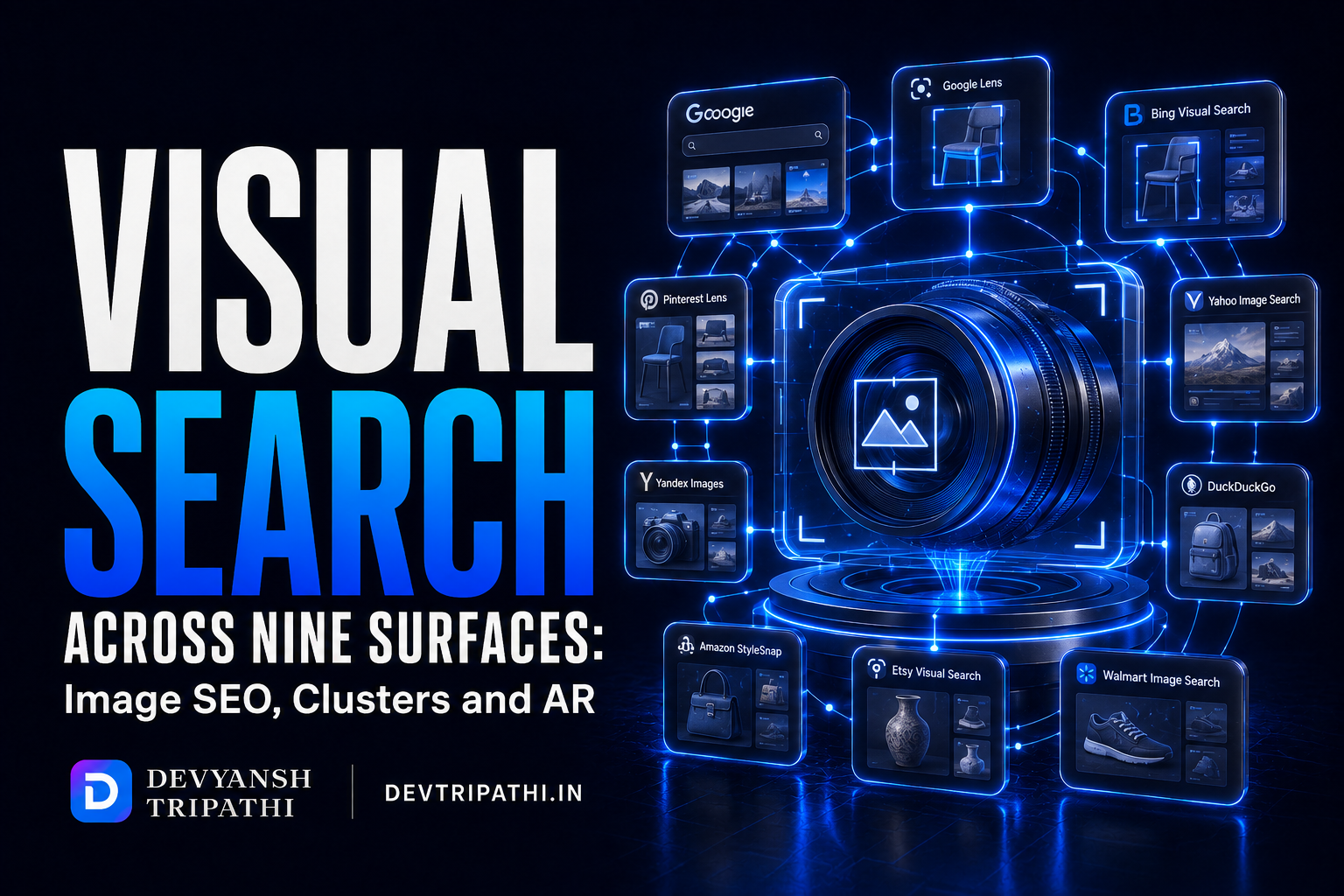
Visual Search Across Nine Surfaces: Image SEO, Clusters and AR
13 July 2026
Visual search optimization in 2026 requires managing presence across nine distinct visual search surfaces simultaneously, as eMarketer’s January 2026 survey found 38% of US online shoppers used visual search in the past 90 days, up from just 22% one year earlier, while Google Images now drives approximately 22% of all web searches and Google Lens processes billions of visual queries monthly, confirming that image-based discovery has moved from a niche feature to a primary, high-intent acquisition channel most brands still leave largely unoptimized.
This advanced guide covers the complete nine-surface visual search framework for 2026: the specific adoption data confirming visual search has crossed from novelty to mainstream primary discovery behavior, the platform-by-platform optimization requirements for Google Lens, Pinterest Lens, and Amazon Visual Search that each rely on different matching mechanisms, the five pillars of technical image SEO that most sites have never properly implemented, the AR-enabled visual commerce integrations driving measurably higher conversion rates, and the visual clustering strategy that applies topical authority principles to image assets specifically.
Is Your Brand Visible Across the Nine Surfaces Where 38% of Shoppers Now Search Visually?
Get a complete visual search audit covering your Google Lens matching readiness, Pinterest Lens visual cluster coverage, image schema implementation, and the specific technical gaps preventing your products from appearing in the visual search results your highest-intent shoppers are already using.
Get My Visual Search AuditWhy Visual Search Has Crossed the Mainstream Adoption Threshold in 2026
Visual search optimization has moved decisively from an emerging, experimental capability to a primary discovery surface that a meaningful and rapidly growing share of consumers use as their default search method for product discovery. The eMarketer finding that 38% of US online shoppers used visual search in the past 90 days, up from 22% just one year earlier, represents a 73% relative growth rate in a single year, a pace of adoption that few search behaviors in recent history have matched.
The behavioral driver is straightforward: visual search users arrive already knowing what they want, having seen it, and needing only to identify where to find it or what it is called. This creates meaningfully higher purchase intent than text search, where users are often still formulating and refining their understanding of what they need through the search process itself. Search has become genuinely multimodal in 2026: users photograph products, reverse-search images, and ask AI assistants questions that pull visual content directly from the web, meaning brands with unoptimized images are invisible to an entire, rapidly growing layer of search activity that competitors may already be capturing.
38%of US shoppers used visual search in the past 90 days, up from 22% a year earlier (eMarketer Jan 2026)
22%of all Google web searches now driven by Google Images (Digital Applied 2026)
300%+year-over-year growth in Pinterest visual searches (Hashmeta 2026)
60%of Gen Z consumers prefer visual search over text search for product discovery
The Nine-Surface Visual Search Landscape
Effective visual search optimization in 2026 requires understanding that nine distinct platforms now constitute the visual search landscape, each with different matching mechanisms, audience characteristics, and technical optimization requirements. Treating visual search as a single undifferentiated channel, or optimizing only for Google Lens while ignoring the other eight surfaces, leaves substantial discovery opportunity uncaptured.
Billions of Monthly Visual Queries, 30% Annual Growth
Google Lens: The Dominant Visual Commerce Surface
Google Lens allows users to point a smartphone camera at any object and instantly search for similar products, information, and purchase options, with integration into Google Shopping making camera-based product discovery a primary ecommerce acquisition channel for visual product categories. Lens relies on visual matching rather than text signals, using computer vision to identify objects and match them against Google's indexed product image database. Sites appearing in Lens results consistently share visually clear product images shot against clean, uncluttered backgrounds that closely resemble how a real user would photograph the item.
2.5B+ Monthly Queries, 300%+ YoY Growth
Pinterest Lens: Interest-Based Visual Discovery
Pinterest Lens optimization operates on fundamentally different principles from Google Lens because Pinterest SEO is largely interest-based rather than query-based. Just as topic clusters increase relevance in traditional content SEO, visual clusters increase Pinterest Lens ranking: providing broader visual context around a product, including lifestyle shots, complementary items, and styling context, helps Lens understand a brand's complete visual ecosystem rather than evaluating isolated product images in a vacuum. Beauty and fashion brands using AR try-on tools integrated with Pinterest Lens report measurably higher add-to-cart rates than brands relying on static product images alone.
Growing Ecommerce Integration
Amazon Visual Search and Cross-Platform AI Image Upload
Amazon Visual Search serves the highest-commercial-intent segment of visual search traffic, since users arrive already within a purchase-ready shopping context. Optimization requires complete product image sets meeting Amazon's specific technical standards alongside comprehensive product data that supports accurate visual matching. Simultaneously, ChatGPT's image upload capability and Gemini's camera understanding function represent the newest visual search surfaces, where users submit photographs directly to conversational AI systems requesting identification, comparison, or purchase guidance, requiring the same structured product data and entity clarity that supports competitive visual query scenarios covered in our Multimodal Search Optimization guide.
The Five Pillars of Technical Image SEO
Despite the scale of visual search adoption, technical image optimization remains one of the most neglected areas of SEO, with most websites still serving outdated image formats, generic file names, missing or keyword-stuffed alt text, and no structured data whatsoever. Five specific technical pillars constitute a complete image SEO foundation that most competitors have not properly implemented, representing significant available opportunity.
| Pillar | Requirement | Why It Matters for Visual Search |
|---|---|---|
| Descriptive File Names | Product-specific naming using key attributes, not generic IMG_1234 formats | Provides textual anchor context that supports visual matching accuracy |
| Meaningful Alt Text | Specific, accurate descriptions avoiding keyword stuffing | Primary accessibility and machine-readable content signal |
| Next-Gen Image Formats | WebP format, offering 25 to 35% smaller file sizes than JPEG at equivalent quality | Improves Core Web Vitals and page experience ranking signals |
| Structured Data | Complete Product and ImageObject schema with all properties populated | Effectively mandatory for competitive rich result and Lens shopping eligibility |
| Image Sitemaps | Dedicated XML sitemap entries ensuring complete image discovery and indexing | Ensures full product catalog visibility across all search and Lens surfaces |
Images now serve multiple ranking functions simultaneously beyond pure visual search: they affect page load speed and Core Web Vitals scoring, they create independent ranking opportunities in Google Images and Google Lens results, and they feed directly into how AI systems understand a page’s overall topical relevance and quality. This multi-function role means image optimization investment produces returns across traditional SEO, visual search, and AI citation performance simultaneously rather than serving only one narrow purpose.
Visual Search Users Arrive With Higher Purchase Intent. Your Job Is Simply to Be Visible.
Dev Tripathi builds complete nine-surface visual search programmes covering Google Lens optimization, Pinterest Lens visual clustering, technical image SEO across all five pillars, and structured data implementation that makes your products discoverable across every major visual search platform.
Build My Visual Search StrategyVisual Clustering: Applying Topical Authority to Image Assets
Visual clustering extends the pillar-cluster content architecture principles covered in our Topical Authority SEO guide specifically to image assets, recognizing that Pinterest Lens and similar interest-based visual platforms reward brands demonstrating a complete, coherent visual ecosystem rather than isolated product shots. A brand publishing only individual product photographs without surrounding lifestyle, styling, and complementary-product imagery provides visual search algorithms with a thin, disconnected signal compared to a brand that has built out a comprehensive visual context around each core product line.
Building effective visual clusters requires photographing products in multiple contexts: the standard clean product shot for Google Lens matching accuracy, lifestyle and in-use photography for Pinterest Lens interest-based discovery, and detail or texture shots that support the specific visual matching criteria different platforms weight most heavily. The more visual context a brand provides across a coherent product ecosystem, the better each individual platform’s matching algorithm understands the brand’s complete visual identity, improving match accuracy and increasing the surface area for discovery across every related query a potential customer might submit.
AR-Enabled Visual Commerce as the Next Optimization Frontier
The integration of augmented reality try-on and preview tools with visual search platforms represents the leading edge of visual search optimization in 2026, with measurable conversion advantages already documented across multiple categories. Furniture brands using AR preview tools integrated with Lens report visual search traffic converting at a 30% higher rate than standard traffic, while beauty brands using AR lipstick and cosmetics try-on tools integrated with Lens report higher add-to-cart rates than static image presentation alone achieves.
For brands in visually driven categories including furniture, fashion, beauty, and home decor, AR integration should be evaluated as a visual search optimization investment rather than only a general ecommerce feature, given the documented conversion lift specifically attributable to AR-enhanced visual search traffic compared to traffic arriving through static image matching alone. Gartner’s research projecting a 30% ecommerce revenue increase for early visual search optimizers reflects this compounding advantage: brands that establish strong visual search foundations now, including AR integration where category-appropriate, are positioned to capture disproportionate share of the rapidly growing visual search traffic documented in the eMarketer adoption data.
Frequently Asked Questions About Visual Search Optimization in 2026
What is visual search optimization in 2026?
Visual search optimization in 2026 is the practice of preparing product images, technical infrastructure, and structured data so that computer vision-based search systems including Google Lens, Pinterest Lens, Amazon Visual Search, and AI platforms with image upload capability can accurately identify, match, and surface a brand's products when users search using photographs or camera input rather than typed text queries. It requires managing presence across nine distinct visual search surfaces, each with different matching mechanisms and technical requirements.
Why has visual search adoption grown so rapidly in 2026?
Visual search adoption grew from 22% to 38% of US online shoppers in a single year according to eMarketer's research, a 73% relative growth rate, driven by the practical advantage visual search offers for product identification and discovery: users can photograph an item they have already seen rather than attempting to describe it accurately in text. This creates higher purchase intent than text search because the user has already identified the specific product, and the search technology itself, powered by increasingly sophisticated computer vision, has become accurate and accessible enough for mainstream daily use.
How does Google Lens optimization differ from traditional image SEO?
Google Lens optimization differs from traditional image SEO because it relies primarily on visual matching through computer vision rather than text-based signals like alt text and file names, though these textual signals still provide supporting context. Lens uses deep learning models trained on billions of images to identify objects in photographs, cross-referencing visual elements including color, shape, texture, and pattern against its indexed database. Sites appearing in Lens results consistently feature visually clear, high-resolution product images shot against clean backgrounds that closely match how real users photograph similar items.
Why does Pinterest Lens require a different optimization approach than Google Lens?
Pinterest Lens requires visual clustering rather than isolated product optimization because Pinterest SEO is fundamentally interest-based rather than query-based. Providing broader visual context around a product, including lifestyle photography, styling context, and complementary items, helps Pinterest Lens understand a brand's complete visual ecosystem rather than evaluating a single product image in isolation. This differs from Google Lens, which prioritizes precise visual matching accuracy for direct object identification over broader contextual and interest-based discovery signals.
What are the five pillars of technical image SEO for 2026?
The five pillars are descriptive file naming using product-specific attributes rather than generic camera-generated names, meaningful and accurate alt text that avoids keyword stuffing, next-generation image formats like WebP offering 25 to 35% smaller file sizes than JPEG at equivalent quality, complete structured data through Product and ImageObject schema, and dedicated image sitemaps ensuring comprehensive indexing. Together these five pillars form the technical foundation that most competing sites have not properly implemented, representing significant available optimization opportunity.
Why do visual search users convert at higher rates than text search users?
Visual search users arrive with meaningfully higher purchase intent because they have already seen and identified the specific product they want before initiating the search, unlike text search users who are often still formulating and refining their understanding of what they need throughout the search process. This means the optimization objective for visual search shifts from persuasion toward pure visibility and accurate matching: the brand's job is simply to be discoverable and correctly identified when a high-intent shopper photographs a similar item, rather than convincing an undecided browser to consider a purchase.
How does AR integration improve visual search conversion rates?
AR-enabled visual commerce integrations, including try-on and preview tools connected to Lens and similar platforms, allow users to visualize products in their own context before purchasing, closing the gap between visual discovery and purchase confidence. Furniture brands using AR preview tools integrated with Lens report visual search traffic converting at a 30% higher rate than standard traffic, while beauty brands using AR try-on tools report higher add-to-cart rates than static image presentation achieves alone, confirming AR integration as a measurable conversion optimization lever specifically within the visual search channel.
What is visual clustering and how does it improve visual search performance?
Visual clustering applies the same principle as topical content clusters specifically to image assets: building comprehensive visual context around a product line through multiple photography types, including clean product shots, lifestyle and in-use imagery, and detail or texture photography, rather than relying on a single isolated product image. This comprehensive visual coverage helps platform-specific matching algorithms, particularly Pinterest Lens's interest-based discovery system, understand a brand's complete visual identity, improving match accuracy and increasing the range of related queries that surface the brand's products.
Which image format is recommended for visual search optimization in 2026?
WebP is the recommended image format for 2026 visual search and general image SEO, offering 25 to 35% smaller file sizes than JPEG at equivalent visual quality. Smaller file sizes improve page load speed and Core Web Vitals scores, both of which function as supporting ranking signals for overall page authority, while maintaining the visual clarity and detail that computer vision-based matching systems including Google Lens and Pinterest Lens require for accurate product identification and matching.
How does visual search optimization connect to structured data requirements?
Structured data, specifically complete Product and ImageObject schema with all available properties populated, has moved from optional to effectively mandatory for competitive visual search performance in 2026. Complete structured data enables platforms to surface pricing, availability, and purchase pathway information directly within visual search results, and supports the entity clarity that AI-powered visual search surfaces including ChatGPT image upload and Gemini camera understanding require to accurately identify and recommend a brand's products from photographed input.
What is the relationship between visual search optimization and multimodal AI search?
Visual search optimization and multimodal AI search optimization address overlapping technical requirements, since both depend on high-quality, well-structured product imagery and complete schema data to support accurate identification and matching. Visual search optimization specifically addresses dedicated visual search platforms like Google Lens and Pinterest Lens, while multimodal AI search optimization extends the same foundational image and data quality requirements into AI Mode's combined image-plus-text query processing and competitive visual query scenarios. For the complete multimodal framework, see our Multimodal Search Optimization guide.
Capture the Rapidly Growing Share of Shoppers Searching Visually in 2026
With visual search adoption growing 73% in a single year and Google Images now driving 22% of all web searches, unoptimized product imagery represents significant lost discovery opportunity. Get a complete nine-surface visual search programme covering technical image SEO, platform-specific optimization, and visual clustering strategy.
Start My Visual Search ProgrammeConclusion
Visual search optimization in 2026 addresses a discovery channel that has definitively crossed from experimental novelty into mainstream primary search behavior, with 38% of US shoppers using visual search in the past 90 days and Google Images now driving 22% of all web searches. The nine-surface landscape, spanning Google Lens, Pinterest Lens, Amazon Visual Search, and the newer AI-powered image upload capabilities in ChatGPT and Gemini, requires platform-specific optimization approaches built on a shared technical foundation of the five image SEO pillars that most competing sites have not properly implemented.
The visual clustering strategy, AR-enabled commerce integration, and technical foundation covered in this guide position brands to capture the disproportionate share of visual search traffic that Gartner’s projected 30% ecommerce revenue increase suggests is available to early, systematic optimizers. As visual search users arrive with meaningfully higher purchase intent than text search users, the return on visual search optimization investment compounds directly into conversion performance rather than only discovery volume. For the complete video search framework that complements static visual search optimization, see our Video Search SEO Cycle 3 guide.

Devyansh Tripathi
I’m Devyansh Tripathi, an SEO strategist and digital growth expert, helps businesses and individuals rank higher and drive organic traffic. Through DevTripathi., he shares cutting-edge SEO insights, content strategies, and marketing hacks. Passionate about digital success, he’s on a mission to make SEO simple, effective, and result-driven!
Posts
- What Google’s New AI Search Documentation Means for SEO Teams
- Google I/O 2026 Search: AI Agents, Gemini 3.5 and the Unified Box
- Google’s AI Optimization Guide: The Technical and Content Checklist
- July 2026 SEO Update: AI Overviews, llms.txt and Search Console
- Prompt Optimization Beyond Page One: The Position-21 Citation Opportunity
Categories
- AI Citation Optimization
- AI Search Optimization (AISEO)
- AI Visibility Tracking
- Answer Engine Optimization (AEO)
- Brand Authority SEO
- Brand SERP Optimization
- Community Signal SEO
- Conversational Search Optimization
- Generative Engine Optimization (GEO)
- Knowledge Graph Optimization
- Modern SEO Strategies
- Multimodal Search Optimization
- Prompt Optimization
- SEO Trends
- Social Search Optimization
- Topical Authority SEO
- Uncategorized
- Video Search SEO
- Visual Search Optimization
- Voice Engine Optimization (VEO)
- Zero Click Search Optimization
Latest News
Text Widget
Empowering brands with insights, strategies, and stories that drive digital growth.