Why 86% of AI Citations Come From Brand-Controlled Sources
16 July 2026
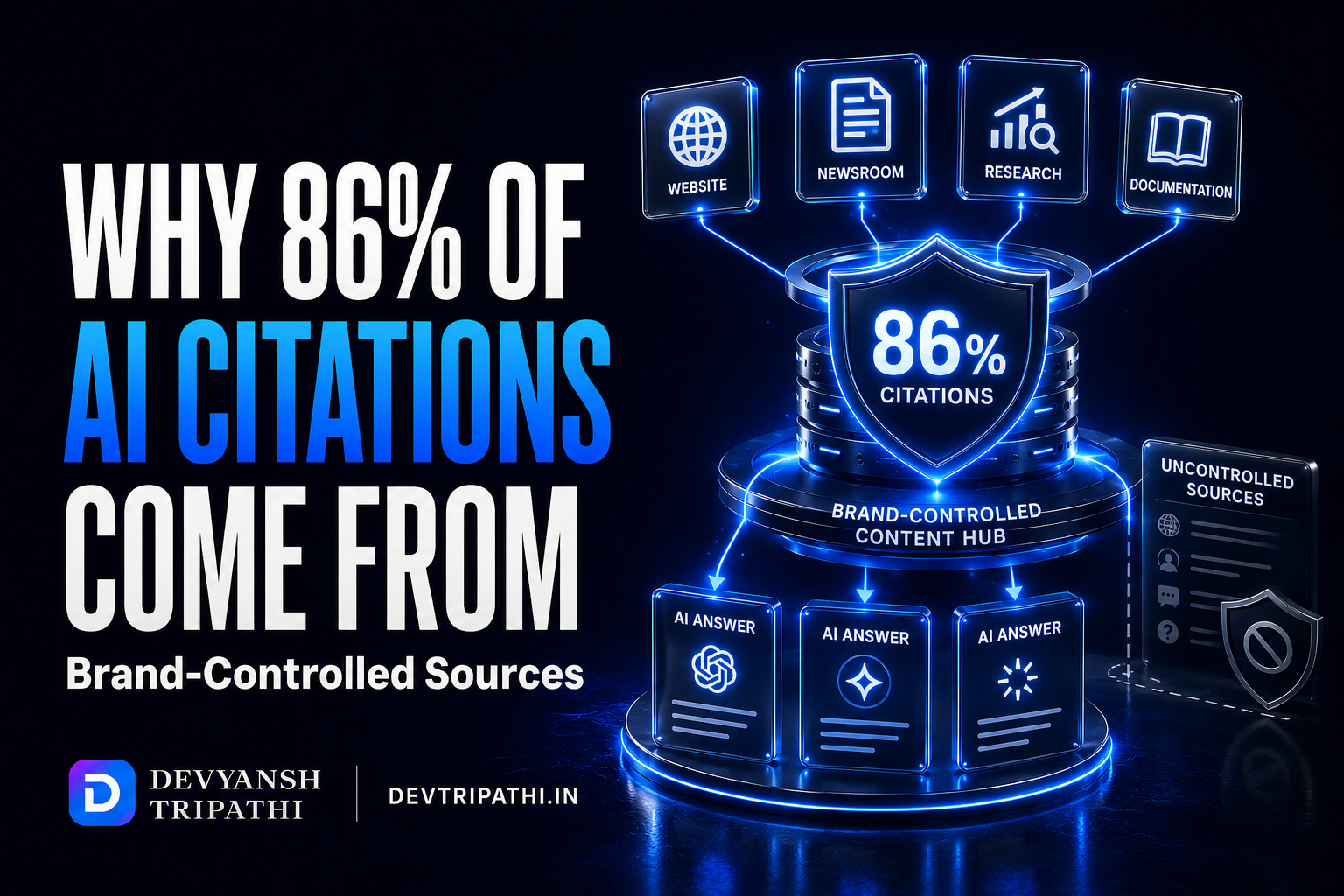
AI citation optimization enters a new phase in mid-2026 with Yext’s analysis of 6.8 million AI citations finding that 86% of citations come from sources brands can directly control, split between first-party websites at roughly 44% and business listings and profiles at roughly 42%, while only 38% of AI citations correspond to a top-10 organic ranking, confirming that classic search ranking and AI citation are related but genuinely distinct games that require their own dedicated optimization effort.
This Cycle 4 guide covers the newest AI citation research reshaping strategy for the second half of 2026: the complete Yext 6.8-million-citation breakdown and why it shifts optimization priority toward controllable sources, the documented brand recall and trust premium that cited brands earn over uncited competitors, the freshness multiplier showing recently updated content appears 4.3 times more often in AI answers, the measurement gap where only 14% of practitioners track AI citation visibility despite 43% naming it a core strategy, and the practical implementation sequence that prioritizes the specific controllable source categories the Yext data identifies as the highest-leverage citation investment available today.
86% of AI Citations Come From Sources You Can Directly Control. Are You Controlling Them?
Get a complete AI citation audit covering your first-party website citation readiness, business listing completeness across major platforms, content freshness cadence against the 85% recency threshold, and the specific controllable-source gaps preventing your brand from capturing the majority-share citation opportunity the 2026 data identifies.
Get My AI Citation AuditThe 86% Controllable Sources Finding and Why It Changes Everything
Yext’s analysis of 6.8 million AI citations represents one of the largest field datasets available in 2026 AI citation research, and its central finding reframes the entire strategic conversation around AI citation optimization. Rather than treating AI citations as primarily dependent on unpredictable third-party earned media coverage, journalist relationships, or algorithmic ranking factors outside a brand’s direct control, the data shows 86% of citations trace back to two source categories a brand can directly manage: first-party websites at approximately 44% and business listings and profiles at approximately 42%.
This finding does not diminish the value of earned media, YouTube presence, or community platform authority covered extensively in prior GEO and brand authority research. It does establish a clear priority sequence: brands should exhaust the optimization potential of their controllable sources, their own website content structure and their business listing completeness across every relevant platform, before treating harder-to-influence earned media and community signals as the primary lever. For most brands, the controllable-source gap represents the fastest, most directly actionable path to measurable AI citation improvement available in the current research landscape.
86%of AI citations come from sources brands directly control (Yext, 6.8M citations)
38%of AI citations correspond to a top-10 organic ranking — confirming ranking and citation are distinct
2.3xhigher brand recall for LLM-cited brands vs uncited brands (JDM Web Technologies 2026)
4.3xmore frequent AI answer appearance for recently updated content (Yext via WitsCode)
The Two Controllable Source Categories in Detail
Understanding exactly what constitutes each of the two dominant controllable source categories allows brands to audit their current coverage precisely and identify the specific gaps producing the largest citation opportunity loss.
~44% of All AI Citations
First-Party Website Content
First-party website citations depend on the content structure, schema markup, and answer-first formatting that make a page's claims directly extractable and verifiable by AI retrieval systems. Because this category represents the largest single controllable citation source, the content architecture practices covered throughout our AI Citation Optimization Advanced Guide, including nested FAQPage schema, data-dense pillar pages, and answer-first structure, remain the foundational investment for capturing this nearly half of total available AI citation share.
~42% of All AI Citations
Business Listings and Profiles
Business listings and profiles, including Google Business Profile, LinkedIn company pages, Crunchbase, industry-specific directories, and review platforms, represent a nearly equal share of total citation opportunity to first-party websites, yet receive dramatically less optimization attention from most brands. Completing every available field, maintaining consistent NAP (name, address, phone) data, and keeping profile information current across every relevant listing platform is a high-leverage, low-cost investment relative to its documented citation share, and often the fastest gap to close for brands beginning a systematic AI citation programme.
The Documented Brand Recall and Trust Premium
The commercial case for AI citation optimization has strengthened considerably with JDM Web Technologies’ 2026 finding that brands cited by LLMs see 2.3 times higher brand recall and earn an 86% trust score compared to only 54% for uncited brands, alongside a documented 40 to 65% traffic increase within six months of implementing dedicated LLM SEO strategies. This trust differential reflects a specific mechanism: when an AI system cites a brand as a source, the user implicitly extends some portion of their trust in the AI platform itself to the cited brand, a credibility transfer effect that has no equivalent in traditional organic search results, where users evaluate each result independently regardless of ranking position.
This trust premium compounds the brand authority effects covered in our Brand Authority SEO Cycle 3 guide: a brand earning consistent AI citations builds recall and trust simultaneously, each reinforcing future citation probability as the brand’s entity recognition strengthens across the AI systems evaluating it for subsequent queries. The 40 to 65% traffic increase figure, while representing a wide range reflecting variation in starting citation baseline and implementation completeness, confirms the ROI case for AI citation investment is now backed by measured outcome data rather than only correlation-based citation rate metrics.
The Freshness Multiplier: 4.3x More Frequent Appearance
Content freshness has emerged as one of the single highest-leverage controllable levers in the 2026 AI citation research base. Recently updated content appears roughly 4.3 times more often in AI answers, and approximately 85% of AI Overview citations come from content published or updated within the past year according to Yext’s data. This finding is significant because freshness, unlike earned media placement or entity authority building, is entirely within a brand’s direct control and can be executed on a defined operational schedule without requiring external cooperation from journalists, platforms, or community members.
The practical implementation requires establishing a systematic content verification cadence, distinct from full rewrites, that updates statistics, adds recent developments, and refreshes visible timestamp signals on a regular schedule for priority pages. Given that 85% of AI Overview citations trace to content updated within the past year, brands with content libraries containing pages untouched for eighteen months or longer are likely losing a meaningful share of achievable citation volume purely to staleness, independent of the underlying content quality.
Only 14% of Brands Track AI Citation Visibility. Do Not Be Flying Blind on Your Highest-Growth Channel.
Dev Tripathi builds complete AI citation optimization programmes covering controllable source audits, business listing completeness across every major platform, systematic freshness cadence implementation, and the measurement infrastructure that closes the tracking gap most competitors have not yet addressed.
Build My AI Citation ProgrammeThe Measurement Gap: Ambition Without Infrastructure
Goodfirms’ 2026 survey of 100 or more SEO and marketing professionals across 20 or more countries surfaced a striking disconnect between strategic intention and operational execution: 43% of respondents named AI optimization a core 2026 strategy, yet only 14% actively track AI and LLM citation visibility using available tools. This gap means the substantial majority of brands claiming AI citation as a strategic priority have no systematic way of knowing whether their efforts are producing results.
The survey also found only 11% of respondents monitor branded search volume or share of voice, a signal that matters more than it might initially appear because it captures the downstream effect of AI citation exposure that direct referral tracking cannot see: a user who encounters a brand in an AI-generated answer and later searches for that brand by name generates a branded search lift that never appears in standard referral analytics. Goodfirms characterizes this as fundamentally an awareness problem rather than a tooling problem, since AI visibility tracking tools including Otterly.ai, Promptmonitor, and Peec AI are already accessible; most organizations have simply not yet connected AI citation strategy to a corresponding measurement discipline. For the complete measurement framework addressing this gap, see our AI Visibility Tracking guide.
Closing the Measurement Gap: A Practical Starting Point
Brands seeking to close this measurement gap should begin with the two lowest-cost, highest-signal tracking practices the Goodfirms data implicitly recommends: weekly manual citation testing across ChatGPT, Perplexity, and Google AI Mode for a defined set of 15 to 20 priority queries, and monthly branded search volume tracking in Google Search Console as the proxy for AI citation exposure effects that direct analytics cannot capture. Neither practice requires a paid subscription to begin, making the 14% adoption rate a genuine strategic opportunity rather than a resource constraint most brands cannot address.
Multi-Platform Presence as a Citation Multiplier
Yext’s research confirms that sites present on four or more platforms are approximately 2.8 times more likely to appear in ChatGPT recommendations, a finding consistent with prior 2026 research establishing multi-platform presence as a compounding citation authority signal. This multiplier effect interacts directly with the controllable-source finding: since business listings and profiles alone account for approximately 42% of total AI citations, and since presence across four or more platforms nearly triples ChatGPT citation likelihood specifically, completing business listing coverage across every relevant platform functions as a dual-benefit investment, capturing direct listing-based citations while simultaneously building the multi-platform presence that amplifies citation probability on conversational AI platforms.
| Citation Source Category | Share of Total Citations | Controllability | Priority Action |
|---|---|---|---|
| First-Party Website | ~44% | Fully controllable | Answer-first structure, schema, freshness cadence |
| Business Listings and Profiles | ~42% | Fully controllable | Complete every field, maintain NAP consistency, expand to 4+ platforms |
| Earned Media and Third-Party | ~14% | Partially controllable | Strategic distribution, expert positioning, ongoing relationship building |
Implementation Sequence for the Controllable-Source Priority
The 86% controllable-source finding suggests a specific implementation sequence that most brands should follow to capture the highest-leverage citation opportunity first, before investing heavily in the harder-to-influence earned media category that represents the remaining smaller share of total citation volume.
Begin with a business listing audit across the five to eight platforms most relevant to your category, completing every available profile field and verifying NAP consistency across all of them, since this is typically the fastest gap to close and directly addresses 42% of total citation opportunity. Simultaneously, audit your top 20 highest-priority website pages against the answer-first structure and schema requirements covered in our GEO Cycle 3 guide, addressing the 44% first-party website citation category. Establish the freshness verification cadence needed to maintain the 85% within-the-past-year recency threshold that Yext’s data identifies as a citation prerequisite. Only after these three controllable-source actions are operational should earned media distribution and community platform authority building receive primary strategic focus, since they address the smaller remaining share of the total citation opportunity documented in the 2026 field data. For the complete zero-click strategy that this citation-first approach directly serves, see our Zero-Click Search Optimization Cycle 3 guide.
Frequently Asked Questions About AI Citation Optimization in 2026
What does the 86% controllable sources finding mean for AI citation strategy?
Yext's analysis of 6.8 million AI citations found that 86% come from sources brands can directly control: approximately 44% from first-party websites and approximately 42% from business listings and profiles. This means the majority of AI citation opportunity sits within a brand's direct influence rather than depending primarily on unpredictable earned media coverage, allowing brands to prioritize controllable, low-cost optimization work before investing heavily in harder-to-influence third-party relationship building.
Why do only 38% of AI citations correspond to a top-10 organic ranking?
The 38% overlap figure confirms that traditional search ranking and AI citation selection are related but genuinely distinct outcomes governed by different evaluation criteria. AI systems evaluate content for citation based on answer extractability, entity clarity, and structural signals that differ from the backlink and domain authority signals that primarily drive traditional organic rankings. A page can rank well organically without earning AI citations, and a page can earn AI citations without ranking in the traditional top 10, requiring brands to optimize for both outcomes as separate objectives.
What is the brand recall and trust premium documented for AI-cited brands?
Brands cited by LLMs see 2.3 times higher brand recall and earn an 86% trust score compared to only 54% for uncited brands, with a documented 40 to 65% traffic increase within six months of implementing dedicated LLM SEO strategies. This trust premium reflects a credibility transfer effect: when an AI system cites a brand as a source, users implicitly extend some portion of their trust in the AI platform to the cited brand, a mechanism that has no direct equivalent in traditional organic search results evaluated independently by each user.
Why does content freshness matter so much for AI citation eligibility?
Recently updated content appears approximately 4.3 times more often in AI answers, and roughly 85% of AI Overview citations come from content published or updated within the past year. This makes freshness one of the highest-leverage controllable levers available because, unlike earned media placement, it requires no external cooperation and can be executed on a defined internal schedule. Brands with content untouched for eighteen months or longer are likely losing meaningful citation opportunity purely to staleness, independent of the underlying content quality.
What is the AI citation measurement gap and why does it matter?
The measurement gap refers to the disconnect between strategic ambition and tracking infrastructure: 43% of marketers name AI optimization a core 2026 strategy, but only 14% actively track AI citation visibility. This gap means most brands claiming AI citation as a priority cannot verify whether their efforts are working. Goodfirms characterizes this as an awareness problem rather than a tooling problem, since accessible tracking tools already exist; organizations have simply not yet connected their AI citation strategy to a corresponding measurement discipline.
Why should brands track branded search volume as an AI citation proxy?
Only 11% of marketers monitor branded search volume or share of voice despite its value as an indirect AI citation impact signal. When a user encounters a brand in an AI-generated answer and later searches for that brand by name, this branded search lift never appears in standard referral analytics because the original AI exposure generated no trackable click. Monitoring branded search volume growth in Google Search Console provides a proxy measurement for AI citation exposure effects that direct analytics tools cannot otherwise capture.
How does multi-platform presence multiply AI citation likelihood?
Sites present on four or more platforms are approximately 2.8 times more likely to appear in ChatGPT recommendations according to Yext's research. This multiplier interacts directly with the controllable-source finding, since business listings and profiles alone account for approximately 42% of total AI citations. Completing business listing coverage across four or more relevant platforms functions as a dual-benefit investment: capturing direct listing-based citations while simultaneously building the multi-platform presence that amplifies citation probability on conversational AI platforms specifically.
What is the significance of the 44.2% first-30%-of-text citation finding?
Previsible's July 2026 research found 44.2% of all LLM citations come from the first 30% of a text, with 31.1% coming from the middle 30 to 70% span. This confirms that front-loading the most data-dense, directly responsive content early in a page's structure continues to determine citation extraction probability at the paragraph level, reinforcing that content architecture decisions about where specific claims and data points are positioned within a page materially affect citation likelihood independent of overall content quality.
What is the recommended implementation sequence given the 86% finding?
The recommended sequence prioritizes controllable sources first: complete a business listing audit across five to eight relevant platforms addressing the 42% listing-based citation category, then audit top-priority website pages against answer-first structure and schema requirements addressing the 44% first-party website category, then establish a freshness verification cadence maintaining the 85% within-the-past-year recency threshold. Only after these controllable-source actions are operational should earned media distribution and community platform authority building receive primary strategic focus, since they address the smaller remaining share of total citation opportunity.
How does business listing completeness affect AI citation performance?
Business listings and profiles account for approximately 42% of total AI citations, nearly matching the first-party website share, yet typically receive far less optimization attention from most brands. Completing every available field on Google Business Profile, LinkedIn company pages, Crunchbase, and relevant industry directories, while maintaining consistent name, address, and phone data across all of them, represents a high-leverage, low-cost investment that directly addresses a citation category most competitors have not fully optimized, often making it the fastest available gap to close for brands beginning a systematic AI citation programme.
How does the 86% controllable sources finding relate to broader GEO strategy?
The 86% finding refines rather than replaces broader GEO strategy by establishing a clear priority sequence within it: controllable sources (first-party website and business listings) should receive primary optimization investment before harder-to-influence earned media and community signals, since together they account for the substantial majority of total citation volume. This does not diminish the value of the brand authority and earned media strategies covered in the broader GEO framework, but it does provide evidence-based guidance for sequencing that investment for maximum near-term citation impact. For the complete integrated framework, see our GEO Cycle 3 guide.
Ready to Capture the 86% of AI Citations You Can Directly Control?
Get a complete AI citation optimization programme covering business listing completeness across every relevant platform, first-party website structure audit against answer-first and schema requirements, systematic freshness cadence design, and the measurement infrastructure that closes the tracking gap most competitors have not yet addressed.
Start My AI Citation ProgrammeConclusion
AI citation optimization in the second half of 2026 is guided by the clearest strategic priority signal the discipline has yet produced: 86% of AI citations come from sources brands can directly control, split almost evenly between first-party websites and business listings and profiles, while only 38% correspond to traditional top-10 rankings, confirming AI citation as a genuinely distinct optimization objective. The documented 2.3 times brand recall premium, the 4.3 times freshness multiplier, and the 2.8 times multi-platform presence effect together provide a quantified, evidence-based case for treating AI citation as a core, measurable business channel rather than a speculative emerging tactic.
The largest remaining opportunity may not be technical but operational: with only 14% of practitioners tracking AI citation visibility despite 43% naming it a strategic priority, most brands have not yet closed the gap between ambition and measurement. Brands that complete the controllable-source optimization sequence and build the tracking infrastructure to measure its impact are positioned to capture disproportionate share of a citation landscape where the majority of competitors have not yet systematically addressed either dimension. For the complete AI visibility tracking framework that closes this measurement gap, see our AI Visibility Tracking guide.

Devyansh Tripathi
I’m Devyansh Tripathi, an SEO strategist and digital growth expert, helps businesses and individuals rank higher and drive organic traffic. Through DevTripathi., he shares cutting-edge SEO insights, content strategies, and marketing hacks. Passionate about digital success, he’s on a mission to make SEO simple, effective, and result-driven!
Posts
- What Google’s New AI Search Documentation Means for SEO Teams
- Google I/O 2026 Search: AI Agents, Gemini 3.5 and the Unified Box
- Google’s AI Optimization Guide: The Technical and Content Checklist
- July 2026 SEO Update: AI Overviews, llms.txt and Search Console
- Prompt Optimization Beyond Page One: The Position-21 Citation Opportunity
Categories
- AI Citation Optimization
- AI Search Optimization (AISEO)
- AI Visibility Tracking
- Answer Engine Optimization (AEO)
- Brand Authority SEO
- Brand SERP Optimization
- Community Signal SEO
- Conversational Search Optimization
- Generative Engine Optimization (GEO)
- Knowledge Graph Optimization
- Modern SEO Strategies
- Multimodal Search Optimization
- Prompt Optimization
- SEO Trends
- Social Search Optimization
- Topical Authority SEO
- Uncategorized
- Video Search SEO
- Visual Search Optimization
- Voice Engine Optimization (VEO)
- Zero Click Search Optimization
Latest News
Text Widget
Empowering brands with insights, strategies, and stories that drive digital growth.