Zero-Click SEO: Win AI Overviews, Snippets and Knowledge Panels
23 May 2026
That model is now fundamentally incomplete.
Over 60% of all Google searches in the United States now end without the user clicking any external website result. For queries where AI Overviews appear, organic click-through rates drop by as much as 61% compared to traditional results. According to Bain Research, 80% of consumers use zero-click results for at least 40% of their searches. The click is no longer the only currency of search visibility.
This is not a crisis. For SEO professionals who understand the new landscape, it is one of the most significant competitive opportunities available. The brands that appear in featured snippets, AI Overviews, and Knowledge Panels gain brand exposure, authority positioning, and purchase intent influence at the exact moment users are forming opinions, even when they never visit your website at all.
Zero Click Search Optimization is the practice of structuring your content and brand presence to win maximum visibility across all SERP features and AI-generated answers, with or without the resulting click.
This guide covers exactly how zero click search works, which SERP features matter most, and the specific optimization strategies that win them.
What Is Zero Click Search?
Zero click search refers to any Google search that satisfies the user’s intent directly on the search results page without requiring a click to an external website. The user submits a query, gets an answer on the SERP itself, and leaves without visiting any website.
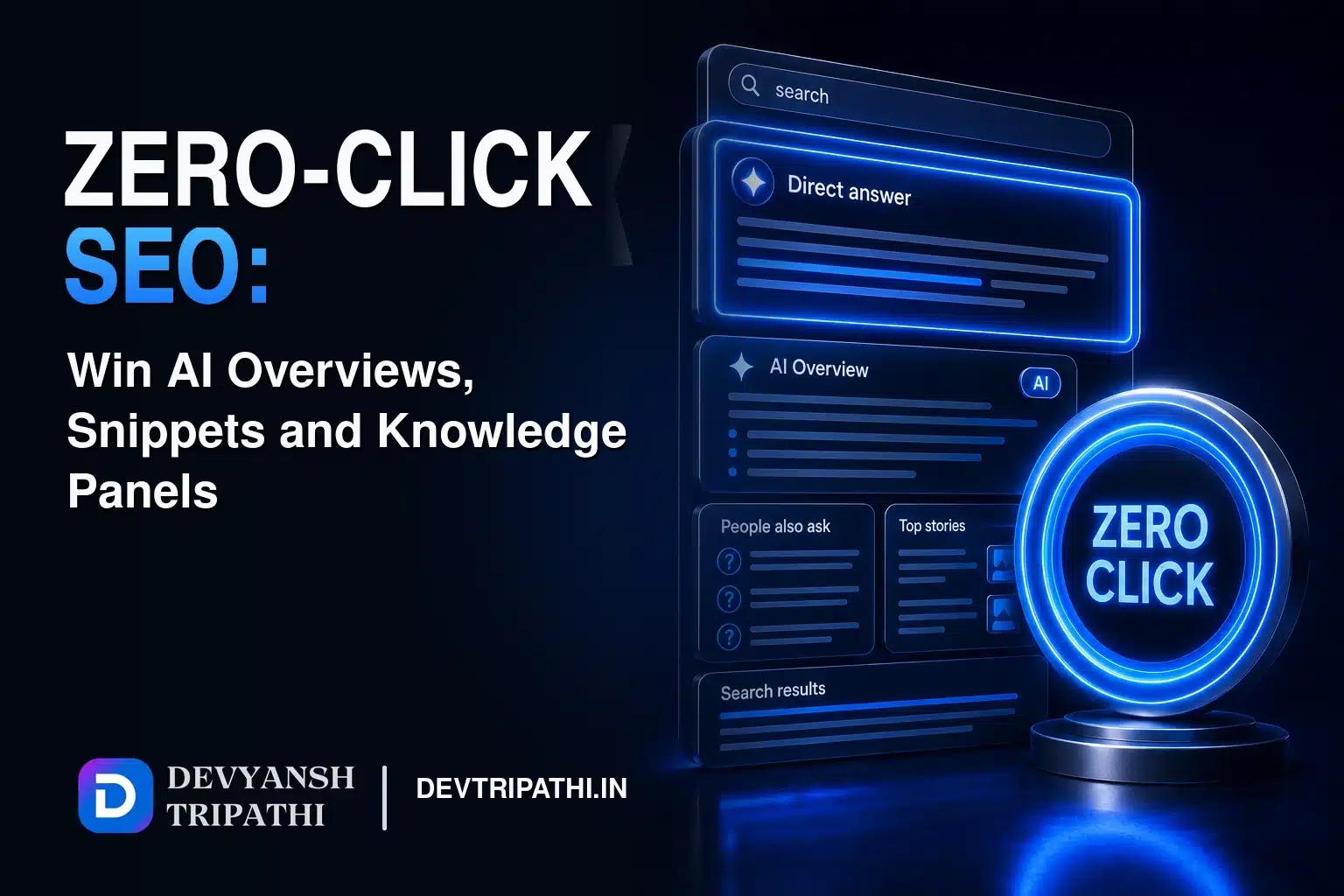
Zero click results are delivered through several SERP features: AI Overviews, featured snippets, Knowledge Panels, People Also Ask boxes, local packs, weather and calculator widgets, dictionary and translation boxes, and direct answer cards.
According to SparkToro and Rand Fishkin’s ongoing research into click distribution, the majority of Google search traffic never reaches any external website. Combined with the growth of AI-powered answer layers, zero click rates for informational and news queries have risen sharply. Zero click rates for news searches rose from 56% to 69% between May 2024 and May 2025 according to research cited in multiple 2026 SEO industry analyses.
The critical insight: zero click does not mean zero value. It means the value has shifted. Brand impressions, authority signaling, and top-of-funnel influence now happen at the SERP level. The brands that optimize for zero click visibility capture that value. The brands that optimize only for clicks miss it entirely.
For related reading on the AI Overviews component of zero click search, see: How to Appear in Google AI Overviews at https://devtripathi.in/blogs/how-to-appear-in-google-ai-overviews/ and What Is Google AI Overview and How It Affects Blog Traffic at https://devtripathi.in/blogs/what-is-google-ai-overview-blog-traffic/
The 5 Major Zero Click SERP Features and How to Win Each One
Feature 1: Google AI Overviews
AI Overviews are the dominant zero click feature in 2026. They appear in an estimated 47 to 55% of all Google searches, and when they are present, organic click-through rates drop by 61% for competing results. For informational queries, the AI Overview is now the primary answer delivery mechanism on the Google SERP.
However, being cited inside an AI Overview is itself a high-value outcome. Brands cited as AI Overview sources receive measurably more clicks than non-cited competitors on the same SERP. Research shows a 92% correlation between domains ranking in the traditional top 10 and domains cited in AI Overviews.
How to win AI Overview citations:
Place a direct answer block answering the primary query within the first 150 words of the page. Research from Search Engine Land shows 55% of AI Overview citations come from the first 30% of page content.
Deploy FAQPage, Article, and ItemList JSON-LD schema in a single structured data block.
Rewrite H2 and H3 headers as questions that mirror real user queries.
Build topical authority across a full cluster of related pages on your subject.
Include expert quotes with attribution and specific statistics with source references.
For the complete AI Overview optimization guide, see: Answer Engine Optimization (AEO): The Complete Guide at https://devtripathi.in/blogs/answer-engine-optimization-aeo-complete-guide/
Feature 2: Featured Snippets (Position Zero)
Featured snippets extract a direct answer from a single source page and display it above all organic results. They are the oldest and best-understood zero click feature, and they remain a primary optimization target because they simultaneously provide SERP visibility, voice search answers, and AI Overview source eligibility.
Types of featured snippets:
Paragraph snippets: Used for definition and explanation queries. Triggered by question-format queries beginning with “what is,” “what does,” “who is,” and “how does.”
List snippets: Used for process and ranking queries. Triggered by “how to,” “steps to,” “best X,” and “top X” queries.
Table snippets: Used for comparison queries. Triggered by “X vs Y,” “types of X,” and “comparison of X” queries.
Video snippets: Used for instructional queries. Triggered when YouTube videos are the clearest format for the answer.
How to win paragraph snippets: Write a direct definition paragraph of 40 to 60 words immediately following a question-format H2 or H3 header. Use the Subject Is Predicate sentence structure. Avoid marketing language, hedging, or padding.
How to win list snippets: Structure the page with a question-format header, followed by a numbered or bulleted list of steps or items. Each list item should begin with an action verb. Keep each item to one clear sentence.
How to win table snippets: Use HTML tables with clear headers and concise cell content. Comparison tables with three to five rows outperform longer tables for featured snippet selection.
For a complete framework on question-format content and FAQ optimization for AI extraction, read: How to Write FAQ Sections for AI Overviews at https://devtripathi.in/blogs/how-to-write-faq-sections-ai-overviews/
Feature 3: Knowledge Panels
Knowledge Panels display comprehensive entity information about brands, people, organizations, and topics directly on the SERP. They appear for branded queries and represent one of the clearest signals that Google has recognized your brand as a trusted Knowledge Graph entity.
Knowledge Panels carry significant zero click brand authority value. When a user searches for your brand and sees a Knowledge Panel with your logo, description, founding date, key people, and social profiles, their confidence in your brand increases even if they never visit your website.
How to build and optimize a Knowledge Panel:
Register your brand on Wikidata with consistent entity information.
Complete and verify your Google Business Profile with all available data fields.
Maintain consistent Name, Address, Phone, and founding information across LinkedIn, Crunchbase, and major industry directories.
If eligible, create or contribute to a Wikipedia article about your brand.
Implement Organization and Person schema markup on your website with JSON-LD.
Build enough authoritative third-party mentions that Google’s systems can cross-reference your entity information with confidence.
Once Google creates a Knowledge Panel for your brand, you can claim it through Google Search Console and suggest edits to ensure the displayed information is accurate.
Feature 4: People Also Ask (PAA) Boxes
People Also Ask boxes appear in over 50% of Google searches and expand dynamically as users interact with them. They are one of the most visible zero click features because they appear in the middle of organic results rather than above them, capturing attention throughout the scrolling journey.
PAA boxes are directly connected to how AI systems select FAQ content for featured extraction. Pages that appear in PAA boxes for multiple related queries signal strong topical authority to Google’s ranking systems.
How to win PAA placements:
Structure your FAQ sections around the exact questions that appear in PAA boxes for your target queries. Use Google Search to manually research PAA questions for your key topics and incorporate them as verbatim or closely-phrased H3 headers.
Write standalone, direct answers of 40 to 60 words for each question.
Apply FAQPage schema to all FAQ content.
Build content clusters that cover a topic comprehensively, as PAA box selection is strongly correlated with topical authority signals.
For detailed guidance on building FAQs that win PAA placements and AI citations, see: How to Write FAQ Sections for AI Overviews at https://devtripathi.in/blogs/how-to-write-faq-sections-ai-overviews/
Feature 5: Local Pack (Google Maps 3-Pack)
The local 3-pack appears for location-based queries and displays three businesses with their name, rating, address, and opening hours directly on the SERP. For local businesses, local pack placement is the most important zero click target available, as it captures commercial intent from users ready to make a purchase decision.
How to win local pack placement:
Google Business Profile: Claim, verify, and fully complete your Google Business Profile. Include business category, service description, photos, opening hours, and attributes.
NAP Consistency: Ensure your business Name, Address, and Phone number are identical across every online platform.
Review Volume and Quality: Actively generate and respond to Google reviews. Higher review volume and rating correlate strongly with local pack placement.
Local Content: Create dedicated landing pages for each service area with location-specific content that includes the city and service area naturally.
Local Backlinks and Citations: Earn links and mentions from local news sites, community organizations, and India-based directories relevant to your service area.
For a deep dive on local SEO signals and their connection to voice search, see: Voice Engine Optimization (VEO): The Complete Guide at https://devtripathi.in/blogs/voice-engine-optimization-veo-complete-guide/
The Inverted Pyramid Method for Zero Click Content
The Inverted Pyramid Method, also called BLUF (Bottom Line Up Front), is the most effective content structure for zero click optimization. It reverses the traditional content structure where the main conclusion appears at the end.
Standard content structure (wrong for zero click): Introduction and context, expanding detail, supporting evidence, conclusion and answer.
Inverted Pyramid structure (correct for zero click): Direct answer first (40 to 60 words), supporting context and detail, expanded analysis, FAQs, conclusion.
The logic is clear: AI systems and featured snippet algorithms scan for extractable answer patterns. Google’s crawlers no longer read only for holistic understanding. They scan for extractable patterns. A page structured with the answer first provides a clear extraction target. A page structured with the answer at the end forces the algorithm to read the entire piece before finding the citable content, reducing selection probability.
Apply the Inverted Pyramid to every page on your site that targets an informational query. Use confident Subject Is Predicate sentence structures. Avoid hedging language like “it is important to consider” or “one might argue.” Write as if you are the authority being quoted, because in zero click SEO, you are.
The Click Conversion Strategy: How to Turn Zero Click Visibility Into Traffic
Zero click visibility does not mean zero business value. The key is designing a strategy that converts SERP-level impressions into consideration and delayed visits through brand recall and content depth signals.
For informational queries where zero click rates are highest, accept the answer-layer reality and optimize fully for citation quality. The traffic that does click through from AI-informed searches is typically higher-quality and further along in the consideration process than cold organic traffic.
Three proven methods to convert zero click exposure into business outcomes:
Method 1 — Incomplete answers that earn the click: Structure featured snippet content so the 40 to 60 word answer provides value but makes clear that more depth is available on the page. Users who need the complete answer, not just the summary, will click through. This works best for complex how-to queries, multi-step processes, and comparison content.
Method 2 — Brand recall through repeated SERP impressions: Consistent presence in featured snippets, PAA boxes, and AI Overviews builds brand recall through repeated exposure. Users who see your brand name cited three or four times across different queries are significantly more likely to search for your brand directly when they reach a purchase decision stage. Track branded search volume growth in Google Search Console as the downstream metric of your zero click brand-building activity.
Method 3 — Depth content that extends the visit: Every zero click optimized page should have substantial depth content below the answer block. Users who click through for more detail should find content that is genuinely comprehensive. Long pages with clear structure, useful visuals, and strong internal links to related content reduce bounce rates and improve the engagement signals that reinforce your authority with Google’s ranking systems.
For the complete internal linking and content depth strategy that supports zero click optimization, see: Entity SEO, GEO, and Topic Authority in AI Search at https://devtripathi.in/blogs/entity-seo-geo-topic-authority-ai-search/
Measuring Zero Click Search Performance
Traditional keyword ranking reports and organic traffic metrics are insufficient for measuring zero click performance. Build a dedicated zero click measurement framework:
SERP Feature Tracking: Use Semrush, Ahrefs, or SERPWatcher to track how many of your target keywords trigger SERP features and how many of those features include your content. Monitor featured snippet ownership rate, PAA inclusion rate, and AI Overview citation frequency separately.
Impression Volume in Google Search Console: Total impressions, not just clicks, measure your true SERP presence in a zero click world. Track impression growth for target keywords even when click counts remain flat. Impression growth in the absence of click growth indicates increased zero click SERP feature appearances.
Branded Query Growth: Monitor month-over-month growth in branded search queries. This is the most direct metric for measuring whether zero click brand exposure is converting into brand recall and direct searches.
AI-Referred Traffic: Track sessions from AI platform domains in GA4 using a custom channel group. This measures the click-through rate from AI citations, which is a premium zero click conversion metric.
Click-Through Rate by Query Type: Segment CTR in Search Console by informational versus commercial versus navigational intent. Declining CTR on informational queries alongside stable or growing impression volume typically indicates increasing zero click SERP feature appearances, which is a positive outcome, not a problem.
Frequently Asked Questions About Zero Click Search Optimization
What is zero click search and why does it matter for SEO?
Zero click search refers to Google searches that satisfy user intent directly on the search results page through features like AI Overviews, featured snippets, Knowledge Panels, and PAA boxes, without requiring a click to any external website. It matters because over 60% of all Google searches now end this way, meaning more than half of all search activity never reaches any website. Brands that optimize for zero click visibility capture brand exposure and authority positioning at the moment of discovery, even without the click.
Does zero click search hurt SEO?
Zero click search redistributes SEO value rather than destroying it. While click volumes for purely informational queries decline, brands that appear in featured snippets, AI Overviews, and Knowledge Panels gain brand awareness, authority signals, and consideration influence at scale. Brands cited in AI Overviews also receive more clicks than non-cited competitors on the same SERP. The brands hurt by zero click are those optimizing exclusively for clicks on informational queries. The brands that win adapt their strategy to capture SERP-level visibility as a primary metric alongside traffic.
What is the most important zero click optimization target in 2026?
AI Overviews are the dominant zero click target in 2026. They appear in an estimated 47 to 55% of all Google searches and, when present, reduce organic click-through rates by 61% for competing results. However, brands cited inside AI Overviews receive measurably more clicks than non-cited competitors on the same page. Optimizing for AI Overview citation is simultaneously a zero click brand visibility play and a click-through optimization strategy.
How do I win a featured snippet for my page?
To win a featured snippet, your page must already rank in approximately the top 10 for the target query. From that position, structure the page with a question-format H2 or H3 header matching the query, followed immediately by a direct 40 to 60 word answer paragraph using Subject Is Predicate sentence structure. For list snippets, use a numbered list with action verb-led items. For table snippets, use a clean HTML table with short cell content. Featured snippet ownership typically updates within 1 to 4 weeks of content restructuring.
What is the Inverted Pyramid Method for zero click content?
The Inverted Pyramid Method, also known as BLUF (Bottom Line Up Front), is a content structure where the direct answer to the primary query appears in the first 150 words of the page, before any supporting context or expanding detail. This is the opposite of traditional content writing. It is the most effective structure for zero click optimization because AI systems and featured snippet algorithms scan for extractable answer patterns and reward content that places the citable answer prominently and clearly.
Can zero click visibility drive business results without website traffic?
Yes. Consistent presence in SERP features builds brand recall through repeated impressions. Users who encounter your brand name cited in featured snippets, AI Overviews, and PAA boxes across multiple separate searches are significantly more likely to search for your brand directly when they reach a purchase decision stage. Bain Research shows 80% of consumers use zero click results for at least 40% of their searches. The purchase intent from those searches does not disappear because no click occurred. It converts through brand recall into a later branded search or direct visit.
What is a Knowledge Panel and how do I get one?
A Knowledge Panel is a box that appears on the right side of Google search results for branded queries, displaying verified information about your brand or personal entity. Google creates Knowledge Panels for entities it recognizes in its Knowledge Graph. To earn a Knowledge Panel, build consistent entity information across Wikidata, Google Business Profile, LinkedIn, Crunchbase, and major industry directories. Implement Organization or Person schema on your website. Once a panel appears, claim it through Google Search Console to verify and manage the displayed information.
How do People Also Ask boxes work and how do I rank in them?
People Also Ask (PAA) boxes dynamically display questions related to the user’s query and expand with answers from web sources when clicked. They appear in over 50% of Google searches and are directly connected to FAQ content that uses FAQPage schema. To rank in PAA boxes, identify which questions appear in PAA results for your target queries using manual Google search, then incorporate those exact questions as H3 headers in your content with direct 40 to 60 word standalone answers. Apply FAQPage JSON-LD schema to all FAQ content.
Does zero click search affect e-commerce and transactional queries?
Much less than informational queries. According to research from Digital Applied, AI Overviews largely avoid recommending specific products directly due to liability considerations. Transactional and commercial intent queries still drive click-through behavior at significantly higher rates than informational queries. The zero click challenge is primarily an informational content issue. E-commerce and service pages targeting commercial and transactional intent keywords still benefit from traditional click-through SEO, supported by zero click brand awareness built through informational content.
How does zero click search interact with voice search?
Voice search is a specific form of zero click search where the answer is delivered audibly rather than displayed visually. All voice search results are zero click by definition: the user asks a question, the assistant reads an answer aloud, and the interaction ends without a website visit. Voice search optimization (VEO) and zero click search optimization share the same core tactics: featured snippet optimization, FAQPage schema, 40 to 60 word answer blocks, and question-format headers. Optimizing for zero click visibility directly improves voice search eligibility simultaneously.
What tools are best for tracking zero click search performance?
For SERP feature tracking: Semrush, Ahrefs, and SERPWatcher track featured snippet ownership and SERP feature presence across target keywords. For AI Overview citation monitoring: Otterly.AI, AthenaHQ, and manual testing in Google AI Mode, ChatGPT, and Perplexity. For impression and click analysis: Google Search Console Performance Report, segmented by query type and filtered for SERP feature-eligible queries. For Knowledge Panel monitoring: Google Search Console brand query tracking and manual branded search testing.
What is the single most impactful zero click optimization change I can make today?
Add a direct 40 to 60 word answer block immediately following a question-format H2 header in your highest-traffic informational article. This single structural change is the most commonly missed and highest-impact zero click optimization available. Pages with this structure win featured snippets, appear in PAA boxes, and qualify as AI Overview citation sources at significantly higher rates than pages where the answer is buried in the body of the text. Update your five most important informational pages with this structure and monitor SERP feature inclusion over the following 30 days.
Conclusion
Zero click search is the new normal of Google. With over 60% of searches ending on the SERP, optimizing exclusively for clicks is a strategy built on the minority of search interactions. The brands winning in 2026 are the ones that have accepted this reality and built content systems designed to capture value at every layer of the search experience: the click, the citation, the brand impression, and the recalled name that converts into a purchase days or weeks later.
The framework is clear: win AI Overview citations with answer-first content and triple schema stacking. Win featured snippets with the Inverted Pyramid structure and question-format headers. Win Knowledge Panel presence with entity consistency and structured data. Win PAA placements with FAQPage schema and verbatim question matching. Win local pack positions with Google Business Profile completeness and NAP consistency.
None of these require abandoning traditional SEO. They require extending your existing optimization discipline to cover the full SERP surface where your audience now spends most of their search time.
Start with your five most important informational articles. Add direct answer blocks in the first 150 words. Deploy FAQPage schema. Rewrite your H2 headers as questions. Then measure your impression growth, branded search volume, and AI citation frequency over the following 60 days.
Zero click is not the end of SEO value. It is the redistribution of where that value is captured.
SparkToro — Zero Click Search Research: https://sparktoro.com/blog/how-much-of-googles-search-traffic-is-left-for-anyone-but-google/
Google Search Central — Featured Snippets Documentation: https://developers.google.com/search/docs/appearance/featured-snippets
Google Knowledge Panel Help: https://support.google.com/knowledgepanel/
Schema.org FAQPage: https://schema.org/FAQPage
Digital Applied — Zero Click SEO Guide: https://www.digitalapplied.com/blog/zero-click-search-seo-strategy-guide-2026

Devyansh Tripathi
I’m Devyansh Tripathi, an SEO strategist and digital growth expert, helps businesses and individuals rank higher and drive organic traffic. Through DevTripathi., he shares cutting-edge SEO insights, content strategies, and marketing hacks. Passionate about digital success, he’s on a mission to make SEO simple, effective, and result-driven!
Posts
- What Google’s New AI Search Documentation Means for SEO Teams
- Google I/O 2026 Search: AI Agents, Gemini 3.5 and the Unified Box
- Google’s AI Optimization Guide: The Technical and Content Checklist
- July 2026 SEO Update: AI Overviews, llms.txt and Search Console
- Prompt Optimization Beyond Page One: The Position-21 Citation Opportunity
Categories
- AI Citation Optimization
- AI Search Optimization (AISEO)
- AI Visibility Tracking
- Answer Engine Optimization (AEO)
- Brand Authority SEO
- Brand SERP Optimization
- Community Signal SEO
- Conversational Search Optimization
- Generative Engine Optimization (GEO)
- Knowledge Graph Optimization
- Modern SEO Strategies
- Multimodal Search Optimization
- Prompt Optimization
- SEO Trends
- Social Search Optimization
- Topical Authority SEO
- Uncategorized
- Video Search SEO
- Visual Search Optimization
- Voice Engine Optimization (VEO)
- Zero Click Search Optimization
Latest News
Text Widget
Empowering brands with insights, strategies, and stories that drive digital growth.