
GEO Checklist for Beginners: 15 Things to Do Before Publishing a Blog Post
01 April 2026
Publishing a blog post in 2026 without a GEO checklist is like cooking a meal without a recipe you might get lucky, but you are leaving too much to chance.
Search behavior has shifted. AI tools like ChatGPT, Perplexity, and Google AI Overviews are answering questions before users ever see a list of blue links. If your content is not structured for AI retrieval before you publish, it may rank on Google and still earn zero AI citations, missing an entire channel of high-intent traffic that converts at up to 14.2%, compared to 2.8% for standard organic search.
This GEO checklist covers 15 specific actions to take before every blog post goes live. They are organized into four phases: content structure, authority signals, technical foundations, and pre-publish review. None of them require a developer or a budget. Every one of them can be done by a solo blogger today.
If you want to understand the strategy behind this checklist, the previous posts in this series cover what GEO is, how AI Overviews work, and how EEAT connects to your AI citation chances all of which give context to why each item here matters. But if you are ready to publish, the checklist below is everything you need.
Why a Pre-Publish GEO Checklist Changes Everything
Most bloggers still run a 2020 SEO checklist: check keyword density, add meta description, compress images, hit publish. That process produces diminishing returns in 2026.
The gap between ranking in Google and being cited by AI is where most blogs are losing visibility. According to research tracking AI citation patterns, brands that invert this gap optimising for AI citation first, with traditional SEO as the foundation consistently outperform competitors. AI-referred sessions have grown 527% since 2024. The window to establish citation authority before competitors is still open. But it requires a deliberate, systematic process every time you publish.
The 15-item checklist below is that process.
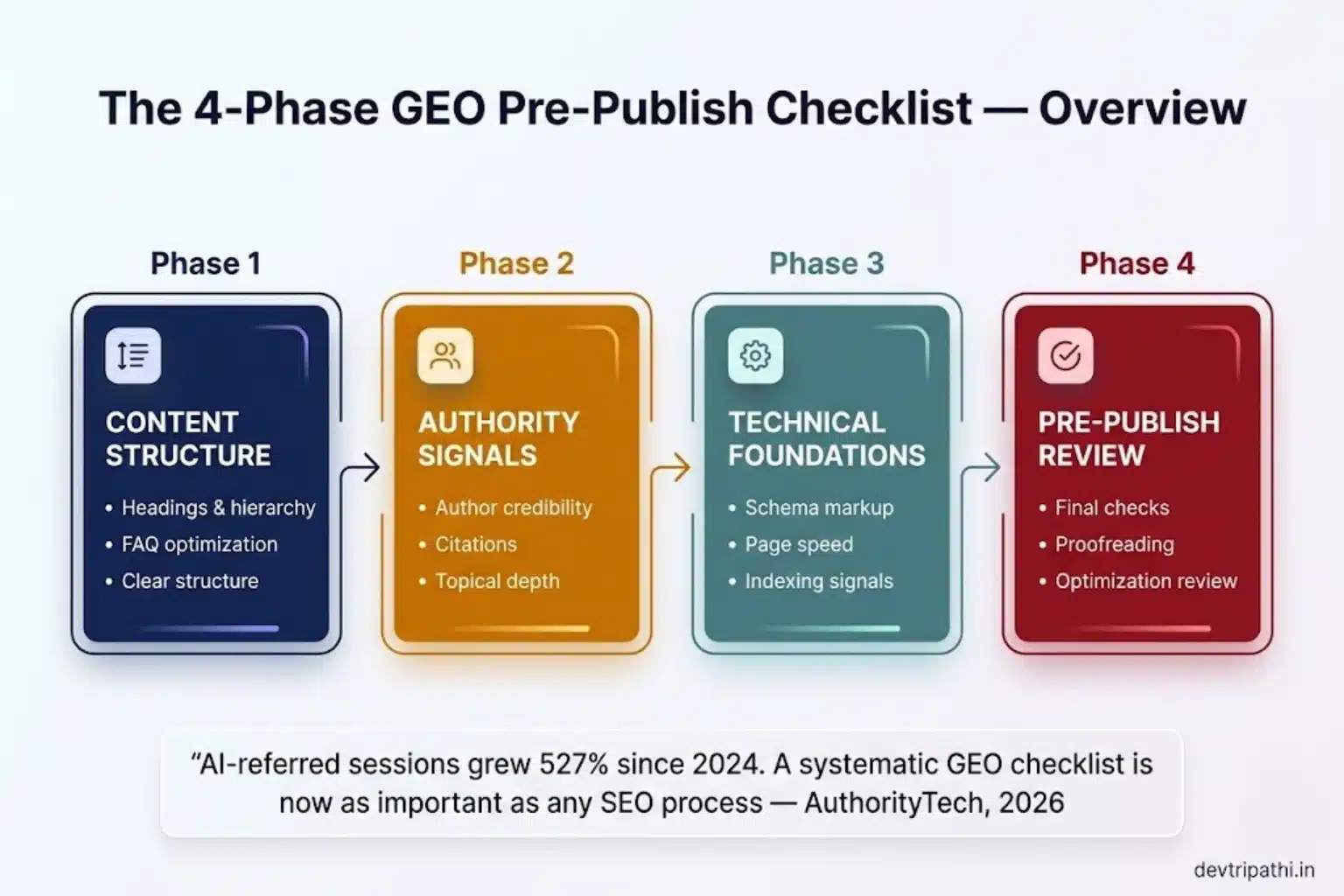
This GEO checklist ensures your blog is optimized for AI-driven search engines like ChatGPT, Google AI Overviews, and Perplexity.
Phase 1 Content Structure (Items 1–5)
Content structure is where AI retrieval begins. AI systems do not read your article from top to bottom they extract specific passages that match sub-queries. Every structural decision you make determines how easily those passages can be found, evaluated, and cited.
Phase 2 Authority Signals (Items 6–9)
Authority signals tell AI systems whether your content comes from a source worth citing. The Princeton GEO paper the foundational academic study that coined the term found that AI engines strongly favour earned media and third-party-recognised sources. Building authority signals into every post is how you consistently pass the trust threshold.
Phase 3 Technical Foundations (Items 10–12)
Technical GEO overlaps significantly with traditional SEO but adds AI-specific layers most standard checklists still miss. These three items are the ones most bloggers skip, and skipping them directly limits AI crawler access to your content.
Phase 4 Pre-Publish Review (Items 13–15)
The final phase is a quality review pass checking the three elements most likely to disqualify content from AI citation even when everything else is done correctly.
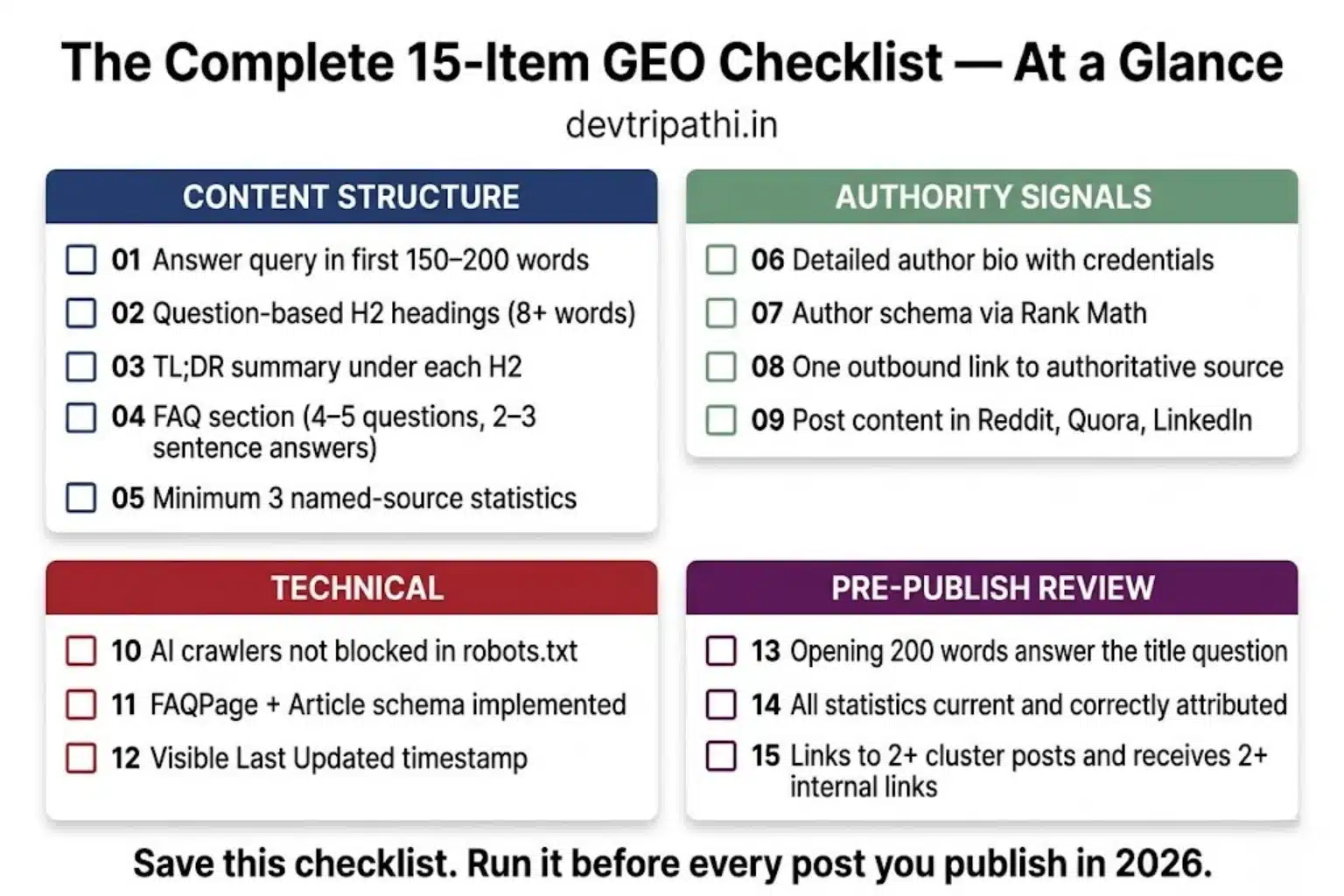
How to Use This GEO Checklist in Your Workflow
The most effective way to use this checklist is to build it into your publishing process as a standard final step the same way a journalist runs a subediting pass before filing a story. It should take 15–20 minutes per post once you are familiar with all 15 items.
For new blogs, start by implementing items 01, 04, 05, 06, 07, 11, and 12 first these seven items account for the majority of AI citation eligibility improvement and can be applied to existing content in a single afternoon. The remaining items build on this foundation over time.
For existing blogs with published content, run items 01, 04, 05, 11, 12, and 15 as a retrofit audit across your top 10 highest-traffic posts. Research tracking tactical GEO changes found that refreshing existing content with these specific improvements produces measurable citation improvements within 30–45 days faster than building new content from scratch.
The blogs already published in this GEO content cluster covering what AI Overviews are, how GEO differs from SEO, and what EEAT means in 2026 all follow this checklist. The consistency you see across the series in terms of structure, data citation, FAQ sections, and author transparency is this checklist applied systematically, post by post.
FAQs
