
single

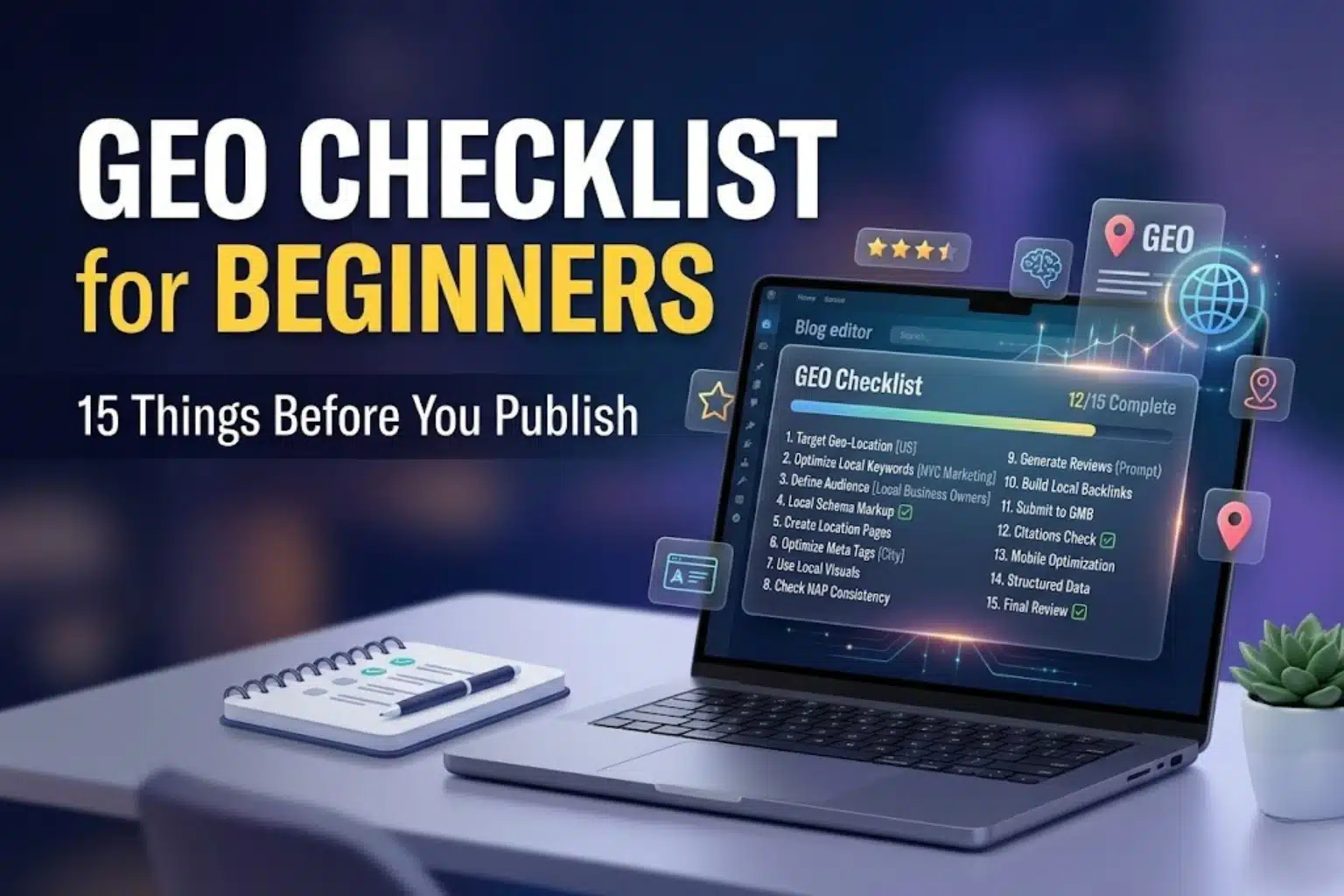
GEO Checklist for Beginners: 15 Things to Do Before Publishing a Blog Post

01 April 2026
The Impact of 5G Technology

Publishing a blog post in 2026 without a GEO checklist is like cooking a meal without a recipe  you might get lucky, but you are leaving too much to chance.

Search behavior has shifted. AI tools like ChatGPT, Perplexity, and Google AI Overviews are answering questions before users ever see a list of blue links. If your content is not structured for AI retrieval before you publish, it may rank on Google and still earn zero AI citations, missing an entire channel of high-intent traffic that converts at up to 14.2%, compared to 2.8% for standard organic search.

This GEO checklist covers 15 specific actions to take before every blog post goes live. They are organized into four phases: content structure, authority signals, technical foundations, and pre-publish review. None of them require a developer or a budget. Every one of them can be done by a solo blogger today.

If you want to understand the strategy behind this checklist, the previous posts in this series cover what GEO is, how AI Overviews work, and how EEAT connects to your AI citation chances  all of which give context to why each item here matters. But if you are ready to publish, the checklist below is everything you need.

Why a Pre-Publish GEO Checklist Changes Everything

Most bloggers still run a 2020 SEO checklist: check keyword density, add meta description, compress images, hit publish. That process produces diminishing returns in 2026.

The gap between ranking in Google and being cited by AI is where most blogs are losing visibility. According to research tracking AI citation patterns, brands that invert this gap  optimising for AI citation first, with traditional SEO as the foundation  consistently outperform competitors. AI-referred sessions have grown 527% since 2024. The window to establish citation authority before competitors is still open. But it requires a deliberate, systematic process every time you publish.

The 15-item checklist below is that process.
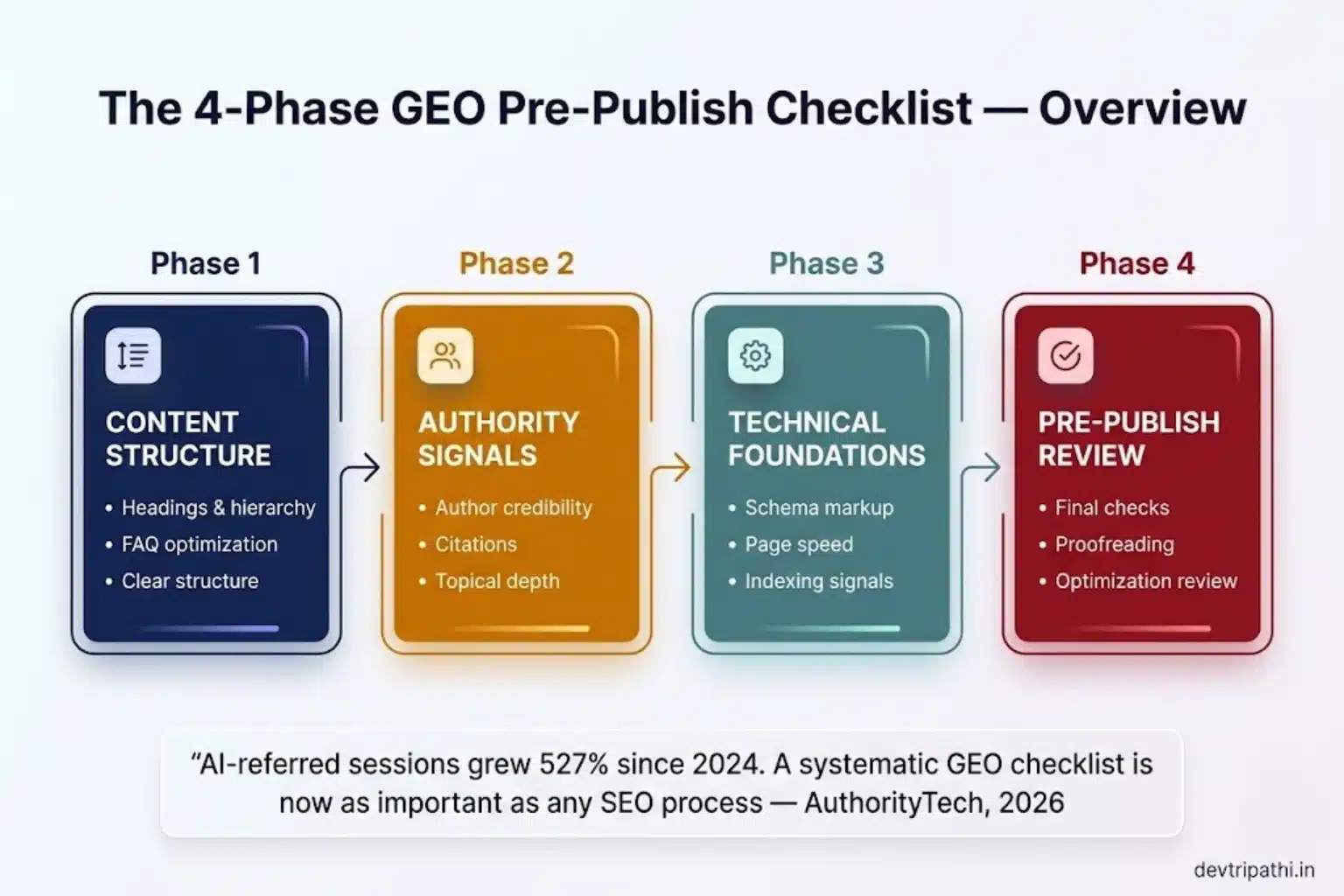
4-phase GEO pre-publish checklist overview content structure, authority signals, technical foundations, pre-publish review GEO checklist for beginners 2026

This GEO checklist ensures your blog is optimized for AI-driven search engines like ChatGPT, Google AI Overviews, and Perplexity.

Phase 1  Content Structure (Items 1–5)

Content structure is where AI retrieval begins. AI systems do not read your article from top to bottom  they extract specific passages that match sub-queries. Every structural decision you make determines how easily those passages can be found, evaluated, and cited.

Phase 1: Content Structure

01

Answer the core query in your first 150–200 words. State the direct answer in your opening paragraph. Do not build up to it — AI systems that use RAG retrieval weight opening content heavily when selecting passage chunks.

02

Use question-based H2 headings (8+ words). Rewrite every H2 as a natural, complete question. BrightEdge confirms that question-style queries of 8+ words trigger AI Overviews far more frequently than shorter keyword headings.

03

Add a TL;DR summary below each major H2. A 1–2 sentence summary under each section heading creates a self-contained, citation-ready passage that AI systems can extract without needing surrounding context.

04

Add a 4–5 question FAQ section at the end of every post. Each question should be 5–10 words. Each answer should be 2–3 sentences — direct, complete, and self-contained. This is consistently one of the highest-impact GEO optimisations.

05

Include at least 3 specific statistics with named sources. Every factual claim should have an attributed data point. Replace vague statements ('research shows') with specific ones ('According to Seer Interactive's 2025 study of 25 million impressions...'). Verifiability is a core AI citation signal.

Phase 2  Authority Signals (Items 6–9)

Authority signals tell AI systems whether your content comes from a source worth citing. The Princeton GEO paper  the foundational academic study that coined the term  found that AI engines strongly favour earned media and third-party-recognised sources. Building authority signals into every post is how you consistently pass the trust threshold.

Phase 2: Authority Signals

06

Add a detailed, credentialled author bio to every post. Include your specific experience in this niche, any relevant credentials or certifications, and a link to your author page. Anonymous content cannot pass the AI trust threshold regardless of how well it is structured.

07

Implement author schema using Rank Math. Go to Rank Math → Schema → Add Person schema for the post author. Include job title, description, image, and social profile links. Pages with proper author schema see 130–250% higher AI citation rates.

08

Include at least 1 outbound link to a credible, authoritative external source. Link to a published study, an official documentation page, or a recognised industry organisation. This signals trust and cross-verifiable expertise to AI systems evaluating your content's reliability.

09

Mention your content in relevant Quora answers, Reddit threads, or LinkedIn posts after publishing. AI engines like ChatGPT and Perplexity actively monitor community platforms for credibility signals. Consistent mentions across external platforms are among the strongest authority signals available to solo bloggers.

Phase 3  Technical Foundations (Items 10–12)

Technical GEO overlaps significantly with traditional SEO  but adds AI-specific layers most standard checklists still miss. These three items are the ones most bloggers skip, and skipping them directly limits AI crawler access to your content.

Phase 3: Technical Foundations

10

Check that AI crawlers are not blocked in your robots.txt file. Open your robots.txt (yourdomain.com/robots.txt) and verify that GPTBot, ClaudeBot, PerplexityBot, and Google-Extended are not listed under Disallow. Blocking these crawlers makes your content invisible to the AI systems you are trying to get cited by.

11

Implement FAQPage and Article schema for every post. Use Rank Math's schema settings to add both Article schema (with author details) and FAQPage schema (linked to your FAQ section). Pages with correct schema markup are 3 times more likely to earn AI citations than those without. For how-to posts, also add HowTo schema.

12

Set a visible 'Last Updated' timestamp at the top of the post. AI engines that use real-time retrieval — Google AI Overviews and Perplexity — strongly weight content recency. A clearly displayed update date signals freshness directly to both AI systems and human readers.

Phase 4  Pre-Publish Review (Items 13–15)

The final phase is a quality review pass  checking the three elements most likely to disqualify content from AI citation even when everything else is done correctly.
Phase 4: Pre-Publish Review

13

Read your opening 200 words aloud. If it does not directly answer the title's question within the first two sentences, rewrite it. This is the single most-failed item on most bloggers' pre-publish process — and the one with the highest AI citation impact.

14

Verify every statistic is current and correctly attributed. Outdated or misattributed data is a trust signal failure. Check that every specific number, percentage, or research finding is from a source published within the last 12–18 months and that the source is correctly named and linked.

15

Confirm your post links to at least 2 other posts in your content cluster. Internal linking within a topical cluster reinforces domain-level topical authority — the single most powerful long-term GEO signal. Every published post should link to at least two related cluster posts and receive links from at least two existing cluster posts.

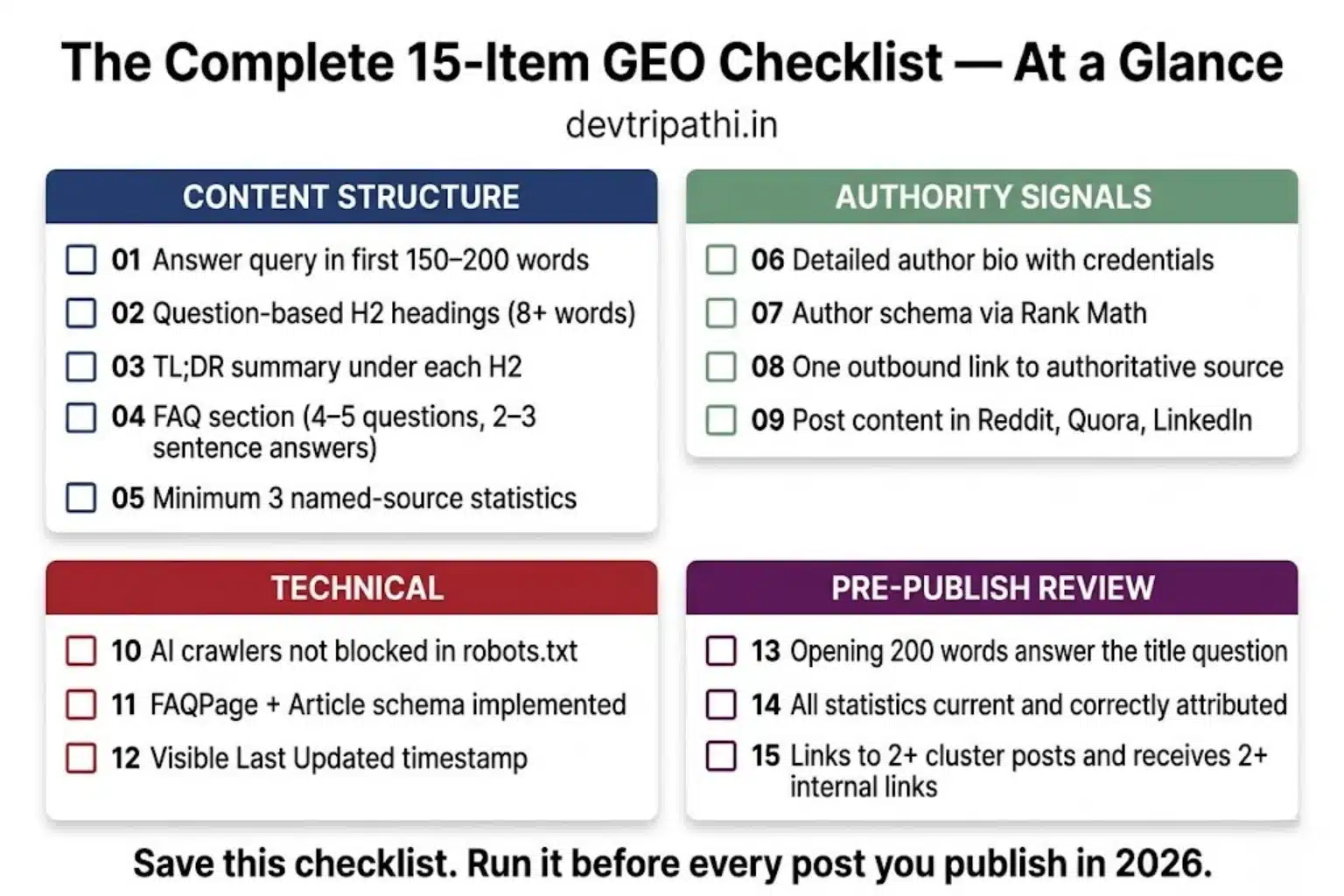
Complete 15-item GEO pre-publish checklist for bloggers in 2026 content structure, authority signals, technical foundations, and pre-publish review GEO checklist beginner guide

How to Use This GEO Checklist in Your Workflow

The most effective way to use this checklist is to build it into your publishing process as a standard final step  the same way a journalist runs a subediting pass before filing a story. It should take 15–20 minutes per post once you are familiar with all 15 items.

For new blogs, start by implementing items 01, 04, 05, 06, 07, 11, and 12 first  these seven items account for the majority of AI citation eligibility improvement and can be applied to existing content in a single afternoon. The remaining items build on this foundation over time.

For existing blogs with published content, run items 01, 04, 05, 11, 12, and 15 as a retrofit audit across your top 10 highest-traffic posts. Research tracking tactical GEO changes found that refreshing existing content with these specific improvements produces measurable citation improvements within 30–45 days  faster than building new content from scratch.

The blogs already published in this GEO content cluster  covering what AI Overviews are, how GEO differs from SEO, and what EEAT means in 2026  all follow this checklist. The consistency you see across the series in terms of structure, data citation, FAQ sections, and author transparency is this checklist applied systematically, post by post.

FAQs

What is a GEO checklist and why do I need one?

A GEO checklist is a pre-publish framework of specific optimisation steps that make your blog content readable, citable, and trustworthy to AI search engines like ChatGPT, Perplexity, and Google AI Overviews. You need one because standard SEO checklists do not cover the structural, schema, and authority signals that AI systems use to select citation sources - and without those signals, your content may rank on Google but remain invisible in AI-generated answers.

How is a GEO checklist different from a regular SEO checklist?

A standard SEO checklist focuses on keyword placement, meta tags, backlinks, and page speed - signals that influence Google's ranking algorithm. A GEO checklist adds AI-specific layers: answer-first content structure, FAQPage schema, author schema, AI crawler access verification, and named-source citation requirements. The two checklists overlap significantly in quality foundations, but GEO adds items that SEO alone does not cover.

How long does it take to run the GEO checklist before publishing?

Once you are familiar with all 15 items, the checklist takes 15-20 minutes per post. The first few times you run it may take 30-40 minutes as you build familiarity with schema settings and structural requirements. Most bloggers report that after applying it consistently for 3-4 posts, the checklist items become part of their natural writing process and the review pass gets faster.

Do I need to be technical to use this GEO checklist?

No. All 15 items are accessible to non-technical bloggers using standard tools. Rank Math handles schema implementation without coding. Robots.txt checks require only opening a URL in your browser. Content structure items are writing decisions, not technical ones. The only item that may require a developer's help is if your robots.txt is blocking AI crawlers - but checking it takes under two minutes.

Should I apply the GEO checklist to old blog posts or only new ones?

Both. For existing content, prioritise your highest-traffic informational posts first. Run items 01 (answer in first 200 words), 04 (add FAQ section), 05 (add named-source statistics), 11 (add schema), 12 (add Last Updated timestamp), and 15 (add internal cluster links). These six items produce the fastest citation improvement on existing content - typically within 30-45 days. For new posts, apply all 15 from the start.

Which item on the GEO checklist has the biggest impact on AI citation rates?

Items 04 and 11 - the FAQ section and FAQPage schema together - consistently produce the highest individual impact. Pages with FAQ schema are 60% more likely to appear in AI Overviews than pages without it. When combined with a well-written FAQ section, this pair of optimisations addresses both the content format and the structured data signal that AI systems use to identify citable Q&A content.

Does the GEO checklist apply to ChatGPT and Perplexity, not just Google AI Overviews?

Yes. All major AI search platforms evaluate content using similar trust and structure signals. Perplexity strongly favours recently updated content with clear named-source citations. ChatGPT weights content from domains with consistent topical expertise. The 15 items in this checklist improve citation eligibility across all AI platforms, not just Google AI Overviews.

What happens if I publish without running the GEO checklist?

Your content may still rank on Google and receive standard organic traffic. But without the structural and authority signals the checklist covers, AI systems are significantly less likely to cite it in generated answers. Over time, as AI-referred traffic grows as a share of total search traffic - AI-referred sessions have grown 527% since 2024 - the compounding visibility gap between optimised and unoptimised content widens.

How often should I update my GEO checklist?

Review your GEO checklist every 90-120 days as AI search platforms update their citation behaviours. The core items - answer-first structure, FAQ schema, named-source statistics, author transparency - are stable across platforms and unlikely to change. Platform-specific signals - such as which AI crawlers to allow in robots.txt - should be updated as new platforms emerge. Superlines and Search Engine Land both publish regular GEO best practice updates worth bookmarking.

Does item 10 (AI crawler access) really matter that much?

Yes - it is a binary gate. If GPTBot, ClaudeBot, or PerplexityBot are blocked in your robots.txt, those platforms simply cannot crawl your content. All the content structure and schema optimisation in the world cannot compensate for a page that the AI system has no access to. This is the first technical check that should be done for any site that wants AI visibility - and it is the one most easily overlooked.

Can I use AI tools to help me run the GEO checklist?

Yes - AI writing tools can help you rewrite introductions to be answer-first, generate FAQ questions from your content, and check whether your statistics have named sources. However, the EEAT and authority items - author bios, outbound links, community mentions, internal linking - require human judgement and cannot be delegated to AI. Use AI tools to accelerate the content structure items while personally owning the authority signal steps.

Should I prioritise the GEO checklist over my regular publishing schedule?

Yes - if you have to choose between publishing more posts quickly with no GEO checklist, or publishing fewer posts with the full checklist applied, choose quality over quantity. Research consistently shows that AI systems reward topical authority and content depth over publishing volume. Ten well-optimised posts in a tight cluster outperform fifty thin posts scattered across different topics for AI citation purposes.

How do I know if my GEO checklist items are working?

Track three indicators: AI referral traffic in Google Analytics (filter for chatgpt.com, perplexity.ai, gemini.google.com), impressions-to-CTR patterns in Google Search Console on informational queries, and periodic manual searches of your target keywords to check whether your content appears in AI Overview citations. Most sites see initial citation improvements within 30-90 days of consistent checklist application.

Is there a free tool that checks my GEO checklist automatically?

Geoptie offers a free GEO checklist audit tool that checks content structure, schema implementation, and AI crawler accessibility without a subscription. Google's Rich Results Test verifies schema implementation for free. Google Search Console shows you AI Overview impression patterns at no cost. For more comprehensive AI citation tracking across ChatGPT and Perplexity, Otterly.AI offers a 14-day free trial starting at $29 per month after.

What is the single most common GEO checklist mistake beginner bloggers make?

Publishing without a named, credentialled author. Anonymous content - posts without a visible human author identity - cannot pass the EEAT trust threshold that AI citation systems require. It does not matter how well the content is structured or how many statistics it contains: without a named author with verifiable expertise, the content fails the most fundamental AI citation eligibility check. Fix this first, on every post, before anything else on the checklist.

Devyansh Tripathi

I’m Devyansh Tripathi, an SEO strategist and digital growth expert, helps businesses and individuals rank higher and drive organic traffic. Through DevTripathi., he shares cutting-edge SEO insights, content strategies, and marketing hacks. Passionate about digital success, he’s on a mission to make SEO simple, effective, and result-driven!

Leave a comment

Your email address will not be published. Required fields are marked *