
How to Write FAQ Sections That Get Featured in AI Overviews
02 April 2026
FAQ sections have always been useful for readers. In 2026, they have become something more significant: the single fastest structural change a blogger can make to improve AI citation rates.
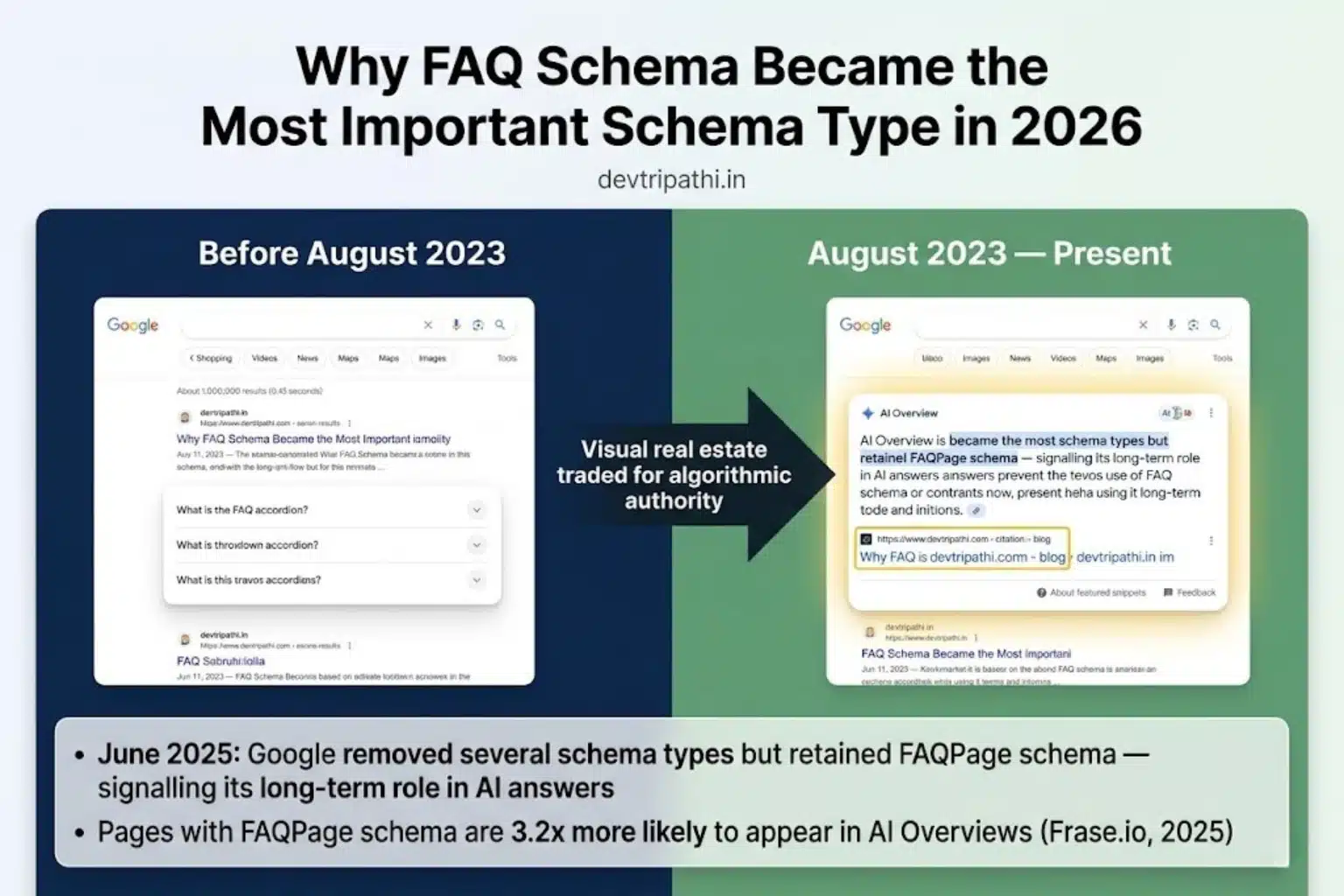
Pages with FAQPage schema are 3.2 times more likely to appear in Google AI Overviews than pages without it, according to Frase.io's analysis of AI citation patterns. FAQ content has one of the highest citation rates among all structured data types across ChatGPT, Perplexity, and Google AI Overviews combined.
But not all FAQ sections earn citations. The difference between a FAQ that gets cited and one that gets ignored comes down to four specific things: question source, answer length, answer completeness, and schema implementation. This guide covers all four with examples, a question-sourcing framework, and a step-by-step Rank Math implementation guide.
If you have already read earlier posts in this series covering what AI Overviews are, how EEAT connects to GEO, and the 15-item pre-publish checklist, you will recognise that FAQ sections appear in all three as a high-priority action. This post goes deeper on that single item because it deserves a full guide of its own.
Why FAQ Sections Are the Highest-Return GEO Investment for Bloggers
Google confirmed in June 2025 that it is removing support for several structured data types Book Actions, Course Info, and others. In that same announcement, it explicitly retained FAQPage schema as a supported feature. This is significant: while other schema types were retired, Google chose to keep FAQ schema because of its ongoing role in AI answer generation.
The strategic implication is clear. Google just signalled that FAQ-structured content is a stable, long-term investment. Not a short-term trick a fundamental component of how AI systems extract and cite information. As Zumeirah's February 2026 analysis put it: Google may no longer show FAQ dropdowns visibly on most SERPs, but it uses that exact same data to populate its AI-driven summaries. The schema is no longer a marketing gimmick it is the primary input for the world's most powerful answer engines.
The return on investment for a well-written FAQ section is unusually high for the effort involved. Adding five targeted, well-structured questions with proper schema to an existing post typically takes 30–45 minutes. The citation impact measured by AI referral traffic improvements is often visible within 30 days.
The 4 Rules of an AI-Citable FAQ Section
Rule 1 Source Questions From Real User Searches, Not Your Own Guesses
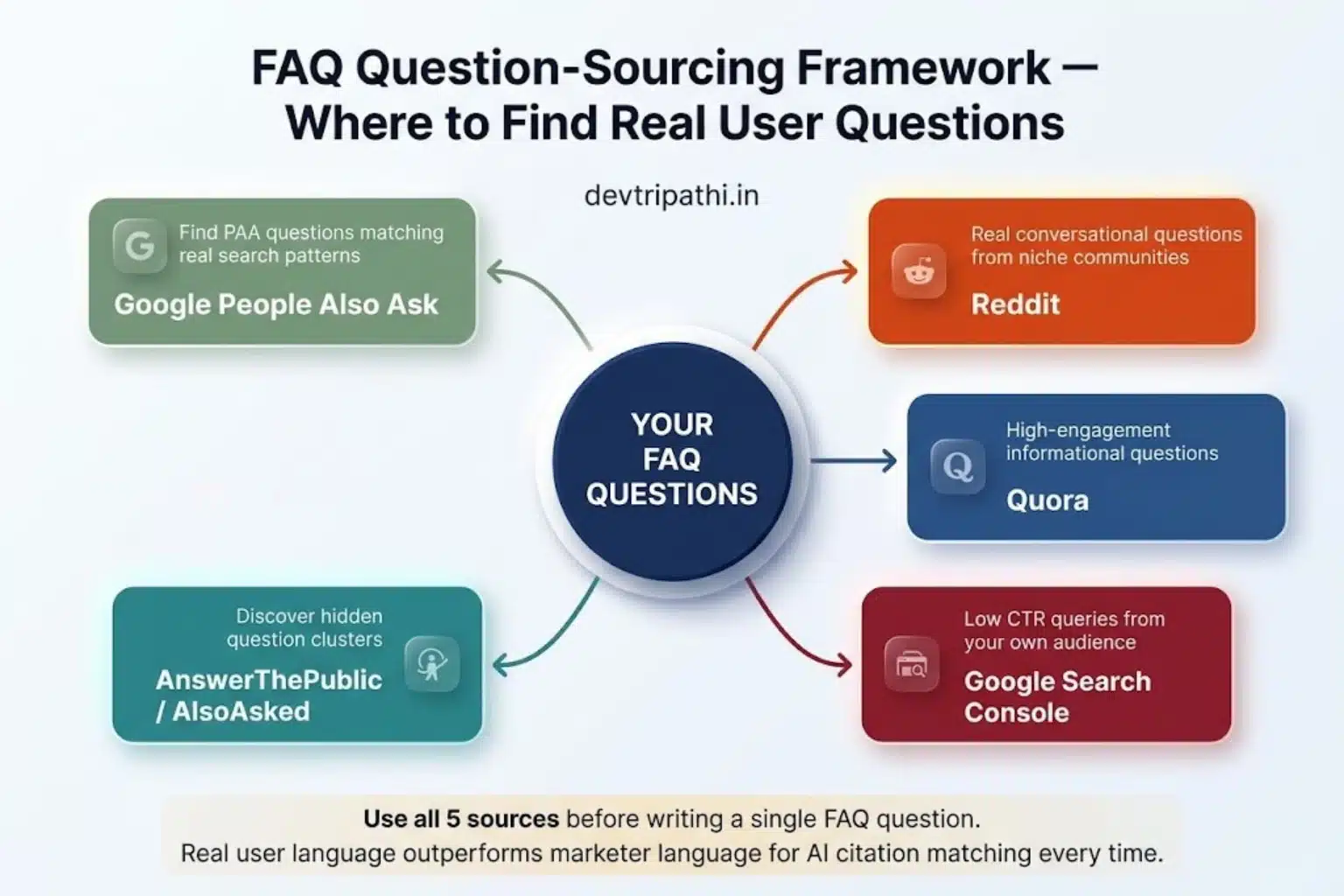
The most common FAQ mistake is writing questions based on what the blogger thinks readers want to know rather than what readers are actually searching for. AI systems match FAQ answers against real user queries. A question that nobody searches for cannot be cited in answer to a query nobody makes.
The four most reliable sources for real user questions are: Google's People Also Ask (PAA) boxes for your target keyword, Reddit threads in relevant subreddits, Quora questions in your niche, and AnswerThePublic or AlsoAsked for question-cluster mapping. Run your focus keyword through all four sources before writing a single FAQ question. Use the exact phrasing real users use not a cleaned-up marketing version of their question.
Rule 2 Keep Questions Under 15 Words, Conversational in Tone
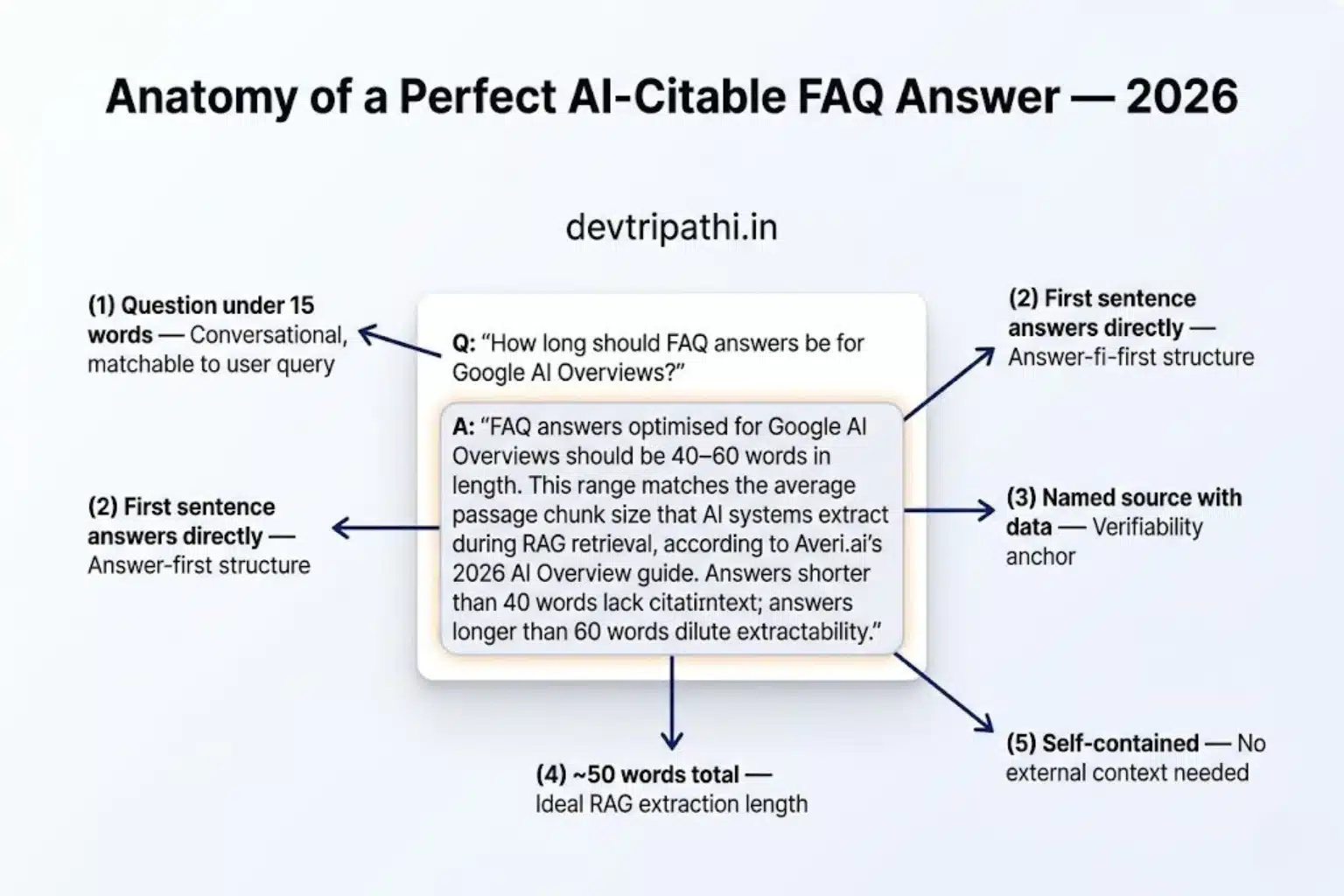
Google's own FAQPage structured data documentation specifies that each Question should include the entire text of the question. Research from Getpassionfruit's January 2026 FAQ schema analysis recommends keeping questions under 15 words or 80 characters for optimal AI processing. Longer questions fragment poorly when AI systems decompose them into sub-queries.
Question format matters as much as length. 'What is FAQPage schema and how does it work in 2026 when combined with other structured data types?' is too long and too complex. 'What is FAQPage schema and why does it matter?' is the right format specific, conversational, and matchable against a real user query.
Rule 3 Write Answers That Are 40–60 Words, Fully Self-Contained
This is the most technically important rule for AI citation. AI systems using RAG retrieval extract passage chunks and use them without surrounding context. Your FAQ answer must make complete, accurate sense when read in isolation without the question above it, without the article around it, without any additional framing.
The 40–60 word target is drawn from research across multiple AI citation studies. Averi.ai's January 2026 AI Overview optimisation guide confirms that AI Overviews average 157 words across the whole summary, with individual cited passages typically running 40–60 words. Answers shorter than 40 words often lack sufficient context to be citable. Answers longer than 60 words dilute precision and reduce the chance of the AI selecting the exact passage.
Here is the difference between a weak FAQ answer and a citation-ready one:
Rule 4 Every Answer Must Contain at Least One Specific Data Point
Verifiability is the trust signal that separates cited content from ignored content in AI systems. An answer that makes a claim without specific attribution gives the AI nothing to verify. An answer that cites a named source, a specific percentage, or a documented finding gives the AI a verifiable anchor it can cross-reference.
The minimum standard: every FAQ answer should contain at least one specific data point with a named source. 'Many experts recommend keeping answers under 60 words' fails this standard. 'Averi.ai's 2026 AI Overview optimisation research recommends 40–60 word answer blocks as the optimal length for AI extraction' passes it.
Where to Place Your FAQ Section and How Many Questions to Include
Placement matters more than most bloggers realise. The most effective position for a FAQ section is at the end of the main body content, before the conclusion where it functions as a structured summary of the most important questions the article addresses, plus additional questions the article did not cover in full.
Do not place your FAQ section at the very top of the post. That position is reserved for your answer-first opening paragraph. Placing a FAQ at the top breaks the content flow for human readers and does not provide the AI with the deeper article content it needs to assess overall page quality before the FAQ section.
For question count, Frase.io's analysis recommends aiming for 5–10 questions per page with 40–60 word answers. The GEO Content Cluster approach used in this series targets 15+ questions per post a higher number that increases the probability of matching multiple user sub-queries across a single page. For most beginner bloggers, starting with 5–7 well-researched questions and building toward 10–15 over time is the practical approach.
How to Implement FAQPage Schema Using Rank Math Step by Step
Rank Math is the recommended implementation method for FAQPage schema for WordPress bloggers. It generates valid JSON-LD automatically and links the schema directly to your visible FAQ content satisfying Google's requirement that all FAQ content in the schema must be visible on the page.
Step 1 Write Your FAQ Content First, Then Add Schema
Write your FAQ questions and answers as visible content in the post first in a dedicated FAQ section with clear H3 or bold headings for questions and paragraph text for answers. Schema should reflect visible content, not create new content. Google explicitly requires that all FAQ content in the schema must be visible to the user on the source page.
Step 2 Add the Rank Math FAQ Block
In the WordPress block editor, search for the Rank Math FAQ block and insert it. Type each question into the question field and each answer into the answer field. Do not use the standard Rank Math FAQ block as decoration the questions and answers you enter here should match exactly what is visible in the post's main content.
Step 3 Verify Schema in Google's Rich Results Test
Once the post is published, paste the URL into Google's Rich Results Test (search.google.com/test/rich-results). This tool validates whether the FAQPage schema is correctly formatted and shows how Google reads the structured data. Fix any errors shown before the post is promoted or shared. A schema error silently disqualifies your FAQ from AI citation without any visible indication on the published page.
Step 4 Layer Article Schema on the Same Post
Do not stop at FAQPage schema. Also implement Article schema (or BlogPosting schema) on the same post via Rank Math's schema settings. Including the author name, credentials, publication date, and last-modified date in the Article schema provides the EEAT context that makes the FAQPage citations more credible. Research confirms that layered schema FAQPage combined with Article or HowTo gives AI systems a multi-dimensional view of the content that increases citation probability above either schema type used alone.
Platform-Specific FAQ Optimization Google vs Perplexity vs ChatGPT
Different AI platforms have slightly different preferences when extracting FAQ content. Writing FAQ sections that perform across all three major platforms requires understanding what each one prioritizes.
Google AI Overviews emphasizes EEAT signals, content freshness, and featured-snippet-style formatting. FAQ answers for Google should include specific dated statistics, a visible author with credentials, and content updated within the last 90–180 days. Perplexity prefers conversational, experience-driven content with practical examples and community insights. Questions sourced from Reddit and Quora perform especially well here. ChatGPT, which has over 800 million weekly users and AI visitors who convert 4.4 times better than traditional organic traffic, according to TreDigital's 2025 research, weights content from domains with consistent topical expertise and layered schema implementation.
The FAQ approach that performs best across all three platforms simultaneously is to source questions from People Also Ask and Reddit, write answers in the 40–60 word range with named-source statistics, implement FAQPage and Article schema together, and update the post every 90–180 days with current statistics. This balanced approach, as confirmed by Frase.io's multi-platform citation research, maximizes citation probability across all major AI search environments at once.
FAQs
