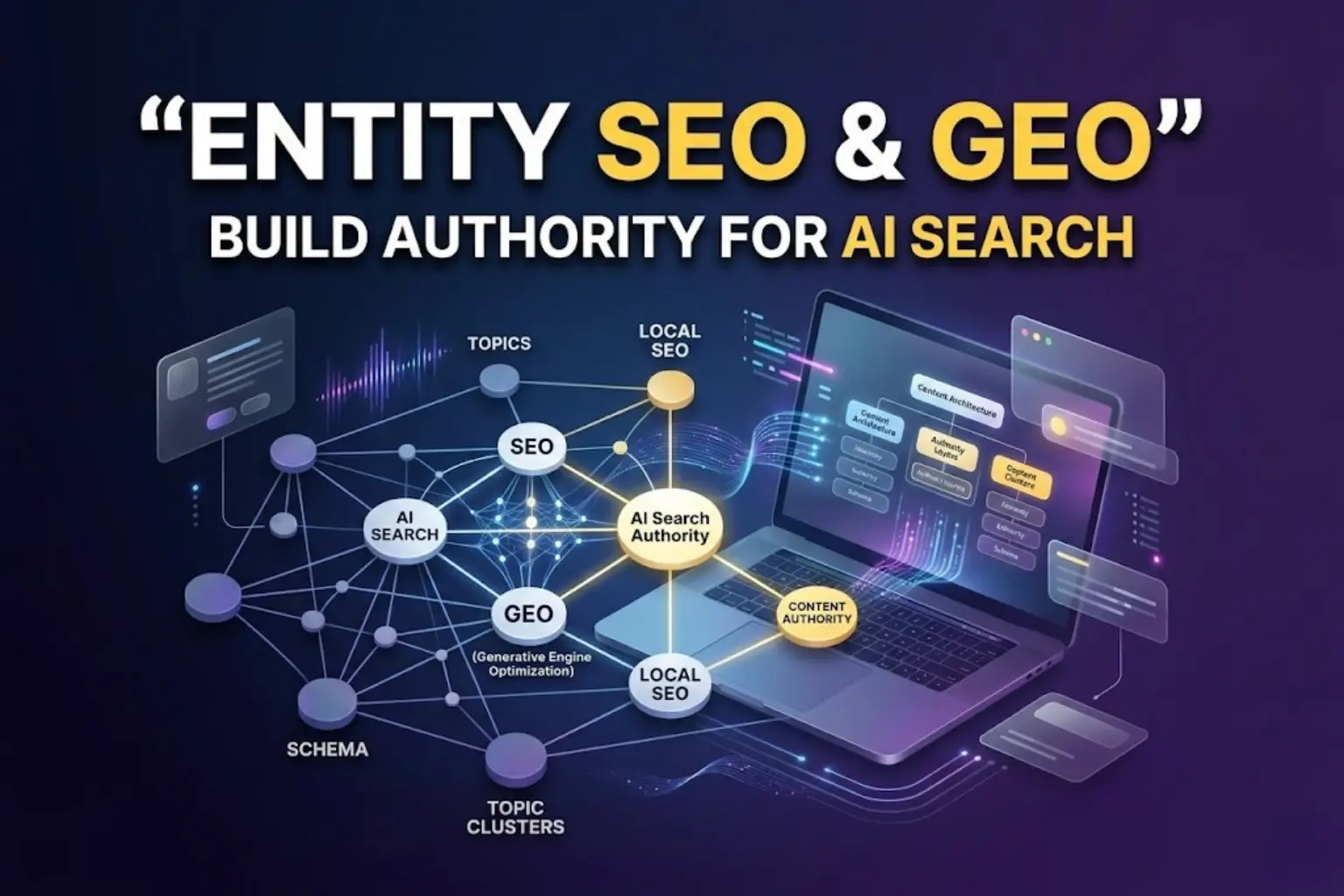
Entity SEO and GEO: How to Build Topic Authority for AI Search (2026)
03 April 2026
Entity SEO and GEO: How to Build Topic Authority for AI Search
When someone searches for 'Marie Curie' on Google, the search engine is not matching two words against an index. It is retrieving a pre-built entity a node in the Knowledge Graph with defined attributes: scientist, Nobel Prize winner, radioactivity researcher, born 1867 in Warsaw. All relationships mapped. All context pre-loaded.
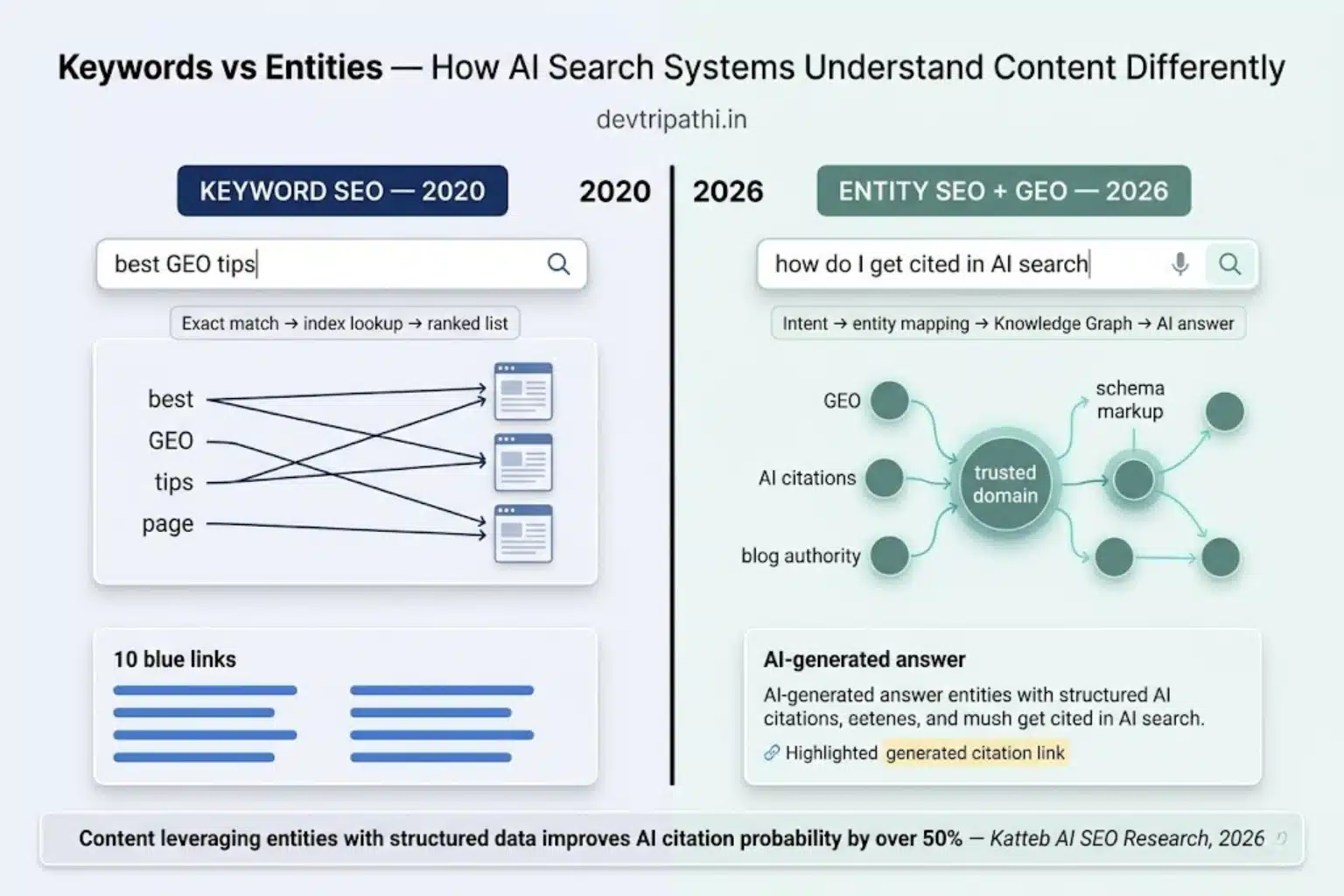
In 2026, this is how AI search systems evaluate your blog too. Not as a collection of keyword-optimised pages but as an entity, or a cluster of related entities, with relationships to other known concepts in the AI's knowledge base.
Entity SEO and GEO have become inseparable because AI systems understand the world through entities and their relationships, not through keywords and backlinks. Content leveraging entities with structured data improves AI citation probability by over 50%, according to Katteb's AI SEO research. Yet fewer than 25% of the most-mentioned brands are also the most-sourced in AI answers meaning entity authority, not just brand awareness, determines citation.
This guide explains what entities are in the context of SEO and GEO, how Google's Knowledge Graph determines AI citation selection, and the 6 concrete steps any blogger can take to build entity-level topic authority that makes their content consistently citable across AI search platforms.
What Is an Entity in SEO and Why Does It Matter for GEO?
In SEO, an entity is any distinct, identifiable concept a person, place, organization, product, or idea that can be uniquely identified and described with specific attributes. Google's Knowledge Graph, first launched in 2012, is a vast web of entities and the relationships between them.
When you search for 'apple,' Google uses entity recognition to determine whether you mean the fruit or the technology company. This disambiguation is powered by entity data: the attributes, relationships, and context Google has mapped for each distinct concept. For a blogger, the practical implication is clear: if your blog is recognized as an entity or as an authoritative source on a set of related entities AI systems can connect your content to topic clusters, verify your expertise, and confidently cite you.
As Search Engine Land's December 2025 entity-first content guide confirms, content is now judged less by exact phrasing and more by entity coverage, contextual relevance, semantic relationships, and demonstrated expertise within a defined topic space.
How Google's Knowledge Graph Powers AI Citation Selection
Google's Knowledge Graph is the structural backbone of how Google AI Overviews and increasingly other AI systems decide which sources to trust. It is a database of billions of facts about entities and their relationships. Every time Google encounters content that consistently discusses a defined set of related entities, it uses that data to assess whether the source belongs in its authoritative network for that topic.
For a blogger, every post published on a related topic, every internal link between posts, every schema tag labelling the content's entities, and every external mention of the blog on authoritative sites contributes to how Google's Knowledge Graph maps the domain.
WiRe Innovation's January 2026 entity SEO guide confirms that when a brand consistently maps to specific entities through structured data, content clusters, and sameAs references Google gains confidence in that site as an authority on related topics. That confidence directly feeds into whether content gets cited when an AI generates an answer about those entities.
ChatGPT alone handles over 2.5 billion prompts daily, yet fewer than 25% of the most-mentioned brands are also the most-sourced, according to Search Engine Land's December 2025 analysis. The gap between brand awareness and entity authority is where most bloggers are losing AI citation opportunities they do not even know exist. Understanding how EEAT signals connect to entity recognition as covered in Blog #14 of this series helps explain why entity authority and trust signals are inseparable in 2026.
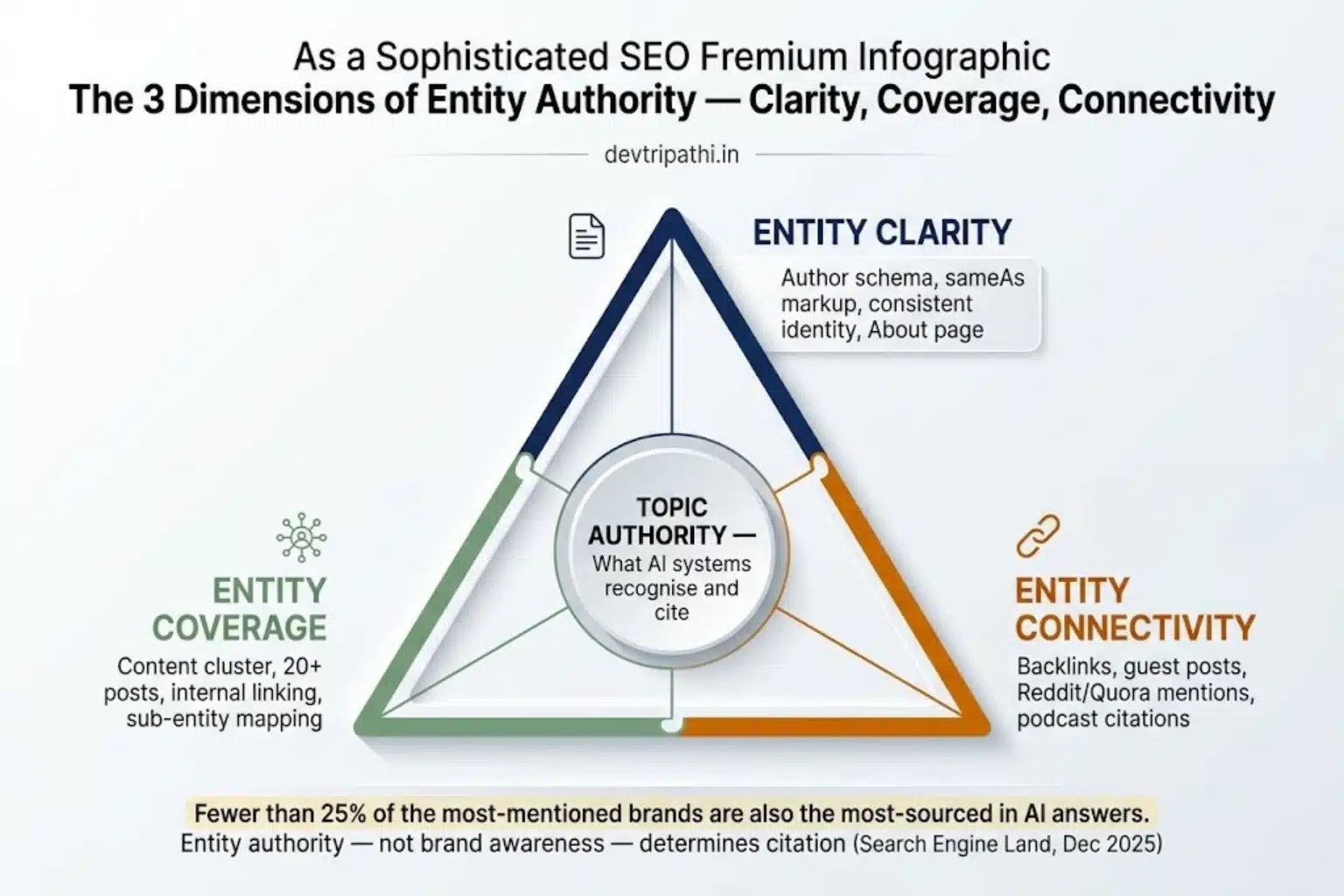
The 3 Dimensions of Entity Authority for Bloggers
Dimension 1 Entity Clarity: Being Unambiguously Identifiable
Entity clarity means AI systems can unambiguously identify who you are, what you cover, and what relationships you have to other entities in your niche. For a blogger, this means author identity, site topic focus, and niche-specific expertise must be consistently and explicitly declared across every signal point.
Practical requirements for entity clarity include: a consistent author name and identity used across all published content, an About page that explicitly states what topics the site covers and for whom, sameAs schema markup linking the author entity to LinkedIn, Twitter/X, and other authoritative platforms, and Organisation schema on the homepage defining the site as a named entity in a specific topical space. OpenCloud's January 2026 AI SEO strategy guide states it clearly: in the entity-first search paradigm, it is not about what keywords you target it is about which Knowledge Graph nodes you are connected to.
Dimension 2 Entity Coverage: Building Comprehensive Topical Depth
Entity coverage means your content collectively represents all the major sub-entities and sub-topics within your niche. Each post in your content cluster is a node in your own mini Knowledge Graph and the internal links between posts are the edges that define how those nodes relate to each other.
MRS Digital's January 2026 entity SEO guide describes this as topical depth and relevance: when you create interconnected, high-quality content around a core entity, you strengthen semantic relationships and entity associations in Google's Knowledge Graph. This improves citation eligibility across broader query ranges, not just specific queries each individual post targets. The GEO content cluster this series builds each post covering a distinct sub-entity of Generative Engine Optimisation is the structural implementation of entity coverage at a domain level.
Dimension 3 Entity Connectivity: Being Recognized by Others
Entity connectivity means other authoritative sources reference, link to, or mention your entity. This is the external validation component of entity authority the part AI systems use to confirm that self-declared expertise is corroborated by the wider authoritative web.
For bloggers, entity connectivity is built through: backlinks from industry-relevant sites, guest posts on established platforms, citations in roundup articles, mentions in podcast transcripts and YouTube descriptions, and consistent participation in Reddit and Quora discussions where the expertise is referenced by others. AI systems like ChatGPT monitor non-traditional sources Reddit threads, YouTube transcripts, community forums for entity credibility signals, according to Katteb's 2026 research. A blog mentioned consistently in relevant subreddits builds a different kind of entity signal than one that only exists on its own domain.
6 Practical Steps to Build Entity Authority for GEO
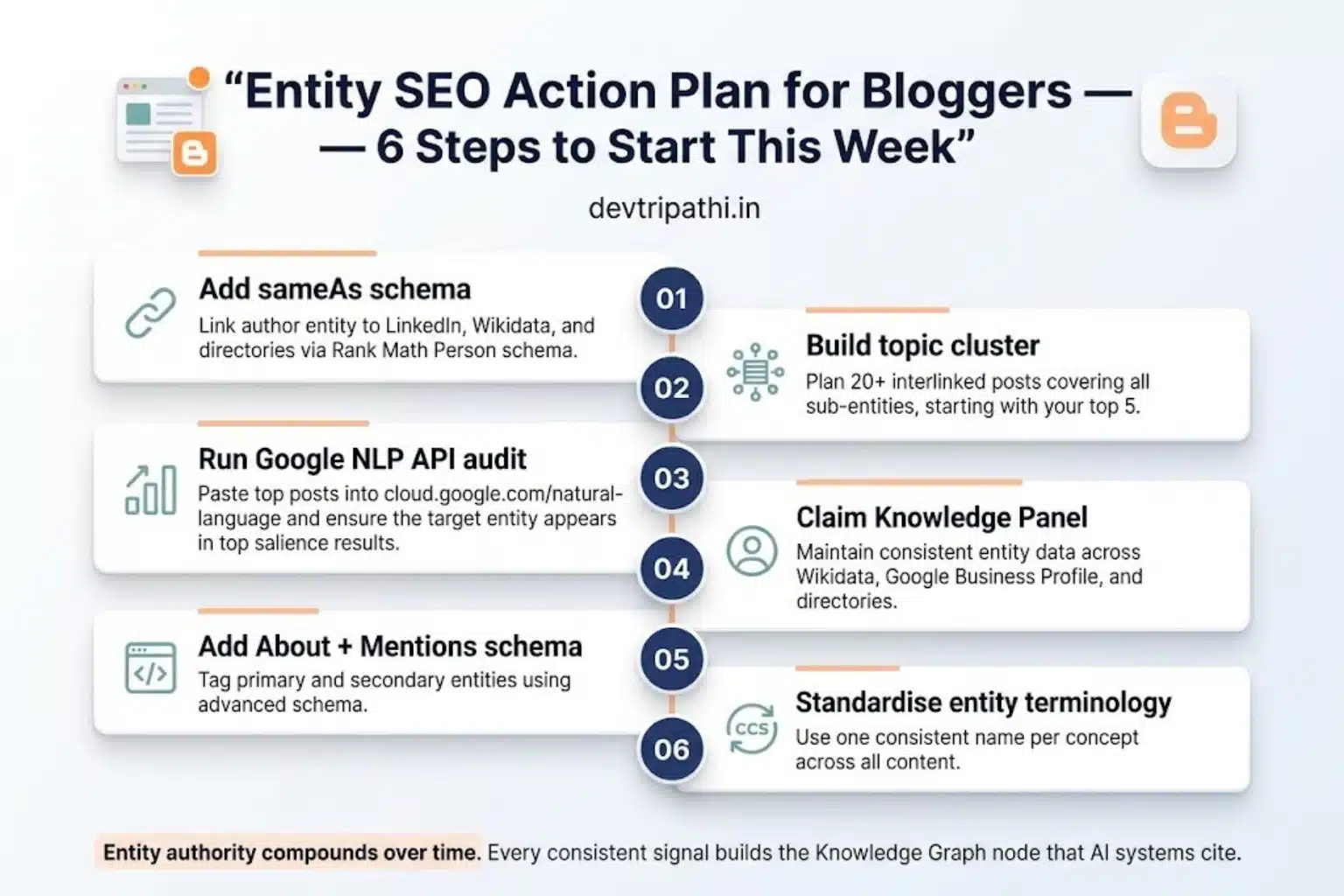
Step 1: Implement same schema to Link Your Entity Across the web.
The sameAs property in schema markup is one of the most powerful entity signals available to bloggers. It links your author or organization entity to other authoritative profiles where the same entity exists, such as LinkedIn, Crunchbase, Wikidata, Google Business Profile, and social accounts.
When AI systems encounter sameAs links, they cross-reference identities across multiple trusted platforms, a process that builds entity confidence rapidly. Use Rank Math's person schema settings to add sameAs links for each author. For the site's organization entity, add organization schema to the homepage with sameAs links to every major external profile maintained.
Step 2: Build a Topic Cluster of 20+ Interlinked Posts
A topic cluster is the content implementation of entity coverage. Each post covers a specific entity or subtopic within the niche. The pillar post defines the central entity. The cluster posts explore related entities and link back to the pillars and each other. The internal link structure creates the edge network of a mini knowledge graph.
ClickRank's GEO research describes this as a knowledge map: when an AI crawler sees internal connections between cluster posts, it classifies the site as a high-authority source for the entire topic, not just the keyword each post targets. Twenty or more interlinked posts on a single topic is the threshold most entity SEO researchers identify for establishing Knowledge Graph recognition in a defined niche.
Step 3: Use Google's Natural Language API to Check Entity Salience
Google's free Natural Language API (cloud.google.com/natural-language) analyzes text and returns the detected entities with a salience score, a measure of how central each entity is to the content. High entity salience means the AI system can clearly identify what the content is about.
Paste each blog post's content into the API and check which entities score highest. If the target entity is not in the top three salience results, the content needs restructuring around that entity more explicitly. This free tool gives a direct window into how Google's own AI systems read the content, and it is one of the fastest ways to identify entity SEO gaps that GEO checklist items alone would not reveal.
Step 4: Claim and Optimize Your Google Knowledge Panel
A Google Knowledge Panel appearing on the right side of search results for a named entity signals to Google that the entity has been confirmed as distinct and authoritative in the Knowledge Graph, the highest level of entity recognition available to individual content creators.
MRS Digital's entity SEO guide confirms that earning a Knowledge Panel signals to both Google and AI systems that the entity behind the site is verified, authoritative, and connected to the wider web of known concepts. To earn a knowledge panel, maintain consistent entity information across Wikidata, Google Business Profile, and major industry directories. Consistency of entity data across these external platforms is the primary trigger for knowledge panel generation.
Step 5: Add About and Mentions Schema to Every Post
The About and Mentions schema properties are underused entity signals that directly tell AI systems what each page is about and what secondary topics it references. About points the AI toward the primary entity of the page. Mentions identifies secondary entities and the related topics the page also covers.
For a post about entity SEO and GEO, the About property references 'Generative Engine Optimization,' and the Mentions properties reference 'Google Knowledge Graph,' 'schema markup,' 'topic authority,' and 'EEAT.' This explicit entity mapping gives AI systems a machine-readable content summary before they read the article, improving both indexing accuracy and citation selection probability.
Step 6: Maintain Consistent Entity Terminology Across All Posts
Entity recognition requires consistent terminology. If the same concept is called 'AI Overview,' 'Google AI Overview,' 'SGE,' and 'Search Generative Experience' interchangeably across posts, AI systems may map these as separate entities rather than recognizing them as the same concept, fragmenting the entity authority signal.
Define the canonical term for each key entity in the content cluster and use that term consistently wherever the entity is referenced. Katteb's AI SEO research confirms that consistent entity terminology is foundational for AI crawler mapping: the AI must be able to correctly map content to overall brand authority and thematic content clusters, and inconsistent naming prevents success.
How Entity Authority Compounds Over Time
The most important characteristic of entity authority is that it compounds. Unlike individual keyword rankings that can be lost to algorithm updates, entity authority in a Knowledge Graph is self-reinforcing: the more posts published within a topic cluster, the more internal links created, the more external sources mention the entity the stronger each individual signal becomes.
As an entity becomes more firmly established in Google's Knowledge Graph, each new post published benefits from the authority the entire cluster has already built. A new post on a sub-entity gets citation credibility from its connection to a recognised pillar entity. As OpenCloud's strategy guide puts it: the shift is about becoming the trusted source that AI systems want to cite a mindset change from ranking for keywords to being the definitive authority on topics.
The GEO content cluster this series builds is not just a content plan. It is an entity authority architecture. Each post is simultaneously valuable content for readers and a node in the semantic graph that AI systems use to understand, trust, and cite the domain. Build for authority, structure for machines, create for genuine human value and the compounding effect takes care of the rest.
